

When your truck displays the warning ‘Service StabiliTrak’, it’s more than just a simple alert; it’s a significant indicator of your truck’s performance and safety. Long-haul truck drivers, truck company owners, fleet managers, and maintenance specialists need to understand what this warning means, the potential causes behind it, and the steps to address it effectively. This article delves into the Electronic Stability Control (ESC) system that underpins the StabiliTrak alert, the common issues that can trigger it, the serious consequences of ignoring the warning, and essential diagnostic and repair procedures. Equipped with this knowledge, you can ensure your vehicle remains safe and roadworthy, ultimately safeguarding both drivers and cargo.
When the Truck Says Service Stability: Interpreting the ESC Warning and Keeping Control on Every Drive
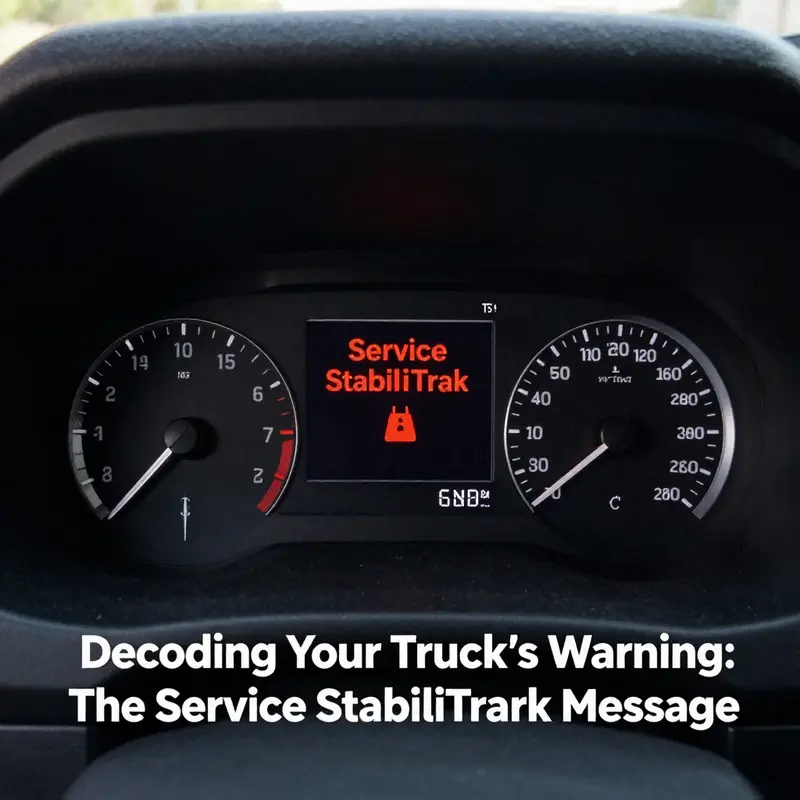
A message such as “Service Stability” on your dashboard can feel alarming. Yet it is a warning with a concrete purpose: it tells you that the truck’s electronic stability control system—the network that helps keep the vehicle pointed in the driver’s intended direction—has detected a fault or an irregular condition that could compromise stability. Rather than a single malfunction, this warning often signals that one part of a finely tuned safety system is not behaving as it should. In practical terms, it means the truck’s computer and its array of sensors are signaling to the driver that the brakes, engine torque, and steering inputs may not be coordinated in the way you expect during tricky road situations. Understanding what this warning means, why it can appear, and what to do next can make the difference between a controlled drive and a dangerous moment on ice, mud, or a slick turn.
At its core, the stability control system is designed to prevent loss of control. It does this by constantly watching how the vehicle actually behaves compared with how the driver intends it to behave. The system uses a constellation of sensors: wheel speed sensors that monitor rotation at each corner, a steering angle sensor that captures how far and in what direction the wheel is turned, a yaw rate sensor that measures the vehicle’s rotation around its vertical axis, and a lateral acceleration sensor that tracks side-to-side forces. When the driver steers into a corner, the system analyzes whether the vehicle is following that intended path. If it detects oversteer—where the rear end wants to slide out—or understeer—where the front end pushes wide—the stability control steps in. It does so by applying brakes to individual wheels and, in some cases, reducing engine power to help guide the vehicle back toward the driver’s intended trajectory. This is a nuanced choreography, and any glitch in the sensors, the control module, or the circuitry that ties them together can light up the warning that you’re seeing.
What triggers the warning can be as varied as the weather and road conditions. A simple misalignment can put extra strain on the system. Dirty or damaged wheel speed sensors, which are among the most common culprits, can feed the control unit inaccurate data about wheel rotation. In a similar vein, a compromised steering angle sensor can misreport how sharply you are turning, throwing off the comparison the computer relies on. Electrical gremlins—loose connectors, corroded pins, a blown fuse, or a hiccup in the software that runs the system—are other frequent causes. In addition, older or contaminated brake fluid can affect the ABS portion of the system, which works hand in hand with stability control, so even a seemingly minor fluid issue can ripple into a warning for stability. It is important to remember that the warning is not a sign of an all-or-nothing failure; it is an indication that the system found inconsistent data or a fault that could, under certain circumstances, reduce your ability to maintain control.
The chapter of the story you are living when the warning lights up is rarely a single moment of failure. It is more often a chain: a sensor reports a reading that is out of spec, the control module flags a fault, and the system decides to either limit its intervention or, in a worst-case scenario, disable parts of its operation to protect the vehicle. In many instances, the message may be accompanied by an accompanying ABS light or a traction control indicator. The key is to treat the warning seriously, even if you feel the vehicle continues to drive relatively normally. The human brain can compensate for minor drift during a stop or a gentle turn, but in a sudden maneuver or in slick conditions, the stability control is a safety net that prevents you from drifting past your control boundaries. The danger lies in assuming that the system is merely a nuisance or that a restart will always fix it. While a momentary glitch might clear after a restart, persistent warnings demand inquiry and, often, professional diagnosis.
To those who live and drive in environments where traction is inconsistent—rain on pavement, gravel, wet leaves, ice—the stability control system becomes more than a feature; it is a guardrail. It helps guide the vehicle through the split-second decisions that occur during cornering, emergency steering, or sudden deceleration. The human driver retains the primary responsibility for steering and braking, but the system offers support by dampening wheel slip, maintaining steering feel, and preventing abrupt yaw that could push the vehicle toward a loss of control. When the warning appears, it is not just a red light on a panel; it is a signal that the vehicle’s central nervous system may need attention. And attention, in turn, means moving from a mindset of routine driving to a mindset that places greater emphasis on safety checks, especially in adverse weather.
The path forward after you see the warning is not a sprint to the nearest repair shop only if the truck is behaving erratically. There are steps you can take that balance safety with practicality. First, check whether you inadvertently deactivated the system. Some vehicles have a button to disable stability or traction control, often labeled ESP or a similar acronym. If you pressed it by mistake, simply re-engaging the system can restore functionality. If the warning persists, the prudent move is to proceed with caution to a safe place where you can perform a more thorough check. A restart can clear temporary glitches, but it is not a guaranteed fix. If the light remains on after a restart, the situation shifts from a minor nuisance to a condition that warrants diagnostic testing.
Diagnostic work in this area is highly specialized. A professional technician, equipped with an OBD-II scanner and the appropriate knowledge base, can retrieve fault codes stored in the vehicle’s computer. These codes offer a map of where the system found an issue—whether it is a sensor, a module, or a hydraulic unit related to the braking system. The codes do not always point to a single cause; they often guide the technician to a cluster of possible faults that fit the symptoms observed on the vehicle. A technician can interpret the codes in the context of recent maintenance history, weather conditions, and the vehicle’s recent driving patterns. This is important because a code might reflect a temporary condition that has since resolved or a persistent fault that requires replacement or repair. In other words, the diagnostic journey is both a search for truth and a careful process of ruling out non-critical anomalies before proceeding with repairs.
A crucial aspect of this diagnostic journey is ensuring accurate data. Sensors can malfunction for reasons that are not inherently dramatic—dust, road grime, or a small electrical transient can upset readings long enough to trigger codes. The communications network linking sensors to the control module must be reliable; loose connectors or corroded pins can generate intermittent faults that do not consistently appear during a test drive. Sometimes, a more practical approach is warranted: the technician may verify wheel speed sensor alignment, clean sensor housings, and inspect wiring harnesses for wear. In some cases, the solution is as simple as replacing a worn sensor or repairing a frayed wire. In others, it requires a software update or recalibration of the steering angle sensor. And in the rarest cases, the fix involves replacing the ABS module or a hydraulic unit that mediates braking force to individual wheels.
The act of diagnosing and repairing does not only restore the vehicle’s stability functions; it also restores confidence for the driver. When the warning has been understood and addressed, the system can re-enter the road with all its protective capabilities. Yet even after a repair, the driver should consider whether the environment in which they drive has contributed to the issue. A vehicle that frequently travels through poor road conditions or endures heavy braking in wet weather may benefit from proactive maintenance checks as part of a broader safety plan. Regular inspection of wheel speed sensors for dirt and damage, ensuring brake fluid levels are correct and free of contaminants, and verifying the integrity of electrical connectors can prevent recurrence of the fault. Keeping up with maintenance reduces the likelihood that a future warning will appear during an important drive, offering riders a smoother experience and drivers greater peace of mind.
Beyond the mechanics, there is a broader truth about the stability control system: it is not a substitute for safe driving, but a sophisticated ally. It is trained to intervene in moments when the driver’s input and the vehicle’s behavior diverge. Its interventions are subtle yet profound. It will apply braking force to individual wheels, sometimes reducing engine torque, to guide the vehicle back toward the planned path. In emergency scenarios, this can be the difference between a minor correction and a hazardous loss of control. Recognizing the limits of the system is essential. It cannot overcome physics if the vehicle is operating well beyond its friction limits or if the tires are severely worn or unsuitable for the current conditions. In such cases, the system’s interventions may be overwhelmed, and immediate, cautious driving is the best path forward until the vehicle can be inspected.
For those who want a practical anchor in this landscape, consider maintenance resources that emphasize the core idea: the stability control system is a complex, sensor-driven safety net that depends on clean data, sound electronics, and well-maintained brakes. The steps a driver takes when the warning lights are on are not just about eliminating a light; they are about preserving control in real-world settings. If the warning appears during a rain-slicked exit ramp or on a gravel curve, you already know how quickly a small misalignment can become a loss of traction. In those moments, the system’s value lies in its capacity to anticipate and compensate, not in its ability to perform miracles. And the more you understand how the system works and what can cause it to malfunction, the more empowered you will be to approach maintenance proactively rather than reactively.
In the broader arc of truck safety, the stability control system represents a convergence of several subsystems that were once separate: Anti-lock Braking, Traction Control, and Vehicle Dynamics control. The modern approach blends these elements into a unified safety strategy, one whose effectiveness grows as sensors become more precise and algorithms more sophisticated. While the exact configuration may vary by vehicle model and year, the underlying principle remains constant: data, interpretation, and action must align to maintain control when it matters most. This is why the warning is not simply a nuisance light; it is a signal to check the system, protect your own safety, and invest the time needed to ensure the vehicle’s safety technologies function as intended.
For those curious about more formal procedures and official troubleshooting protocols, consult the official service bulletin repository referenced in professional circles. It offers detailed guidance that aligns with the exact steps technicians take when diagnosing stability control faults. However, real-world practice also emphasizes clarity of communication with the vehicle owner. Explaining that the warning indicates a fault within the stability control network, rather than a single sensor alone, helps owners understand why a simple fix is rarely sufficient and why a thorough diagnostic is essential. This distinction matters when you’re deciding whether to press on to a destination or pull over to the side of the road to assess conditions and call for assistance if needed.
Beyond the diagnostic room and the repair bay, there is a broader message about vehicle safety and responsibility. If a truck’s stability system alert persists, it invites a routine that some drivers may overlook in the hustle of daily tasks: monitoring tire condition, keeping fluids at proper levels, and ensuring that lights and warning indicators are functioning. It invites a moment of mindfulness about road conditions and the limitations of vehicle technology. It invites a careful, measured approach to driving when the system is not performing as it should. In that sense, the warning becomes a pedagogy—a reminder that our collective safety relies on both human judgment and machine-assisted stability working in harmony.
To keep the narrative grounded in everyday practice, consider a practical step you can take right now. If you notice the warning after a long day of driving on variable surfaces, plan a service visit soon. Bring up recent maintenance, road conditions, and any incidents that might have affected the vehicle’s electrical system. Share your observations about how the vehicle behaved after the warning—whether it drove normally, braked differently, or felt unstable in turns. This information helps technicians reproduce the scenario and narrows the field of possible causes. It turns a potentially opaque diagnostic process into a focused, efficient one. And it reinforces the broader point: stability control is a shield that works best when its data streams are clean, its components are in good repair, and the driver and technician are aligned in understanding the vehicle’s behavior.
If you are looking for maintenance-oriented reading that complements this discussion, there is value in resources that emphasize practical upkeep and the upkeep of critical safety systems in trucks. For example, see fire-truck maintenance training. This literature, while oriented toward specialized vehicles, reinforces the principle that routine maintenance and timely attention to warning signals are central to uptime, safety, and reliability on the road. fire-truck maintenance training
In sum, the service stability warning is a gateway to safer driving rather than a mere mechanical inconvenience. It calls for a measured response: acknowledge the risk, verify whether an accidental deactivation occurred, perform a controlled restart if appropriate, and seek professional diagnosis when the warning persists. The goal is not to eradicate every fault code through a single fix but to understand the system well enough to preserve your vehicle’s core safety functions while avoiding the risk that a hidden fault could escalate under demanding driving conditions. The journey from warning to repair is a journey of data, collaboration, and careful, safety-conscious action. And while the exact fault may vary—from a dirty wheel speed sensor to a more complex electrical issue—the approach remains consistent: respect the warning, protect yourself on the road, and trust trained technicians to restore the integrity of the stability control system so you can drive with confidence again.
External resources can provide additional context and official procedures. For readers seeking formal troubleshooting procedures and up-to-date guidance, consult the official service bulletin repository: https://www.gm.com/techservice/tsb-search.html
null

null
null
null
What Your Truck’s ‘Service StabiliTrak’ Message Really Means: A Clear Diagnostic Path to Reclaim Stability
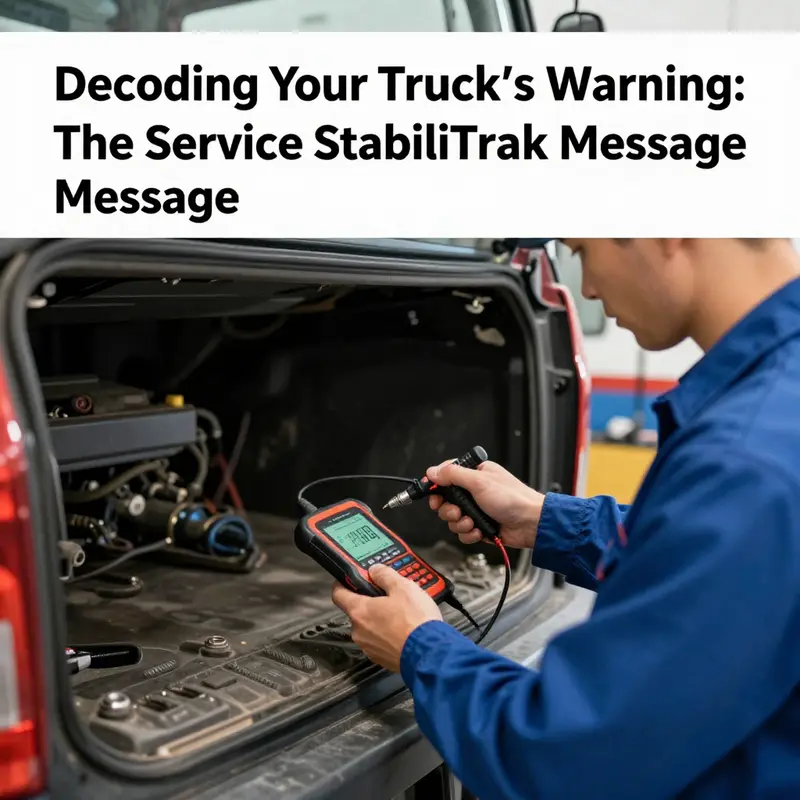
When your dashboard lights up with the Service StabiliTrak warning, the reaction should be calm but purposeful. StabiliTrak, the branding some GM vehicles use for Electronic Stability Control, is designed to prevent skidding and loss of control by monitoring how the vehicle behaves under steering input, throttle changes, and road surface conditions. The system is constantly watching for signs that the vehicle is departing from the driver’s intended path. When it detects a discrepancy—such as understeer, oversteer, or an unexpected yaw—it can intervene by applying brakes to individual wheels and by reducing engine torque to help the driver maintain directional control. This is not just a clever feature; it is a fundamental safety layer that works in real time to keep you in command of the vehicle during sudden maneuvers, slippery pavement, or uneven traction. The warning light that accompanies this message, however, signals more than a single fault; it is a cue that the computer has found conditions that may compromise the integrity of the stability system. It is a heads-up that the ESC might not perform as intended in a future corner, lane change, or wet patch. A prudent driver treats the warning as a prompt to verify the system’s health, not as a license to ignore potential faults. The brightness and persistence of the light can also indicate whether the system has self-detected a fault that temporarily disables stabilization, or if the fault is persistent and likely associated with sensors, wiring, or control modules. In many GM vehicles, the StabiliTrak or ESC warning can appear in tandem with other indicators such as ABS or Traction Control, underscoring the way these subsystems share a common data network and sensor family. When one element of that network falters, the others can respond with alerts of their own. In practical terms, the warning tells you to suspect a chain of possibilities rather than a single, definitive culprit. The range of causes can be broad, from something as simple as a blown fuse or a wheel that isn’t spinning in sync with its siblings to something more intricate, like a degraded steering angle sensor, a failing wheel speed sensor, or a software anomaly within the stability control module. This breadth is why the diagnostic path is both systematic and disciplined: it respects the safety intent of the system while guiding a technician through a process that distinguishes between a quick fix and a more involved repair. The first measure is to observe the overall dashboard narrative. If other warning lights accompany Service StabiliTrak—especially ABS or brake warnings—the likelihood is high that the fault lies within the wheel speed sensors or the brake control network. If the StabiliTrak light stands alone, the fault may be localized to a single sensor, a harness ground, or a module calibration. Either way, the goal is to move from suspicion to evidence, from uncertainty to confirmed conditions that can be repaired. The diagnostic journey then shifts toward reading the vehicle’s electronic fingerprints: the Diagnostic Trouble Codes, or DTCs, stored by the vehicle’s on-board computer. A GM-compatible OBD-II scanner is the tool of choice for retrieving these codes, and the codes themselves should be interpreted in the context of the sensor data and the driving scenario in which the light appeared. Among the codes commonly associated with StabiliTrak concerns are C0035, C0040, and C0050, each pointing to a distinct part of the stability equation. C0035 is a signal that centers on the steering angle sensor. This device translates the physical position of the steering wheel into an electrical signal that the stability software uses to gauge the driver’s intended path. When the steering angle sensor reads inconsistencies or drifts out of calibration—potentially from moisture intrusion, connector wear, or physical misalignment—the ESC can interpret the wheel’s position incorrectly. That misinterpretation may trigger the system to intervene in ways that feel abrupt or unnecessary, and it can illuminate the StabiliTrak light even when the road looks ordinary. C0040 flags wheel speed sensor concerns. Each wheel’s speed sensor feeds live data to the stability computer, enabling it to detect wheel slip, yaw, or misalignment. If a sensor is dirty, damaged, or its wiring harness is compromised, reading errors can cascade into incorrect stability decisions. A misread wheel speed can make the system overreact or fail to react when it should, resulting in warning activity and a possible loss of trust in the vehicle’s handling through a corner or during braking. C0050 points to the yaw rate sensor, which helps determine how quickly the vehicle is rotating around its vertical axis. If this sensor is faulty or its calibration is off, the stability system might suspect a yaw that isn’t there or miss one that is, producing counterproductive brake applications or a hesitant stabilization response. The presence of these codes is not a final verdict but a directional map. The map needs to be interpreted in light of the sensor conditions, the surrounding weather, and how the vehicle behaved when the warning appeared. Before delving into parts replacement, a practical, home-friendly approach begins with a careful physical and environmental check. Start with a visual sweep of the wheel areas and the wheel wells: are there obvious signs of damage, corrosion, or moisture intrusion around wheel speed sensors, which are often mounted near the hub, and the steering angle sensor, which is typically connected to the steering column assembly? Do not overlook the wiring harnesses that feed these devices. A loose or corroded connector, or a pin with poor contact, can produce erratic data without any dramatic external sign. The tires themselves deserve scrutiny. Improper tire pressure, uneven wear, or a mismatch in tire size or type can create handling quirks that the ESC interprets as instability, particularly in corners or on uneven pavement. In some cases, a simple wheel alignment or tire service can quiet the light if the fault was a misalignment or a nonuniform tire condition masquerading as a sensor fault. Yet the story does not end there. In modern stability systems, software and calibration data live in the control module. A glitch in the software, a failed update, or corrupted calibration data can all provoke a false alarm or a nonfunctional stability routine. When this occurs, the remedy may involve software reinitialization, reflash, or targeted reprogramming of the control electronics, steps that require professional equipment and access to vendor-specific training and documentation. After any repair or replacement, it is standard practice to clear the stored DTCs with an OBD-II scanner and perform a controlled test drive to confirm that the fault has not recurred under real-world conditions. This reset is not a shortcut; it validates that the system’s fault has been addressed and that the stability software can return to normal operation without surprise reactivation. If the light returns after a basic fix, or if the fault persists during a test drive, the pathway forward becomes clear: professional service. The ESC system is a high-stakes safety feature. Its operation depends on a network of sensors communicating through robust data buses and on a control module that can calculate stability limits in fractions of a second. When faults linger or signals degrade, diagnosing them reliably requires specialized tools, test procedures, and, if necessary, calibration or reprogramming of the module. This is where manufacturer documentation becomes essential. For GM vehicles, the diagnostic framework is supported by official service literature and technical service bulletins that outline specific test procedures, sensor tolerances, and the reprogramming steps needed to restore specification. Relying on established procedures reduces the risk of misdiagnosis and helps ensure that any fixed fault produces a lasting improvement rather than a temporary symptom. The value of this disciplined approach is twofold: it protects the vehicle’s stability system’s integrity and it guards the occupants. The process begins with data gathering—recording the exact codes, documenting the conditions in which the warning appeared, and noting any changes in handling or braking feel—and ends with a test drive that reproduces the scenario under which the fault first appeared. If the story still ends with the light on after basic checks, it is time to bring in a technician who can perform a deeper diagnostic that might include real-time sensor signal verification, bus health checks, and a more exhaustive verification of brake and electronic stabilization logic. In such cases, the technician will lean on official GM service documentation or trusted repair resources to follow model-specific steps and tolerances. This is not a ritual of guessing; it is a guided, evidence-based approach designed to minimize unnecessary repairs while preserving safety. For readers who want to deepen their practical understanding beyond the immediate repair narrative, a maintenance-resource such as fire-truck-maintenance-service-training can be a useful touchpoint for grasping the broader precepts of diagnostic discipline and routine maintenance that keep complex vehicle systems healthy. It is not a substitute for professional diagnostics, but it can provide useful context about how routine checks, sensor inspection, and calibration workflows fit into a larger safety-first maintenance philosophy. In the broader landscape of stability and braking control, the governing principle is objective data over intuition. The stability system’s decisions are data-driven, and the diagnostics that support those decisions rely on standardized procedures and documented tolerances. The GM reference library—comprising technical service bulletins and diagnostic procedures—offers model-specific steps that guide technicians through the maze of potential fault conditions. Access to these resources helps ensure that resolutions are based on tested methods rather than on speculative fixes. If you want to consult the official diagnostic paths, GM’s technical service bulletins repository is the primary external resource, offering model-specific instructions and validated repair steps that technicians use to restore functionality and verify that the warning light goes out when the issue is corrected. Remember that the journey from warning to resolution is about safety and reliability. The process may involve simple checks, careful sensor inspection, and judicious software updates, or it may require more involved repairs that only a trained technician can perform with the right tools. Either way, treating Service StabiliTrak as a critical safety signal rather than a nuisance preserves your stability on the road and protects you and others from the consequences of a driveline or braking fault. The takeaway is straightforward: respond promptly, diagnose methodically, and rely on established procedures and documentation to guide repairs. By grounding your approach in data, inspection, and, when necessary, calibrated reprogramming, you can restore the system’s protective function and reduce the chance that a future warning will catch you unprepared. For further reading on the diagnostic paths and model-specific guidance that underpin this approach, consult the GM service documentation and bulletins, which lay out the approved procedures for diagnosing and repairing StabiliTrak faults. External resource: https://www.gm.com/technical-service-bulletins. The aim is to deliver clarity, safety, and confidence when a Service StabiliTrak message appears, helping you move from concern to controlled, informed action. To keep you connected with ongoing maintenance and safety stewardship, you can also explore related maintenance resources that bridge consumer concerns with professional service, such as the linked training and maintenance content that supports responsible vehicle care: fire-truck-maintenance-service-training.
Final thoughts
Understanding the ‘Service StabiliTrak’ message on your truck’s display can save lives and assets. The Electronic Stability Control is critical for safe driving, particularly in challenging conditions. By familiarizing yourself with the common causes and knowing the consequences of neglecting this warning, you can maintain both the safety of your vehicle and the efficiency of your operations. Regular diagnostics and timely repairs are vital for the longevity of your truck. Stay informed and proactive to ensure a safer road ahead.