
When your truck’s dashboard displays the ‘Service Airbag’ warning, it’s an immediate signal that something within the safety restraint system requires attention. For long-haul truck drivers, trucking company owners, fleet managers, and aspiring drivers, understanding this warning can be crucial not only for safety but also for the operational integrity of your vehicles. Throughout this guide, we’ll delve into what the ‘Service Airbag’ message means, explore its common causes, discuss the potential implications of ignoring it, and outline actionable steps to take when you encounter this warning. Together, we can ensure safer journeys on the road ahead.
Reading the Warning: What a Service Airbag Message Really Means for Your Truck and Crew

When a truck dashboard lights up with a conspicuous Service Airbag warning, it can feel like a sudden brake on peace of mind. The message is not a declaration that airbags will deploy imminently, but rather a red flag that the safety restraint system is not ready for the unpredictable nature of a crash. The airbag system in a heavy truck is a complex network: sensors positioned at key points, wiring that carries tiny yet critical signals, a control module that interprets those signals, and the airbags themselves waiting in reserve. The onboard diagnostic system continually watches for inconsistencies among these components. If any fault is detected—whether a loose connector, a damaged wire, a faulty sensor, or a malfunctioning control module—the system stores a fault code and illuminates the Service Airbag light. This is the system’s way of saying, in a precise yet urgent language, that safety can no longer be guaranteed until the fault is found and repaired by a qualified technician.
The distinction between a warning and an immediate deployment is important. The light signals a loss of confidence in the readiness of the airbags. It does not mean the airbags have deployed or will explode without warning, nor does it imply the truck is unsafe to drive in every sense. In many cases, a vehicle can still be operated, but the risk profile changes. A crash under the influence of a malfunctioning airbag system could result in airbags not inflating when needed, or inflating in a way that creates additional injuries. Because the consequences are so serious, treating the warning with urgency is the responsible choice for any operator who relies on the vehicle for work, safety, and crew protection.
To understand why this warning appears, it helps to picture the airbag system as a system of checks and balances. The sensors detect relatively minor events—like sudden deceleration or an impact—and relay information to the airbag control module. The module evaluates the data against predetermined thresholds and sequences the deployment of airbags accordingly. At the same time, it checks the integrity of the wiring harnesses, the condition of the connectors, and the health of the airbags themselves. If a single sensor drifts out of spec, if a connector has become detached, or if the module encounters a fault, the module will flag the issue and prevent blind deployment. The system’s safeguarding logic is designed so that it can fail-safe around single-point issues while still protecting the occupants by ensuring that, in the worst scenario, airbags anyway have a higher chance of functioning correctly when needed.
Among the most common culprits behind a Service Airbag warning are relatively simple, tangible issues. A sensor that has become loose or damaged can feed unstable data to the control module. Damaged wiring or corroded connectors can disrupt the delicate signals required for correct timing and inflation. The airbag control module—a compact electronic brain—can fail or lose calibration over time. Then there are installation factors: aftermarket accessories that interfere with airbag deployment, such as certain seat covers or steering wheel adornments, can physically impede the mechanism or alter sensor readings enough to trigger a fault. Even a routine incident, like a minor collision that did not deploy the airbags but damaged some systems, can leave the diagnostic memory with a fault that needs clearing and re-testing after proper repair. Finally, voltage instability—caused by a weak or aging battery or alternator issues—can momentarily skew sensor readings or reset sequences, prompting the warning even if no mechanical fault persists at the time.
If you see the Service Airbag light, the proper response is not to press on and hope it clears itself. The warning is built to prompt professional verification because airbags are life safety devices. The diagnosis typically requires a professional OBD-II scanner capable of reading the fault codes stored in the vehicle’s computer. Those codes provide specific direction about which component or circuit failed or is behaving abnormally. A technician will interpret the codes, perform a targeted inspection, and verify whether the fault is intermittent or persistent. This process may involve checking sensor connections, testing the sensor circuits with specialized equipment, inspecting the airbag modules, and validating the power and ground paths that feed the system. In some cases, a simple reseating of a connector or replacing a damaged harness can resolve the issue. In others, a faulty module or a breached airbag unit may need replacement.
One practical reality of the diagnostic journey is the equipment used. Because airbag systems are integrated with vehicle electronics, an ordinary code reader is often not enough. Technicians rely on manufacturer-specific or advanced diagnostic tools that can interrogate the airbag system more deeply, sometimes performing dynamic tests that simulate fault conditions in a controlled environment. For truck operators, this underscores the value of engaging an authorized service center or a shop that has experience with airbag systems in heavy vehicles. The goal is to restore the system to a condition where it’s fully tested and certified to deploy correctly in a crash, rather than simply removing the warning light or masking the fault with a workaround.
Beyond the mechanical and electrical components, there is a human element to the Service Airbag warning that’s worth recognizing. A fault can arise from prior maintenance that did not account for the airbag system’s sensitivities. For instance, work around the steering wheel or at the dash area can disturb sensor alignments or connector locks. Post-accident inspections, even if the airbags did not deploy, can leave behind tripped fault codes that need to be managed. The takeaway is that the presence of the warning is an invitation to examine how the vehicle has been maintained, what aftermarket modifications have been made, and whether the vehicle’s electrical system is delivering clean, stable power to the safety restraints. In each case, the objective remains constant: to ensure the airbags will function reliably when a collision occurs.
A broader context helps frame the urgency. Airbags are part of a constellation of safety features that protect occupants while the vehicle operates in demanding conditions. Trucks often operate in environments where vibrations, temperature swings, and long duty cycles push electronics to the edge. The Service Airbag warning reflects the system’s vigilance under those real-world conditions. It is not a cosmetic alert; it is the manifestation of the system’s insistence that something has changed in the safety equation and requires attention before the next trip. This is especially important for fleets and operators who depend on consistency and uptime. While the warning can be frustrating in a busy schedule, it is a protective mechanism that prioritizes occupant safety over convenience.
From a practical standpoint, the best course is straightforward. Do not ignore the warning. Do not assume that a quick dash of the light will be enough to keep moving. Park the vehicle safely and arrange for professional inspection at an authorized service center. If the vehicle must be moved for safety reasons, limit its use to transporting to a nearby service facility and avoid long drives or rough terrain. Communicate clearly with maintenance personnel about any recent incidents, modifications, or battery issues that might have contributed to the fault. When discussing the diagnosis with technicians, share details about any indicators you noticed—unusual cabin odors, flickering lights, or intermittent loss of power—that could help pinpoint the root cause more quickly. The more precise the information, the faster the fault can be isolated and a proper repair plan devised.
The path from warning to repair often involves a few logical steps. First, confirm no accident or impact has occurred that would require resetting or recalibration. Second, inspect the sensor housings and connectors for obvious signs of damage or disconnection. Third, verify the airbag module and associated components for signs of wear or corrosion. Fourth, test the system’s electrical integrity, paying attention to voltage levels, ground paths, and battery health. Fifth, clear fault codes and re-check the system after a controlled test to ensure the fault does not reappear. Each of these steps, performed by a trained technician, moves the vehicle toward a state where the airbag system is once again ready to protect the crew in a worst-case scenario. The importance of a methodical approach cannot be overstated, given the life-saving purpose of the airbags and the legal implications that can accompany a malfunctioning restraint system.
For readers who want to broaden their understanding of how to maintain safety systems while keeping a fleet on the road, there is value in cross-referencing specialized maintenance content. For a broader view on maintaining crucial safety systems, see fire-truck maintenance training importance. This resource emphasizes disciplined maintenance routines, the role of certified technicians, and the discipline of documenting safety-related work. While the context may be geared toward fire apparatus, the underlying principles—rigorous inspection, correct installation practices, and professional calibration—are transferable to any heavy vehicle where safety systems protect crews and cargo. The integrity of these systems rests on a culture of proactive upkeep rather than reactive fixes.
Ultimately, the Service Airbag warning is not a verdict on the truck’s overall reliability. It is a precise signal about the readiness of one critical safety subsystem. When the warning appears, the appropriate response is to treat it with the seriousness it deserves, to undertake a careful diagnostic, and to pursue a repair plan that returns the airbag system to a fully functional state. Doing so protects the driver, any passengers or crew, and the vehicle’s occupants in the event of a crash. It also aligns with broader safety commitments that govern professional driving, fleet management, and regulatory expectations. Keeping airbags healthy is part of a larger, ongoing commitment to safer operations, more reliable equipment, and a culture of responsibility that values every mile driven as a chance to avert harm rather than simply complete a journey. The Service Airbag warning is not a nuisance to be dismissed; it is a reminder that safety systems deserve timely attention, skilled handling, and careful verification before the next mile is traveled.
Reading the Service Airbag Signal: What Your Truck Is Telling You About Safety and Survival
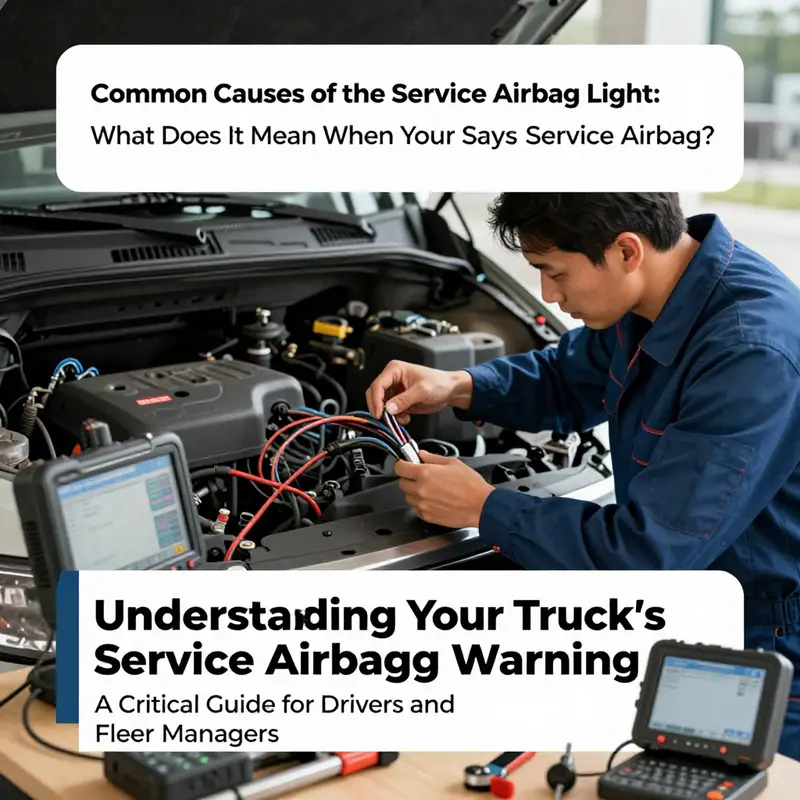
When the dash lamp labeled Service Airbag glows, it isn’t a mere inconvenience. It is a precise warning from the truck’s brain—the onboard diagnostic system—alerting you that something in the Supplemental Restraint System (SRS) is not performing as it should. In practical terms, that light means the airbags and related safety devices may not deploy correctly in a crash. The consequences are not hypothetical: in a collision, the system could fail exactly when you need it most. The truck may keep running and driving smoothly, but the safety net designed to protect occupants could be compromised. This is not a problem to be dismissed or postponed. It is a fault condition that deserves careful attention, diagnosis, and repair by a qualified technician using proper diagnostic tools and procedures.
To understand why the Service Airbag light comes on, it helps to picture the SRS as a tightly coordinated network rather than a single component. At the heart of the system is an airbag control module that monitors a network of sensors placed in strategic crash zones and in the seat belt system. There are impact sensors in the front corners of the vehicle, a crash sensor in the passenger area, and the seat occupancy sensor or weight sensor that helps decide whether a front airbag should deploy in a given crash. There are also the seatbelt pretensioners, which tighten the belt in a crash to remove slack and better position the occupant for airbag deployment. All of these parts communicate with the control module through a complex web of wiring harnesses, connectors, and a clock spring in the steering column that maintains electrical continuity to the airbags as the steering wheel turns.
When any fault arises—an intermittent short, a loose connector, a degraded sensor reading, a failed pretensioner, or a power issue—the SRS self-check catches it and stores a code in its memory. This code is like a map for the technician, pointing to the exact component or circuit that is out of spec. Reading these codes requires an OBD-II scanner capable of accessing SRS-specific fault data. Unlike generic engine codes, SRS codes are specialized and require manufacturer-approved procedures to interpret correctly. If you see the Service Airbag light, do not attempt a quick reset or a DIY bypass. Short-term clears may hide a dangerous fault, and a system that fails to deploy in a crash defeats the purpose of the airbags entirely.
Among the more common triggers for the warning light are three issues that a careful inspection can often reveal. First, wiring connections can loosen or corrode, especially in the sensitive zone beneath the front seats where weight sensors and some airbag modules live. The under-seat environment experiences vibration, moisture intrusion, and gradual wear, all of which can degrade connections enough to interrupt a circuit intermittently. Second, the seatbelt pretensioners themselves can fail or send incorrect signals to the SRS control unit. When a pretensioner malfunctions, the system senses an abnormal condition and flags the fault with the warning light. Third, a blown fuse in the SRS circuit can cut power to critical components and illuminate the light. Fuses are the simplest fix on paper, but they are often a symptom of a larger issue, such as an overload in a failed wire or a short elsewhere in the circuit.
There are other, less obvious culprits as well. A deteriorated clock spring in the steering column, which maintains the connection for the airbag and the steering wheel controls, can develop a fault that triggers the light. Moisture infiltration into connectors or modules can create corrosion paths that disrupt signals. A faulty airbag module itself is another possibility, though less common than a sensor or wiring problem. Even the battery’s voltage level can influence SRS operation; a persistently low voltage may prevent the system from reaching its required operating state, particularly during start-up when sensitivity is high. In some cases, the light may come on after a minor, non-crash event, such as a strong jolt from hitting a curb or a heavy load shifting in the cabin. The key point is this: any single fault in the SRS can cause the light to come on, and the consequences of neglect are too severe to guess at.
Diagnosing the exact cause requires a measured, methodical approach. A professional technician will typically begin with a diagnostic scan that specifically targets SRS fault codes. These codes narrow the field to a particular circuit or component—be it a sensor, a harness, the airbag module, or a related fuse. The next steps usually involve a physical inspection that mirrors where the fault code points. If the code mentions a sensor or harness under the seat, the technician will inspect seat rails, connectors, and moisture exposure. If the code points to a clock spring or steering-column wiring, the procedure shifts to a careful examination of the steering wheel assembly and its connectors. The technician will check for continuity, resistance, and any signs of damage or corrosion. They will verify the integrity of the fuses and the power supply to the SRS, and they will test the airbag module’s readiness through manufacturer-recommended procedures. It is not unusual for technicians to perform a careful wiggle test of connectors, clean and reseat pins, and, where appropriate, replace worn or damaged wiring harnesses.
One important caution: attempting to reset the light without fixing the underlying fault is unsafe. The SRS system is designed to be self-checking and self-protective. A reset without repair can leave occupants exposed in a crash, and in some cases, the system can enter a non-deploy condition or deactivate airbags entirely to prevent unintended deployment. Because airbag deployment involves high-energy events, any maintenance or repair work must follow strict safety protocols. Technicians typically disconnect power, discharge capacitors, and use proper restraint and safety measures to protect themselves and the vehicle occupants during inspection and repair. In short, the Service Airbag warning is a reliability and safety signal that should be treated with urgency and respect rather than curiosity or convenience.
What does this mean for drivers who see the light while on the road? The prudent course is to minimize driving, especially in high-risk environments. If you must move the vehicle, drive cautiously and avoid situations that could lead to a collision. Schedule service as soon as possible with a reputable technician who has access to the right diagnostic tools and the vehicle’s service data. If your truck is used for urgent work or heavy hauling, consider arranging immediate towing to a service facility rather than attempting to operate the vehicle under fault conditions. While the vehicle may feel fine, the confidence you gain from knowing the safety system has been verified is worth more than any temporary mobility.
When the problem is diagnosed, the fix will depend on the fault code and the condition discovered during inspection. A blown fuse is a straightforward wiring correction, often requiring a fuse replacement and a check for shorted circuitry that caused the fuse to blow. Loose connections, especially under seats, may be cleaned, reseated, and tightened to restore reliable signals. Faulty seatbelt pretensioners or corrosion in the seat wiring may require replacement of the affected components, with care taken to ensure compatibility with the vehicle’s airbag control module. A damaged clock spring or steering-column wiring is typically replaced as a unit to restore proper communication and avoid future misreads. If the airbag module itself is implicated, the service procedure becomes more involved, requiring calibration or replacement and reinitialization of the SRS with the proper diagnostic procedures. The common thread through all these possibilities is the necessity of a careful, codes-driven approach rather than a guesswork repair. This ensures not only the immediate fault is resolved but also that the system remains trustworthy in the long run.
Preventive instincts play a critical role here as well. Regular vehicle maintenance that includes checks of the electrical system, battery health, and connectivity in the cabin can reduce the likelihood of an unexpected SRS fault. If a vehicle frequently experiences water ingress in the cabin area, addressing the source of moisture becomes essential, since corrosion is a persistent adversary of SRS reliability. Similarly, during seat maintenance or replacement, technicians should inspect the under-seat area for signs of wear or damage to the wiring harnesses and connectors. These routine precautions build a safety margin, ensuring that when the moment comes, the airbag system can perform as designed. Owners and operators should also keep in mind that the SRS is a safety-critical system with a finite service life and parts obsolescence concerns. If a vehicle wears high-mileage sensors or older modules, a future fault could be rooted in component aging, making timely inspections even more valuable.
The chapter on what to do next would be incomplete without acknowledging the limits of layperson troubleshooting. An OBD-II scan is essential, but it does not replace the need for professional expertise. SRS-related codes can be as nuanced as they are important. A technician’s interpretation, supported by manufacturer service data and, when applicable, update procedures, makes the difference between a temporary fix and a dependable safety system. The goal is to restore the system’s full functionality and to confirm that every component is ready to perform in the moment of truth. In the field, this means the service story should conclude with a verified deployment readiness after wiring checks, sensor tests, and module reinitialization. Owners should keep a detailed service record, because SRS components have scrutinized lifecycles and may require scheduled maintenance or replacement at defined intervals. A transparent maintenance history helps preserve both safety and vehicle value, while also providing a clearer path for future diagnostics should a new fault appear.
In sum, when your truck shows the Service Airbag light, you are receiving a vital early warning about a safety system that protects you in a crash. The light invites you to shift from concern to action: obtain a precise code reading, follow through with a careful physical inspection of likely fault areas, and rely on trained technicians to perform tests, repairs, and reinitialization with the correct tools and procedures. The stakes are real, and the payoff is the certainty that the airbags—your last line of defense in a collision—will be ready when you need them most. Reading the signal correctly can be the difference between a preventable risk and a confirmed commitment to safety on every mile of the road.
For a deeper technical explanation of common airbag light causes and fixes, see the external resource linked here: https://www.autocenters.com/airbag-light-on-common-causes-and-solutions-explained
Beyond the Dashboard Signal: What a Service Airbag Warning Really Means for Your Truck and Your Safety
A Service Airbag warning on a truck dashboard is more than a momentary distraction. It is a quiet alarm that interrupts the rhythm of a routine drive and asks you to pause, assess, and prioritize safety. When the light—often labeled SRS for Supplemental Restraint System or shown as a schematic of a person with an airbag—comes on, it signals that one or more components of the airbag system may not be performing as designed. The message is simple in appearance but complex in implication: the system that protects you and your passengers in a crash might not function when it is needed most. The vehicle can still run, the engine can hum along, and the GPS can lead you to your destination, yet the safety network designed to restrain and protect you during a collision could be unreliable. The warning is not merely a maintenance nuisance; it is a warning about the reliability of a core safety feature that depends on a careful chain of sensors, wiring, control modules, and a deployed airbag at the right moment and with the right force. In practical terms, the signal reflects a fault state—one or many parts of the system are not communicating or not ready to deploy. The root causes can be as mundane as a loose connector or as intricate as a degraded sensor array, but the risk remains the same: a crash could expose occupants to injuries that airbags are specifically engineered to lessen or prevent. Recognizing that the warning is a sign of potential system weakness helps shift the mentality from “ignore it until later” to “address it now.” The cost of doing nothing with such a warning is measured in lives, not merely dollars, and that is why the guidance from safety authorities is unambiguous: the system needs proper diagnosis and repair by qualified technicians using appropriate diagnostic tools. A professional evaluation is essential because the airbag system does not function like other components a vehicle owner might inspect visually or test with a generic code reader. The system relies on a web of sensors and modules that must communicate correctly, and a fault in any single node can compromise the entire safety package. The diagnostic journey begins with attention to context. If the warning appears after a jolt, a collision, or an electrical fault, it may point to a sensor or harness affected by the event. If the light appears after a battery or charging issue, power supply problems could be the underlying culprit. In some cases, the issue is a sedimented code that remains latent until a specific condition is met, only to surface later when a technician runs a comprehensive readout with an advanced OBD-II scanner. The truth is that the warning should be treated as a call to action rather than a mere inconvenience. The airbag system, including the frontal airbags and side-curtain devices, is designed to deploy in a crash to reduce impact forces on the torso and head. Failure to deploy as intended can convert a survivable crash into a life-threatening one. The stakes are real, and the data behind airbags’ safety performance is compelling. The National Highway Traffic Safety Administration has documented that frontal airbags have saved tens of thousands of lives since their widespread adoption, underscoring how crucial correct deployment is for occupant protection. That context makes the warning more than a routine maintenance alert; it is a direct link to the vehicle’s fundamental safety architecture. The practical consequences of driving with an unresolved SRS warning extend beyond personal risk. In many states, safety-related issues that remain unfixed can complicate or even prevent a vehicle’s annual inspection, making it illegal to operate the truck on public roads. Insurers may view an unaddressed airbag fault unfavorably in certain circumstances, potentially affecting coverage decisions or claim outcomes. This matters not only in the moment of a crash but in the legal and financial landscape that surrounds vehicle ownership. The warning also reinforces a broader truth about modern safety systems: airbags do not exist in isolation. They are integrated with seat belts, pretensioners, and occupant-sensing devices to tailor protection to the situation and the occupant. When any piece of that integrated chain is compromised, the overall safety posture weakens. A seat belt might still restrain a passenger, but without a correctly functioning airbag system to complement it, the risk profile shifts unfavorably. The decision to act promptly when the Service Airbag light glows is a decision to preserve not just the vehicle’s value but the safety of every person on board. In the process of diagnosing and addressing the issue, technicians typically begin with a precise fault code readout using an OBD-II scanner. This step goes beyond a generic check; it reads stored trouble codes and, often, freeze-frame data that reveals the conditions under which the fault occurred. A technician will interpret these codes in the context of the vehicle’s history, recent electrical work, and battery health. A low or fluctuating voltage can cause intermittent sensor misreads or module resets, leading to incorrect fault reporting. Because airbag systems rely on stable power, an aging or undercharged battery can masquerade as a more serious fault, triggering the warning when the root cause is simply a voltage problem that can be corrected with a battery service or alternator check. Yet even when voltage issues are resolved, the system may still require component replacement or recalibration. Sensor units—such as crash sensors located in the frame rails or seat-mounted sensors that detect occupancy—are among the most common failure points. Damage to wiring harnesses, moisture intrusion, or corrosion at connectors can interrupt the signal paths that tell the airbag modules when and how to deploy. A malfunctioning airbag module, or a fault in the control unit, can also illuminate the warning. The repair path depends on the diagnosis. In some cases, a reflash or recalibration of the airbag control module may restore proper function. In other scenarios, damaged wiring or a faulty sensor will need to be replaced, and the system will require post-repair diagnostics to confirm proper operation. Thorough testing after repair is essential. Modern airbag systems rely on a precise calibration sequence that ensures deployment forces align with occupant weight and seating position. The technician will often perform functional tests that verify readiness and ensure that the crash sensors, deployment loops, and squibs—the devices that initiate the airbags—are all synchronized. The aim is to return the system to a known good state, documented in the vehicle’s service records, and to clear the light once the fault is resolved. Throughout this process, it becomes evident that addressing a Service Airbag warning is not about chasing a quick fix. It is about restoring a critical safety function whose performance is only as reliable as the weakest link in the chain. The decision to pursue professional service is reinforced by the principle that airbags operate under extreme conditions. They must deploy reliably in a crash, often within milliseconds, and any delay or failure can have irreversible consequences. The moral of the story is not to fear the complexity of the system but to respect its complexity and the careful maintenance it requires. The chapter’s throughline is clear: a warning light is an invitation to uphold the integrity of safety systems, not to gamble with risk. For readers who want to connect this vigilance to broader maintenance disciplines, consider how regular, systematic checks—like those emphasized in comprehensive maintenance training—support safety-critical systems across the fleet. fire truck maintenance training importance. This reminder is not a critique of the driver but a call to adopt an ongoing maintenance mindset that treats safety as a shared responsibility across the entire vehicle ecosystem. In practical terms, keep a record of any electrical work, battery replacements, or sensor-related repairs, and communicate these details to any technician who inspects the airbag system in the future. The goal is to build a clear, traceable history that helps technicians diagnose future issues quickly and accurately. When the Service Airbag warning finally receives a definitive repair, the moment is not just about erasing a light; it is about reestablishing a state of readiness. The airbag system, reset and validated, can rejoin the vehicle’s safety suite and again stand ready to respond as designed in a collision. In that sense, the warning becomes a catalyst for a disciplined safety habit rather than a symbol of neglect. The responsibility lies with the operator to prevent neglect, the shop to diagnose with precision, and the system to protect with reliability. The path from warning to restored safety is a chain of careful steps and careful decisions, anchored in an understanding that airbags are not optional add-ons but essential life-support components. For readers seeking a more authoritative framework, the National Highway Traffic Safety Administration’s airbag information offers a reliable foundation for what to expect during diagnostics, repair, and post-repair verification. External resource: NHTSA Airbag Information. https://www.nhtsa.gov/vehicle-safety/airbags
Reading the Service Airbag Warning: What Your Truck Is Telling You and How to Respond
When your truck lights up with a “Service Airbag” warning, it isn’t a routine reminder to check a light bulb or top up fluids. It’s a safety alert built into the vehicle’s onboard diagnostic system, signaling that something in the Supplemental Restraint System (SRS)—the airbag system and its related components—needs attention. This section isn’t about fear-mongering; it’s about a practical, safety-first approach to a fault that could affect how the airbags deploy in a crash. The SRS includes a network of sensors scattered around the vehicle, crash detectors, an airbag control module, and a maze of wiring that must all work in concert for the airbags to perform when they’re needed most. When the warning is lit, the system has detected a fault or an out-of-range condition that could compromise deployment timing, force, or even the airbags’ ability to deploy at all. It’s a heads-up that should move a driver from routine driving to deliberate action, because the stakes are personal safety and the well-being of passengers in the cab and beyond.
The reason the warning matters goes beyond the immediate glow of a dashboard light. Airbags are a crucial part of a layered safety strategy that also includes seat belts, crumple zones, and reinforced structures. If any part of that network is degraded—perhaps a sensor has shifted out of place, a connector has loosened, or a wire has frayed—the system may still appear to function on the surface, but its reliability under impact is compromised. The warning light, then, acts as a diagnostic flag. It says, in effect: there is a fault that may prevent airbags from deploying when you need them, or in some cases, deploy at the wrong time. Either outcome would undermine safety, and that is not a risk you want to take lightly.
From the moment the light appears, there is a practical path to follow. The truck may still run as usual, and you can continue driving to a safe destination, but the right move is to limit exposure to higher-risk driving—avoid long trips or heavy cargo loads if possible—until a qualified technician can diagnose and repair the fault. The diagnostic approach is built on two pillars: code reading and physical inspection. Modern trucks store fault codes in an airbag control module, accessible through an OBD-II scanner or a specialized SRS diagnostic tool. A reading session will reveal a code or a set of codes that point toward the likely culprit—whether it’s a sensor, a harness, a connector, or the control unit itself. The codes offer a map, but they’re not the entire story. A skilled technician will correlate the codes with a physical inspection, because many faults in airbag systems are intermittent or caused by something as simple as a corner of wiring that has been pinched by a moving component, or a connector that has become corroded in a damp environment.
The range of potential culprits is broad, and understanding them helps keep a calm, purposeful mindset. A loose or damaged airbag sensor is a frequent trigger. These sensors are precision devices designed to detect a collision and determine the appropriate deployment force and timing. If a sensor is loose within its mounting, has suffered impact damage, or has experienced vibration fatigue, it can send a faulty signal. Likewise, wiring issues are common—frayed or pinched wires, cracked insulation, or corroded connectors can interrupt the data stream that travels from the sensors to the airbag module. The airbag control module itself can fail, either from internal faults or from a partial power interruption that leaves the module in an uncertain state. A recently disconnected battery can also set off a fault as the system reinitializes after power is restored; in some vehicles, the system will run a self-check and flag issues as part of a normal re-powering sequence. While these scenarios vary by make and model, they all share one core truth: any fault in the SRS can erode confidence in safety, which is why the response must be prompt and careful.
The importance of the warning is underscored by the fact that airbags have to perform without delay under a broad range of conditions, from high-speed collisions to more modest impacts. Even if the airbag has never deployed since the vehicle rolled off the factory floor, the integrity of the system is still essential. In the event of a crash, the passenger’s protection depends on the precise timing and deployment of the airbags, as determined by the sensors and controlled by the module. A degraded system may either fail to deploy or deploy inappropriately, risking injury rather than preventing it. This is not a repair you attempt on your own or postpone indefinitely. It requires professional evaluation to confirm whether the fault is a sensor, wiring, module, or a reinitialization issue following a battery disconnect. The goal is not to replace every part preemptively but to identify the exact fault code or symptom and address it through targeted repairs.
When you take your truck in for service, the technician’s first step will be to connect a diagnostic tool to read the fault codes stored in the airbag control module. These codes guide the technician toward the device or connection that is failing. But the silver bullet of diagnosis is not just reading a code; it is a process of validation. Inspecting the sensors for secure mounting and visible damage, examining connectors for signs of corrosion or looseness, and verifying the integrity of the wiring harness are all necessary steps. The technician may test sensor resistance, verify continuity, and check the power supply to the airbag module. In some cases, a reset after a battery disconnect can be necessary to reinitialize the system and clear a spurious fault that might have arisen from a momentary voltage fluctuation. It is here that the repair landscape unfolds into concrete actions: replacing a damaged sensor, repairing or replacing frayed wires, or, when the fault lies with the airbag control unit itself, replacing the unit may be required. Each path has its own diagnostic marker and repair cost, and the technician’s judgment will hinge on the exact fault codes and on the test results gathered during the inspection.
It’s helpful to keep in mind that the process of diagnosing and repairing an airbag system is not merely about restoring a light on the dashboard. It’s about restoring a crucial life-safety function. That is why the National Highway Traffic Safety Administration (NHTSA) emphasizes inspection and recall checks as part of responsible vehicle ownership. An investigation into an airbag fault may uncover a broader issue, including recalls affecting the same vehicle model. People often assume airbag problems are rare or confined to older vehicles, but the reality is that airbag systems can be affected by manufacturing issues, faulty components, or environmental exposure. Checking for recalls and staying informed about safety advisories is a prudent step, especially if multiple vehicles of the same model show similar warning patterns in similar climates or driving conditions. For owners seeking reliable guidance on vehicle safety systems and recalls, the NHTSA website provides robust resources and up-to-date information on airbags, recalls, and related safety frameworks. See the official guidance for more context on how airbags are designed to protect occupants and how recalls are managed to address widespread faults.
In practical terms, the path forward after a Service Airbag warning is straightforward but essential. Schedule an appointment with a certified mechanic who has experience with airbag systems and SRS diagnostics. The technician will use a diagnostic tool to pull the fault codes, then proceed to a careful, hands-on inspection of sensors, wiring, and the control module. The likely outcomes of the diagnostic process fall into a few concrete repair categories: replacing damaged sensors, repairing or replacing damaged wiring harnesses or connectors, performing a system reset after a battery disconnect if required, and, in some cases, replacing the airbag control unit itself. Each repair is designed to restore the system’s integrity and ensure proper deployment timing under crash conditions. The work is technical, precise, and time-sensitive, because the goal is to maximize occupant protection and minimize risk in the event of a collision.
Throughout this process, it can be reassuring to remember that the diagnostic approach is evidence-based and systematic. A trained technician isn’t guessing; they are following a method that cross-checks electrical signals, physical condition, and software status. If you’re curious about the practical side of maintenance and safety training, this is the type of knowledge that is often distilled in professional training programs and keeps fleet operators compliant with safety standards. For readers who want to dig deeper into maintenance topics for emergency vehicles or heavy-duty trucks, consider exploring resources that emphasize rigorous maintenance regimes and safety-focused repairs, since those principles directly apply to how you handle a Service Airbag warning in any vehicle, including trucks used in demanding and mission-critical roles. To those building or maintaining fleets, the emphasis on proactive maintenance and rapid, correct response to warnings translates into fewer roadside interruptions, higher uptime, and, most importantly, safer operations for crews and the public.
Ultimately, the chapter of your truck’s life when you see a Service Airbag warning is a moment to slow down and treat safety as an active process rather than a passive status. This is not about replacing intuition with fear but about replacing uncertainty with a clear action plan: verify fault codes, inspect and test components, perform necessary repairs, and reinitialize when required. It is a sequence that protects you, your passengers, and the people you serve in emergency and daily driving alike. If you’re seeking a concise guide to how maintenance professionals approach the broader field of safety-critical systems, you can read about how ongoing training shapes reliable maintenance outcomes in the context of fire and emergency services, including fleet-care strategies and best practices for routine diagnostics and repairs. For deeper insight into ongoing maintenance training and its role in keeping critical systems like airbags trustworthy, refer to the dedicated fire-truck maintenance training resource linked here: fire-truck-maintenance-service-training. This resource embodies the mindset that safety-first maintenance is not a one-off task but a disciplined, continuous practice that supports uptime and reliability across the fleet. To reinforce safety awareness and practical decision-making, it’s also useful to consult authoritative external information on airbags, recalls, and safeguards, such as the National Highway Traffic Safety Administration’s guidance at the official website: https://www.nhtsa.gov.
Final thoughts
In summary, a ‘Service Airbag’ warning on your truck denotes an urgent need for inspection and potential repairs of the airbag system. The implications of neglecting this warning can be severe, affecting not just the vehicle’s safety but also the health of your business. Prioritizing airbag system checks and repairs is essential for maintaining operational integrity and safety on the roads. By following the steps outlined in this guide, you can ensure that both driver and cargo remain secure regardless of the challenges faced on long-haul routes.