
Navigating the world of truck services can be challenging, especially with the various companies available today. A&M Truck Services Inc, though elusive, has sparked interest among long-haul truck drivers, trucking company owners, and fleet managers. In our exploration, we’ll delve into the nuances of what A&M Truck Services Inc might offer, comparing it to established players like A&M Commercials Ltd. We’ll also discuss what similar companies provide, assessing the services available in the truck industry today. Finally, we’ll examine A&M’s place in this competitive landscape and consider its path forward. Each chapter will contribute to a comprehensive understanding of A&M Truck Services and its relevance in the trucking world.
Navigating Identity on the Open Road: Unraveling the Puzzle of A&M Truck Services Inc
When researchers set out to map a company’s footprint, a name is not a passport but a waypoint. The quest for a firm called A&M Truck Services Inc begins with a simple search and quickly reveals a web of distinct entities that share a fragment of the map. In the world of logistics and transport services, names matter as much as numbers, licenses, and addresses. A name can promise dependability or invite misdirection. In the case of A&M Truck Services Inc, the trail leads away from a single, clearly defined entity and toward a constellation of similarly named businesses that operate in adjacent spaces. The absence of a direct, verifiable record for a standalone entity by that exact name does not end the inquiry; it reframes it. It invites caution, due diligence, and a careful distinction between possible siblings or impersonators and a legitimate service provider that could be a fit for clients seeking reliable freight movement or fleet support.
From the outset, the research landscape makes a crucial distinction. The name A&M Truck Services Inc appears to be a phrase that could belong to several different business profiles depending on jurisdiction, industry focus, and the way the company chooses to present itself publicly. In this instance, the most authoritative signals point toward two distinct entities with similar branding or name fragments but different core competencies and geographic footprints. The first is a long established family business in Northern Ireland known as A&M COMMERCIALS LTD. This entity operates as a trader of trucks, trailers, and engineering machinery, with a stock listing that exceeds a few hundred items and a global export orientation. The second is a consulting firm headquartered in the United States that specializes in performance improvement and business advisory services, a company whose work spans industries but does not align with vehicle sales or trucking operations. Neither of these is A&M Truck Services Inc in the sense of a trucking service operator in the United States that manages a fleet or offers freight hauling as a core service. Yet their existence matters because it provides a framework for understanding how easily a name can be conflated with a closely related but distinct business profile.
The Northern Irish firm, A&M COMMERCIALS LTD, stands out in the landscape as a clearly defined entity with a specific commercial focus. It has flourished as a family enterprise for more than three decades, a period during which the company has built a reputation around the sale of trucks, trailers, and engineering machinery. It carries a robust inventory, including a diverse range of heavy vehicles, and it supports global export logistics. The official portal for this company is a beacon for potential customers who seek transparency about stock levels, vehicle provenance, and export capabilities. The emphasis on both new and used platforms positions the firm as a bridge for buyers who require access to a wide breadth of choices and who demand reliable export mechanisms that can handle customs, shipping, and insurance considerations. The significance of this entity in the A&M ecosystem lies in how easily its name could be misread or misremembered by someone looking for a US based operator named A M Truck Services Inc. When names blur across borders and business models, the risk of confusion increases, but so does the opportunity for careful, informed decision making. The amcommercials.com portal serves as a touchstone for verifying a credible, established counterpart in the same sphere of truck sales and export activity, which in turn highlights the need for precise naming when evaluating potential partnerships or service agreements.
The other notable profile in the misnomer landscape is a US headquartered consulting firm that provides global professional services focused on performance improvement and business strategy. This entity bears the A&M mark, but it does not live in the same corridor as truck sales or logistic execution. Its portfolio sits in a different lane altogether, where the core competencies center on organizational effectiveness, process optimization, and advisory services rather than fleet management, vehicle procurement, or freight operations. The existence of this consulting firm matters because it underscores a recurring pattern in the research world: the same or similar names can travel far beyond their original scope and can mislead outsiders who are not careful with cross-checking credentials, licensing, and core business activities. A misalignment between the name and the business function can create operational and reputational risk for clients who might base decisions on perceived proximity rather than demonstrable capability. It is precisely this risk calculus that motivates a disciplined approach to gathering evidence about a company’s identity before engaging in contracts, sourcing equipment, or transferring sensitive logistics data.
Against this backdrop, the absence of a clean, verifiable record for a US based A&M Truck Services Inc invites a set of questions that any responsible reader should ask. Is there a private or dormant entity that uses this name as a DBA or as part of a larger corporate structure? Could the name be used by a small operator in a particular state that has not yet scaled to a widely visible public footprint? Or has the name simply never existed as a standalone corporate entity, with the perception of a trucking service arising from a misreading of a related company’s activities? In such moments, the absence of evidence is not evidence of absence, but rather a signal to triangulate with additional sources and to examine the operational footprint that a potential company claims to serve. There is a practical value in this careful approach. When a business claims to manage truckload shipments or to provide reliable freight hauling across interstate and intrastate routes, one would expect to see a trace of regulatory legitimacy, a record of licensing, a verifiable address, and a public-facing platform that demonstrates service capabilities. The absence of these markers for the exact entity name in question makes the conversation about which firm, if any, truly operates under the banner of A&M Truck Services Inc a necessary exercise in due diligence rather than a straightforward identification.
The investigation therefore widens to include nearby, analogous profiles where the name is close but the service scope diverges. A&M COMMERCIALS LTD emerges as the closest concrete analogue in terms of business type—vehicle sales and export readiness—in a jurisdiction with well-established commercial registries and predictable export channels. The Northern Irish context matters here because it speaks to a regional ecosystem where small to mid sized family operations can achieve scale through a combination of local reputation, international demand, and robust logistics partnerships. The company’s digital footprint, anchored by amcommercials.com, provides a transparent window into the breadth of stock, the kinds of vehicles and machinery that move through their network, and the geographic reach they maintain for global buyers. This clarity contrasts with the murkier signal that a US based A&M Truck Services Inc might offer in the absence of a robust public profile or regulatory footprint. In practical terms, a prospective client might misinterpret a general sense of reliability or a long-standing business ethos as proof of specific capabilities in trucking operations. That is a trap that integrity and careful verification help to avoid. The learning from this mismatch is not only about what is known but also about what must be proven when a name is invoked in the world of motor carriers, freight brokerage, and fleet management.
The other reference point, the US based consulting entity, underscores a separate but equally important lesson: the power and allure of a familiar brand can reach far beyond its core domain, shaping expectations in unrelated markets. A consulting firm that emphasizes performance and strategy may be associated in the public imagination with efficiency and scale, yet this association does not automatically translate into evidence of capacity to operate a trucking service or to manage a fleet. For readers who are assessing the credibility of a potential trucking partner, the presence of a consulting identity with a similar name might raise red flags or create unnecessary ambiguity. The prudent path is to anchor any due diligence process in verifiable operational signals—business registration numbers, physical addresses, licensing credentials, insurance coverage, fleet size, maintenance capabilities, and demonstrable service records. Without such signals, the risk is that an inquiry into a seemingly straightforward supplier could devolve into a distraction fueled by nomenclature rather than substance.
In the broader context of the logistics industry, the importance of precise identity comes into sharper relief. Freight movement depends on trust: trust that a carrier can pick up on schedule, move goods securely, and deliver to the right destination without incident. Trust is built on a chain of verifiable data points: the company’s legal existence, its authority to move goods, its insurance status, its safety and compliance record, and its performance history. When a name raises questions about which legal entity is actually operating, those data points become essential checkpoints. They also illuminate a practical layer of decision making for clients and partners. It is not enough to rely on a brand’s reputation or a public relations pitch. In many cases, the most valuable signals come from regulators, registries, and the company’s own disclosures about fleet capabilities and maintenance practices. A diligent reader, therefore, walks a careful line between curiosity and verification, recognizing that a name is a doorway to a larger, more concrete evidentiary framework that should be inspected before any commitment of time, capital, or sensitive information.
From the standpoint of narrative and industry reality, this chapter does not merely catalog possible identities. It also models a discipline of inquiry that readers can apply to similar situations in the future. When confronted with a company name that seems to straddle multiple space, the prudent act is to map the space and to test the boundaries. Ask where the company claims to operate, what regulatory credentials it holds, what its publicly accessible materials demonstrate about its core competencies, and which partners or customers can corroborate its capabilities. If a name is truly unique, the evidentiary trail should be straightforward to follow. If not, the trail will reveal a constellation of related firms, each with its own legitimate or aspirational claim to legitimacy. In that sense, the chapter becomes less about the destiny of a single entity called A&M Truck Services Inc and more about a methodological framework for evaluating transport service providers in a market crowded with similarly branded players.
For readers who want a compact reference for further context on the real world landscape that interacts with this inquiry, a practical touchstone is to review a profile of a transport entity on a major professional platform. Such a profile, even when it does not perfectly align with the exact name in question, can illuminate how one builds credibility as a carrier, broker, or fleet operator in a modern, regulated environment. The presence of a public profile, corroborating details like a corporate address, a registered number, and a transparent service outline, can provide a model of what a strong, verifiable footprint looks like. This deeper understanding also helps frame what clients should expect when they encounter a firm that claims to offer trucking services. The difference between a credible, verifiable operator and a name that has not yet cleared that threshold is the boundary between trust earned and risk assumed. In this light, the exercise becomes a tutorial in due diligence, a reminder that in the complex network of cross border freight, partnerships are built not on a single signifier but on a constellation of verifiable credentials.
As this chapter progresses into the second and third sections of the article, the reader will see how the concepts of identity, verification, and alignment with a client’s operational needs unfold in real time. The following chapters will explore how to assess fleet readiness, maintenance readiness, and the capacity to provide reliable service in diverse logistics ecosystems. The current discussion plants a flag on the crucial first step: confirming who stands behind the name and what kind of practical capabilities they actually demonstrate in the world of truck movement and fleet support. The road ahead in this article is not merely about cataloging company profiles; it is about translating a name into an accountable, verifiable capability map that supports good decision making for shippers, brokers, and fleet managers alike. For readers curious about how procurement and service delivery discussions intersect with the world of transport, a related exploration of procurement strategies and partner selection can be found in a detailed piece on fire apparatus procurement, which offers a parallel lens on the importance of structured evaluation in specialized vehicle ecosystems. See the discussion here: fire apparatus procurement.
In closing this first foray into the identity question, the essential takeaway is not that a hidden truth necessarily exists behind the name A&M Truck Services Inc, but that the road to truth is paved with verifiable data points, careful cross referencing, and an avoidance of assumptions based on nomenclature alone. The next part of this chapter will shift from identity mapping to the mechanisms by which a legitimate trucking service can be distinguished from similarly named entities. It will examine what a credible operator would need to display publicly to earn trust from shippers and partners, including the visible signs of regulatory compliance, fleet capability, and a track record of safe, timely deliveries. That approach not only sharpens the reader’s ability to evaluate a real service provider but also informs best practices for organizations seeking to partner with reliable trucking services in a landscape where names can echo across borders long before the substance behind them is fully understood. The journey from name to capability is not always linear, but it is navigable when guided by a disciplined method of verification and a clear expectation of what robust trucking operations should look like in the modern logistics era. The road continues, and the map begins with clarity about who you are dealing with before you commit to the route ahead. For readers who want to explore practical parallels in procurement and service delivery within related transport spaces, the internal link provided above offers a concrete illustration of how structured procurement discourse intersects with the realm of vehicle and fleet operations.
External context for readers seeking further real world reference can be found through the public professional profile of a similarly named but distinct entity that operates in the broader transport sphere. This external resource provides a snapshot of how credible transport actors present themselves to the market and the kinds of regulatory and credential signals that accompany a legitimate operation. The link to that profile is provided here for further exploration: https://www.linkedin.com/company/a-m-transport/
Chapter 2: Distinguishing Shadows from Signs – Lessons from a Truck Services Review
The analysis begins with a practical question: when a company name appears in discussions about truck services, what can be verified beyond rumor? This chapter argues that a credible partner must present a verifiable footprint: multiple sites, documented export capabilities, a sustained inventory, and a workforce that supports sales and service. It warns against relying on a name alone and emphasizes evidence trails such as registrations, references, and cross-border experience. Readers are guided to compare claims against independently verifiable data and to seek transparent terms, reliable communication channels, and post-sale support as hallmarks of trust in the commercial vehicle sector.
Chapter 3 — Smart Fleets in Motion: Connected Services That Shape Modern Trucking and Their Relevance to A&M Truck Services Inc
The trucking industry stands at the threshold of a quiet revolution, a shift not just in the trucks themselves but in the way fleets operate, plan, and deliver outcomes. The engines hum, the tires roll, and the miles accumulate, but today those miles are increasingly guided by a web of connected services that thread together vehicle health, driver performance, route strategy, and fuel stewardship. This transformation is not a mere upgrade of hardware; it is a fundamental rethinking of how a fleet makes decisions, how handoffs between office and road are managed, and how customers experience reliability and accountability. For a company like A&M Truck Services Inc—whether imagined as a peer to the established players in the space or as a partner to a broad set of fleet customers—the emphasis shifts from selling or leasing a vehicle to delivering a complete, data-driven service ecosystem. The goal is simple in concept but demanding in execution: achieve higher uptime, safer operations, and lower total costs through a cohesive, well-governed set of connected capabilities that operate in harmony with human judgment and regulatory requirements.
At the core of this ecosystem lies real-time vehicle tracking. Fleet managers no longer rely on periodic updates or sporadic status checks; they have a continuous, actionable stream of information about each asset’s location, speed, engine status, and adherence to planned routes. The practical benefits extend beyond mere visibility. When a truck is delayed, managers can recalibrate dispatching, reallocate loads, and communicate revised ETAs to customers with confidence. When a vehicle exits a geofence unexpectedly or encounters an abnormal rundown of hours-of-service, alerts can trigger immediate safety checks or maintenance actions. The upshot is a reduction in wasted time, fewer misdeliveries, and a more predictable service experience for customers who rely on dependable timelines as a competitive differentiator. The administrative gains are equally important: automated documentation for compliance, easier audit trails for maintenance histories, and a clearer picture of asset utilization across the entire fleet.
Predictive maintenance represents the second pillar of this evolution. By tapping into data from onboard diagnostics, vibration sensors, oil analysis, tire wear, and even climate history, fleets begin to anticipate failures before they become costly disruptions. The practical effect is a gentler, more proactive maintenance cadence that avoids the downtime associated with unexpected breakdowns. The cost savings are tangible: fewer emergency repairs, lower repair labor charges, and extended asset life. More subtly, predictive maintenance also reshapes capital budgeting. Instead of large, infrequent expenditure, fleets can plan staggered maintenance windows aligned with production calendars, ensuring that capital is allocated in ways that maximize utilization and minimize idle capacity. For operators, this is a shift from reactive firefighting to strategic lifecycle management, a transition that tends to attract the attention of customers who demand reliability as a non-negotiable expectation.
Driver behavior monitoring adds a human dimension to this technological fabric. Advanced telematics platforms collect data on acceleration, braking, cornering, speeding, idling, and fatigue indicators. Interpreted through careful coaching, this information becomes a powerful driver-safety and efficiency tool. The best implementations treat monitoring as a collaborative effort rather than surveillance; they couple actionable insights with transparent goals and supportive training. The resulting safety culture tends to yield not only fewer incidents but also improved driver retention, as professionals recognize that data-enhanced practices support rather than penalize them. In turn, customers benefit from more consistent service levels, safer handoffs, and a clear narrative about how drivers contribute to overall performance metrics. Importantly, the value of driver-focused programs increases when paired with transparent communication about data use, privacy protections, and the shared objective of keeping teams safe on every shift.
Fuel optimization is another essential thread woven into the fabric of modern fleet management. While the costs of fuel are a given, the opportunity to minimize consumption through smarter routing, reduced idle time, and smoother driving behavior is significant. Telematics-enabled route planning can weigh a mosaic of variables—traffic patterns, weather, road grades, and delivery windows—to identify the most efficient paths. Even small improvements in route selection or throttle management can translate into meaningful reductions in fuel spend, especially when applied across hundreds of miles daily. What makes fuel optimization compelling is its compound effect: small per-mile savings accumulate into a sizable differential over a fleet’s annual operating cycle. In practice, this means turning data into disciplined discipline—drivers guided by real-time cues to optimize acceleration and braking, planners balancing speed with safety and reliability, and executives who can quantify the impact of changes across fuel, maintenance, and labor lines.
The operability of these services relies on a network of integrated platforms that receive, reconcile, and present data in a usable format. In a mature fleet, telematics interfaces with maintenance scheduling systems, supply chain software, routing tools, and billing platforms to create a coherent picture of performance. The value of such dashboards is not merely the breadth of data but the depth of insight: causal links between early maintenance indicators and downtime, or between aggressive driving patterns and tire wear, or between route choices and on-time delivery rates. Achieving this level of integration requires a thoughtful governance framework. Data standardization, access controls, and clear ownership of analytics are essential to prevent information overload and to ensure that decisions are made on reliable, reconciled data rather than conjecture. In this setting, success is less about accumulating more data and more about cultivating a focused, scalable information ecosystem that aligns with the fleet’s strategic priorities—service reliability, safety, and cost control.
In conversations about the shape of the industry, it is useful to think about the role of digital platforms that tie these services together. A mature fleet leverages a unified platform that, in effect, becomes the nerve center of operations. Such a system ingests a range of signals—from GPS coordinates to diagnostic trouble codes to fuel usage metrics—and then layers them with business rules, predictive models, and alerting mechanisms. The result is a set of proactive interventions: pre-emptive maintenance tickets, automatic route adjustments, and driver coaching prompts delivered at the moment of decision-making. The impact extends beyond the fleet itself; dispatch teams gain the ability to communicate commitments with greater confidence, customers receive more accurate delivery forecasts, and maintenance partners are engaged in a more predictable workload cycle. In short, connected services create an operating rhythm that converts raw data into reliable, repeatable performance.
There is also a strategic, market-facing dimension to these capabilities. Fleets that embrace connected services frequently become more attractive to shippers and logistics coordinators who prize visibility and predictability. The ability to share live asset status, forecast ETAs, and demonstrate responsible fuel and maintenance practices can translate into better terms with customers, more favorable insurance considerations, and longer-term contracts. These outcomes are not incidental; they are built into a broader business model that treats service quality as a product in its own right. As fleets mature, they begin to think of data-driven performance as a differentiator—a way to differentiate not just on price but on the reliability, transparency, and responsiveness that customers expect in today’s fast-paced supply chains.
The literature on connected services, at the strategic level, points to the emergence of AI-enabled insights and machine learning as the next frontier. These technologies promise more accurate predictions, faster anomaly detection, and even automated decisions—such as pre-scheduled maintenance windows that occur during the least disruptive times for operations. The practical implication is a shift from reactive alerts to proactive, autonomous scheduling that respects safety margins and cost constraints. Beyond maintenance and routing, there is a broader trend toward orchestration platforms that help fleets manage an ecosystem of partners, including maintenance shops, fuel providers, and load-matching marketplaces. Though the ideas are complex, the underlying logic is consistent: when data flows freely and rules are well defined, the system can orchestrate activities across multiple actors in a way that reduces friction and improves outcomes.
Digital freight marketplaces, which connect shippers to carriers through algorithmic matchmaking, illustrate another dimension of this evolution. These platforms optimize load utilization, reduce empty miles, and often include real-time pricing and route optimization. For fleets, participation in such marketplaces can enhance utilization without compromising service levels. For customers, the result is more reliable capacity and the potential for more competitive pricing through higher efficiency. In the abstract, these marketplaces embody a broader principle: the value of connectivity lies not only in the data itself but in the speed and quality of the decisions that data enables. When a fleet can rapidly respond to demand signals, reroute, reassign, or adjust capacity in near real time, it shifts from a transactional actor to a strategic partner in the logistics chain.
There is a broader industry narrative behind these shifts, one that frames connected services as essential to achieving sustainability goals and meeting increasingly stringent safety and emissions standards. The convergence of connectivity, automation, and sustainable operations is not a distant promise; it is a practical trajectory that many operators are pursuing today. The business case sits on a simple premise: better data, better decisions, better outcomes. Yet the path is not without its challenges. Implementing a connected-services strategy requires careful vendor selection, data governance, and change management. It also demands a clear view of what success looks like—from uptime guarantees and safety benchmarks to measurable reductions in fuel consumption and maintenance costs. In this sense, the journey is as much about culture and capability as it is about technology.
Within this evolving landscape, the role of a fleet partner or a service provider becomes crucial. The most effective operators do not merely install sensors and hand over a dashboard; they embed themselves in the daily cadence of a customer’s operations. They help translate data into practical improvements, calibrate targets with fleet managers, and provide ongoing capability-building to ensure the organization can sustain gains over time. For a company like A&M Truck Services Inc, the implication is clear: the opportunity is not simply to offer a truck or a service; it is to deliver a work system that constrains risk, raises reliability, and creates measurable value for customers over the long term. The narrative is not about a single technology—it is about an integrated approach that aligns people, processes, and assets around a shared, data-driven mission.
A note of caution is warranted as well. Connectivity brings with it considerations of data privacy, cybersecurity, and regulatory compliance. Any effective strategy must navigate these issues with a principled stance, ensuring that data collected from vehicles and drivers is used in ways that respect privacy, protect sensitive information, and meet applicable safety and labor regulations. The most resilient programs treat privacy and security not as afterthoughts but as foundational requirements, woven into governance frameworks, access controls, and incident response plans. When these elements are in place, the promise of connected services becomes more credible and durable, not merely a feature of a shiny dashboard.
Finally, the literature and industry insights converge on a hopeful conclusion: the value proposition of connected services for commercial vehicles is substantial, but realizing that potential requires collaboration across players in the ecosystem. Manufacturers, technology providers, fleet operators, and regulators must work together to establish the standards, interoperability, and governance models that enable data to flow securely and effectively. In this context, the future belongs to organizations that treat connected services as an ongoing, negotiated capability rather than a one-time deployment. As you explore models and partnerships, you will find that the best path forward is to build an adaptable platform for continuous improvement—one that evolves with the fleet, aligns with customer expectations, and sustains performance gains across cycles of maintenance, routing, and utilization.
For readers seeking a broader industry perspective on how connected services are reshaping fleets, see the fresh thinking in McKinsey Insights on this topic. It presents a rigorous view of the economics, technology, and organizational changes involved in building smarter fleets, and it offers a framework for thinking about partnerships, data governance, and the practical steps required to move beyond pilot projects toward durable, scalable impact. McKinsey Insights on connected services for commercial vehicles.
As with many substantial shifts, the specifics of implementation will vary by fleet size, geographic context, and customer mix. Yet the overarching pattern is clear: connected services are not a luxury feature for the leading edge but a foundational capability that can redefine reliability, safety, and cost efficiency for fleets of all sizes. In this sense, the chapter you are reading is not simply a survey of what is technically possible; it is a blueprint for how a company—whether exploring the market, expanding an existing portfolio, or reconsidering its long-term strategy—can embed a disciplined, data-driven operating model into everyday practice. The real question is not whether a fleet can benefit from these capabilities, but how quickly organizations can learn to translate data into decisions and decisions into measurable outcomes. When that translation occurs, the value is not in a single improvement, but in the cascade of improvements across uptime, safety, and cost efficiency that ultimately defines a fleet’s reputation and its ability to compete in a crowded market. In that sense, the future of trucking is less about the next gadget and more about the disciplined orchestration of data, people, and machines in service of better service, safer roads, and more sustainable operations.
Internal link: For a closer look at how a leading player frames these capabilities as part of a broader service strategy, see Discovering the Unparalleled Services of 5 Star Truck Inc.
External resource for deeper reading: McKinsey Insights on the value of connected services for commercial vehicles offers a comprehensive backdrop for industry observers and practitioners alike. https://www.mckinsey.com/industries/operations/our-insights/connected-services-for-commercial-vehicles-a-game-changer-for-fleets
Reliability at Scale: Positioning A&M Truck Services for a Resilient North American Freight Network
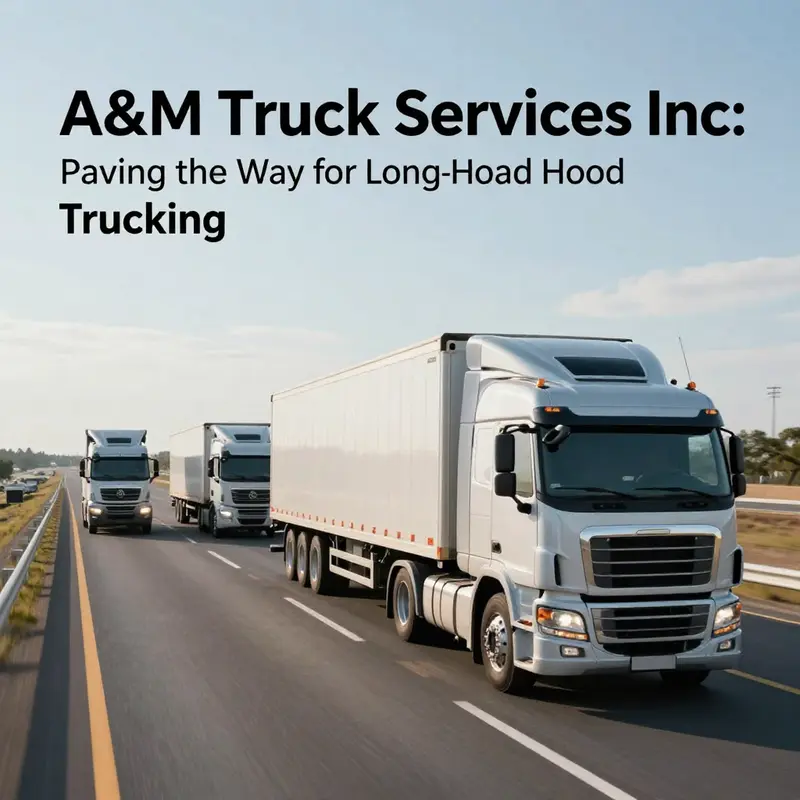
A&M Truck Services stands at a crossroads where reliability, technology, and fleet quality converge to redefine what it means to move goods across a vast and demanding North American landscape. In markets shaped by tighter timelines, volatile weather, and expanding e-commerce fulfillment needs, the company’s market positioning rests on a deliberate blend of consistency, digital sophistication, and asset stewardship. Rather than chasing the lowest bid, A&M carves out a premium space anchored in predictability and trust. This stance is not just about being dependable on a single route; it is about sustaining a performance standard across long-haul corridors and regional lanes alike, where every delay ripples through a shipper’s inventory and a carrier’s reputation.
The backbone of A&M’s stance is reliability, a attribute measured not merely by punctuality but by the steadiness of end-to-end execution. In an era when a single late delivery can disrupt production lines, customs processing, and last-mile handoffs, A&M treats on-time performance as a core capability rather than a KPI tucked into a quarterly report. Reliability, in this sense, becomes a competitive advantage with compounding effects. When carriers consistently meet or beat delivery windows, shippers gain more than time savings; they gain resilience for their own operations. That resilience is increasingly valued as a strategic asset in supply chains that must absorb disruption from weather events, port congestion, and the periodic volatility of fuel price swings. A&M’s emphasis on reliability also translates into measurable outcomes, including fewer missed handoffs, steadier inventory turnover, and stronger overall supply chain predictability for customers who must synchronize manufacturing, distribution, and regional delivery.
Technology integration forms the second pillar of A&M’s market stance. The company has pursued a comprehensive digital transformation that turns data into actionable decisions and actionable decisions into operational routines. At the core is a sophisticated telematics ecosystem that provides real-time visibility into each asset’s location, status, and condition. But visibility alone does not move the needle; the real power lies in the AI-driven route optimization software layered on top of that data stream. The system continuously analyzes live traffic patterns, weather advisories, road restrictions, and fuel efficiency metrics to inform route selection, departure timing, and idling reduction strategies. This dynamic, data-informed approach allows A&M to adapt as conditions shift, maintaining service levels even when a storm reroutes a corridor or a congestion pattern shifts during peak hours. In practice, this means less downtime due to unexpected detours, more reliable delivery windows, and a smoother handoff to the next segment of the supply chain. The emphasis on technology is not merely a selling point; it is a productivity engine that converts information into measurable gains in reliability and customer satisfaction.
Third is fleet quality, an area where ongoing maintenance and asset modernization directly influence service outcomes. A&M’s fleet is described not simply as a collection of trucks and trailers but as a carefully managed system designed for longevity, uptime, and safety. Modernization programs focus on reducing mechanical failures, extending tire life, and ensuring that fleet components stay in peak condition through predictive maintenance beyond the traditional calendar-based approach. The result is a fleet that performs consistently across varied climates, terrains, and seasonal workloads. A high-quality fleet underpins the company’s promise of predictability; when vehicles are well maintained, unexpected breakdowns decline, and the risk of cascading delays across a multi-stop itinerary is diminished. In a market where the cost of downtime can exceed fuel or driver wages, fleet quality is not a luxury—it is essential to the integrity of service and the confidence of shippers who rely on dependable capacity.
Together, these three pillars—reliability, technology integration, and fleet quality—create a positioning that aligns with a broader shift in shipper expectations. A rising share of shippers prioritizes supply chain resilience and service continuity over the absolute lowest price. This recalibration is not a fleeting trend but a structural change in how freight is planned, contracted, and managed. The logic is straightforward: when the cost of disruption is high, buyers are willing to pay a premium for carriers that deliver consistent performance even in the face of uncertainty. A&M’s strategy is to translate that willingness into recurring business by embedding service quality into every facet of operations. The payoff is not only a better margin for the carrier but a more reliable, less risky supply chain for customers who need to synchronize production lines, distribution centers, and retail channels across vast regions.
Industry data from the American Transportation Research Institute’s 2025 assessment of long-haul performance trends reinforces this logic. The report indicates that companies partnering with high-performing carriers experience meaningful reductions in delivery delays and improvements in inventory turnover. While the market remains heterogeneous, those who invest in reliability and advanced logistics tools tend to see compounding gains across multiple metrics, including throughput, asset utilization, and customer retention. This evidence underpins the rationale for A&M’s emphasis on integrated telematics, AI-assisted routing, and a modernization program that keeps the fleet at the leading edge of safety, efficiency, and environmental stewardship. The market is evolving toward a model where the value proposition is built not only on what is moved but on how predictably it is moved, and at what cost to the overall supply chain risk profile.
Looking ahead, the company’s future trajectory builds on its current achievements and adds deliberate, capability-driven investments. Digital transformation is not a one-off project but a strategic program that migrates operations from reactive to proactive. The telematics platform remains the backbone, but the next phase introduces more advanced analytics that translate historical patterns into prescriptive actions. Route optimization becomes not just smarter but anticipatory, factoring in seasonal demand shifts, maintenance windows, and the emergence of new lanes that are currently underserved but increasingly stressed by growth in e-commerce fulfillment. The aim is to create a continuously learning system that reduces buffer stock needs for customers while maintaining service levels that keep inventories and distribution networks lean but resilient.
At the same time, A&M’s commitment to sustainability is designed to align with both regulatory trajectories and client expectations for a lower carbon footprint. The plan to transition toward a hybrid-electric fleet by 2030 is envisioned not as a single technology sprint but as a staged evolution. It starts with pilot deployments on specific corridors where energy prices, charging infrastructure, and demand density support early gains. As the fleet evolves, the company expects to capture a meaningful reduction in carbon emissions—anticipated to be substantial versus 2020 baselines—without compromising the reliability and capacity customers rely on daily. The environmental objective is matched with a practical operational one: cleaner operations in urban corridors and dense distribution networks that minimize nuisance emissions while safeguarding air quality in communities where freight traffic often intersects with public life. This alignment with both policy objectives and client preferences for sustainable logistics positions A&M to win initiatives that reward performance with longer-term contracts and broader scope.
Beyond the core pillars of reliability, technology, and fleet quality, A&M is broadening its value proposition through considered service enhancements. The company is expanding from pure transportation into a more comprehensive logistics partnership. Value-added capabilities emerge that reduce friction for shippers and improve overall supply chain visibility. For example, by integrating cargo protection considerations into the transport planning process, A&M helps clients manage risk more effectively without adding complexity to the procurement cycle. The ability to tailor coverage and support around dedicated accounts gives customers a predictable, one-stop experience. While still anchored in moving freight, the expanded set of capabilities positions A&M as a partner capable of coordinating multiple elements of a shipment—from storage needs to regulatory compliance in cross-border flows when applicable—into a coherent, end-to-end solution. The emphasis remains on reducing risk, increasing predictability, and freeing customers to concentrate on core competencies rather than the burdens of logistics management.
The corridor strategy is central to the envisioned growth path. A&M is prioritizing its footprint along critical industrial arteries, with a focus on long-haul routes that connect major manufacturing bases with distribution hubs and metropolitan consumer markets. The I-70 and I-95 corridors, in particular, represent high-value arteries with dense freight activity, increasing the potential for steady utilization of capacity and predictable demand. In this context, the company views its positioning not as a regional operator but as a network-enabled service provider that can flexibly allocate capacity, optimize lane performance, and respond to surges in demand with minimal disruption to service levels. The vision is to convert velocity into stability: high utilization rates and rapid turnarounds along these corridors translate into faster cycles of capacity availability for customers and stronger revenue resilience for the business.
The narrative of A&M’s market position would be incomplete without acknowledging how shipper expectations have shifted toward collaboration and transparency. In an era where performance data is increasingly scrutinized, the ability to communicate status, forecast potential disruptions, and offer alternative routing or service configurations becomes a meaningful differentiator. The real-time visibility provided by the telematics platform feeds into collaborative planning tools that shippers use to link manufacturing calendars, inventory targets, and distribution throughput. This convergence of technology and process creates a more resilient relationship between carrier and shipper—one grounded in trust, backed by measurable performance, and reinforced by shared clarity about risk and contingency planning. It is a market dynamic that rewards operators who can demonstrate a track record of predictable delivery windows, elevated asset reliability, and the discipline to invest in the capabilities that sustain performance under pressure.
The practical implications for customers and partners are resonant. When a shipper experiences fewer delays, the entire supply chain benefits—from reduced safety stock and shorter lead times to improved capital efficiency and more accurate demand forecasting. In a market where just-in-time and just-in-case strategies coexist, A&M’s model of reliability, supported by advanced analytics and a modern fleet, offers a path to greater supply chain resilience without sacrificing throughput. The emphasis on continuous improvement—through predictive maintenance, smarter routing, and a smarter fleet—means that the company can responsibly commit to service levels that help customers plan with confidence, even as external conditions shift. It also implies a long-term partnership ethos: collaboration is not merely a policy; it becomes a practice that guides future capacity investments, route development, and service design.
Within this framework, one can glimpse a broader industry conversation that is well represented in industry thought leadership and forums. For interested readers, the linked discussion on industry perspectives provides a complementary view on how carriers balance cost discipline with customer-centric service in an increasingly data-driven environment. 5StarTruckIn blog offers ongoing commentary on trucking operations, efficiency, and the evolving expectations of shippers, which aligns with the practical implications of A&M’s positioning described here. While the blog centers on broader industry topics, it helps illuminate how operators translate reliability, technology, and fleet quality into real-world performance and client value.
As the chapter closes on this vision, it is worth reiterating the central premise: market positioning in modern North American freight is not about a single differentiator but about a coherent system of capabilities that together reduce risk, enhance predictability, and deliver sustainable value. A&M Truck Services embodies this approach through a disciplined combination of reliability, digital capability, and asset stewardship. The road ahead, with its evolving regulatory and environmental contours, will test every carrier’s resilience. Yet the strategic investments in telematics, route intelligence, and a phased transition to lower-emission powertrains provide a practical pathway to maintain service excellence while expanding market reach. In that sense, A&M’s future is not a bet on one technology or one lane but a deliberate design for a networked logistics operation that can adapt, endure, and grow as the North American freight ecosystem matures.
External resource: https://www.atrinet.org/reports/2025-long-haul-performance-trends
Final thoughts
A&M Truck Services Inc may be relatively unknown, but exploring its context against established companies sheds light on its potential role in the trucking sector. The comparative analysis with A&M Commercials Ltd reveals specific strengths and weaknesses, while understanding services from similar companies helps highlight market expectations. As we consider the direction the trucking industry is heading, A&M Truck Services Inc’s future looks promising, primarily if it aligns with emerging industry trends and continues to cater to the evolving needs of long-haul drivers, fleet managers, and company owners. In this ever-changing landscape, those who adapt quickly and effectively stand to thrive.