
Understanding trucking involves appreciating its essence as an intangible service. While trucks and loads are tangible assets, the critical value lies in effective transportation and logistics services that define successful operations. This narrative extends to our long-haul truck drivers, trucking company owners, and aspiring drivers alike. By delving into why trucking is classified as an intangible service, we can also illuminate its economic implications, shaping the landscape of commerce. Furthermore, we aim to explore trucking’s societal role and how it connects us all. Join us as we navigate this fascinating facet of transportation.
The Invisible Engine: Reframing Trucking as an Intangible Service That Moves the Economy
Trucking sits at the crossroads of the physical and the perceptual in modern commerce. A row of rigid metal vehicles is visible, loud with engines, and involved in the predictable choreography of loading, routing, and delivering. Yet the essence of what trucking delivers rests not in the metal and tires themselves, but in a non-tangible outcome: the movement of cargo over space and through time. In this sense, trucking is less a product than a service whose value emerges from the orchestration of people, processes, and timing. The physical assets—trucks, trailers, and fuel—provide the stage and the instrument, but the performance that customers pay to see is the reliable passage of goods from origin to destination. If we want to understand trucking as an intangible, we must peer beyond the visible mechanics to the service that unfolds in real time and in real outcomes, where space-time utility becomes the currency of value.
This reframing matters because it speaks to how actors in the logistics ecosystem think about performance, risk, pricing, and governance. The service logic of trucking centers on outcomes rather than on the mere possession of material objects. A customer does not purchase a truck or a seat in a cab; they purchase the act of relocating freight under agreed constraints of time, safety, and cost. The core value lies in success—getting cargo from point A to point B as promised—rather than in the production of a tangible good. This distinction is not merely semantic. It informs strategy, accounting, customer relationships, and how the industry measures success.
The intangible character of trucking emerges most clearly when we examine the nature of the result. Unlike a physical product such as machinery or apparel, which arrives as a completed item that can be stored, displayed, or resold, the outcome of trucking is a dynamic process. It is a function that converts potential capacity into realized service: the space-time displacement of cargo. That displacement is real and valuable, but it cannot be held, touched, or owned in the way a commodity can. The customer’s payoff comes from the cargo arriving on time, intact, and compatible with the receiving schedule. The value is not a box or a pallet; it is the successful navigation of routes, the management of risk, and the assurance of regulatory compliance that permit a shipment to move with confidence through a complex network.
Viewed through this lens, the intangible nature of trucking rests on several interlocking ideas. There is no tangible product at the end of the service chain; rather, there is a non-physical result: the cargo’s change of location within a defined window. The service is produced and consumed simultaneously. When a driver is en route, the customer is experiencing the benefit of transport in real time—the cargo is moving, a plan is being executed, and expectations are being managed. There is no separate phase of production that precedes consumption, as there would be with a manufactured good. The act of moving is the service; the movement itself is the product in use.
Ownership, too, reflects the service nature of trucking. When a customer contracts for transportation, they do not acquire ownership of the vehicle, the driver, or the capacity to move goods at large. They obtain the right to have their freight moved under agreed terms. This lack of ownership transfer is a defining feature of a service rather than a tangible product. It emphasizes that value is extracted from the execution of a process—the planning, coordination, and execution of transport—rather than from the possession of a physical asset. The intangible value in this context is the assurance that, within the boundaries of time, cost, and safety, the cargo will arrive where it is supposed to be.
A further dimension of intangibility in trucking arises from perishability. In inventory management, perishable goods lose value if not used promptly. In trucking, capacity itself is perishable. An empty truck, a vacant trailer, or unused miles on a given day represent foregone value. Unlike holding tangible inventory, capacity cannot be stored for later use without risk. If a truck sits idle, its potential contribution to a service outcome is lost forever for that period. This perishability reframes how firms think about scheduling, demand forecasting, and capacity management. It places a premium on responsiveness, precise forecasting, and the discipline to match supply with the unpredictable cadence of orders, delays, and shifts in demand. The same principle underpins pricing, where the marginal cost of a missed delivery window can surge when demand for speed and reliability rises.
If we push deeper, we see that the intangible value of trucking rests on trust. Trust is built through consistent performance on time, safety, and compliance. It matures through transparency—clear communication about delays, proactive notices about route changes, and honest reporting of incidents. It is reinforced by a reputation for handling sensitive freight with care and for honoring agreements even when conditions on the road are difficult. Customers do not simply buy a transport service; they buy confidence that their cargo will move as promised within the constraints they set. In this sense, the service is a bundle of commitments—to timeliness, to safety, to regulatory adherence, to clear documentation, and to predictable pricing—that together constitute trust. The intangible asset that underpins this trust is a cumulative history of performance, reinforced by organizational routines, culture, and a learning posture that values continuous improvement.
The components of that intangible value often appear as a constellation of capabilities rather than a single product feature. Routing intelligence, for example, is not merely a tool but a capability that blends data, expertise, and experience. The ability to foresee traffic patterns, weather disruptions, and mechanical contingencies and to translate that foresight into a revised plan is an intangible asset. So too is the driver’s skill in handling paperwork, communicating with shippers, and managing a day’s sequence of pickups and deliveries with minimal disruption. Each of these elements contributes to a service that feels reliable even when the road is uncertain. The intangible value is not simply a measure of speed; it is a measure of dependability—the probability that a shipment arrives as expected, that communication is timely, and that the overall transaction proceeds smoothly from quotation to final delivery.
To appreciate how this intangible service is priced and managed, consider the broader logistics ecosystem. The trucking function sits inside supply chains that continually seek to convert uncertainty into predictable outcomes. Carriers and shippers negotiate service levels that specify on-time performance, handling standards, damage rates, and response times for claims. The price reflects not only the physical cost of fuel, maintenance, and labor, but also the value customers place on reliability, flexibility, and transparency. In this sense, pricing becomes a proxy for the intangible assets of execution capability and relationship quality. A carrier that can consistently meet tight deadlines, adapt to last-minute changes, and provide precise, accessible documentation earns a premium not because it provides more physical goods, but because it reduces the buyer’s risk and increases the certainty of performance.
The intangible nature of trucking also shapes how the industry treats information and governance. A service-based perspective elevates the importance of process discipline. It emphasizes the role of standard operating procedures, safety programs, and compliance protocols as essential intangible assets. The more a carrier can demonstrate that it operates with disciplined routines—predeparture checks, real-time visibility for customers, standardized load securement practices—the more trustworthy the service appears. These practices are not physical artifacts but organizational capabilities; they exist in systems, training, and culture. The same logic extends to risk management. The ability to anticipate, communicate, and mitigate disruptions—whether due to weather, equipment failures, or regulatory changes—translates into a smoother service and a stronger reputation. The intangible assets here take the form of resilience, adaptability, and learning, which increasingly determine the long-run profitability and viability of a trucking operation.
From a management perspective, recognizing trucking as an intangible service has practical implications. It reframes performance metrics away from pure asset utilization toward a balanced view that values reliability, safety, and customer experience. On-time delivery rates, dwell times, and transit variance metrics become as important as traditional measures of capacity utilization. Customer satisfaction and repeat business rise in importance because they capture the intangible aspects of experience—trust, perceived value, and confidence in execution. Investment decisions reflect this shift as well. Upgrades to people, training, and information systems that enhance visibility and communication often yield higher returns than purely expanding fleet size. In other words, strong intangible capabilities can permit a given fleet to achieve greater throughput, better service levels, and stronger margins without a proportional increase in capital expenditure.
The narrative above also helps explain why the trucking industry often emphasizes relationships and reputation. A service model rewards consistency and reliability in ways that a product-focused model does not. A shipper faces a portfolio of potential carriers, and the choice often hinges on intangible factors like the carrier’s track record, communication style, and willingness to collaborate across the supply chain. The decision is seldom driven by a single mechanical capability; it is driven by a pattern of behavior that signals predictability and trust over time. This is why language around service quality, safety culture, and partner alignment features so prominently in industry discussions. It is also why the concept of a “service-level agreement” matters as much as any price sheet. The agreement codifies expectations about performance and provides a framework for accountability, further converting intangible capabilities into measurable commitments.
In the broader economic landscape, trucking as an intangible service reflects a larger shift in how value is defined in industrial ecosystems. Modern manufacturing and distribution rely on sophisticated logistics services that operate in the margins between physical assets and information. The material goods themselves often represent a fraction of total value; the remainder is embedded in the orchestration that moves those goods through time and space. This reality is increasingly recognized by analysts and policymakers who study the lifecycle of industrial goods. Intangible assets—knowledge, processes, relationships, and reputations—are central to sustaining performance and competitiveness. In logistics, these intangibles emerge as the ability to anticipate demand, reduce variability, and compress lead times, which translates into lower risk for customers and higher reliability of supply. The intangible service thus becomes a competitive differentiator, one that often outlasts any single fleet or contract and binds parties through trust and shared outcomes.
The implications for how we discuss regulation and taxation are also meaningful. Since trucking is a service, not a tangible product, tax treatment, accounting practices, and regulatory oversight align more closely with service industries. The cost of capital used to fund fleets remains critical, but the value drivers shift toward intangible assets such as organizational capability, customer relationships, and programmatic risk management. Such a framing helps explain why investments in driver training, safety programs, and compliance infrastructure are often described as strategic, not merely operational. These investments cultivate soft assets that make the service more reliable and, in turn, increase its perceived and realized value in the market.
As with any service, the quality of the trucking experience hinges on more than the physical act of moving freight. It demands a partnership mindset, where carriers, shippers, and brokers work together to anticipate needs, manage exceptions, and align on outcomes. The service is enriched when information flows freely, when schedules are adjusted with transparency, and when claims and disputes are handled with fairness and clarity. The intangible nature of trucking, far from diminishing its importance, actually elevates the role of human judgment, collaboration, and organizational discipline in delivering value. In this sense, trucking is not a mere transfer of goods; it is a carefully choreographed exchange of confidence. The cargo is moved, but the lasting impact is the trust formed between the several hands that steer the process forward.
For readers seeking a concrete sense of how these ideas manifest in real practice, consider how a carrier might describe its value proposition. The emphasis is seldom on a single feature; rather, it is on a consistent pattern of outcomes: visible status updates, accurate and timely documentation, proactive risk communication, safe handling, and a demonstrated ability to recover from disruptions without eroding service levels. Each of these elements contributes to an intangible stack of assets that, when combined, yields a service experience that customers are willing to pay a premium for. The more that a company cultivates these capabilities, the more the service resembles a carefully engineered process rather than a simple movement of freight. And the more it resembles a carefully engineered process, the more it can scale, innovate, and sustain value during periods of demand volatility and economic pressure.
To close the loop on the conceptual frame, it helps to recognize that the intangible nature of trucking does not diminish its importance. On the contrary, it makes the industry a quintessential example of how value is created in contemporary commerce. The physical world provides the stage, but the economic drama unfolds in the invisible spaces where people, processes, and performance converge. The trucks are essential instruments, yet the service they enable—reliable relocation of goods—constitutes the real product. The intangible assets that support this service—trust, transparency, capability, and resilience—are the currencies by which the market rewards performance. In a world where supply chains grow more complex and customer expectations rise, the ability to deliver an outcome that is predictable, safe, and timely becomes the defining advantage of trucking as a service. This is the core insight that helps practitioners, researchers, and policymakers alike move beyond a narrow view of transportation as a physical activity and toward a holistic understanding of trucking as an intangible service that moves not only cargo but also confidence, collaboration, and value across the economy.
For readers who wish to explore the broader implications of intangibles in logistics and transportation more deeply, a foundational resource on intangible assets offers context on how non-physical value is defined, measured, and deployed in economies that increasingly prize knowledge, relationships, and process-driven performance. See the external resource for a broader economic lens on intangibles and how they shape strategic decisions in modern business environments: https://www.investopedia.com/articles/economics/08/intangible-assets.asp
To connect this chapter to ongoing industry conversations, consider how a particular logistics provider frames its service quality and reliability on the road. The emphasis on consistent performance, clear communication, and proactive problem-solving illustrates how a carrier translates intangible capabilities into tangible outcomes for customers. For readers seeking reflective examples from the field, the following internal resource offers a perspective on service quality and reliability as a core driver of value in trucking: Exploring 5 Star Truck Inc. quality service and reliability on the road. This link serves as a practical waypoint for understanding how service narratives are constructed, tested, and improved within the industry, reinforcing the central argument that trucking is fundamentally an intangible service even as it relies on tangible machinery to perform.
In sum, recognizing trucking as an intangible service reframes our understanding of what creates value in transportation. It shifts attention from the physical assets to the dynamic performance of a process that moves goods through space and time. It foregrounds trust, reliability, and risk management as core capital assets. It explains why performance metrics matter not only for efficiency but for the assurance of outcomes. And it positions the industry to capitalize on the growing demand for dependable, transparent, and adaptive logistics in an economy that increasingly prizes seamless movement and predictable results. The truck remains visible, but the service—broad, relational, and time-bound—remains the true engine behind freight’s progress. The intangible becomes the practical, the reliable, and the indispensable instrument through which trade travels across markets and borders. In that sense, trucking is not a byproduct of the road; it is the road’s most persistent and influential invisible hand, shaping how goods are moved and how value is created in the modern economy.
Intangible Wheels: Reframing Trucking as a Service in the Modern Logistics Economy
Trucking has long occupied a paradoxical space in the economy. It sits at the intersection of tangible assets—rigs, trailers, yards, and fuel tanks—and an increasingly intangible service that underpins every shipment, every delivery window, and every customer promise. The core value proposition of trucking is not the mere possession of trucks or the capacity to haul cargo; it is the orchestrated performance of a transportation service that unfolds in real time through codified routines, advanced data systems, and organizational discipline. In this sense, trucking is an intangible service delivered through high levels of coordination, visibility, and energy-aware planning. The material elements—vehicles, engines, and road networks—are essential, but they function as means to an end rather than the end itself. The service travels with the cargo across geography, market cycles, and regulatory moods, and it is defined by reliability, transparency, and sustainability as much as by speed or capacity.
Operationally, intangible factors become crucial levers for performance. Scheduling becomes probabilistic and anticipatory; route planning must account for battery levels, charging durations, and energy availability. Real-time tracking evolves from a simple location feed to a core service capability that informs customers and coordinates across ecosystems. The economics of scale shift toward information flows, predictive analytics, and digital coordination that reduces dwell times and energy waste. The stronger the integration between data platforms, fleet management, and customer interfaces, the greater the productivity gains. The intangible assets—algorithms, platforms, and disciplined execution—become the true differentiators in a market still moving physical goods.
Looking ahead, the service perspective emphasizes dependability, transparency, and sustainability. Data-driven maintenance, energy-aware routing, and seamless coordination with shippers and carriers turn transportation into a lifecycle service rather than a one-off transfer. The future of trucking as a service rests on how well ecosystems support planning, fault tolerance, and energy management under real-world constraints. In this sense, the service is not a substitute for physical transport but a matured interpretation of value, where intangible competencies determine whether a shipment arrives on time, every time, with clarity and confidence.
The Invisible Road: Trucking as a Crucial Intangible Service Behind Modern Society
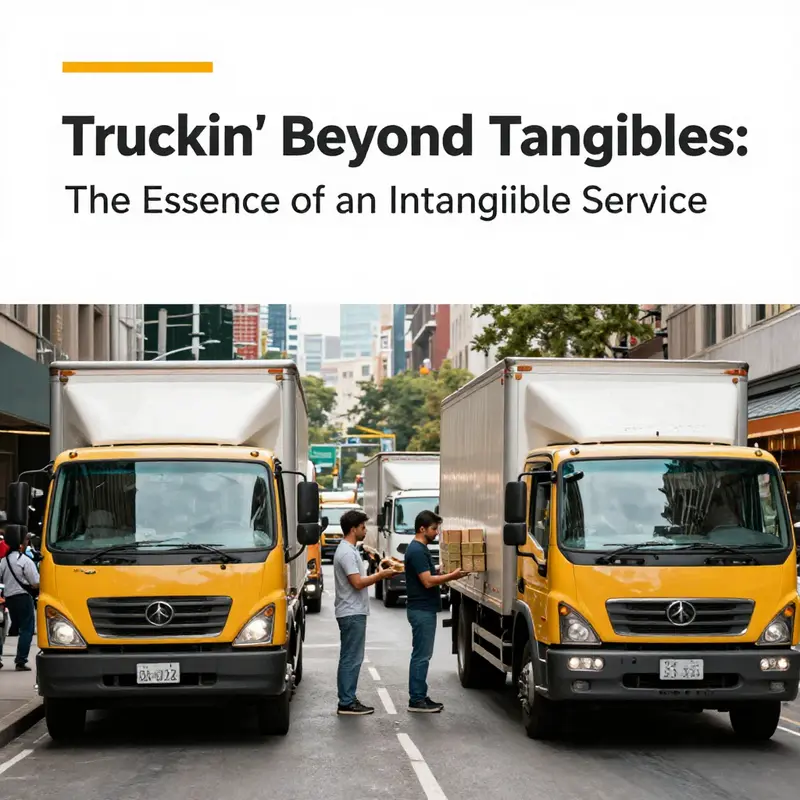
The everyday functioning of modern life rests on a quiet, often unseen network of services that move people, goods, and ideas from point A to point B. Among these, trucking stands out as a quintessential intangible service. The act of moving cargo from one locus to another is bound up in a complex choreography of planning, execution, and control that cannot be grasped by simply holding a physical product. Even though trucks, fuels, and containers are tangible and visible, the value that trucking provides resides in performance: the timely, coordinated, and reliable transformation of logistics into a dependable service proposition. This perspective invites us to see trucking not as a product at all, but as a sophisticated process that underpins social well‑being and economic continuity. The service at the heart of trucking is the capability to organize space, time, and risk so that goods arrive where they are needed, when they are needed, and in a condition that preserves their value. That capability—the promise of reliable transportation—constitutes the core intangible asset of the industry. It is the trust that consignors and receivers place in the system, the confidence that a shipment will show up on schedule, and the assurance that the route and the method chosen respond to changing circumstances with agility and care.
Viewed through this lens, trucking embodies a pivotal form of social infrastructure. It binds producers to consumers, researchers to markets, and communities to essential life-sustaining resources. Food, medicines, fuel, and manufactured components rely on the invisible network of carriers and logisticians that make continuous flow possible. The tangible output—the delivery itself—serves as a visible confirmation of a much broader, intangible capability: the capacity to coordinate complex operations across geographies, time zones, and regulatory environments. In this sense, the societal role of trucking extends beyond mere movement. It is a reliability engine for supply chains, a stabilizing force in the face of demand volatility, and a buffer against disruption. The intangible quality of dependable service, rather than the physical asset alone, explains much of trucking’s value in contemporary economies. The resilience of the system hinges on people’s ability to anticipate, adapt, and respond when conditions shift. This is where the human elements—the expertise of drivers, planners, dispatchers, and network managers—become as critical as any mechanical component. The labor behind the wheel and at the desk embodies trust and accountability, turning a basic transport function into a dependable service experience that customers can bank on.
The societal logic of trucking collaborates with the broader evolution of the industrial landscape, one where intangibles increasingly define value. In a world where production can be modular and markets fluid, the demand for reliable transportation is driven as much by the performance of the service as by the physical movement itself. This aligns with a growing understanding that industrial goods accumulate value through intangible components such as speed, flexibility, predictability, and the ability to adapt to shifting requirements. The service quality delivered by trucking firms rests on these intangible dimensions: the ability to coordinate multi‑leg journeys, manage time buffers, and recover from disturbances with minimal impact on downstream processes. When disruptions occur—be it weather, congestion, regulatory changes, or a sudden shift in demand—the strength of the service lies in timing and communication. A carrier’s capacity to provide updated ETAs, transparent tracking, and proactive problem solving is what customers remember and rely upon, not merely the photograph of a loaded trailer.
This emphasis on intangible value does not diminish the importance of physical assets. Trucks, documentation, warehouses, and fuel are essential components of the system. However, their contribution to value becomes meaningful only through the service that harnesses them. The physical components enable the service, but the service itself—defined by reliability, visibility, and responsiveness—becomes the enduring source of value. The modern trucking ecosystem thrives on the integration of labor, systems, and data. Skilled drivers bring on‑the‑ground judgment, while dispatch and logistics professionals translate live information into actionable decisions. Real‑time tracking, route optimization, load monitoring, and performance analytics convert raw movement into a managed, trustworthy experience. The intangible core, then, is not a product you can hold; it is an assurance—a perceived probability that the shipment will reach its destination under agreed terms. That assurance matters to supply chain participants no less than the physical transport itself.
Within this framework, trucking’s societal impact becomes more visible when we consider what happens in times of stability and times of upheaval. In ordinary periods, the service maintains routine life: groceries arrive on shelves, parts arrive at manufacturing lines, and retailers stock inventory with predictable cadence. The continuity supported by trucking underpins consumer confidence and economic activity. In extraordinary times—natural disasters, health emergencies, or sudden price shifts—the same intangible service demonstrates its true value. The capacity to reallocate resources quickly, reroute shipments, and communicate changes transparently becomes a public good. The perceived reliability of trucking networks influences business investment, labor markets, and even regional planning. The societal dividend is not merely convenience; it is the steady circulation of goods that keeps households fed, clinics stocked, and jobs secure. In this sense, trucking operates as a form of social insurance, an intangible commitment that keeps the grand machine of society functioning even when shocks occur.
As researchers have noted, the intangible elements of service quality—trust, punctuality, and adaptability—are central to how trucking is perceived and valued. The same ideas recur across industrial contexts, where the movement of materials is inseparable from the performance of the service that organizes that movement. The value placed on dependable delivery rests not on the physical presence of a fleet alone but on a track record of on‑time performance, accurate information, and consistent problem solving. These factors shape broader economic outcomes: supplier–buyer relationships become more robust; capital flows respond more confidently to stable logistics performance; and consumer expectations adjust to a world where reliable transport is taken for granted. In other words, the intangible service is the social fabric that binds markets and communities together, weaving an invisible but indispensable layer through which the visible goods travel.
Sustainability and innovation are redefining the contours of trucking’s intangible value in contemporary policy and business discourse. The transition toward zero‑emission fleets and more energy‑efficient operations introduces new intangible costs and benefits. Charging or refueling time, lower cargo density, and the need for charging infrastructure all carry non‑physical consequences: they affect perceived reliability, schedule integrity, and the ability to meet service commitments. The intangible costs—such as longer turnaround times or reduced payload—must be weighed against the environmental and social gains of reduced emissions and improved air quality. The success of such transitions depends on more than hardware upgrades; it requires collective social acceptance, skilled workforce adaptation, and forward‑looking regulatory frameworks that recognize the value of a cleaner, quieter, and smarter transportation system. A 2024 study on decarbonizing road freight emphasizes that technological advances must be paired with changes in norms, expectations, and logistical practices if these innovations are to translate into sustained societal benefits. The invisible costs and benefits of green transition are thus integral to the service’s perceived quality and to the public trust that underpins long‑term adoption.
Framed this way, trucking emerges as a critical form of public infrastructure that operates through intangible assets: the confidence that a network will perform, the transparency of operations, and the capacity to adapt to evolving needs. The service is not merely a function of moving freight; it is a dynamic interplay of people, processes, and data that creates predictable outcomes in an uncertain world. In building and maintaining this intangible capability, the industry relies on careful combination of human capital—drivers, planners, technicians—and sophisticated systems for scheduling, tracking, and risk management. It also depends on a shared commitment to professional standards, safety, and continuous improvement. The value delivered to society is thus a composite of reliability, safety, and accountability, in addition to the physical delivery of goods. This composite, intangible by its nature, is what makes trucking essential to everyday life and to the resilience of economies that rely on timely access to inputs and products.
An additional layer of complexity arises when we consider the perception of value in industrial contexts. Recent academic discussions point to frameworks that highlight how tangible services and intangible products interact within the lifecycle of industrial offerings. They remind us that perceived value is shaped by more than the physical characteristics of a service or product; it is molded by the reliability of performance, the clarity of communication, and the confidence customers have in the provider’s ability to deliver under varying conditions. In practice, this means that trucking firms can compete not only on price or equipment but on the consistency of service, the quality of information flows, and the speed with which problems are resolved. The intangible aspects of service delivery—when executed with excellence—create durable reputations, repeat business, and long‑term partnerships that stabilize markets and support community well‑being. The broader economic narrative is clear: intangibles in logistics, such as trust and adaptability, are as important as the concrete assets that physically move goods from origin to destination.
For readers seeking a practical lens on how these ideas translate into everyday practice, industry conversations often circle back to the importance of leading indicators that signal service quality rather than mere asset utilization. The ability to identify bottlenecks, communicate anticipated delays, and offer proactive contingency plans is what elevates a transportation operation from a visible act to a trusted service. In this sense, the intangible service becomes a competitive differentiator. Customers do not merely look at the distance traveled or the number of pallets moved; they evaluate the reliability of the promise and the clarity of the information that accompanies each shipment. The human element—the judgment, empathy, and problem‑solving prowess of people who orchestrate the movement—continues to be the defining feature that sustains high performance even when machines and algorithms become more involved. This perspective helps explain why, in many contexts, the success of logistics networks hinges on a culture of reliability, continuous improvement, and open communication, rather than on any single technological breakthrough.
The single most important takeaway is that trucking, at its core, is an intangible service whose value is realized through performance, not possession. The physical assets are indispensable enablers, but they are not the service itself. The service lives in the predictable outcomes: shipments arriving on time, information that travels as fast as the freight, and relationships built on trust between carriers, shippers, and receivers. The societal payoff is straightforward: a population that can rely on steady access to essential goods, a business sector that can plan with confidence, and a political economy that can weather shocks with less disruption. This reframing invites us to see trucking as a form of social infrastructure that requires investment in people, processes, and partnerships as much as in trucks and terminals. It also invites policymakers, researchers, and practitioners to value the intangible elements of service quality alongside the tangible assets that physically move goods.
To broaden the conversation beyond the limits of any single discipline, consider how this intangible service perspective aligns with practitioner communities that discuss, teach, and share insights about transportation and logistics. For deeper reflection on how service tangibility and value perception shape industrial practice, readers may explore broader discussions in relevant industry literature and practitioner resources, such as updates and conversations hosted on the 5 Star Truckin blog. This resource offers practical insights into how service reliability, safety culture, and operational discipline influence outcomes on the road and in the yard, reinforcing the central argument that trucking is fundamentally an intangible service at scale. 5 Star Truckin blog
In sum, trucking’s societal significance rests on an intangible yet powerful combination of reliability, coordination, and adaptability. The movement of goods is the outward sign of a deeply held capability to manage time, risk, and information. When viewed through this lens, trucking becomes not just a business activity but a form of social infrastructure that sustains daily life, supports economic continuity, and aligns with evolving aspirations toward sustainable, intelligent mobility. This perspective helps bridge the insights from the research materials with the lived experience of households, workers, and communities who rely on a logistics system that works—quietly, consistently, and reliably—behind the scenes. As we turn to subsequent chapters, the conversation will continue to explore how these intangible elements interact with policy design, organizational culture, and technological innovation to shape the future of transportation and the public’s perception of value in the logistics ecosystem.
External resource: Tangible Services and Intangible Products in Industrial Product. https://www.researchgate.net/publication/391234567TangibleServicesandIntangibleProductsinIndustrialProduct
Final thoughts
In summary, embracing trucking as an intangible service reshapes our understanding of its role within our economy and society. This perspective highlights the importance of quality service over physical assets. Long-haul truck drivers and company owners are encouraged to consider the value delivered to customers beyond just the transport of goods. With this insight, stakeholders can promote and innovate trucking services to foster growth and connectivity within our communities.