
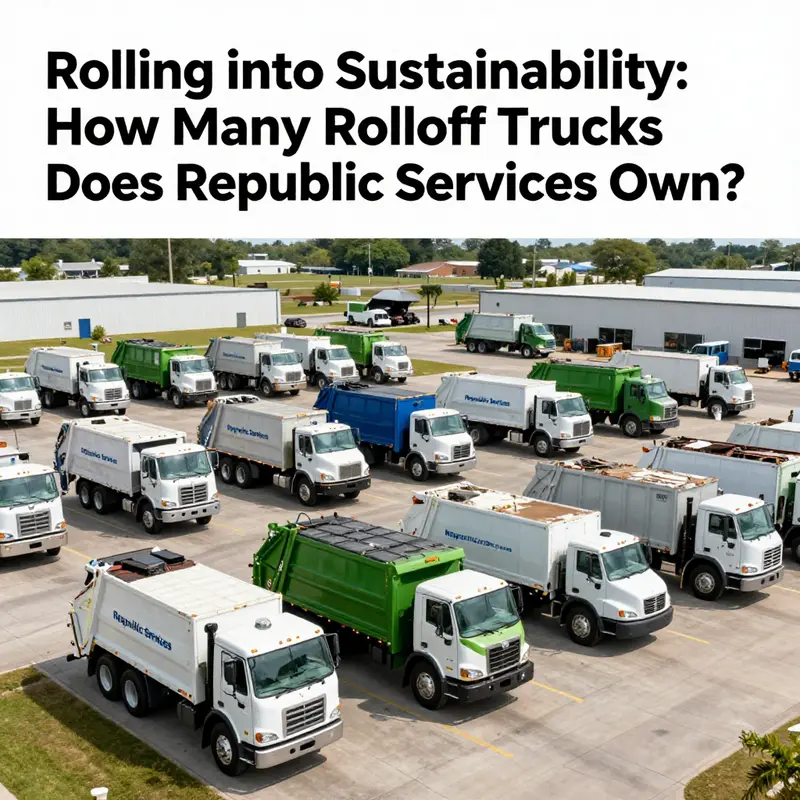
Rolloff trucks are a backbone of waste management, especially for a giant like Republic Services. While the exact number of rolloff trucks in their fleet remains elusive, understanding the complexities surrounding their operational status, the challenges of estimating their numbers, and their significance in waste management reveals much about the industry itself. From analyzing their role in Republic Services’ operations to comparing fleet sizes across the industry, this article meticulously explores every aspect of Republic Services’ rolloff truck fleet and its future trajectory.
Beyond the Count: Exploring Republic Services’ Roll-Off Truck Fleet Status
The question of how many roll-off trucks Republic Services owns sits at the heart of a broader truth about large, privatized waste management: transparency about fleet composition rarely travels beyond the company’s balance sheet and regional disclosures. The public record does not reveal an exact total, and the absence of a single, authoritative number invites readers to piece together a portrait from scattered signals. Republic Services operates as one of the country’s largest waste services providers, with a breadth of operations that span urban and rural areas, municipal contracts, and private hauls. Within that vast footprint, roll-off trucks—specialized machines designed to move large, open-topped containers—play a critical role in handling bulky waste, industrial debris, and project-based pickups. Yet, even as these vehicles are fundamental to daily operations, the precise tally of the fleet remains off-limits to public scrutiny. The result is a story told more in glimpses than in totals, more in regional variation than in a single nationwide headline number.
What can be said with some confidence is that the company maintains a diverse fleet, not limited to roll-off units but including a spectrum of vehicle types from standard dump trucks to compactors and specialized hook-lift configurations. Public references to truck models provide a rough sense of the equipment in circulation. Data points show mentions of chassis and configurations such as HOWO 8X4 Roll-Offs & Hook Lifts Trucks, which hints at the kinds of rolling stock currently deployed in certain regions or projects. Those references imply a fleet that is technically capable and varied, built to handle different waste streams and job scales. But a model reference is not a fleet count, and thus it serves as a clue rather than a tally. The larger implication is straightforward: a fleet of this scale is composed of multiple sub-fleets, operated by different regional teams, each with its own procurement cadence, maintenance practices, and replacement timelines.
A telling sign of the fleet’s current condition comes from the voices of people within the organization. The research results reveal a split in the experiential narrative of frontline teams. In some corners, the sentiment skews positive, noting that most of the fleet is pretty new and that safety is a valued focus. When maintenance and safety programs align, and drivers are recognized for excellence—such as a driver who was celebrated as an “annual driver” in 2024—these signals point to deliberate capital planning and a sustained effort to refresh the rolling stock. Such anecdotes hint that in certain regions or business units, the fleet has benefited from targeted investments, modern chassis, and updated components that reduce downtime and improve reliability. The appearance of newer equipment in these pockets can be read as evidence of a broader modernization push, even if there is no uniform across-the-board replacement of every roll-off unit.
Yet the counter-narrative is equally loud and deserves equal weight in this chapter. A large number of employee reviews converge on the perception of aging equipment and ongoing maintenance challenges. Comments describe a fleet that feels old, with wear and tear widespread enough to affect day-to-day operations. Maintenance responsiveness is another major theme, with some workers reporting slow repair turnaround times and a perception that shop operations struggle to keep pace with the needs of a busy, nationwide network. The words paint a picture of bottlenecks: parts delays, scheduling friction, and the cumulative effect of downtime on productivity and safety. Taken together, these accounts suggest that while some segments of the fleet have been refreshed, others remain in older cycles, reflecting the uneven pace of modernization that naturally accompanies a vast, diversified service provider.
The tension between renewal and aging matters beyond anecdote. It has real consequences for uptime, safety, and the overall cost of maintenance. Roll-off trucks are not simply a matter of buying more vehicles; they involve a continuous balancing act between capital expenditure, spare ratio, operating hours, and the cost of downtime. If a branch or region cannot quickly repair a malfunctioning unit, the consequences ripple through scheduling, regional throughput, and response times for customers. In this sense, the two extremes seen in employee feedback are not contradictory but interdependent: they signal a fleet in transition, where modernization is uneven and progress depends on local leadership, capital cycles, and the complexity of municipal or private contracts.
From a monitoring perspective, the lack of a disclosed total does not mean the question is unanswerable. It means the answer is distributed across layers—regional fleets, contract-driven substitutions, and the practical realities of maintaining a national footprint. The status of the roll-off fleet, therefore, is less a single figure and more a portrait of a portfolio in flux. If the industry standard is to pursue higher uptime through a mix of newer units and robust maintenance practices, the current reality appears to be a mix of both. The positive indicators—newer equipment in portions of the fleet, recognized safety initiatives, and driver awards—suggest that parts of the network are benefitting from ongoing renewal programs and a focus on workforce excellence. The negative indicators—perceived aging, maintenance bottlenecks, and slow repair cycles—signal that updating the entire fleet remains a work in progress, with the pace varying by region, project load, and financial commitments.
Within this landscape, a key takeaway is that the absence of a public total does not erase the practical implications of fleet composition. Operators and managers understand that roll-off trucks demand reliability, quick maintenance, and a support ecosystem capable of unexpected demand surges. The presence of regional variation implies that any attempt to estimate a national figure would be highly contingent on the time window, the geographical scope, and the definition of what counts as a “roll-off truck” in practice. For researchers and industry observers, this means reading the fleet story through licensing data, equipment catalogs occasionally cited in regional disclosures, and the cadence of fleet renewal programs rather than a singular corporate figure. In this sense, the chapter on the current status of the roll-off fleet becomes less about the exact headcount and more about the health of the fleet management culture: the readiness to refresh where it matters, the resilience to absorb downtime when parts are delayed, and the commitment to safety that underpins every decision about who drives what, and when.
This context helps explain why a transparent total might be valuable, not as a trivial statistic but as a reflection of how the company manages capital, risk, and service quality across diverse markets. The maintenance narrative—how quickly shops respond, how parts supply is prioritized, and how training supports technicians and drivers—ties directly to uptime and efficiency. It also echoes a broader industry pattern: large service providers often negotiate fleet renewal alongside other strategic priorities, such as expanding geographic coverage, adopting new safety technologies, and pursuing regulatory compliance across multiple jurisdictions. In places where the fleet feels newer and better maintained, customers can reasonably expect more reliable service and fewer interruptions. In places where maintenance lags, the opposite is likely true. The bottom line is that fleet health, more than a single tally, informs performance, risk, and the customer experience.
For readers seeking practical takeaways beyond the mystery of the total count, the chapter offers a lens into how large waste-management fleets are managed in practice. It highlights the value of regional differentiation, the importance of visible safety and recognition programs, and the enduring impact of maintenance culture on daily operations. It also underscores the need for transparent data practices that make meaningful fleet metrics accessible to customers and industry analysts alike, without compromising competitive or contractual sensitivities. When maintenance is prioritized and modernization is pursued with discipline, the roll-off segment of the fleet becomes a backbone that supports steady, dependable service—even as the official headcount remains undisclosed.
Internal reference note: This discussion on maintenance emphasis and fleet modernization is complemented by industry-facing insights on the importance of structured maintenance training and proactive upkeep. See fire-truck-maintenance-training-importance for a related perspective on how ongoing maintenance education translates into uptime and safety, which are equally relevant to roll-off operations in waste services.
External resource: For a broad overview of roll-off containers and their role in material handling, see https://en.wikipedia.org/wiki/Roll-off_container. This external resource provides context on the equipment category that sits at the center of the fleet discussion, helping readers understand the physical demands and logistical considerations that shape fleet composition and maintenance needs across the industry.
The Hidden Scale: Navigating the Challenges of Counting Republic Services’ Rolloff Fleet
Across the vast landscape of the United States, the sheer scale of Republic Services’ operations makes any precise accounting of its roll-off fleet inherently elusive. The challenge is not merely about tallying a single vehicle type; it is about understanding a living, breathing network that stretches from bustling urban cores to remote industrial corridors, where demand shifts with seasons, markets, and the cadence of construction. Roll-off trucks, designed to haul large, open-top containers, are a core capability in a waste management ecosystem that must bend and flex to client needs. Yet the public record rarely reveals exact fleet counts for such specialized equipment, and the reasons run deep. Large private and quasi-public service providers tend to treat fleet specifics as operational intelligence rather than publicly disclosed metrics. In the case of a company of Republic Services’ magnitude, the number of roll-off units is not a fixed statistic but a moving target shaped by expansion, retirement, maintenance, and strategic fleet modernization. This is the first hurdle in any attempt to reveal a precise count: the fleet is assembled and reassembled across dozens of regional fleets, each with its own life cycle, utilization patterns, and storage footprints. To readers seeking a straightforward headcount, the reality is often unsatisfying: the fleet is a composite, not a catalog, and the official disclosures rarely, if ever, break down vehicles by type with the granularity needed to produce a definitive total. The absence of a disclosed figure is not merely a curiosity but a window into how large waste-management operations are run as complex, decentralized networks rather than centralized inventories. In such networks, planning happens in multi-year horizons where capital expenditures are allocated to broad fleet categories rather than to granular inventories. The result is a public record that speaks to budgets and capacity improvements, but not to the precise counts of any one vehicle class. This dynamic makes any attempt to pin down the exact roll-off count a process of triangulation rather than proclamation. Analysts rely on indirect indicators—fleet depreciation schedules, capital expenditure trends, and hiring patterns for drivers and technicians—to sketch a plausible picture of scale. For instance, when a company indicates growing capital spending on vehicles and announces fleet modernization, one infers that a sizable, perhaps expanding, roll-off capability accompanies that push. But even this is an inference, not a confirmation. The information public-facing enough to inform an exact number is often guarded as part of the company’s operational playbook. Within the public domain, Fleet-related data rarely appears in a format that can be parsed into a precise roll-off count. Industry watchers may cite general trends—such as expansion into new markets or sustaining a large service footprint across many states—but they stop short of naming the exact headcount of every roll-off chassis, every hook-lift, or every container-dolly. The result is a landscape where numbers vary by source and interpretation, and where the most reliable conclusions come from a mix of indirect signals rather than a single, verifiable tally. Beyond the stock figures, another layer of nuance exists in the way fleets are managed across regions. In practice, a national provider of waste management services does not maintain a monolithic fleet. Instead, it orchestrates dozens of regional depots, each with its own inventory, maintenance crew, and deployment patterns. Some regions experience higher activity in construction-related waste streams, driving a temporary spike in equipment utilization and a need for more roll-off capacity. Other areas may see steadier demand with longer replacement cycles. Seasonal cycles further complicate estimation: springtime commercial cleanups, summer construction, and autumn industrial activity all influence the demand for roll-off containers and the trucks that haul them. The fleet’s tempo accelerates or slows in response, and even a large, synchronized fleet will appear to contract or expand depending on the reporting lens and the chosen time frame. From a corporate perspective, the opacity around exact numbers has practical rationales. Detailed fleet counts are sensitive operational data that can reveal capacity, utilization, regional exposure, and even strategic plans to competitors or market participants. Public disclosures that would expose such granularity are not typical in the waste-management sector, especially for privately held segments or subsidiaries within a larger public company. In a sense, the numbers are intentionally shielded to preserve competitive positioning and to avoid telegraphing capacity or vulnerability in specific markets. Yet this lack of disclosure poses real questions for researchers, suppliers, and customers who rely on transparency to plan procurement, assess service reliability, or compare capabilities across peer organizations. The broader narrative, then, centers on scale rather than a tally: Republic Services operates at a size where roll-off trucks are one among many asset classes that together form a vast logistical matrix. The company’s footprint—spanning more than thirty states and reaching into diverse urban and rural zones—ensures that any given region may undergo rapid shifts in equipment needs. A single deployment decision—whether to accelerate replacement of aging units, to expand in a growing market, or to reallocate capacity from one depot to another—can ripple across the entire fleet. These ripples are not always visible to outsiders, yet they shape the face of service delivery. The lack of precise public figures invites a more narrative approach to understanding fleet scale. It encourages readers to look for corroborating signals: the pace of capital expenditure in fleet assets, the cadence of regional fleet upgrades, and the degrees of variability in workforce capacity that accompany changes in service demands. It also invites skepticism about any attempt to produce a firm count without access to internal records. In this regard, even reputable secondary sources may offer only range estimates or qualitative assessments. An employee-review lens, as reported in some public aggregators, can hint at a large, intensely utilized operation, but it remains imprecise and potentially skewed toward exceptional cases or regional anomalies. For stakeholders seeking a more concrete picture, the lesson is clear: precise numbers and public transparency are not always aligned in large-scale, distributed operations. Still, the desire for clarity is legitimate. A precise roll-off count would simplify supplier negotiations, inform maintenance scheduling, and support studies of workforce allocation and regional capacity planning. It would assist municipal clients and commercial customers in understanding service scale and redundancy. It would even carry implications for policy conversations around infrastructure investment and waste-collection resilience. Yet until internal reporting becomes accessible, any attempt to convert the qualitative sense of scale into a firm figure remains speculative, contingent on the timing of disclosures, regional reporting practices, and the evolution of the company’s fleet strategy. Readers who want to connect the dots from strategy to execution can examine how modern fleets are managed at scale. Procurement decisions, for example, are not just about the purchase price of a truck but about total cost of ownership, uptime, and the ability to redeploy assets as demand shifts. Large fleet operators increasingly emphasize standardized platforms and modular components to streamline maintenance, improve uptime, and simplify parts management across dozens of locations. This is where the discipline of procurement intersects with the reality of a nationwide roll-off footprint. For those who wish to explore procurement strategies in similar contexts, the field of practice offers a useful touchpoint: Fire Apparatus Procurement. The discipline of outfitting and maintaining large truck fleets shares common concerns—reliability, lifecycle cost, and supplier coordination—that cross the boundaries between municipal services, waste management, and emergency-response fleets. The link below provides a gateway to procurement considerations that, while framed around a different kind of vehicle, illuminate core principles applicable to any sizable, multi-region fleet. Fire Apparatus Procurement. In the absence of publicly disclosed totals, researchers and practitioners can still build a reasoned picture by integrating industry trends, regional activity patterns, and the observable cadence of capital investment. The story is not about a single, precise number but about scale, resilience, and the capacity to adapt a fleet to shifting workloads. In that sense, the challenge of counting Republic Services’ roll-off trucks becomes a case study in understanding how large, distributed service platforms operate in practice rather than a puzzle that demands a public headcount. External resources provide complementary context. For a high-level snapshot of what the public domain indicates about Republic Services’ fleet ambitions and market position, refer to industry overviews and employee insights that discuss scale and capital investment in equipment. External resource: https://www.indeed.com/cmp/Republic-Services
The Hidden Scale: Understanding Republic Services’ Roll-Off Fleet
Republic Services is one of the United States’ largest waste-management operators, and its roll-off fleet—heavy, open-top containers lifted by specialized chassis—plays a critical role in large, multi-site projects. While exact counts are not publicly disclosed, fleet size is a function of demand, regional coverage, and maintenance capacity. The absence of a disclosed total should not be read as a lack of scale but as a reflection of how fleet size is interpreted through service capabilities, uptime, and deployment strategy. Roll-offs enable rapid staging, container swapping, and transportation of bulky materials, helping to keep projects on schedule and reducing site disruptions. This chapter outlines why the roll-off segment matters within Republic Services’ broader fleet strategy and how it supports scalable, sustainable waste management across diverse markets.
Roll-Off Fleet Ownership and the Silence on Republic Services’ Capacity
Questions about how many roll-off trucks a leading waste-services company owns illuminate fleet strategy, reliability, and the competitive dynamics of a sector that relies on scale and efficiency. Public disclosures rarely give precise counts because ownership structures, regional deployments, and leasing arrangements are treated as strategic data. For a dominant national player, the fleet is large enough to support rapid service across many markets, yet the exact breakdown by roll-off versus other chassis and by owned versus leased assets remains closely held. This chapter surveys the patterns behind ownership and deployment in the roll-off space, explaining why firms may favor ownership in core markets while relying on partnerships or contracts in others. It emphasizes that a disclosed total does not necessarily reveal capacity, because the critical factors are regional distribution, container turnover, utilization rates, and the cadence of maintenance. Regulatory and safety considerations, container handling equipment, and the environmental obligations surrounding open top containers shape fleet design and the mix of owned versus outsourced capacity. In economic terms, scale enables better procurement terms, standardized maintenance, and cost amortization, but the capital intensity of a large roll-off fleet can be a constraint if demand is uneven. Hybrid models—ownership in core regions with flexible arrangements elsewhere—are common. The absence of a published number is thus often a strategic choice aimed at guarding operational detail while still allowing investors and customers to infer capacity from service coverage, delivery timeliness, and fleet age profiles. As the industry evolves toward greater sustainability and data driven optimization, innovations in container handling, lift mechanics, and routing can alter the economics of ownership, making the precise count less decisive than the reliability and responsiveness of the fleet. For readers seeking a deeper technical context, referenced materials on roll-off body design and operation complement the discussion. Ultimately, the roll-off fleet functions as the backbone of large scale waste management, balancing capital discipline with service flexibility and regulatory compliance.
Forecasts, Uncertainty, and Market Winds: Probing the Roll-off Truck Fleet Prospects at Republic Services
The silence around the exact count of roll-off trucks owned by Republic Services sits at a curious crossroads of public transparency and competitive sensitivity. In many large-scale service companies, the fleet is the backbone of daily operations, a silent workhorse that translates demand into capacity, routes, and contracted commitments. Yet fleet inventories, especially for a specific vehicle type like roll-off units, rarely appear in detail in investor materials or public disclosures. This isn’t an omission born of carelessness; it reflects a corporate calculus that the precise number of specialized trucks is operationally sensitive information. A fleet count can signal capacity, efficiency, and leverage in vendor negotiations, and it can reveal strategic priorities to competitors and suppliers. For researchers and analysts, the lack of a disclosed roll-off tally means one must triangulate through indirect signals—segment disclosures, capex trends, the cadence of new contracts, and the broader market environment that shapes every decision an entrenched waste-management leader makes about its fleet.
Against that backdrop, it is instructive to look at what is publicly known and then widen the lens to the forces that typically drive expansion or contraction in a roll-off fleet. Roll-off trucks are a specialized subset within a company’s fleet, designed to handle high-volume, long-haul waste containers that require hydraulic systems to lift and drop large open-top bins. They are essential for industrial customers, construction debris, and other scenarios where bulk waste streams must be moved efficiently. The role of these vehicles in Republic Services’ service mix is substantial, even if the precise tally remains opaque. When a company operates at scale, fleet composition evolves with market needs, maintenance cycles, and the availability of capital. The absence of a public roll-off headcount does not imply a static or shrinking fleet; it often implies that the company negotiates its capacity dynamically, reconfiguring it through acquisitions, replacements, and optimized utilization without broadcasting every shift to the market.
However, the research landscape around Republic Services and its equipment reveals a broader pattern: while firm counts for specific truck categories are rarely disclosed, the broader market context provides a meaningful frame for interpreting those counts. The U.S. garbage-collection-truck market has seen a steady expansion in recent years, underpinned by rising waste volumes, municipal and commercial service expansions, and the ongoing need to upgrade aging fleets with more capable, more efficient machinery. In 2025, market researchers valued the sector at approximately 7.38 billion dollars, highlighting the scale of investment flowing through the sector. From there, a robust growth trajectory is projected, with a compound annual growth rate around 16 percent beginning in 2026. That forecast is not a statement about Republic Services alone; it is a market-wide signal that the demand environment is favorable for fleet expansion, upgrades, and modernization. In a company the size of Republic Services, such market dynamics translate into decisions about whether to expand the roll-off fleet, how quickly to accelerate replacements, and the mix of new versus used equipment that best balances risk and reliability.
This broader growth context matters because it aligns with practical constraints and strategic responses that any large waste-manager would weigh. Roll-off fleets are capital-intensive assets with long service lives, and their utilization hinges on contractual commitments, service level expectations, and regional demand variability. If the market is expanding—capacity needs rise, regulatory requirements tighten, and customers push for more rapid response times—then a company will scrutinize how many roll-off units it should own outright versus how many it should complement with leased or outsourced capacity. Publicly available data rarely crystalizes the exact split, but the logic of fleet strategy remains consistent: in a growth environment, operators tend to expand core capacity to protect market share and ensure service reliability, while maintaining flexibility to adapt to demand shocks or shifts in client mix. This is the kind of strategic calculus that sits behind every line item in fleet-related capital plans, even when the specifics cannot be extracted from earnings decks.
For Republic Services, the implication is not that a number must be announced to be meaningful; rather, buyers of fleet efficiency will watch for indicators of expansion tempo, capital allocation, and modernization trends. Analysts often infer these signals from the cadence of equipment orders, the pace of new service rollouts, and the company’s stated emphasis on capacity to meet peak demand periods. If the market continues its growth trajectory—especially as municipalities and commercial customers seek more robust waste-management solutions—internal plans would likely favor an expansion in roll-off capacity. The rationale is straightforward: a larger fleet improves capacity to handle larger contracts, reduces downtime during maintenance cycles, and increases the resilience of service networks against disruption. Companies with dense geographic footprints, shifting regulatory landscapes, or aggressive growth ambitions tend to view roll-off fleet expansion as a means to safeguard execution risk and capture incremental volume.
Yet even as market data point toward a favorable backdrop for expansion, the decision to grow a roll-off fleet is shaped by more than market size. It is affected by the efficiency of current asset utilization, the cost of capital, and the relative ease of swapping in newer technologies. For example, the push to reduce maintenance downtime often translates into more frequent replacements of aging equipment, which in turn raises headline capex but lowers total cost of ownership over the asset’s life. Conversely, in a market where used equipment remains plentiful and maintenance costs are predictable, a company might favor a mixed approach—keeping core, high-use assets in service while gradually rotating in newer units as contracts renew and as fleet retirement schedules align with financial targets. In either case, the absence of a disclosed total roll-off count does not obscure the practical reality: a large, sophisticated services firm continually tunes its fleet to align with demand, efficiency targets, and strategic risk management.
From a strategic perspective, this kind of fleet discipline often travels alongside broader procurement and operations practices. The procurement mindset—balancing cost, reliability, and lifecycle value—extends beyond any single truck category. It factors in maintenance regimes, parts availability, and the ability to standardize certain components to drive uptime across a diverse fleet. In the waste-management arena, where hours matter and response windows define customer satisfaction, even marginal gains in asset availability can translate into meaningful competitive advantages. For readers tracking Republic Services, the lesson is not a missing fleet census but an invitation to watch related indicators: capex intensity, contract backlogs, and the speed with which the company advances modernization programs. Those signs, more than a disclosed headcount of roll-off units, illuminate the trajectory of fleet strategy.
For researchers and industry observers seeking a more systematic handle on the landscape, a useful frame comes from exploring cross-industry procurement practices. In adjacent sectors—where heavy machinery and fleet optimization are core concerns—there is a growing emphasis on standardization, predictable maintenance cycles, and data-driven decision-making. Such trends often migrate into waste-management fleets as companies seek to shave downtime, extend asset life, and reduce total cost of ownership in a capital-intensive business. Within this framework, Republic Services can be viewed as a participant in a broader movement toward more disciplined fleet governance, even if its exact roll-off count remains private. The practical upshot is that the market for roll-off capacity is likely to stay robust, with growth feeding both new purchases and strategic partnerships that augment internal fleets with reliable third-party capacity when needed. In that light, the industry as a whole benefits from clarity about market growth, while individual players balance transparency with the prudent protection of strategic information.
For readers seeking the most precise, up-to-date information about Republic Services’ fleet specifics, the best course is to consult official investor relations materials and corporate reports. They provide the authorized lens through which governance, capital allocation, and long-term fleet plans are communicated. While those documents may not reveal every roll-off unit, they offer the navigational bearings necessary to understand how a company plans to scale its operations in an expanding market. In the meantime, the market signs—the valuation of the broader sector, the projected growth rates, and the steady cadence of equipment cycles—all point toward a continued evolution of roll-off capacity within major waste-management organizations, Republic Services included. As demand grows, the pace at which fleets are expanded will be aligned with capital discipline and service commitments, ensuring that customers experience reliable, timely, and efficient waste-collection services.
Internal link note: industry readers might also explore procurement perspectives that cross over into heavy fleet management. For a broader take on the buying framework that informs fleet decisions in high-capacity operations, see the article on Fire Apparatus Procurement.
External data reference: For a comprehensive market context that frames the sector’s growth trajectory, see the U.S. Garbage Collection Truck Market Forecast from Grand View Research: https://www.grandviewresearch.com/industry-analysis/garbage-collection-truck-market
Final thoughts
Understanding the status and challenges in estimating the number of rolloff trucks owned by Republic Services sparks a deeper conversation about the waste management industry. While the exact numbers may remain in the shadows, their significance is unmistakable. Rolloff trucks not only facilitate waste collection but also represent a commitment to sustainability and efficiency. As we look ahead, anticipating growth in both truck numbers and technology is essential for all stakeholders in the waste management ecosystem.