
In the immersive world of Euro Truck Simulator 2, service stations play a crucial role in ensuring smooth, stress-free journeys for truck drivers, fleet managers, and aspiring professionals. Whether you are refueling, getting repairs, or simply resting, knowing where to find these essential facilities can enhance your gaming experience. This guide will explore the key locations of service stations across the map, highlight their importance, delve into their economic impact, and discuss recent updates to these locations. By the end of this article, you will be equipped with all the information needed to make your virtual trucking endeavors more efficient and enjoyable.
Tracing the Service Stations Across Euro Truck Simulator 2
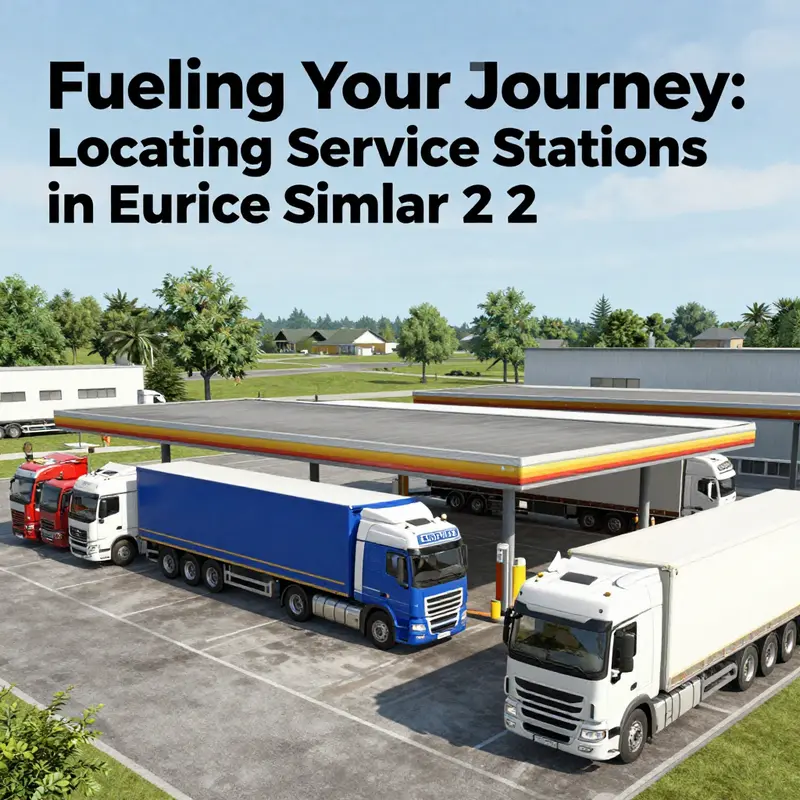
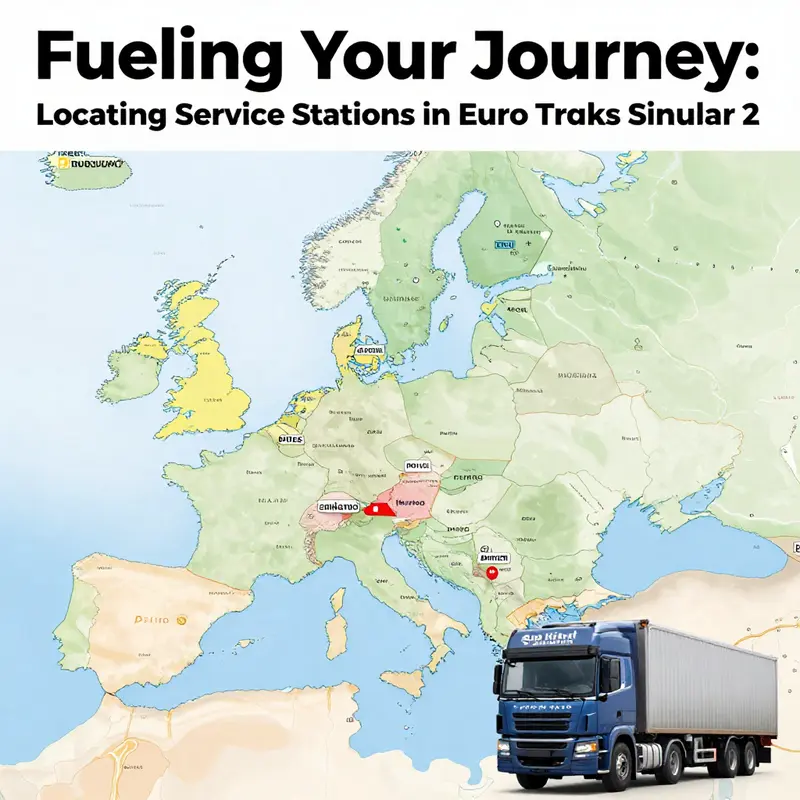
Across ETS2’s map, service stations are more than fuel points; they are waypoints that shape pacing, safety, and immersion. They provide fuel, repairs, showers, and rest, while aligning with the road network’s rhythms. In cities like Kiel, Graz, Madrid, and Bordeaux, stations anchor travel between urban cores and rural lanes, mirroring real European logistics corridors. Each station’s layout — fueling bays, parking, and repair bays — guides the flow of traffic and offers a believable, lived-in atmosphere. The Iberia expansion deepens this, adding Spain and Portugal with hand-placed stations that balance scale and intimacy, from compact depots to large truck parks with showers and eateries. Together, they reinforce the idea that the road is a world of interlocking hubs rather than a single line.
null
null
Refueling the Road: How Service Stations Shape Every Euro Truck Simulator 2 Run
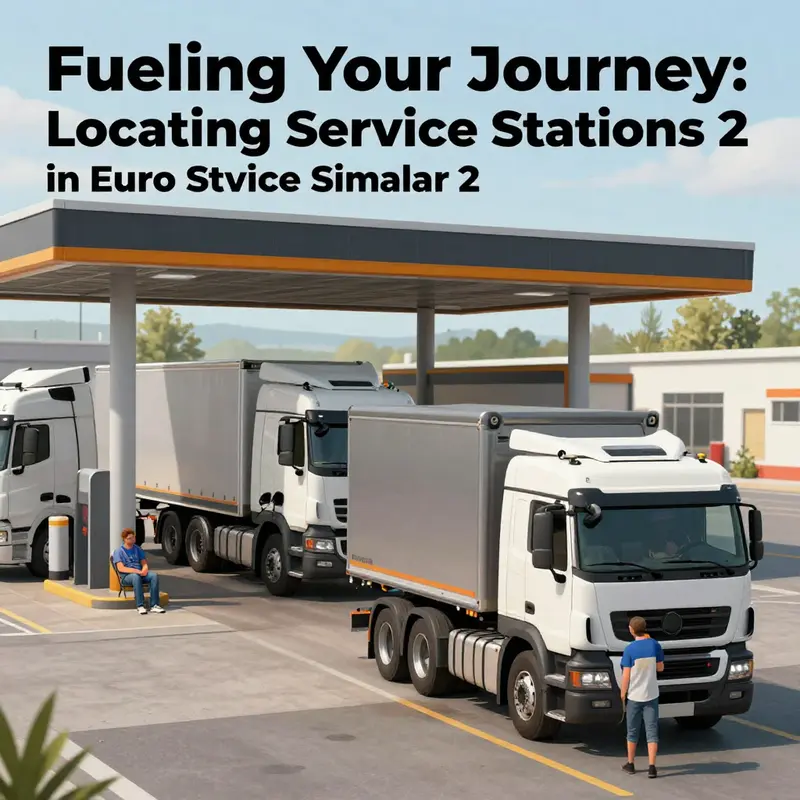
Service stations are more than a pause in the journey. In Euro Truck Simulator 2, they are the quiet anchors that keep a long-haul voyage from tipping into chaos. Across the map, from the rebuilt port cities to the sweeping high-speed corridors, these facilities sit at the heart of every route. The game places them in a way that mirrors real-world logistics: near major hubs, along well-traveled arteries, and in places where a driver can switch from freight planning to operational precision in the space of a few clicks. In the reworked Kiel area, for example, players discover a service station tucked into the market zone, adjacent to a supermarket depot that echoes the real-world logic of supply chains threaded through urban landscapes. In Graz, Austria, a service station sits near the garage, a small, practical reminder that maintenance and storage are two sides of the same coin. And beyond the central European spine, Kristiansand in Norway adds a northern nod to the network, while Lyon, Nantes, Clermont-Ferrand, and Bordeaux in France populate the map with industrial districts and urban rhythms that demand timely refueling and quick repairs. Madrid and Porto further emphasize a continental lattice where service stations act as waypoints along major highway corridors, letting a trucker stretch a long day into manageable segments rather than an endless horizon. These locations are not random accidents of scenery. They are deliberate waystations, placed to reflect the realities of cross-border trucking and the practical needs of a driver chasing on-time deliveries across hundreds of kilometers.
The real-world logic inside the game is reinforced by a sense of scale. A service station is not just a place to fill a tank; it is a node in a broader logistical network. The proximity to large transport hubs and freight depots in the virtual map mirrors how real fleets schedule refueling and maintenance in concert with cargo windows and port operations. Players quickly learn to treat these stops as strategic decisions rather than casual pit-stops. A well-timed refuel can mean arriving at a drop-off with time to spare, while skipping a necessary check can cascade into fatigue, delayed shipments, and penalties that ripple through the entire journey. Even the simplest actions—fueling, quick checks, or a rest break—are not just chores. They are essential controls in the wheelhouse of a driver who must balance speed with safety, efficiency with reliability, and personal stamina with the clock of global commerce.
Maintenance and repair rise to prominence alongside fuel in the clinic of the highway. Service stations act as the first line of defense against wear and tear. In the game, tires wear, engines cough, and seemingly minor ailments can escalate into breakdowns if left unattended. The routine check at a station helps prevent engine failures mid-mission, which would otherwise drain time, money, and morale. This mechanic mirrors the real world where preventative maintenance is a cost of doing business, not a luxury. Players who neglect the upkeep soon discover that a long route from Kiel to Madrid is not just a matter of distance but of the truck’s readiness to endure the strain. The message is clear: stay proactive with maintenance, and the road remains navigable. The digital world rewards prudence with smoother rides, steadier fuel economy, and fewer surprises at the edge of a map that keeps expanding with each update.
Fuel refueling is the most obvious service, yet it is also the most consequential. A truck without enough fuel cannot complete a delivery, and a missed refuel can turn a straightforward assignment into a logistical headache. Service stations give players the essential tool to keep the mission on track: the fuel gauge becomes a decisive element of route planning rather than a mere background indicator. The game’s map design nudges drivers toward efficiency by aligning fuel stops with high-traffic corridors and corridor-ready towns where refueling opportunities are plentiful. This is especially visible in the Madrid and Nantes corridors, where multiple stations line the routes, allowing players to divide long journeys into manageable legs. Regular refueling translates into fewer detours, more predictable arrival times, and a steadier cash flow—critical for investors who want to grow their fleets, or solo players who want to see more of Europe with fewer disruptions.
Rest breaks, though they appear as a simple pause, are a crucial engine of the game’s rhythm. Fatigue management in ETS2 is not about a health meter; it is about balancing the driver’s stamina with the vehicle’s performance and the schedule. Service stations provide the practical space for rest, hydration, and a mental reset. The HUD reminders subtly push players toward responsible pacing, echoing real-world regulations that emphasize safety and compliance. Each rest break is a reminder that the driver is not just moving a cargo; they are stewarding a fragile schedule. When a driver prioritizes rest, the journey is smoother, the next leg feels sharper, and the possibility of error recedes. In short, rest breaks at service stations are not optional add-ons; they are strategic moves in a game designed to reward disciplined planning.
Beyond the obvious services, these hubs connect players to a wider ecosystem of gameplay features. The service-station interface doubles as a gateway to in-game services and choices that shape the broader career arc. For instance, the Online Purchase feature—where players can buy new trucks directly from the map—requires owning five trucks first, a milestone that elevates the stop from convenience to a strategic waypoint in fleet-building. This mechanic reframes the journey as a growing enterprise rather than a solitary odyssey, encouraging players to plan a gradual fleet expansion, optimize each vehicle’s role, and reuse the same network of stations to support a resilient operation. It is a reminder that every stop has a purpose beyond the moment: it is a node in a larger plan to scale, diversify, and sustain a trucking enterprise.
Multiplayer adds another layer of depth to the service-station experience. In persistent-world servers, players converge at these hubs to coordinate deliveries, swap tips, or simply enjoy the European scenery together. The social dynamic at stations mirrors real-world camaraderie on long-haul routes: a shared space where pilots exchange route notes, discuss traffic conditions, or find a quiet corner to plan the next leg. The possibility of meeting up at a station turns a routine refuel into a social checkpoint, where relationships and reputations form as steadily as fuel levels. Communities often organize around these shared spaces, using dedicated server hosts to keep their virtual networks alive. In this sense, service stations become not just logistical points but social anchors that bind the road-tripping community.
Technology expands the station’s role further still. Mods and open-source tools convert these stops into data-rich experiences, transforming routine refueling into a diagnostic session. Projects that stream real-time telemetry into mobile dashboards let players monitor speed, fuel levels, cargo status, and route progress from a device in-hand. What starts as a simple fuel-up evolves into a micro-analytics moment, a chance to verify performance, confirm route plans, and adjust strategies on the fly. This evolution—from a practical refuel to a data-informed decision point—speaks to the broader evolution of ETS2 as a driving sim that rewards players who blend traditional trucking skills with modern technology. Even as players enjoy the scenery of the rebuilt Kiel market zone or the industrial lanes of Lyon, the station remains a workbench for planning, a control room for the road.
The world of service stations in ETS2 is also enriched by the broader modding ecosystem that mirrors the real industry’s appetite for authenticity. Real-world brands and gas stations appear in mods that players install to heighten the sense of immersion. While the base game keeps a clean, fictional branding, mods offer a window into a more granular simulation where trucks encounter recognizable logos, fuel types, and depot layouts. This layering adds texture to the map, encouraging players to approach each city with an eye for the logistics choreography that keeps European supply chains humming. Yet even with these enhancements, the core mechanics remain faithful: stations are the pivotal moments when a driver refuels, repairs, and rests, and where strategic decisions about timing, maintenance, and fleet growth crystallize into measurable outcomes.
A note on the changing landscape of the map and the information players rely on. Updates like the 1.58 patch bring user-interface refinements that change how service stations are accessed and how information is displayed while on the road. The Germany Rework update reshapes regional logistics hubs and urban cores, which can shift the density and placement of stations along key routes. Players who want to stay current should check official announcements and community forums for the latest map changes, as these updates subtly recalibrate the best fueling and maintenance strategies across the continent.
In sum, service stations in Euro Truck Simulator 2 are not incidental stops but essential, multi-faceted elements of the virtual trucking economy. They are the places where fuel, maintenance, rest, fleet management, social interaction, and even data-driven optimization converge. They anchor routes through a vast and evolving map, guiding players to plan smarter, drive safer, and build more resilient operations across Europe. The next time a driver appears at a station in Nantes near a busy industrial district or pauses at a calm forecourt in Porto by the docks, it is worth remembering that such moments symbolize more than a refuel. They symbolize the art of keeping the road alive—one well-timed stop at a time.
For readers seeking additional context on official updates to the game and additional map changes, see the developer’s latest announcements and resource hub at https://www.scssoft.com.
Fuel, Time, and Tarmac: The Subtle Economics of Service Stations in Euro Truck Simulator 2
Every long-haul journey in Euro Truck Simulator 2 is a careful balance between momentum and pause. The road may stretch endlessly across a continent, but the clock and the wallet impose constant constraints. Service stations, placed at strategic points along highways, in city markets, and near major freight hubs, are more than just pit stops. They are the quiet engines of a player’s micro-economy, the nodes where fuel, maintenance, and rest converge to determine profitability and pacing. In this virtual world, the economic impact of service stations emerges not from grand macroeconomic models but from a disciplined, almost logistical arithmetic that mirrors the day-to-day decisions faced by real truckers. The game doesn’t pretend to simulate inflation or GDP growth in a living economy; instead it recreates the frictions and costs that make or break a profitable run. Fuel costs, downtime for maintenance, fatigue management, and the time spent waiting at a station all become levers that shape the bottom line. Each choice—where to refuel, when to repair, how long to rest—shapes the margins the player can claim from a given freight assignment.
The distribution of service stations across Europe in ETS2 reflects the practicalities of real-world logistics. They cluster near major transport corridors and freight depots, along routes that see heavy, sustained traffic. Take Kiel in the reworked German map, where the market zone now houses a service station integrated with a supermarket depot; such design nudges players toward a stop that serves multiple needs in a single moment. Graz, in Austria, features a service station conveniently close to the local garage, a small but meaningful alignment that reduces the total time spent on routine upkeep. Kristiansand in Norway and Lyon in France expand the network’s reach into northern and central Europe, reminding players that long trips may weave through diverse regulatory environments, maintenance norms, and fuel price landscapes. Nantes and Clermont-Ferrand hint at how urban and peri-urban layouts shape refueling strategies, while Bordeaux’s industrial districts and Madrid’s highway-adjacent clusters illustrate a pattern: service stations thrive where freight traffic concentrates, and where transit routes funnel goods through critical bottlenecks.
These locations matter not because they alter the rules of the game, but because they alter the player’s expected costs and schedules. Fuel is a recurring expense that, in the world of ETS2, is both a resource and a strategic variable. A truck that consumes more fuel per kilometer will need to factor refuel stops more often, and the price at each stop can swing the economics of an entire leg. The variable pricing across Europe—where a tankful in Germany may differ from a fill in Romania, for example—adds a layer of route planning that rewards foresight. Players learn to forecast fuel needs across a day’s worth of driving, choosing routes that minimize expensive detours while still satisfying delivery deadlines. The UI changes introduced with patches like 1.58, which restructured how information is presented to the player, further illuminate these choices. When a station’s price, availability of maintenance services, or potential wait times are surfaced more clearly, the player can make near real-time decisions about whether to stretch to a cheaper station farther along the highway or to stop sooner for a quicker turn around.
Maintenance and repairs, once the quiet afterthoughts of a long drive, become visible as a recurring cost center at service stations. A truck can roll in for a routine oil check, tire inspection, or a minor repair that could avert a more expensive breakdown later on the road. The game’s maintenance options, while simplified, introduce a discipline: the longer a vehicle remains in serviceable condition, the higher the reliability and the fewer hours of downtime that cut into billable driving time. In practice, this means players will sometimes trade a minor, immediate expense for a smoother route ahead. The design intention behind these decisions is not to punish players for taking a break, but to reward disciplined budgeting and route thinking. It mirrors how real fleets balance preventative maintenance with trip planning to reduce the risk of expensive roadside repairs or schedule slips that could cost penalties or late fees for deliveries.
Rest is another subtle but important factor. Service stations are, in part, rest hubs where fatigue management intersects with profitability. Driving while fatigued not only reduces safety ratings in the game but also constrains the length of the upcoming driving window. A well-timed rest at a nearby station can reset the clock for the next leg, enabling longer, more efficient stretches of highway driving. The practice aligns with industry wisdom from the real world: efficient operations rely on systematic breaks that keep drivers alert and cargo moving. In ETS2, the consequence of poor fatigue management is more than a safety score; it is tangible efficiency loss, potentially causing delays that ripple through a week’s worth of deliveries. Players quickly feel how a single missed rest opportunity can cascade into missed deadlines, higher fuel costs due to speed penalties, or increased wear on tires and engines that require more frequent stops.
The microeconomics of ETS2’s service stations also teach a broader lesson about infrastructure and its role in trade. Even though the virtual economy doesn’t model large-scale indicators like inflation, the tangible experience of planning around fuel and maintenance shows how infrastructure quality and pricing shape everyday decisions in real logistics networks. Players notice that certain corridors have denser clusters of stations, which smooths the flow of goods by reducing the risk of getting stranded far from a refuel point. Conversely, stretches with sparse coverage force more careful budgeting and sometimes longer detours that increase travel time and fuel consumption. In this sense, service stations function as a proxy for the resilience of a supply chain: their distribution, pricing, and service variety influence the efficiency with which freight can move from corridor to corridor.
Beyond the core gameplay loop, the community has amplified the realism by introducing mods that bring real-world brands and station networks into the game. These additions heighten immersion by aligning in-game fueling options with recognizable brands and layouts. The effect is not simply cosmetic; it deepens the learning experience by highlighting how brand placement, service availability, and logistical convenience can shape routing behavior. Yet the underlying economic logic remains consistent: stations with better service offerings and more favorable pricing create more favorable driving conditions, enabling players to complete more deliveries on time and with lower total fuel and maintenance costs.
The experience also serves as a gentle primer for readers who want to understand the connection between infrastructure placement and regional commerce. The presence of service stations near major highways and freight depots demonstrates a practical principle: reliable refueling and timely maintenance sustain the continuous flow of goods. This continuum—from loading dock to distribution center to highway refueling point—mirrors how real economies rely on well-distributed, service-oriented infrastructure to keep trade moving. In ETS2, the player becomes a proxy for this system, experiencing how every stop, every repair, and every rest break contributes to the ability to deliver on time, to stay profitable, and to keep the virtual wheels turning.
The chapter intentionally avoids overreaching into grand theory and instead stays with the concrete, experiential logic of the game. It is in the humble service station that the game’s most practical economics reveal themselves: the cost calculus of fuel, the value of maintenance, the strategic timing of rests, and the routing choices that emerge when every mile is a cost and every minute of downtime is a potential penalty. The result is a learning environment where players cultivate a disciplined approach to budgeting and route optimization without ever needing a textbook. The lessons resonate beyond the screen, offering a basic template for how real-world logistics balances efficiency with reliability, how drivers and fleets negotiate fuel markets, and how infrastructure quality can make or break a delivery schedule. For those drawn to the craft of planning and the art of keeping goods moving, the service station is less a convenience and more a critical instrument in the orchestra of modern freight.
For further context on the game’s mechanics and design philosophy, see the official ETS2 resource: https://www.eurotrucksimulator2.com/.
From Scandinavia Overhauls to a Smarter Route: The Evolution of Service Stations in Euro Truck Simulator 2
Service stations in Euro Truck Simulator 2 are more than pit stops; they are reliable waypoints that sustain long-haul careers across Europe. You refuel, you rest, you check your truck, and sometimes you grab a bite or a quick wash to keep the miles rolling. Over the years, SCS Software has treated these nodes with care, evolving their placement, density, and character to feel like real-world hubs rather than generic markers. The most dramatic shifts come from major updates that reorganize how stations are placed and how you interact with them. This chapter tracks those shifts, focusing on the 1.57 Scandinavian overhaul and the 1.58 Route Advisor redesign. It explains how the latest changes affect where you find a service station and how you plan longer journeys around the map’s expanding horizons.
With the 1.57 update, the Scandinavian region received a thorough refresh. The map gained new rest areas and fuel stations across Denmark and Sweden, turning a handful of convenience stops into practical refueling points. For players traveling through this neck of Europe, the additions translate into shorter detours and more consistent access to fuel, repairs, and quick checks between cities. The new facilities sit near key corridors and hubs, making them logical anchors in long routes rather than arbitrary pauses. Among the most notable inclusions are Aarhus in Denmark and Karlstad in Sweden, both integrated into a rebuilt road network that features bespoke intersections rather than plain prefab junctions. The result is a smoother, more believable drive on busy European routes, where service stations nod to real-world traffic patterns around freight depots and industrial zones.
Beyond distance and density, 1.57 also sharpens the stations’ identity. Each stop gains more defined layouts, bigger parking areas, easier entry points, and clearer signage tailored to the flow of approaching traffic. This matters because players often revisit a station during a single trip or across multiple runs, and the feel of the place reinforces planning. A station placed near a port district or an industrial park becomes a credible waypoint for cargo chains that loop through major logistics nodes. The Kiel rework in Germany and the northern expansion in Scandinavia illustrate how updates move from cosmetic tweaks to fundamental map logic. Stations become integral to the journey’s rhythm, not just a stopover between cities.
To place this in a broader context, ETS2’s service network has long clustered around large cities and freight corridors. The initial map portraits—Kiel, Graz, Kristiansand, Lyon, Nantes, Clermont-Ferrand, Bordeaux, Madrid, and Porto—show how hubs align with major transport activity. In Kiel the market zone gains a depot connected to trucker services; in Graz proximity to the garage speeds maintenance; Kristiansand sits on Norway’s new routes; Lyon and Bordeaux anchor industrial zones on the French side; Madrid, Nantes, and Porto reflect the density on Spain and Portugal’s highway belts. These patterns persist, guiding players toward efficient routes that balance refueling with rest and cargo opportunities. Updates continue to preserve this logic while expanding the map, ensuring that a service station is a reliable marker on the way to your next cargo terminal.
Another thread is road design and accessibility. The 1.57 Scandinavian refresh includes custom-designed intersections that reduce awkward turns when pulling into a station. In practice, you arrive at a more forgiving entrance, park in a dedicated area, and exit without impeding heavy traffic. Copenhagen’s rebuilt city center further ties service stops into a modern urban fabric, while Aarhus and Karlstad anchor fresh stops on the periphery. The combined effect is a network that feels coherent and navigable, where you can count on finding fuel and rest with predictable ease rather than hunting for a vague icon on a distant corner of the map.
On the software side, the 1.58 update shifts how you engage with these stops without altering their geographic footprint. The Route Advisor—ETS2’s trip-planning companion—receives a redesign that emphasizes clarity and customization. You can place informational widgets where you want them and monitor fuel, rest, and route progress at a glance. Context-sensitive prompts guide players toward available rest or refueling options during driving, reducing the cognitive load for new drivers while preserving depth for veterans. The improved tutorial system now points players toward rest areas and fuel stops at meaningful moments in a journey, so you learn by doing rather than by memorizing a checklist. This is not a wholesale interface makeover; it is an incremental enhancement that makes long trips feel more manageable and less mechanical.
Visual fidelity supports usability as well. HDR lighting enhances signage at service stations, turning price boards and canopy lighting into crisp, legible landmarks as you approach at dawn or dusk. The effect goes beyond aesthetics; it helps you orient yourself at a glance on a congested highway, deciding whether you should stop now or push on to a preferred depot. The increase in brightness and color range translates to fewer misreads and a more confident pull into the pump lane. In short, you see more of the station’s character before you even step on the brake, which makes the choice to stop feel intentional rather than routine.
Community modding also shapes how players experience service stops. Many players install add-ons that introduce more authentic logos and station aesthetics, transforming stops into recognizable real-world analogs. Even when licensing constraints keep brands fictional, the heightened realism deepens the sense of place. A station becomes part of a city’s workflow, not just a decorative waypoint. For players who love cargo realism, this matters: the station you choose can influence route efficiency, wait times, and fatigue management in subtle but meaningful ways. The update trajectory—from new Danish and Swedish stops to refined interfaces and lighting—builds a foundation that mods can further expand, ensuring that ETS2 remains a living map where small details accumulate into convincing journeys.
Looking forward, the ongoing interplay between a richer service network and new horizons in Northern Europe suggests a bright future for practical driving in the game. The upcoming DLC promises to push the map into novel coastal and inland routes, and the groundwork laid by 1.57 and 1.58 ensures fresh stations will fit into a coherent system from day one. For players, this translates into fewer moments of guesswork when plotting trips and more confidence in selecting a resting stop, a depot, or a port-side facility aligned with your cargo schedule. The network’s expansion is not just about more places; it is about smarter planning, better pacing, and a sense that every stop contributes to a more complete story of the haul you drive. In the end, service stations do more than refill your tank—they anchor your journey, turning miles into meaningful milestones.
For official patch notes and more details, see the SCS Software blog: https://www.scssoft.com/blog/ets2-1-57-update
Final thoughts
Understanding the significance of service stations in Euro Truck Simulator 2 enriches the player experience by keeping truckers informed about essential resources. With crucial locations identified, the importance of timely refueling and repairs recognized, and the impact of economic variables realized, gamers can navigate this expansive world more effectively. The recent updates related to service stations also ensure that players have access to the latest, most realistic settings. Going forward, make these stations a priority in your journeys to maximize efficiency and enjoyment as you haul cargo across Europe.