
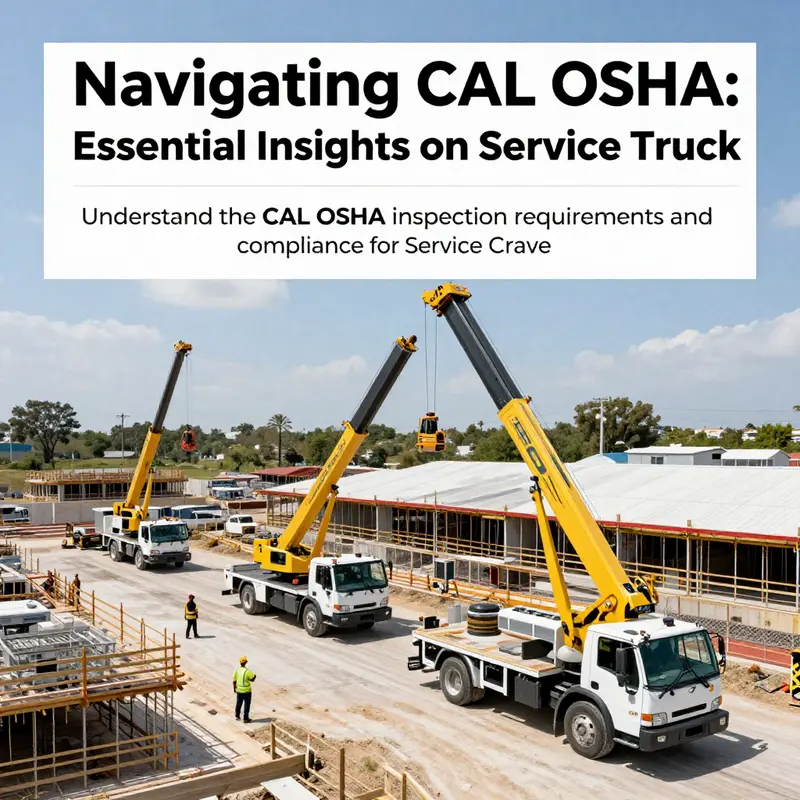
For professionals in trucking and heavy equipment, understanding CAL OSHA inspection requirements for service truck cranes is crucial. As service truck cranes are extensively used across various operations, ensuring compliance with safety regulations is a necessity. This article delves deep into the CAL OSHA’s role, federal OSHA regulations, certification and training for operators, and the implications of non-compliance. Each chapter will illuminate essential aspects that truck drivers, trucking company owners, fleet managers, and maintenance specialists must grasp to navigate the legal landscape effectively.
California’s CAL/OSHA Approach to Service Truck Cranes: Inspections, Certification, and Safety
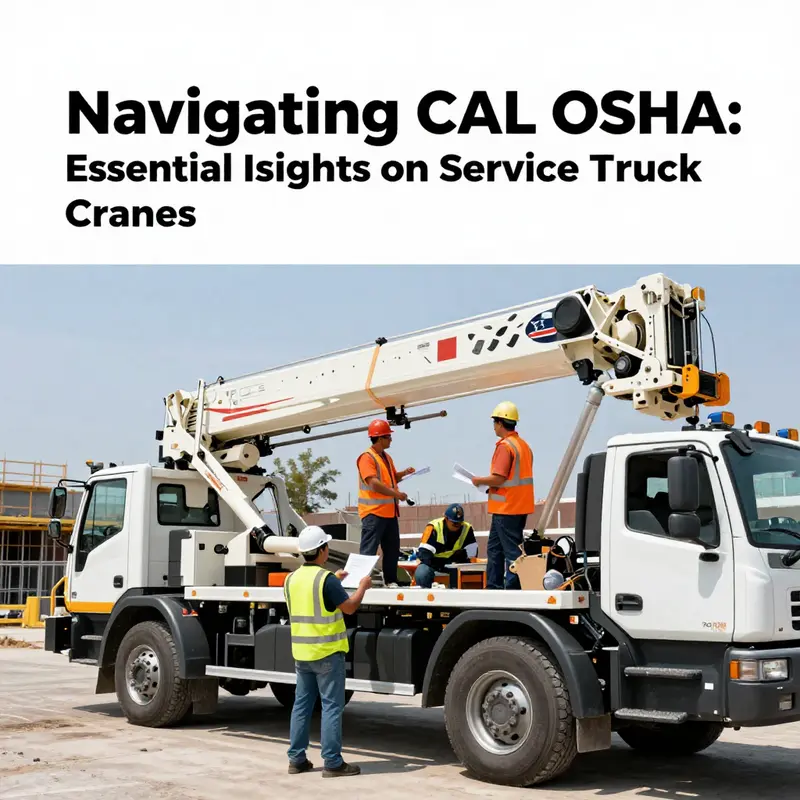
California operates under a regulatory framework that builds on federal crane standards while adding state-specific expectations for service truck cranes (STCs). STCs are typically mobile cranes mounted on service or utility trucks used for maintenance, repair, and emergency response. California’s enforcement emphasizes a continuous cycle of inspections and documentation, beginning with daily pre‑operational checks by a qualified person, followed by periodic (monthly and annual) inspections by a competent person, with all records kept readily accessible on site. The base federal standard provides the foundation, but CAL/OSHA augments it with considerations tied to California’s work conditions, climate, and fleet diversity, resulting in a robust inspection culture and an emphasis on operator competence. In practice, there is no separate “CAL/OSHA inspection” for STCs; instead, compliance rests on a layered program: pre‑shift checks, periodic examinations, and validated operator certification, all supported by written records. The pre‑operational check should confirm the crane’s hoisting mechanism movement, wire rope condition, sheave integrity, outriggers and pads, and safety devices such as load moment indicators and anti‑two‑block systems. Documentation must identify the qualified person, date and time, and any defects found and corrected before operation. Periodic inspections examine structural components, mounting connections, hydraulic and electrical systems, control stations, and safety devices, with checks aligned to manufacturer specifications and CAL/OSHA guidance. Operator certification must cover service truck cranes or equivalent mobile cranes through a nationally recognized program. Onsite records provide the evidence inspectors rely on and help build a proactive safety culture. Management should embed these practices into daily routines, ensuring timely repairs, clear lines of responsibility, and ongoing training so that a compliant program remains current. Readers supervising fleets that cross state lines should consult CAL/OSHA materials for the latest interpretations, as requirements may differ from federal OSHA. In short, safety comes from disciplined pre‑operational checks, preventive maintenance, verified operator competence, and transparent documentation that keeps STCs operating within safe limits on California roads and job sites.
Under the Hook: Federal OSHA Rules and CAL/OSHA Oversight in Service Truck Crane Operations
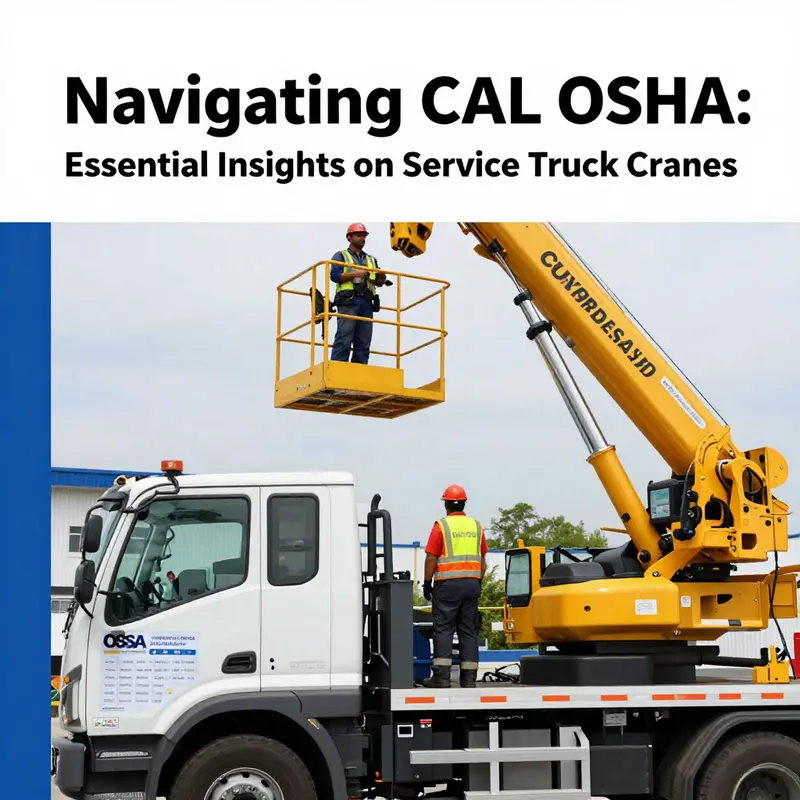
On a worksite, the service truck crane is more than a machine; it is a point of risk and responsibility. This chapter explains how federal OSHA rules and CAL/OSHA oversight shape who may operate a service truck crane, how it is operated, and how equipment is prepared for use. The federal framework rests on 29 CFR 1926.550 (Cranes and Derricks) with requirements for training, certification, and ongoing evaluation. An employer must verify competency through formal training, documented qualification, and periodic requalification before the operator may lift. For service truck cranes, where driving and lifting responsibilities combine, both driving and lifting competencies must be established in a single operator or tightly coordinated team.
Pre-operational inspections are the daily sentinel: check structure, controls, hydraulics, wire rope, hooks, tires/undercarriage, outriggers on level ground, and safety devices. Documentation of findings is required and any defect can mean removing the crane from service. Load testing confirms the crane can lift within its rated capacity under defined conditions and is documented in maintenance records. Signaling and clear communication between signal person and operator reduces risk in confined spaces. Operators must follow manufacturer specifications and load charts; attempting to exceed limits increases the likelihood of failure.
California adds its own enforcement and reporting nuances. Cal/OSHA generally aligns with federal standards but imposes state-specific requirements for training timelines, inspections, and recordkeeping. A California employer must meet both sets of expectations, ensuring operator qualifications, pre-use inspections, load testing, signaling, and adherence to charts are thoroughly documented. In practice, this creates a robust safety net that supports safer operations while requiring diligent recordkeeping and proactive planning.
Practically, compliance means well-documented training and renewals, a daily inspection routine, validated load testing, a clear signaling protocol, and a formal lift plan for each job. It also means management investing in safety through training programs and maintenance planning, recognizing that a safer workforce reduces downtime and injury risk. External resources, including OSHA’s cranes and derricks portal, provide guidance and updates to keep practice aligned with evolving standards.
Certified Confidence on the Boom: How OSHA Certification Shapes Service Truck Crane Use in California
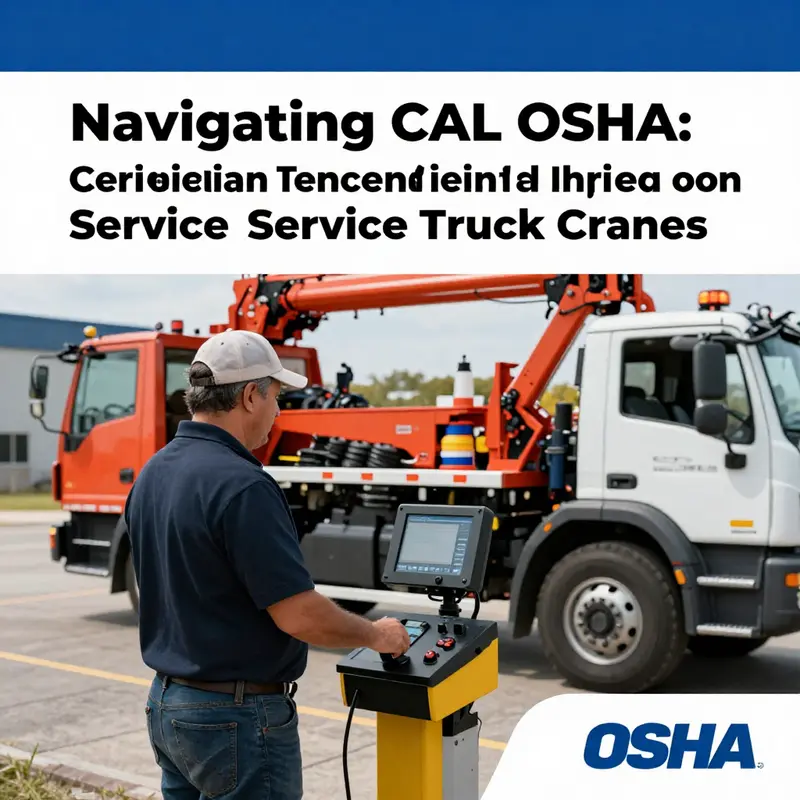
The question of CAL/OSHA inspections for service truck cranes often surfaces in conversations about compliance, bidding, and day-to-day safety. Yet the materials guiding this chapter point to a simpler, more foundational truth: safety hinges on who operates the crane and what they can do, not on a standalone inspection tally. California’s CAL/OSHA program exists alongside federal OSHA, but the provided research materials do not declare a unique CAL/OSHA inspection requirement specific to service truck cranes. Instead, the central regulatory emphasis described is on operator qualification. In practical terms, OSHA’s framework requires that crane operators be qualified to operate the equipment safely, and that qualification is supported by formal training and a documented evaluation. This means employers must ensure operators can demonstrate the knowledge and skill needed to perform tasks correctly and safely, under the conditions encountered on their worksites. The focus, then, is less about counting inspections and more about ensuring that every operator has been prepared, tested, and deemed competent to handle the particular crane in use. When a company chooses to operate service truck cranes, it is making a commitment to a standard of practice where competence is the gatekeeper to entry on the controls. The exact regulatory language, while not reproduced here, frames this as a qualification issue. The consequence for practice is clear: organizations should invest in robust training programs, formal and documented evaluations, and a clear record of operator qualifications that can be presented during audits, project kickoffs, or regulatory reviews. In this light, a CAL/OSHA inspection requirement, if present, would be part of a broader enforcement pattern that looks at overall safety program maturity. The absence of a stated CAL/OSHA inspection mandate in the supplied materials does not diminish the importance of contemporaneous state considerations. California employers, in particular, should remain mindful of state labor regulations that govern how safety programs are implemented and documented, alongside federal OSHA standards. The overarching goal remains the same: operators who can prove their capability to operate service truck cranes safely are the core element of safe performance, compliance, and productivity on site. The practical implication is straightforward: if your organization deploys service truck cranes, your priority should be to establish and maintain an enduring system of training, testing, and certification that can withstand scrutiny from inspectors, customers, and internal safety managers alike. The chain of evidence that demonstrates operator readiness—training records, evaluation notes, and certification credentials—becomes the most tangible indicator of compliance and safety culture on the ground. In this context, the role of certification programs emerges as a pivotal accelerator of safety outcomes. The materials reviewed highlight that the National Commission for the Certification of Crane Operators, commonly known as a nationally recognized certification program, offers formal pathways for operators who run service truck cranes. Although the provided overview notes NCCCO as a widely adopted credentialing route, the essence remains consistent across sources: a certification signals that an operator has completed structured training and passed practical assessments that verify safe performance. The emphasis on certification is not merely bureaucratic; it is a concrete signal to project managers, foremen, and safety officers that the operator has demonstrated the capacity to manage the risks associated with a service truck crane. The chapter’s core takeaway is that compliance in this space is built on qualification, not simply on the existence of an inspection regime. That said, the regulatory environment is not static, and responsible employers apply a dual approach: meet or exceed federal OSHA standards for operator qualification, while remaining attentive to California’s state-specific requirements that may impose additional expectations on recordkeeping, training cadence, or oversight structures. When a company integrates a formal certification track into its workforce, it gains a reliable mechanism to manage risk and to communicate competence across teams and sites. The practical value of certification extends beyond regulatory alignment. In many markets, including regions with high demand for service crane work, widely recognized credentials provide a common standard that contractors, clients, and insurers can trust. Certification can also streamline workforce planning, because managers know they are drawing from a pool of operators who have demonstrated mastery of essential skills through validated assessment. The training landscape described in the sources involves both classroom instruction and practical evaluation, ensuring operators do not merely memorize procedures but also apply them under simulated or controlled field conditions. The NCCCO pathway, as highlighted, combines theoretical understanding with hands-on competence, a combination that helps operators manage complex tasks—ranging from equipment setup and stabilization to precise control of loads and alignment—under real work conditions. It is worth noting that the certification itself is not a one-time hurdle. As equipment, procedures, and safety standards evolve, certification programs often require periodic recertification or ongoing renewal to maintain credential validity. This dynamic reinforces a culture where operators stay current with industry best practices rather than resting on an initial credential. In this sense, the chapter’s narrative on training and certification under OSHA becomes a broader advocacy for continuous professional development. Employers should view certification not as a checkbox, but as an investment in workforce capability that yields long-term safety payoffs, fewer incidents, and more predictable project outcomes. The chapter’s research results also point to practical resources for readers seeking current guidance. For anyone who wants up-to-date information on training and certification requirements—including exam schedules and accredited training providers—the NCCCO’s official site provides authoritative guidance and access to recognized programs. While the chapter keeps a focus on the safety and regulatory dimensions, it is also mindful of the broader ecosystem of knowledge that supports responsible crane operation, including ongoing maintenance, job hazard analyses, and operator readiness. Within this framework, the connections between operator qualification and safe practice become clearer and more actionable. The relationship between training, evaluation, and certification forms a continuum: training builds knowledge, evaluation validates skill, and certification signals competence to perform work with service truck cranes. This continuum aligns with OSHA’s intent to ensure operators who work around heavy lifting equipment can perform their duties with minimized risk to themselves and those around them. In California, this continuum also dovetails with state-specific expectations. While CAL/OSHA may not articulate a distinct inspection requirement for service truck cranes in the materials we considered, it is prudent for employers to harmonize federal standards with state mandates. A practical approach is to document operator qualifications with the same rigor as other safety records, to maintain current certification status, and to ensure that any site-specific procedures reflect both federal safety norms and California’s regulatory context. The result is a safety program that stands up to scrutiny, fosters a culture of professional accountability, and supports reliable crane operation across projects and sites. For readers seeking a broader perspective on how maintenance training intersects with operator readiness, consider exploring related content that discusses the importance of ongoing, disciplined maintenance training as part of a comprehensive safety program. This kind of integration reinforces the idea that certification and hands-on readiness are not isolated steps but a continuous loop that strengthens every link in the safety chain. As you plan training budgets, staffing, and project timelines, keep in mind that the central value of OSHA-aligned certification lies in the assurance that the people who raise, move, and lower loads are proven to do so safely, time after time. The choice to pursue a formal, recognized certification for service truck crane operators translates into tangible benefits: it supports regulatory alignment, enhances project credibility, and lowers the likelihood of incidents caused by operator error. In that light, the topic shifts from a technical checkbox to a strategic element of risk management, workforce development, and client confidence. Keeping these elements in view, organizations can design certification pathways that reflect their specific work environments, while maintaining consistency with national safety standards and state-specific expectations. In sum, the relationship between Certification and Training for Service Truck Crane Operators under OSHA is less about a CAL/OSHA inspection requirement and more about a robust, validated credentialing process. It provides a clear, actionable route for employers to ensure that those who operate service truck cranes are equipped to perform their duties safely and effectively. By embracing formal training, rigorous evaluation, and recognized certification, contractors and safety leaders build a stronger safety culture—one with demonstrable competencies, transparent records, and a shared commitment to safe crane operation on every job site. External resource: NCCCO certification information.
The Hidden Rules of Cal/OSHA: Do Service Truck Cranes Trigger Inspections and How Compliance Protects People
Questions about Cal/OSHA inspections for service truck cranes often come up in safety planning meetings. The short answer is nuanced: Cal/OSHA does not typically publish a blanket requirement that every service truck crane undergoes a stand-alone Cal/OSHA inspection. California enforces crane safety through a combination of state safety orders and the broader federal standards that govern crane operation. In practice, this means that the job site must be safe, the crane must be properly inspected and maintained, and the operator must be qualified. The absence of a standing Cal/OSHA inspection requirement does not grant an exemption from scrutiny. When compliance gaps exist, Cal/OSHA can and will cite hazards and enforce corrective actions, often with significant penalties. This reality places safety at the center of day-to-day decisions rather than in the realm of a single administrative checkbox. It also underscores why many employers invest in structured programs that align with both federal and state expectations, creating a durable path to compliant, safe lifting operations on diverse California job sites.
At the federal level, OSHA requires crane operators to be certified. This is a core element across crane types, including service trucks that feature a mounted crane. Certification is not the same as a one-time training; it is evidence that the operator has demonstrated knowledge of applicable load charts, signaling, and safe operating procedures. The National Certification Commission for the Construction and Crane Operations, NCCCO, offers a dedicated service truck crane certification path that many employers recognize as a credible standard. Even where Cal/OSHA applies, the federal standard remains a baseline. In California, the state enforces the same core safety principles but can intensify oversight through more frequent inspections or broader hazard analyses when hazards are identified. The result is a layered compliance landscape: pass the federal bar through certification, and then meet California’s expectations with disciplined process, documentation, and ongoing supervision. This dual framework helps organizations protect workers while navigating the realities of public safety oversight on busy job sites.
Given this regulatory frame, the question shifts from whether inspections exist to how inspection and maintenance activities are integrated into ongoing compliance. Daily pre-use inspections of the crane and its attachments are not optional; they are a practical, legally defensible practice that helps catch anything that could fail during lifting. These checks should cover critical components, such as the crane’s hydraulics, wire rope, hooks, limit switches, and outriggers, as well as the operating controls and emergency stop. Any defect, unusual noise, or abnormal movement should trigger removal from service until it is repaired by qualified personnel. Cal/OSHA’s enforcement actions tend to focus on whether such inspections were performed and whether deficiencies were addressed promptly. While there may be no explicit CAL OSHA inspection mandate for STCs, a failure to perform required inspections can be treated as a citation-worthy hazard. This is where practical safety culture—rooted in consistent, documented checks—meets legal accountability, turning routine maintenance into a powerful risk-reduction tool.
Beyond daily checks, there is a broader obligation to maintain records and ensure operator qualifications. OSHA requires operators to be certified, but California also expects employers to demonstrate a program that keeps training, testing, and re-certification up to date. The STC certification program offered by NCCCO is widely recognized because it tests familiarity with load capacities, working areas, and the signaling protocols that keep everyone safe during lifts. Such credentials are not mere paperwork; they are indicators that a worker understands how to interpret load charts, how to communicate with signal persons, and how to recognize environmental risk factors such as underground utilities and overhead lines. In turn, Cal/OSHA will scrutinize whether the employer has a process to verify ongoing competency, including recertification and practical performance checks on the job site. A robust program therefore combines certification with a live on-site evaluation, ensuring the operator can apply theory under real conditions while supervisors document performance against clear safety standards.
Non-compliance has consequences that go beyond the chance of a minor citation. The legal and financial stakes for employers can be substantial. Citations carry fines that scale with severity and whether violations are willful or repeat. Even a single, avoidable incident can trigger investigations, a mandatory corrective action plan, and increased scrutiny in subsequent inspections. In practical terms, non-compliance raises the risk of crane tip-overs, dropped loads, or electric hazards that injure workers and invite costly workers’ compensation claims and litigation. The reputational harm that follows a well-publicized accident or a Cal/OSHA citation can affect client relationships and recruitment, making proactive safety a strategic business choice as much as a regulatory requirement. California’s enforcement posture often emphasizes the seriousness of hazards and the need for timely remediation, and this dynamic reinforces the idea that compliance is a day-to-day discipline rather than a periodic exercise.
To mitigate these risks, employers should embed a layered, evidence-based safety program. Start with a clear commitment to training and certification that aligns with OSHA’s guidelines and California’s expectations. Alongside operator credentials, assign a competent person to manage the crane program, ensuring that equipment is suited to the work, properly loaded, and protected by exclusion zones during lifts. Equipment maintenance cannot be left to chance; it should be anchored in manufacturer recommendations and augmented by a formal inspection schedule that includes daily checks, periodic in-depth inspections, and annual evaluations by a qualified inspector. The emphasis should be not only on reacting to problems but also on preventing them by a proactive maintenance culture and robust supervision on the ground. A well-structured program also requires clear responsibilities, a well-documented plan for lifts, and a mechanism to review near-misses and incidents so improvements are embedded in the safety system rather than sidelined as administrative tasks.
Operationally, this means documenting every lift, keeping a log of inspections, and maintaining easy access to load charts, rigging configurations, and signal procedures. It also means designing work processes that anticipate hazards—such as avoiding lifts near power lines, establishing clear communication protocols between the operator and ground personnel, and creating exclusion zones that others on the site can recognize and respect. When uncertainty arises about a given lift—whether due to wind, visibility, or the crane’s condition—the safest choice is to pause and re-evaluate. A strong California crane program will routinely cross-reference federal standards with state requirements and will adapt to site-specific conditions, particularly on projects with unique hazards or restricted workspaces. This adaptive mindset is what allows a workforce to stay compliant while remaining productive, flexible, and ready to respond to changing field conditions without compromising safety.
From a practical standpoint, many organizations recognize that a rigorous training and maintenance cycle offers more than regulatory compliance; it improves uptime, reduces downtime, and sustains a safer work environment. This alignment between compliance and reliability is especially important for service truck cranes, which operate in dynamic settings where terrain, weather, and adjacent activities constantly change. Operators who hold valid credentials, who understand load capacities, and who follow well-documented procedures contribute to a culture of safety that benefits everyone on site. For teams building such a culture, a structured reference is provided by comprehensive maintenance training articles, like the one described in the internal link below. The emphasis on ongoing education helps ensure that crews stay current as equipment evolves and standards shift. The ongoing dialogue between training, field experience, and regulatory expectations creates a resilient safety system rather than a brittle compliance checklist, and it helps teams transform risk into predictable, controllable performance on every lift.
Lastly, the California regulatory landscape recognizes that safety is a shared responsibility. Employers must ensure that the workplace environment itself supports best practices—adequate lighting, stable ground conditions for outriggers, and the absence of nearby personnel during critical lifts. Workers, in turn, must follow established signals, stay alert to potential hazards, and report concerns promptly. When all these elements are in place, Cal/OSHA enforcement actions decrease, but the value of compliance remains high. The aim is not to avoid inspections but to create a work environment where inspections are routine checks rather than crisis responses. In this sense, the question of whether Cal/OSHA requires a separate inspection for a service truck crane becomes less about a specific checkbox and more about a continuous commitment to safety, training, maintenance, and accountability.
To explore practical steps and reinforce the idea that safety is built into everyday work, organizations can consult targeted resources in their field. For example, ongoing maintenance planning can be supported by informative articles on fire truck maintenance training, which emphasize the importance of routine checks, parts life, and technician readiness. This resource is accessible through the internal link: fire-truck-maintenance-training-importance. Maintaining the habit of reviewing such materials helps teams stay vigilant and prepared, even as equipment and tasks vary from one site to another. In addition, organizations should stay connected with official regulatory sources to ensure that practices remain aligned with current requirements. For official regulations, consult Cal/OSHA at https://www.dir.ca.gov/dol/cal_osha. This combination of training, documentation, and regulatory awareness creates a practical, forward-looking approach to service truck crane safety in California, where the goal is always to protect workers while delivering reliable service on the job.
Final thoughts
Understanding CAL OSHA’s requirements related to service truck cranes is essential for enhancing safety and compliance in your operations. By properly training and certifying crane operators and adhering to OSHA regulations, companies not only protect their workers but also safeguard their equipment and reputation. Remember, the costs of non-compliance can be severe, both legally and financially. Investing in compliance is investing in the future of your business.