
Do Service Trucks Need a DOT Number?
Mechanics, plumbers, electricians, landscapers, utility crews, towing operators, fleet managers, and owner-operators ask this constantly, and the answer is rarely a simple yes or no. What decides it is how the truck is configured, how heavy it is, and where it is driven — not the type of work it does.
A USDOT number is a unique identifier the Federal Motor Carrier Safety Administration (FMCSA) assigns to businesses that operate commercial motor vehicles. It ties a company’s vehicles and drivers to one compliance record, used for safety audits, crash and inspection reporting, and compliance reviews. Operating without one when it is required can bring civil penalties and can limit a company’s ability to work legally across state lines.
Three factors decide whether a service truck needs a USDOT number:
- GVWR limits — the vehicle’s gross vehicle weight rating, and the federal and state weight thresholds that apply to it.
- Crossing state lines — how interstate and intrastate operation differ.
- Exemptions — the operating conditions under which a truck may be exempt.
Below, each factor is worked through with the detail contractors and fleet managers actually need. Broader operational guidance is available from 5 Star Truck Inc.
What Is a USDOT Number, and Who Needs One?
A USDOT number is a unique identifier assigned to a business or individual that operates commercial vehicles. Regulators use it to track safety performance, roadside inspections, crashes, and compliance history under a single record. The FMCSA (Federal Motor Carrier Safety Administration), the federal agency responsible for commercial vehicle safety in the United States, issues and oversees it. You will also hear it called a DOT number; the two terms mean the same registration.
The FMCSA requirement applies to a commercial motor vehicle used in interstate commerce — meaning the vehicle crosses state lines, or carries goods, materials, or passengers that do, as part of your business. The rule follows how a vehicle is operated and used, not its type, brand, or appearance. A plain service truck and a box truck can both trigger it if they meet the criteria.
Generally, you need a USDOT number if your commercial vehicle:
- Operates in interstate commerce, and
- Meets certain weight thresholds based on its gross vehicle weight rating (GVWR), or
- Carries hazardous materials in a quantity that requires a placard, or
- Transports more than eight passengers including the driver for compensation, or more than 15 passengers including the driver, not for compensation.
What drives registration is weight and commerce criteria, not the color, size, or look of the vehicle. A modest service truck hauling tools across a state line may qualify, while a nearly identical truck that never leaves its home state might not.
What Is GVWR – and Why the 10,001-Pound Threshold Matters
Gross Vehicle Weight Rating (GVWR) is the maximum weight a single vehicle is designed to carry safely, as set by the manufacturer. It is not a suggestion or a target — it is an engineering limit built around the frame, axles, suspension, brakes, and tires. You will find it stamped on the driver-side door jamb and on the vehicle’s safety compliance label.
Because the manufacturer sets GVWR at the factory, it stays fixed for the life of the truck. Bolting on a heavier bed, welder, crane, or tank does not raise it; the extra weight simply eats into your remaining capacity. Once you know your rating, the next job is keeping the truck compliant and road-ready — the kind of quality service and reliability operators depend on.
Why DOT and FMCSA Care About GVWR
For commercial vehicles, GVWR is the number regulators care about most. The Federal Motor Carrier Safety Administration (FMCSA) uses it to decide who needs a USDOT number and who must follow federal safety rules.
The threshold is straightforward:
- A vehicle with a GVWR of 10,001 pounds or more generally requires a DOT number when operating in interstate commerce.
- Vehicles rated at 10,000 pounds or less often fall outside that requirement, though other conditions can still apply.
GVWR vs. the Other “Weights”
Operators mix these terms up constantly:
| Term | What it means |
|---|---|
| GVWR | Manufacturer’s maximum safe weight rating for the vehicle itself (fixed) |
| GVW | Gross Vehicle Weight – what the vehicle actually weighs right now, loaded (varies) |
| GCWR | Gross Combination Weight Rating – the manufacturer’s max for a truck plus trailer combined |
GVWR is a rating that never changes. GVW is a measurement that shifts with every load. A service truck with a 12,000-lb GVWR can roll out empty at 8,000 lbs and still fall under the rule, because the rule references the rating, not the actual weight. Check the door-jamb label first, then apply the 10,001-pound threshold to your own operation.
Interstate vs. Intrastate Operation: Why Crossing State Lines Matters
Location is the second factor. Where a truck operates is often the deciding line between federal registration and no federal registration at all.
What Is Interstate Commerce?
Interstate commerce is commercial activity that crosses state boundaries. Under federal rules, a vehicle operates in interstate commerce if it crosses state lines or transports goods, passengers, or materials across state lines — even when your own truck never leaves your home state. The nature of the shipment, not just the path of your vehicle, can put you in interstate operation.
Because this activity reaches beyond a single state’s authority, it falls under federal oversight. A qualifying commercial vehicle used in interstate commerce generally must register with the FMCSA and display a USDOT number.
What Counts as Intrastate Operation?
Intrastate operation is activity confined within a single state. Your truck starts and finishes its work inside one state’s borders, and the goods it carries stay within that state as well. These rules come from the individual state, not the FMCSA. Many states still require their own DOT number or a state-specific identifier, and their weight or use thresholds may differ from the federal standard.
The Practical Takeaway
If your service truck ever crosses state lines, or hauls goods that will, treat it as interstate commerce and plan for a USDOT number. If it stays entirely within one state, check your state’s own rules. Fleet operators who value quality service and reliability on the road watch both sets of rules. When in doubt, confirm your status directly with the FMCSA before you drive.
Exemptions and Exceptions: When the DOT Number Requirement Does Not Apply
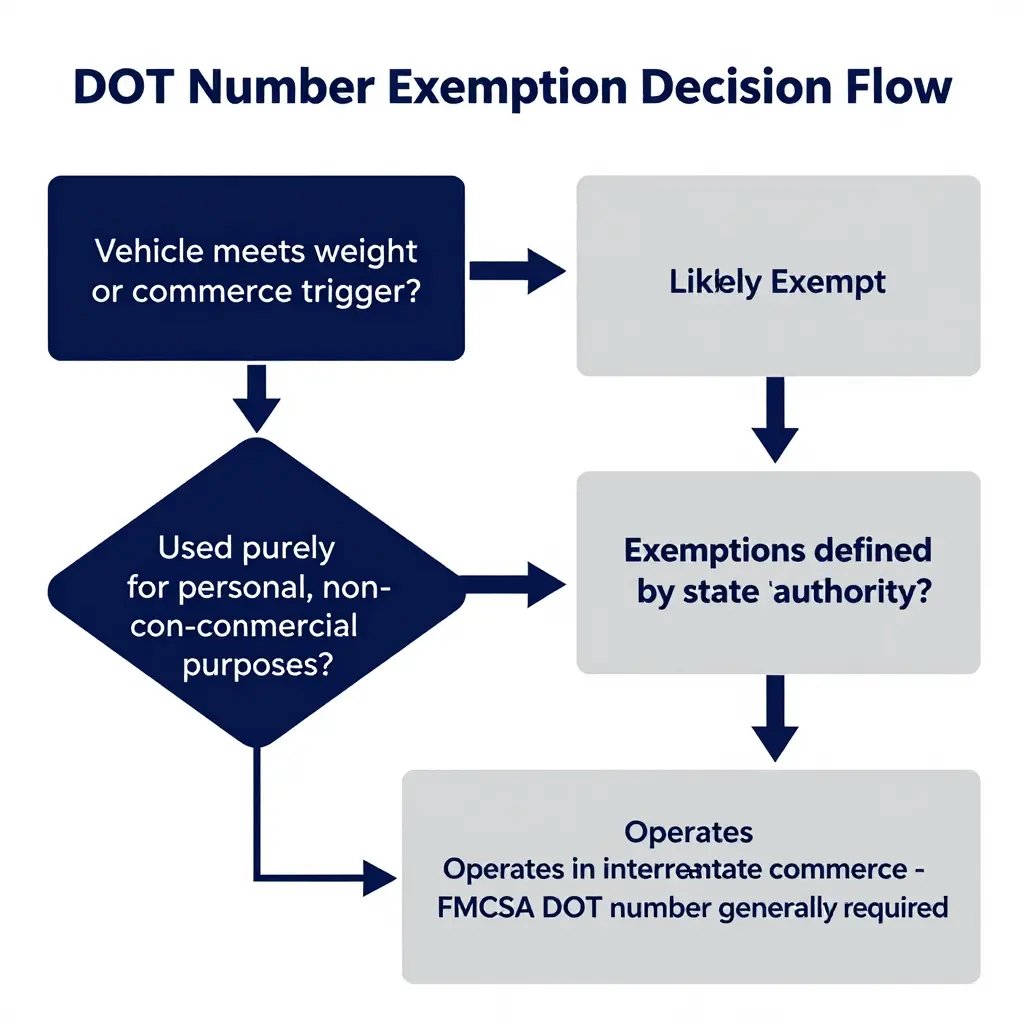
Even when a service truck meets a weight threshold or crosses a state line for business, certain exemptions can remove the federal DOT number requirement. They are narrow, conditional, and read strictly by regulators. Knowing them helps operators avoid both needless registration and costly compliance gaps.
The General Principle Behind Exemptions
The federal registration rule under the FMCSA applies to commercial vehicles operating in interstate commerce. Exemptions carve out specific activities that either fall outside that definition or that lawmakers chose to exclude. An exemption has to match your actual operating facts, not your intentions or occasional practice.
Purely Personal Use
Vehicles used strictly for personal, non-commercial purposes generally fall outside the DOT number requirement. If a truck never transports goods or performs services for a business and generates no commercial revenue, it typically is not engaged in commerce at all. This exemption depends on consistent, documented personal-only operation.
Certain Agricultural Operations
Federal law provides limited exemptions for specific farm-related operations. These hinge on the nature of the agricultural activity, the distances traveled, and whether the operation crosses state lines. They do not blanket-cover every truck used on a farm, so confirm the precise conditions before relying on one.
Intrastate Operations Under State Thresholds
A truck that never leaves a single state operates in intrastate commerce, not interstate commerce. For these vehicles, the DOT number requirement and its exceptions are defined by the specific state authority rather than the FMCSA alone. Many states set their own weight and use thresholds, meaning a truck that would need a federal number in interstate operation may be exempt within state lines, or vice versa. Confirm your state’s rules.
Why These Exemptions Are Narrow
An exemption rarely survives a change in how a truck is used. One interstate trip, a load of commercial cargo, or a weight above a state threshold can end it. Document your operations and verify your status with the relevant authority.
Several conditions may exempt a service truck from a USDOT number, and reviewing them quickly can save time and paperwork:
- Personal Use Only – A truck driven strictly for non-commercial, personal purposes generally falls outside DOT number requirements.
- Under 10,001 Pounds GVWR – A vehicle rated below the federal weight threshold is not a commercial motor vehicle under that test, whether it operates across state lines or within one.
- Intrastate Operation – Staying within a single state and meeting that state’s lower weight or commerce threshold can remove the federal DOT number obligation.
- Covered Farm Vehicles – Trucks used in agricultural operations within specified mileage limits may be exempt.
- Government-Owned Vehicles – Vehicles operated by federal, state, or local governments are typically excluded from these registration rules.
- Emergency and Fire Apparatus – Fire trucks and rescue vehicles are exempt from the federal rules while they are involved in emergency and related operations.
- Occasional Personal Property Transport – Moving your own household goods without a business purpose generally does not require a DOT number.
- Non-Business Charitable Use – Some charitable or nonprofit operations may qualify for exemptions when the activity is not commercial.
- Hazardous Materials Exception – Hauling certain hazardous materials usually voids most exemptions and triggers a DOT number requirement.
These categories are a starting point, not a guarantee, and even an exempt vehicle may still face state-level registration or safety obligations. For more on dependable operators who keep compliant equipment on the road, explore quality service and reliability in trucking, and confirm your specific situation with your state authority or the FMCSA before assuming you are exempt.
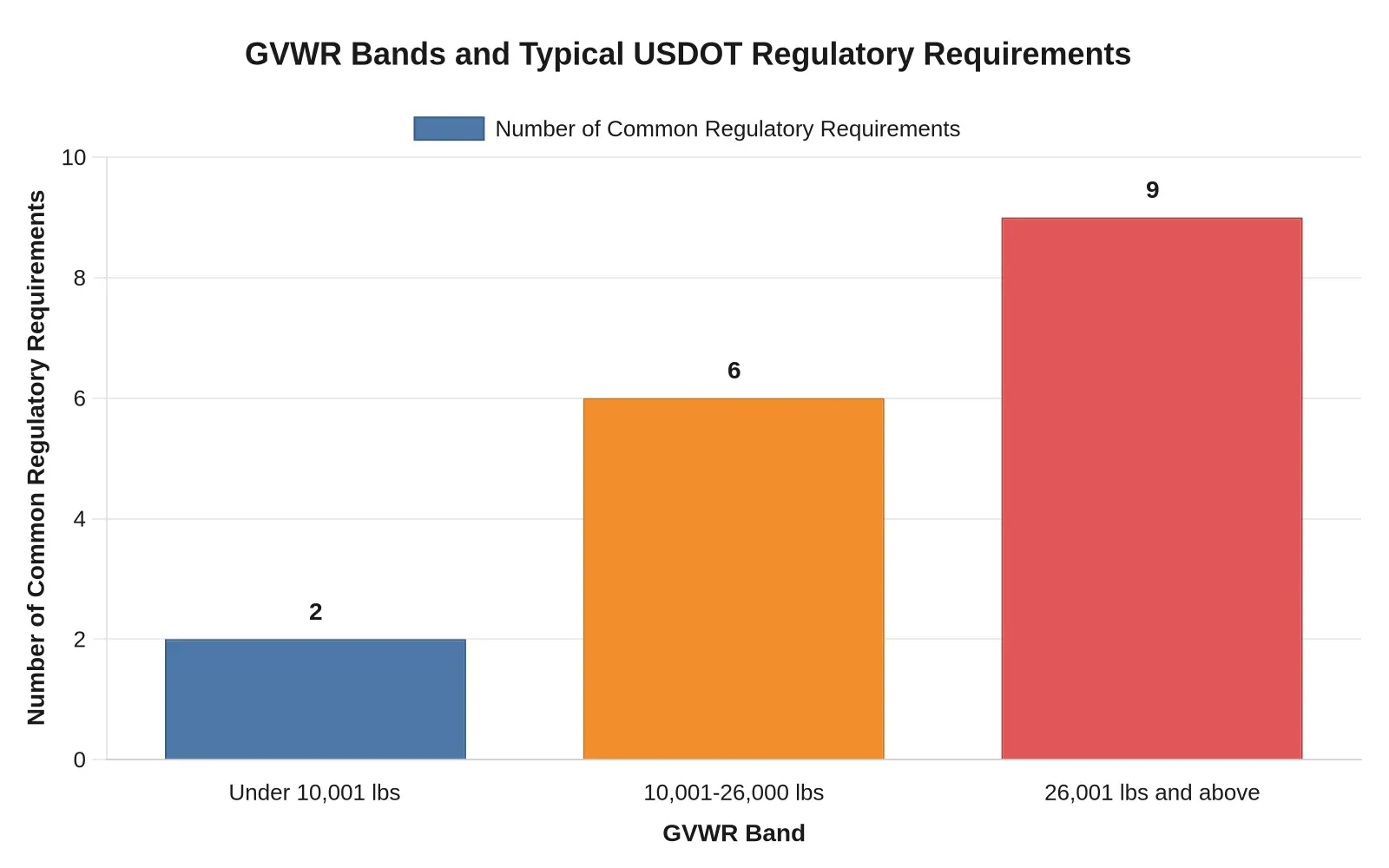
Caption: This chart compares common GVWR bands against the number of typical USDOT regulatory requirements that apply at each level. As vehicle weight rises from under 10,001 lbs to 26,001 lbs and above, the number of applicable compliance obligations jumps sharply — from roughly 2 basic conditions at the lightest tier to about 9 at the heaviest, reflecting the increasing scope of USDOT number, CDL, and recordkeeping rules for larger trucks.
Frequently Asked Questions About DOT Numbers
Does a pickup truck used for work need a DOT number?
Not automatically. A work pickup needs a USDOT number only when it meets specific federal criteria. If the vehicle is used in commerce and either has a GVWR of 10,001 pounds or more, carries certain hazardous materials, or transports enough passengers for compensation, it triggers federal registration. A standard half-ton pickup below the threshold that stays within one state often needs no federal number at all. How the truck is used and how much it is rated to weigh are what count — not whether it has a company logo on the door.
Is the 10,001-pound GVWR threshold based on actual weight or rated weight?
Rated weight. GVWR is the maximum operating weight your truck is designed to carry, including the vehicle itself, fuel, passengers, and cargo, as set by the manufacturer — not the number on the scale at any given moment. A truck with a 12,000-pound GVWR crosses the threshold even when it is running nearly empty. That is why operators should read the certification label on the door jamb instead of guessing from today’s load.
Does crossing a state line always trigger the DOT number requirement?
No. Crossing a state line does not by itself create a federal requirement. Interstate operation matters only when the vehicle also meets a threshold such as the 10,001-pound GVWR, the hazardous materials rules, or the passenger limits. A small truck that stays under those limits can legally cross state lines without a USDOT number.
Is there an exemption for occasional interstate trips?
In limited, specific situations, exemptions may apply, but they are narrow and depend on the facts. Common ones cover certain farm vehicles, some government operations, and specific covered farm equipment. A contractor who crosses a state line only occasionally is not automatically exempt just because the trips are rare. Verify the exact rule before assuming an exemption protects you.
Do I need a DOT number if I only operate intrastate?
Not from the federal government. Purely intrastate operation generally falls outside FMCSA jurisdiction, so a USDOT number is usually not required. Many states, however, run their own intrastate programs and may require a state-issued number using similar GVWR triggers. Confirm the rules with your state’s motor carrier office before you assume you are clear.
What happens if I operate without a required DOT number?
Operating without a required number can lead to fines, out-of-service orders, and added liability after a crash. Registering early is far cheaper than a compliance penalty. For help keeping your work trucks road-ready and compliant, review the quality service and reliability on the road offered by experienced fleet specialists.