
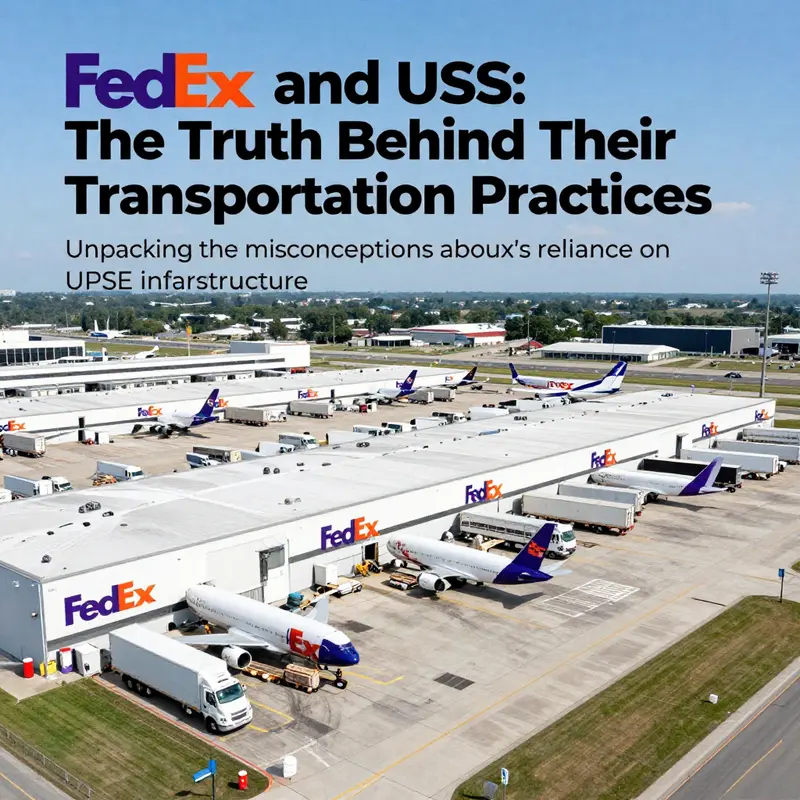
Understanding the dynamics between FedEx and the United States Postal Service (USPS) is crucial for those in the transportation and logistics fields. This examination reveals that FedEx operates an entirely independent network when it comes to its trucks and planes. From their extensive fleet to strategic decisions regarding contracts with USPS, each facet reflects their commitment to efficiency and cost-effectiveness. In the following chapters, we will explore whether FedEx utilizes USPS assets, how this shapes their cost strategies, their delivery network implications, and what competitive advantages arise from maintaining a distinct operation.
Not Shared Wheels: How FedEx Builds Its Independent Air and Ground Network Beyond USPS Assets
Many readers wonder whether FedEx relies on the United States Postal Service’s trucks or planes to move parcels. The straight answer is simple: FedEx operates its own, independent network. The reality behind that answer is a story of scale, specialization, and strategic separation that few observers glimpse in a quick headline. FedEx’s logistical ecosystem is designed to control the entire flow of a shipment—from pickup to final delivery—so customers experience consistent speed, reliability, and visibility. This design is intentional, not accidental, and it centers on a fleet, a network, and a suite of processes built from the ground up to meet demands that differ from what a postal service handles. While both FedEx and the USPS move packages, they do so as separate entities with distinct assets and service models. The implications reach far beyond a simple question of asset sharing; they illuminate how private couriers compete, differentiate, and invest in the kind of capacity that keeps time-sensitive shipments moving around the world.
FedEx operates a fleet whose size and composition reflect a deliberate commitment to speed and predictability. The company maintains a fleet of aircraft numbering well over six hundred, with a mix of wide-body freighters and broader regional workhorses. On the ground, the delivery network spans tens of thousands of vehicles, designed to serve both international routes and domestic corridors with tight service windows. This combination supports a multi-layered network in which shipments can be routed through dedicated air hubs, connected by a robust ground backbone, and then directed to final-mile delivery with a level of control that is rare in mixed-use networks. The result is a system where a package’s path—from origin facility to the recipient’s door—follows a carefully choreographed sequence, guided by real-time tracking and global visibility that customers increasingly expect as a baseline capability.
A common misconception stems from the historical relationship between FedEx and USPS. In earlier years, USPS mail could travel on FedEx aircraft as part of a separate contractual arrangement. That arrangement reflected a different kind of partnership—one that involved FedEx providing airlift capacity for USPS as a client rather than FedEx sharing USPS assets. Crucially, this was not a case of USPS trucks or planes being used for FedEx operations. It was a service provided by FedEx to USPS, separate from how FedEx runs its own shipments. The distinction matters because the heart of FedEx’s strength lies in assets it owns, assets it deploys in its own branding, and assets it deploys under its own scheduling logic and performance metrics. The partnership model, where it persisted in some form for a period, was ultimately re-evaluated in light of profitability and cost structures. Low pricing for air cargo capacity and the high costs of maintaining an air network aimed at relatively low-value, fast-turnaround deliveries created a mismatch between revenue and expense. As a result, FedEx began restructuring its network, leaning further into an autonomous transport system designed to serve FedEx customers directly rather than operate as a carrier for another organization’s core services.
To understand why FedEx remains independent, it helps to consider the architecture of its network. The aviation component is more than a fleet; it is a system of hubs and flight routings optimized for speed and reliability. Aircraft are allocated to keep essential connections open, with flights scheduled to move time-critical shipments on the earliest feasible departures. Ground operations are similarly structured around a vast fleet of vehicles, a distributed network of regional sorting facilities, and a layering of sortation and loading processes that minimize dwell time. The combination of air and ground assets, along with a data-driven operations backbone, enables FedEx to offer time-definite delivery across a broad global footprint. The company’s emphasis on end-to-end control extends to information systems that provide customers with real-time shipment visibility, flexible integration options, and security features that reassure both commercial clients and individual senders.
The difference between FedEx’s approach and that of a universal postal service becomes clearer when considering how branding and service design shape customer expectations. The USPS, as the nation’s official postal operator, carries duties and responsibilities that extend beyond parcel delivery, including mail stewardship and universal service obligations. FedEx, by contrast, positions itself as a private, cross-border logistics partner focusing on express, freight, and time-critical solutions. This difference drives investment choices and network design. FedEx channels capital toward capacity and technology that support a rapid, tracked, and predictable delivery experience. The objective is not merely to move parcels from point A to point B; it is to provide a confidence-building promise: that a shipment will arrive within a defined window and be traceable every step of the way. In practice, this translates into dedicated air routes, precision scheduling, and a global network of facilities calibrated to minimize handling steps and maximize on-time performance.
The outcome of maintaining an independent network is evident in how FedEx positions itself in the logistics ecosystem. A large, privately owned fleet affords a level of control that is critical for handling high-priority shipments, hazardous or sensitive cargo, and large volumes during peak seasons. It also supports a coherent customer experience across borders, languages, and regulatory environments. In addition to the physical assets, FedEx has built sophisticated tracking and integration capabilities. Customers can access shipment data in real time, use automated systems to trigger routing changes, and leverage API integrations to embed shipment status within their own enterprise workflows. This level of visibility is central to the company’s value proposition for businesses that rely on predictable timelines and tight supply-chain coordination.
The decision to move away from an air network previously aligned with a USPS-related contract reflects a broader strategic posture. Private carriers like FedEx tailor their networks to the needs of their current and prospective customers, seeking efficiency gains that come from network cohesion, scale, and predictable pricing structures. In this context, the choice to bring more of the process under FedEx control reduces exposure to external policy shifts, pricing reviews, or service scope changes that might occur when a public or government entity is a direct client. The effect is a more coherent schedule, better capacity planning, and improved risk management. It is a look into how a major logistics company evolves in response to market signals and internal performance data, choosing to prioritize investments that reinforce reliability and speed for the segments that matter most to its customer base.
That emphasis on control surfaces in everyday experiences of FedEx customers. When a package is in motion, the tracking updates, the proposed delivery windows, and the ability to adjust delivery options all reflect a system designed to minimize uncertainty. The company’s network design also accommodates a diverse array of services beyond standard parcel delivery. It supports freight forwarding, customs brokerage, and other specialized capabilities that require a seamless interface between transportation, warehousing, and regulatory compliance. The capacity to move large, high-value, or time-sensitive cargo through a single, integrated chain is a hallmark of FedEx’s value proposition and a key reason why the company has invested heavily in its own assets and processes rather than subsidizing external aircraft or trucks.
For readers looking to connect the dots between the practical, day-to-day experience of shipped parcels and the broader strategic choices behind FedEx’s independence, the geography of the network matters as much as the physical assets themselves. Global reach, consistent service standards, and the discipline to maintain a tightly integrated information ecosystem are the quiet engines of this model. In a world where a shipment might traverse multiple countries, customs regimes, and regulatory environments, the ability to rely on a single, owned, and well-managed network reduces the points of failure that can accompany shared or partially outsourced systems. It is this integrated approach that enables FedEx to compete on speed, reliability, and visibility while maintaining a distinct identity separate from public postal operations.
As the industry continues to evolve, the preference for private networks that can be tuned to the needs of business customers remains clear. The FedEx model—owning and operating the backbone of air and ground movement, coupled with advanced data capabilities and controlled service levels—illustrates a broader trend toward end-to-end management of the customer experience. The end result for clients is a predictable, trackable, and auditable journey from shipment initiation to final delivery, which strengthens trust and repeat business across diverse markets. The specifics of contracts, pricing structures, and asset allocation will continue to shift as market conditions change, but the underlying premise remains constant: when a carrier owns the assets and the operational playbook, it can steer performance in a way that is difficult to achieve through shared resources alone.
For those seeking more formal confirmation of FedEx’s network composition and its strategic stance on asset ownership, further details are available from the company’s official materials. External resource: https://www.fedex.com/en-us/about.html
Independent Skies, Separate Roadways: Why FedEx Keeps Its Fleet Separate from USPS Assets

When people ask whether FedEx uses the United States Postal Service trucks and planes, the question often wrestles with a surface-level assumption and a deeper reality. The straightforward line is clear: FedEx does not rely on USPS assets to move packages along its primary routes. Yet the broader landscape—comprising independent networks, contractual relationships, and the different missions of each organization—requires a careful reading. This chapter offers that reading not as a dry catalog of corporate facts, but as a narrative about how speed, predictability, and security are achieved when a company builds and manages its own traffic arteries. It also dispels a lingering misconception that asset sharing would automatically reduce costs. In practice, the two entities operate parallel and competitive pathways, each governed by its own fleet, its own hubs, and its own service commitments. The consequence is a logistical ecosystem in which collaboration, if it happens at all, occurs through contracts and handoffs rather than through shared ownership of assets. That distinction matters for how goods move, how pricing is structured, and how customers experience delivery in everyday life.
FedEx maintains its own extensive fleet and ground network, a self-contained system designed to deliver time‑sensitive shipments with a level of control that shared assets cannot readily provide. On the air side, a substantial aircraft fleet keeps pace with the demands of rapid movement, while the ground operation relies on a vast cadre of delivery vehicles that funnel packages from regional hubs through sorting centers to the final mile. The scale behind this autonomy matters: the volume of daily movement means even small delays can ripple across thousands of packages. The operations that support this scale emphasize consistency in speed, visibility, and security. For anyone chasing a promise of overnight transit, the difference is not simply where a package begins or ends, but how the chain of custody and the routing logic are governed from origin to destination. The implication is simple and powerful: control over the choreography of assets allows an organization to meet stringent service standards with fewer surprises along the way.
Historically, there was a period when USPS relied on the carrier’s daytime aviation capacity to move mail under a contract that treated the aircraft and routes as part of a shared, compensated arrangement. Such an arrangement opened access to a robust air network, but it was anchored in terms and pricing that did not always align with the costs of maintaining expensive air cargo capacity for lower‑value, time‑critical shipments. Over time, the economics proved challenging, and the model was gradually phased out. The company began restructuring its network to rely more heavily on internal resources and pricing discipline, aligning capacity with demand and cost. This transition reflects a broader industry shift: operators that invest in controlling capacity and capacity utilization tend to fare better when prices reflect true costs and when service commitments are calibrated to the realities of high‑volume, time‑sensitive operations. The shift is not about abandoning customers but about ensuring the reliability and profitability that keep the network resilient in the long run.
To understand why independence matters, visualize the network as a spine with many limbs rather than a single, straight pipeline. The spine comprises the core resources—aircraft, routes, and facilities—owned and managed by the carrier. The limbs represent the regional and local operations that feed into the hubs, enabling the final mile to arrive within promised windows. Because these assets are not co‑owned with another agency, planners can time departures, adjust for weather or congestion, and allocate capacity in ways that align with the company’s service commitments. This autonomy also reduces exposure to external pricing pressures or schedule constraints tied to another organization’s priorities. In effect, the carrier can respond to demand shocks—whether a rush of shipments at month end or an unexpected peak in a particular season—without waiting for another party’s calendar to clear. The result is a more predictable rhythm, a steadier pace, and a sharper ability to honor commitments that matter to customers and business partners alike.
An important byproduct of this structure is the ability to maintain rigorous standards for integrity and security. High‑value or sensitive shipments require an unbroken chain of custody, continuous tracking, and the confidence that the carrier can meet time commitments even when external conditions are less than ideal. The independent fleet, along with the management and communications systems built around it, is designed to support this level of reliability. When weather turns adverse or fuel costs spike, the cost accounting and capacity planning are anchored in a private, internally disciplined system rather than a shared cost pool. That kind of resilience translates into customer trust: a business shipping critical components, or a family sending time‑sensitive documents, can anticipate a predictable experience because it is built on internal tools and rules rather than on a partner’s shifting priorities. This is where the value of autonomy becomes tangible in everyday outcomes.
Pricing strategies flow naturally from the insistence on internal control over capacity and schedules. Rather than anchoring rates to a shared asset base, the carrier designs its pricing around shipment characteristics such as volume, timing urgency, and the value of service guarantees. The reality is that discounting and price differentiation respond to how much capacity is available and how fast a shipment must move. In practice, customers who can commit to larger volumes or who can tolerate slightly longer lead times often benefit from more favorable terms, while those with urgent requirements may encounter premium pricing for faster delivery. These dynamics are not a clever trick of asset sharing but a carefully calibrated balance between capacity, price, and promise. The outcome is a transparent framework in which clients receive clear expectations, backed by a network purpose-built to meet them rather than a patched‑terry system stitched together with another organization’s assets.
For households and businesses, the practical upshot is a reliable sense of where a package is at any moment and when it will land on the doorstep. Real‑time tracking, proactive status updates, and a robust process for addressing concerns are all anchored in the principle that the network operates as a single, accountable system. The trade‑off of independence is that the company cannot rely on a shared, non‑owned fleet to absorb demand spikes at a moment’s notice. Instead, capacity is maintained through a carefully managed inventory of aircraft, vehicles, and facilities, alongside the people and technology that coordinate them. In a marketplace where speed, predictability, and security matter more than ever for both business customers and families, that singular focus on internal orchestration becomes a meaningful differentiator. It helps explain why, even as USPS remains a major player in the broader parcel market, the underlying strategy for each carrier rests on distinct priorities, disciplined capital budgeting, and a long horizon for profitability.
Beyond the operational mechanics, the broader market context matters for strategy and consumer choice. The competition among major players in the parcel arena centers on how quickly and reliably goods can move from origin to final destination, rather than on any simple asset‑sharing arrangement. Each carrier’s footprint, governance of the network, and service commitments shape the options available to customers, and each organization must continuously evaluate whether its own assets and capabilities can deliver value at a sustainable price. With that perspective, the question of using USPS assets becomes less a matter of immediate economics and more a question of accountability, risk, and strategic fit. In the end, the business decision is not about pooling trucks or planes but about choosing a partner or carrier whose service standards, cost discipline, and long‑term profitability align with customer needs and corporate goals. That is the frame within which pricing, scheduling, and service guarantees are ultimately understood by shippers and recipients alike.
For readers seeking a definitive point of reference, official information about the carrier’s fleet and operations is available on its corporate site. https://www.fedex.com
Independent Wings and Roads: FedEx’s Self-Contained Fleet
FedEx maintains an independent, company-owned logistics network with its own aircraft and ground fleet. Historically, FedEx did engage in limited USPS-related air transport under contractual arrangements, but the assets remained FedEx’s and were not shared with USPS. Over time, the model shifted toward greater self-sufficiency to maximize speed, reliability, and control. The current network emphasizes a large aviation portfolio and a robust ground fleet designed to handle time-definite shipments without relying on external partners for core capacity. This separation reduces handoffs, improves predictability, and allows FedEx to optimize pricing and service levels within its own ecosystem. In short, FedEx’s wings and wheels belong to FedEx, delivering a consistent experience across its network.
Independent Wings, Separate Roads: How FedEx Builds Speed and Trust Without Reusing USPS Assets

When people ask whether FedEx relies on USPS trucks or airplanes, the instinctive answer is simple: FedEx operates its own, purpose-built transportation network. The longer answer reveals a deliberate separation that underpins the entire brand promise of speed, reliability, and constant visibility. FedEx has assembled a formidable, independent system, underpinned by its own fleet of aircraft and a vast ground delivery network. The message is not merely about capacity; it is about control over scheduling, routing, and service quality, all of which are central to why customers choose FedEx for time-sensitive shipments. This independence helps FedEx defend a reputation for predictable delivery windows and real-time tracking, while it also shields the company from fluctuations in public-sector service policies or pricing that could undermine performance targets.
At the heart of FedEx’s strategy is a fleet that supports global reach and flexible response to demand. The company operates a fleet of more than six hundred fifty aircraft, designed to handle a continuous stream of departures and arrivals around the world. In tandem with air capacity, FedEx maintains a massive ground fleet—tens of thousands of dedicated delivery vehicles—that feed the network from regional hubs to local destinations. This scale permits a tightly choreographed flow: shipments move from origin to a series of FedEx hubs, pass through security and customs screening where relevant, and then proceed on the next leg of the journey with an almost clockwork regularity. The architecture is not a patchwork of partnerships; it is a deliberately constructed ecosystem where service levels are governed by the company’s own schedules and capacity planning.
Historically, FedEx did carry a contractual relationship with the United States Postal Service that involved using FedEx aircraft to carry USPS Priority Mail, with a two-day delivery promise. This arrangement was described in the broader literature as a service FedEx provided to USPS, one that leveraged FedEx’s air network to move mail on daytime flights. Crucially, that usage did not amount to a shared fleet or a pooling of USPS assets. The assets—aircraft, ground vehicles, and hubs—remained FedEx property and operated under FedEx control. Over time, however, the economics of that arrangement shifted. The USPS contracts that used FedEx capacity became less favorable from a profitability standpoint. The combination of lower pricing for public mail services and the high fixed costs of operating expensive air cargo capacity for comparatively low-value, ground-service-level deliveries created an unsustainable model for FedEx’s core business logic. As a result, the airline and ground system that once integrated USPS work is being restructured to emphasize FedEx’s own, higher-margin capabilities.
What this means for customers is more than just a matter of where a package is loaded. It means that the timing, routing, and handling of each shipment are governed by FedEx’s internal schedules, not by a shared public infrastructure. The physical assets—aircraft and ground vehicles—are positioned and managed to support the company’s service guarantees, not to supplement a government mail operation. The emphasis is on reliability and speed, with the ability to adapt quickly to demand spikes, weather disruptions, or airspace constraints without waiting for a partner schedule. In this light, the value proposition rests on proprietary logistics expertise, precise inventory control at hubs, and a network design that minimizes handoffs and delays.
This architecture underpins the kinds of services customers expect from a leading global carrier. Time-sensitive shipments are prioritized, and the chain of custody is tightly maintained from pickup to final delivery. The network’s strength lies in the capacity to assign priority lanes, optimize flight legs, and schedule departures to meet strict service windows. Rather than relying on another organization’s pricing, constraints, or priority rules, FedEx can tailor its routing, combine shipments on the most efficient legs, and, when needed, deploy higher-cost resources for critical shipments. The impact is less from fancy branding on a single aircraft and more from a disciplined, day‑in, day‑out orchestration of people, planes, cars, and warehouses that together deliver visibility and predictability to customers.
The shift away from a USPS-centered model also speaks to the economics of modern logistics. Air cargo is expensive, and the value of fast air transport varies by the nature of the shipment. For low-value, high-volume ground services, air capacity can quickly become a poor fit if pricing does not reflect the true cost of operations. FedEx’s restructuring is, in essence, a recalibration: the company is leaning more heavily on assets it owns and controls and reducing reliance on public-sector arrangements that compress margins without delivering a commensurate uptick in service quality. This is not a retreat from speed or a retreat from serving USPS-bound traffic in some fashion; it is a move toward a leaner, more profitable configuration that preserves the core advantage of an independent network while maintaining flexibility to support various service levels.
To understand why control matters so deeply, consider the concept of “flight arrangements” and the logistics reality behind it. What looks like a simple schedule on a timetable is, in practice, a complex negotiation of capacity, timing, and risk. When a shipment must travel on the fastest possible sequence of legs, the operator must be able to assemble aircapacity, gate slots, ground handling, and intermodal transfers in a way that does not depend on a third party’s timetable. Having a proprietary fleet makes it possible to keep a high degree of reliability even as global demand for air cargo shifts with economic cycles or geopolitical events. It also enables a higher degree of security and compliance, factors that matter when shipments cross borders and pass through multiple regulatory regimes. In short, the independence of FedEx’s network is a cornerstone of its ability to promise, and deliver, speed with confidence.
From a customer perspective, the effect is tangible. Tracking becomes more than a line on a screen; it is a real, actionable feed that reflects the actual status of aircraft and ground movements within a single, accountable system. Operational exceptions—like weather delays or early-morning gate changes—can be addressed at the source with minimal cascading impact. When a shipment needs to be rerouted, the decision can be made and executed within the same orchestration layer, preserving service commitments without the friction that often accompanies inter-company coordination. This is the core of FedEx’s value proposition: speed and reliability realized through an integrated, self-contained logistics network rather than through a flexible but less controllable use of public assets.
The broader significance of maintaining an independent network becomes clearer when considering the competitive landscape. In a field defined by constant pressure to reduce transit times and improve visibility, dependence on public infrastructure can become a bottleneck. Privatized networks can adapt more rapidly to emerging routes, weather patterns, or capacity constraints and can deploy premium options for customers who require the fastest possible delivery with guaranteed timing. The decision to minimize shared assets aligns with a strategic orientation toward reliability, predictability, and the capacity to offer differentiated services to businesses that rely on precise supply chain timing. It is not that the USPS is incapable of meeting similar needs; rather, the FedEx model demonstrates how a carrier can de-risk its operations by owning its networks and by designing services that exploit that ownership to the fullest.
The narrative of FedEx’s network is not static. The company’s restructuring efforts reflect ongoing learning about where profits come from and how to balance peak-season demand with steady-state operations. The aviation network, initially optimized to serve daytime USPS transport, is being adapted to new realities where profitability drives change in the mix of capacity and the manner in which it is allocated. The ground side of the network, likewise, continues to evolve as package density patterns shift, e-commerce volumes rise, and cross-border flows demand ever-greater efficiency. All of this points back to the central truth: the FedEx edge rests on an integrated, privately managed system whose strength is the organization’s ability to forecast, allocate, and control—the pillars of speed, reliability, and trackability that customers rely on every day.
From an industry viewpoint, the case of FedEx helps illuminate a broader lesson about competitive strategy in logistics. Speed, density, and service clarity are not achieved by borrowing someone else’s rails or by sharing an asset base that can erode a brand promise. They come from a deliberate decision to invest in and operate a standalone network. Companies that pursue that path often end up delivering more consistent transit times, tighter control over exception handling, and a customer experience that feels seamless from pickup to last-mile completion. The contrast between an independent network and a shared one is not merely about who owns the hardware; it is about who bears the responsibility for meeting commitments in real time, who bears the costs of capacity during spikes, and who reaps the benefits of fine-grained scheduling.
For readers seeking a concise summary of this approach and its rationale, a resource from FedEx’s own small business center emphasizes that the competitive edge arises from the company’s own infrastructure and logistics network rather than shared public services. This emphasis on internal capabilities reinforces the narrative that independent networks are central to achieving fast, reliable, and trackable shipping—attributes that resonate with businesses of all sizes seeking dependable supply chain performance. In the end, the question is not whether FedEx could squeeze some value from public assets; it is whether the long-term value of speed, reliability, and control justifies keeping those assets separate and fully under the company’s governance. The answer, built from years of experience and continuous refinement, leans strongly toward independence as the most reliable path to maintaining trust in a world where delivery speed increasingly defines competitive advantage.
To explore this vantage point further, see the broader discussion on how a carrier’s network design and asset strategy shape performance across markets: Exploring the excellence of 5 Star Truck Inc, your premier trucking solution. This linked perspective, while centered on a different segment of transportation, echoes the core idea that fleet reliability, route optimization, and disciplined asset management are foundational to dependable service.
External resource: https://www.fedex.com/en-us/small-business-center.html
Final thoughts
In summary, a clear understanding of FedEx’s operations reveals they do not utilize USPS trucks or planes, but instead rely on their own extensive resources. This independence allows FedEx to enhance their operational efficiency and adapt strategically in the competitive logistics marketplace. With the changes in contracts and the emphasis on profitability, FedEx’s departure from reliance on USPS assets not only secures their future but also positions them favorably in an evolving industry.