
In the bustling world of trucking, understanding tax obligations is crucial for long-haul truck drivers, trucking company owners, fleet managers, and aspiring drivers. Navigating federal and state taxes can be complex, but gaining a clear insight into taxable activities ensures compliance and potentially maximizes profits. This article delves into three essential areas of taxation related to trucking services. You’ll first explore federal tax implications, breaking down key components like the Heavy Highway Vehicle Use Tax. Next, examine how various states impose their own regulations on trucking services and the potential variances in taxability across different regions. Finally, assess the often-overlooked sales tax considerations that can arise from related transactions. By the end, you’ll be equipped with a comprehensive understanding of the tax landscape in the trucking industry.
Tax at the Wheel: Decoding Federal and State Realities of Trucking Service Taxability
A trucking operation rolls out at dawn, its cab catching the first light as it carries the day’s load toward distant markets. For many owners and operators, the questions that arise around taxes can feel almost as heavy as the payload itself. The simple claim that trucking services are “taxable” begs a more nuanced answer. The core service of transporting goods for hire—the act of moving freight from point A to point B—does interact with tax codes on multiple fronts, but not always in the same way that a consumer might expect. To understand what is taxable and what is not, it helps to view the landscape as a constellation of taxes that apply to different pieces of the business rather than a single blanket on the service itself. In practice, the revenue a trucking company earns from freight charges is treated as business income and is subject to corporate or other business-level income taxes. That is a fundamental tax reality for carriers operating in the United States, regardless of the state in which they are registered or the routes they traverse. Yet the particular taxes that accompany the operation—the federal highway use tax, and the various state-level taxes—are not uniform across the country and do not tax the service as a simple, single transaction in the way a sales tax might be understood in retail. The distinction matters, because it shapes financial planning, pricing strategy, and even compliance workflows for fleets large and small.
One of the common points of confusion concerns whether the trucking service itself is subject to a federal sales tax or something akin to a sales tax on the transaction of moving goods. The reality, as described by federal guidance, is more granular. The federal highway system is financed in part by a vehicle-use tax that is assessed not on the service the carrier provides, but on the use of the vehicle that performs the transport. This “use tax” approach reflects a policy choice to charge the users of the highway rather than to levy a sales tax on freight charges at the point of service. In other words, a trucking company’s revenue from hauling freight is taxed as business income under federal and state income tax regimes, while the highway use tax operates as a separate obligation tied to the operator’s fleet and its vehicles’ weight and usage. The separation between service income taxation and vehicle-use taxation creates a framework that can be misunderstood if one only hears the shorthand that trucking services are taxable. In truth, both statements can be true at once, but they target different aspects of the business and different tax bases.
At the federal level, the mechanism most people encounter in discussions of highway-related taxes is the federal highway use tax. This is sometimes described in terms of the Internal Revenue Code’s regulatory framework for heavy vehicles, and it is often discussed in the same breath as the Highway Use Tax, which is a vehicle-use tax rather than a pure sales tax on service income. The tax is described as a “benefit tax”—a charge tied to the public highways that enables and sustains the road network the trucking industry relies on to move goods efficiently. The policy logic is straightforward: heavier and more frequent use imposes greater wear and tear and thus should bear a larger share of the highway’s maintenance and improvement costs. The practical effect, however, is that vehicle owners are responsible for calculating and remitting this tax based on the vehicle’s weight and usage, not on the particular freight transaction they are performing at any given moment. The result is a stable revenue mechanism for the government that does not directly alter the price of each freight bill, but it does feed into the overall cost of operation for fleets, influencing equipment decisions and long-run capacity planning.
The weight thresholds and rate structures that govern the federal highway use tax, as described in the provided materials, show a progressive character. The tax applies to vehicles that exceed a certain gross weight threshold, with the annual rate adjusted in relation to weight. The example figures cited describe a baseline threshold and a per-weight-charge formulation, leading to higher totals for heavier fleets. For instance, the tax framework notes a threshold at a relatively low weight, with incremental charges increasing as the vehicle weighs more, culminating in a ceiling where the total annual charge for the heaviest vehicles can reach into well into the upper hundreds or thousands of dollars. It is critical to emphasize that the tax is calculated and reported by the vehicle owner, not collected by the trucking service on each individual freight transaction. The distinction between who files and who pays might feel nitpicky, but in practice it means fleet accounting must separate the vehicle-use liability from the service revenue, ensuring compliance across the spectrum of federal, and later state, obligations. This separation also helps clarify why a carrier’s pricing for freight is not determined by an on-the-ground tax at the moment of service but rather by a broader budgeting process that accounts for all vehicle-related costs over the year.
While the federal highway use tax centers on the vehicle and its usage, state-level taxes add another layer that can complicate the tax picture for trucking services. States don’t all adopt the same approach to trucking as a taxable activity, and even when they tax the activity, the basis and scope often diverge from federal practice. One of the more notable examples tied to the initial research overview is the Washington State approach, where the activity of hauling goods for hire is subject to the Business and Occupation (B&O) tax. The B&O tax is a tax on the privilege of doing business within the state and is assessed on gross receipts, or sometimes on specific activities, depending on the B&O classification a carrier falls into. The exact rate and the rules for apportionment or exemptions vary by state and even by local jurisdictions, which means a trucking company operating across multiple states faces a patchwork of obligations. In this sense, the question “Is trucking service taxable?” becomes a question of how and where the service is delivered, who the customer is, and what state-based tax obligations apply alongside the federal framework. It is not merely a matter of whether the freight moves from one location to another, but whether the carrier’s earnings and operations trigger state-level tax classifications for doing business in that state.
Beyond income and usage taxes, another axis of taxation concerns sales tax on related goods and services that fleets may sell or provide as part of their business model. For many carriers, there are ancillary revenues tied to maintenance, fuel services, or equipment-related sales—depending on the state—where a sales tax or use tax might apply. The rules governing whether such charges are taxable can hinge on state tax policy on services and tangible property, the nature of the sale, and how the transaction is structured. The broader takeaway is that the trucking service’s core mission—moving goods—sits in a tax landscape where the service revenue is taxable as business income; the vehicle-use tax is a separate, vehicle-centric duty; and sales or use taxes on related goods or specialized services complicate the accounting at the edge of the business. For practitioners, this means that simply labeling trucking as a taxable activity is too blunt a lens. A more precise framing recognizes multiple tax levers, each with its own regulatory trigger and reporting pathway.
A practical thread that runs through federal and state considerations is the way these taxes are documented and remitted. On the federal front, there is a well-known filing responsibility for heavy highway vehicles governed by the relevant federal tax code provisions. For fleets, the requirement to file forms by specific deadlines—such as those associated with the heavy use tax—means that compliance sits on the calendar of the fleet owner or the operator’s accounting function. The Form 2290, for instance, is a familiar point of reference for owners of heavy highway vehicles that first use public highways within a tax year, establishing a baseline for registration and the associated tax. The emphasis here is that this is a usage-based tax born out of the vehicle’s characteristics and its on-road footprint, not a direct tax on the act of providing hauling services. The separation is clear in practice: the trucking service’s revenue is subject to business income taxes in the appropriate jurisdiction, while the vehicle-use tax is assessed against the vehicle’s weight and on-road presence, remitted by the owner of the vehicle.
The interplay between federal and state tax rules often creates questions about how a trucking business should structure its affairs for tax efficiency. For example, some carriers organize as corporations or pass-through entities, which exposes them to corporate income tax regimes or to pass-through taxation at the owner level, depending on the entity type. Others opt for state-specific registrations that affect how B&O taxes or sales taxes apply. The choice of corporate form, the location of registration, the mix of on-road weight, and the routes most frequently traveled all influence the effective tax burden. In practice, the trucking firm must manage a dual lens: one that views the business income taxed at the entity level, and another that tracks vehicle-use taxes and state-specific obligations tied to operation within each state’s borders. The overarching message is that taxability in trucking is not a singular verdict but a composite assessment across fiscal layers. This reality urges fleet managers and owners to implement integrated tax planning, where the cost of compliance is factored into pricing, maintenance schedules, and investment decisions.
A crucial throughline in this discussion is the distinction between taxes that are charged at the point of sale for the service and taxes that are incurred as a function of asset ownership and operation. The federal highway use tax is not charged as part of the service charge on a freight bill; it is a separate, ongoing obligation tied to the vehicle. In this sense, a carrier cannot simply pass along the highway-use cost to customers on every shipment in the same way a sales tax might be added to a retail purchase. Instead, the use tax elevates the cost baseline of owning and using heavy vehicles on public roads. The consequence is a layered cost structure, where the price of hauling goods includes the vehicle’s use costs, insurance, maintenance, depreciation, and the corporate tax obligations that accompany revenue. The net effect is that customers may experience stable freight rates that reflect competitive market dynamics, while the carrier’s internal cost accounting must capture the highway-use tax as part of the fleet’s annual cost of ownership, distributed across the fleet’s utilization and capacity planning. In the end, the question of taxability remains nuanced and context-dependent, requiring ongoing attention from accountants and fleet managers who must reconcile multiple tax regimes within a single business model.
To keep pace with the complexity, many operators turn to guidance and resources that help translate statutory language into practical accounting steps. One straightforward approach is to keep a clear separation in the books between revenue from freight charges and the various tax liabilities associated with the fleet. This separation allows a carrier to monitor corporate income tax obligations on revenue, while simultaneously tracking the federal highway use tax liability for each vehicle and the state-level taxes that may apply to doing business in a particular jurisdiction. It also clarifies the treatment of related sales or use taxes on goods sold to customers or on services provided to support the core operation, such as fleet maintenance or fuel services, where applicable. While the exact line items will vary by company and state, the core principle remains: treat each tax as its own cost center within the broader fiscal picture, rather than trying to amalgamate everything into a single “truck tax.”
For readers who want to situate these details within a broader narrative of industry practice and policy, there is value in turning to industry-specific resources that discuss how fleets navigate the tax landscape in real time. These references can provide context about how revenue recognition, fleet composition, and regulatory changes interact with tax obligations. To further explore practical perspectives and policy considerations, you can consult resources that elaborate on the drivers behind highway-use taxation and its implications for fleet decision-making. If you are curious about broader industry commentary and potential best practices, a visit to the industry blog can offer perspectives that complement the formal guidance. For readers who want a direct pointer to such discussions, the following link can serve as a useful starting place: 5startruckin.com/blog. This resource provides a general gateway to industry insights, helping readers connect tax considerations with day-to-day fleet management and strategic planning. 5startruckin.com/blog
As a final synthesis, the enduring answer to the question, “Is trucking service taxable?” is: yes, in a multi-layered way. The service revenue is taxed as business income, subject to the applicable corporate or pass-through tax regime. The federal highway use tax is a separate, vehicle-use charge tied to the fleet’s weight and road usage, not a charge levied on the service transaction itself. State taxes add another dimension, with regimes like the Washington B&O tax illustrating how the privilege of doing business within a state can hinge on gross receipts and activity classifications. And beyond these core taxes lie the potential sales or use taxes on ancillary goods or services that accompany the core operation, depending on state rules and the precise nature of the transaction. The practical upshot for fleet managers and business leaders is to maintain a clear, integrated understanding of how each tax component appears on the books, how it is reported, and how it informs strategic choices about fleet composition, routing, and pricing. In doing so, a trucking business can remain compliant while aligning its financial performance with the realities of a regulated, infrastructure-supported industry.
For readers seeking further technical detail about the federal highway use tax, including its basis, weight thresholds, and filing responsibilities, the Internal Revenue Service provides official guidance. The federal highway use tax is a vehicle-use tax rather than a sales tax on the service; it is calculated with reference to vehicle weight and usage, and the owner of the vehicle is responsible for reporting and payment. To review the official guidelines and potentially update expectations in light of policy changes, you can consult the IRS Federal Highway Use Tax Guidelines. This external resource offers the authoritative context that helps explain why the highway system’s maintenance is funded through vehicle-use charges rather than tax-on-service charges. For more details, see: https://www.irs.gov/businesses/small-businesses-self-employed/federal-highway-use-tax.
In sum, trucking services operate within a complex tax ecosystem. The revenue from hauling is taxed as business income; the vehicles that perform the service are subject to a use tax; and state tax regimes may impose additional obligations on doing business within their borders. The practical implications for fleet owners are clear: tax planning must be embedded in the core financial model, aligned with regulatory requirements, and revisited regularly as rules evolve. The result is not a single tax on the act of moving goods, but a structured set of liabilities that, together, define the true cost of providing trucking services in a regulated economy. This layered understanding helps explain why responsible operators monitor weight, fleet composition, and regulatory developments as part of daily and strategic decision-making, ensuring they deliver reliable service without compromising compliance or financial health.
The Patchwork Ledger: How State Tax Rules Shape Trucking Service Taxability
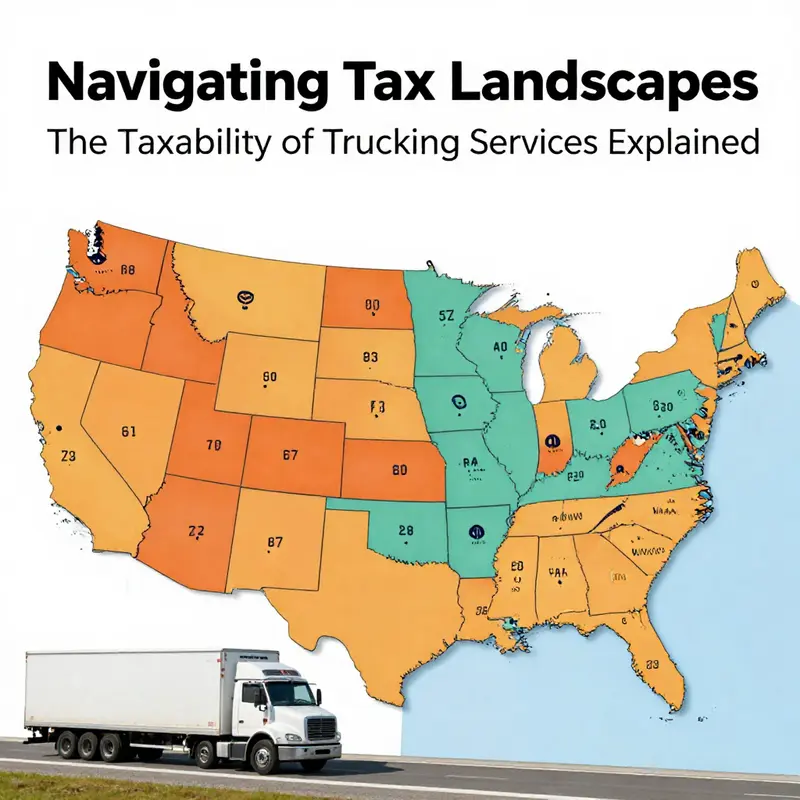
Across the United States, the simple act of moving goods by truck is not taxed in a single, uniform way. Instead, trucking services operate in a complex, state-by-state landscape where multiple levies can apply at once and where exemptions can hinge on nuanced distinctions. This chapter follows the thread of that patchwork, showing how state-level taxation shapes the tax footprint of trucking operations and why understanding the local rules matters as much as understanding federal obligations. As the initial overview makes clear, the federal government imposes clear duties on the use of heavy vehicles, but it is the states that fill in the larger picture with their own taxes on the privilege of doing business, the sale and use of related goods, and, in some cases, the service itself. The resulting mosaic is not merely a compliance chore; it is a map of where value is captured in the trucking ecosystem, from the moment a carrier accepts a shipment to the moment maintenance crews purchase tires, fuel, and parts to keep fleets rolling.
In many states, trucking services fall under a family of taxes that are not always obvious at first glance. Consider the Public Utility Tax, a levy that arises from the state’s view of transportation as a public service, especially when a carrier operates as a common carrier that serves the public at large. The logic here is not about whether a shipment is profitable but about the state’s decision to tax the privilege of providing a transportation service to the public. This tax, where it exists, threads through the carrier’s receipts and, in some jurisdictions, can be calculated on gross receipts, sometimes with adjustments. The effect on the bottom line can be meaningful, particularly for operators who run lean margins or who operate in markets with razor-thin rate discipline. The PUT, though lesser known to many outside regulatory circles, is a reminder that state treasuries look not only at what is earned but at what is necessary to sustain public infrastructure that makes trucking possible in the first place.
The Business and Occupation (B&O) tax is perhaps the most consistently visible state levy for transportation-related businesses. In Washington State, for example, the B&O tax applies to the privilege of doing business within the state, and the rate can be tied to gross receipts or to specific activities. The same broad framework—taxing the privilege to operate—appears in other states, even when the precise calculation mechanics differ. For trucking companies and independent operators, B&O or its equivalent can apply to the gross receipts from freight hauling, but exemptions or credit structures exist in various jurisdictions. The result is a balance between a state’s desire to capture economic activity and a carrier’s need to allocate resources to operational costs without erosion by taxes that treat every shipment as equally taxable regardless of profitability or efficiency.
In many places, the tax story also includes sales and use taxes tied to the tangible goods that trucking businesses purchase or lease to keep their operations moving. Fuel, tires, parts, and maintenance services—these are not merely inputs but part of the ongoing cost of delivering freight. When a state imposes Retail Sales Tax or Use Tax on these items, the effect is felt in the procurement side of the business. In practice, this can mean that a carrier faces tax leakage not only on what is earned but on what is spent before and during each trip. The interplay between tax on services (such as the act of moving goods) and tax on goods (such as fuel or tires) creates a layered cost structure that operators must track with precision to prevent unexpected liabilities.
A practical question for many readers is this: how can trucking operations navigate that state-by-state variability without drowning in forms and audits? The answer lies in two practical disciplines: disciplined taxonomy of services and careful, proactive compliance management. First, classify the service correctly. States often look at the nature of the service to determine taxability. Is the carrier providing transportation labor as a service, or is the service bundled with the sale of a product or fuel card? The line can blur, particularly when a carrier also sells goods, leases equipment, or provides ancillary services to shippers. Understanding where the service ends and the sale of tangible property or the use of taxable inputs begins helps determine which tax regime applies. Second, recognize the role of cargo type and carrier classification. Some states differentiate tax treatment for bulk freight, hazardous materials, or time-sensitive deliveries. They may also distinguish between common carriers, which offer services to the general public, and contract carriers, which operate under private agreements. Those distinctions can tilt the tax outcome in meaningful ways, sometimes yielding exemptions or reduced rates for particular cargoes or operating models.
The Washington example is frequently cited because it illustrates the layering of taxes that can confront a trucking business operating in a single state. In Washington, as described in the state’s guidance, a carrier can be subject to the Public Utility Tax for transportation services rendered, the B&O tax based on the privilege of doing business within the state, and the Retail Sales Tax or Use Tax on taxable inputs such as fuel, tires, or parts. The practical implication is that a single shipment may trigger multiple tax events: revenue-based tax for the service itself and consumption taxes on the inputs used to perform that service. For operators, the consequence is that cost accounting must allocate tax impacts to the right line items and that forecasting must reflect the total tax burden, not just the price charged for transportation.
Compliance becomes more complex when one considers nexus—the point at which a carrier is obligated to collect taxes in a state. A carrier that operates across state lines may find itself registering for state taxes in multiple jurisdictions. This is not merely a matter of filing once a year; it requires ongoing registration, periodic reporting, and timely payment. Each state has its own nexus standards, which determining factors include where the vehicle is garaged, where the service is performed, and where employees are based. Even for fleets that are primarily interstate, the presence in a particular state can create a taxable footprint that would not exist if operations were entirely within another state. The practical implication is the need for a comprehensive tax map for the business—one that identifies which taxes apply where and how to allocate revenue and input costs accordingly.
The broader landscape is further complicated by exemptions and special regimes. Some states provide relief or reduced rates for certain types of freight or for carriers operating under specific regulatory regimes. These exemptions can be highly targeted, applying only to particular cargo classes or carrier configurations. For operators, awareness of these exemptions offers real value, potentially lowering the total tax burden when the business structure and operation align with the state’s policy favors. The upshot is that a one-size-fits-all approach to trucking taxes rarely works. Instead, a thoughtful, state-specific assessment informs pricing, budgeting, and compliance planning.
From a practical standpoint, the job of staying compliant rests on disciplined recordkeeping. It is not enough to track revenue alone; operators must also capture the temporal and spatial details of each shipment, the nature of the service provided, and the exact inputs purchased for operation. This granularity supports accurate tax calculation and audits, and it helps to justify exemptions or reduced rates when appropriate. Deployment of robust accounting practices—such as frictionless integration of transportation management systems with tax data, or a simple but rigorous manual ledger for smaller fleets—can make the difference between smooth compliance and costly missteps. In the end, state tax rules are not just about what must be paid; they reflect policy choices about how the state invests in infrastructure, how it incentivizes or moderates industry activity, and how it balances revenue needs with the realities of operating a trucking business.
To many readers, the takeaway is not a rigid checklist but a mindset: know the tax rules that apply where you operate, understand how they interact with the true cost of providing transportation services, and build your pricing and procurement processes around that tax reality. When a carrier understands that the service itself can be taxed, that inputs can carry their own tax obligations, and that exemptions may exist, it becomes possible to plan for tax costs with the same rigor as fuel efficiency or maintenance schedules. This approach also helps in discussions with shippers and brokers who increasingly seek transparency about the true cost of transport, including tax considerations that affect overall cost of service. In short, the state-by-state tax story for trucking services is not a bureaucratic nuisance; it is a business discipline that, when understood, helps operators price, plan, and perform with greater certainty.
For those seeking broader context and ongoing updates, resources such as state Department of Revenue guidance provide essential guidance on registration, reporting, and payment obligations. This is especially relevant in states that publish policy guidance on how transportation services are taxed and where exceptions or special rates may apply. Engaging with these resources early in the planning cycle can help prevent surprises as a fleet expands or contracts its service footprint. Operators may also find value in industry perspectives on how taxation intersects with procurement and fleet management. A practical way to access broader industry insights is to explore the main industry blog hub, where practitioners discuss regulatory changes, compliance best practices, and real-world experiences in trucking finance and administration. For a broad view of industry discussions, refer to 5startruckin.com/blog/.
The federal layer, while distinct, interacts with state rules in meaningful ways. The federal framework sets the basics for vehicle use taxes and registration requirements, and it is not uncommon for carriers to encounter both layers in a way that requires synchronized compliance across tax regimes. The Heavy Highway Vehicle Use Tax, administered by the federal government, sits alongside the state-level B&O, PUT, and sales/use taxes, creating a total tax burden that reflects not only the activity of moving goods but the broader economic footprint of operating a trucking business. Carriers must plan for these costs when pricing contracts and negotiating with shippers who may hold procurement arrangements beneath a higher cost baseline that includes both federal and state taxes.
For practitioners, a practical approach to navigating this landscape starts with mapping the tax obligations that arise from each service touchpoint. Begin with the core activity—the transportation of goods for hire—and determine how each state views that service. Then sequence the tax events along the lifecycle of a shipment: initial service provision, fuel and maintenance procurement, regulatory registrations, and any cross-border considerations if inter-state operations are involved. This mapping helps identify where to allocate revenue and expenses for tax purposes and where to apply any exemptions that the state may offer. It also clarifies what records must be kept for audit purposes and how to structure filings so that compliance is as efficient as possible. The goal is not to avoid tax but to understand it precisely and to manage it in a way that aligns with the company’s broader financial plan.
In sum, state-level taxation of trucking services is a nuanced and dynamic field. The rules vary, but the underlying principles are consistent: the service of moving freight is a taxable activity in many contexts, taxes on inputs are common, and exemptions exist but require careful attention. The best path for operators is a proactive one—develop a tax map aligned with business operations, implement robust recordkeeping, and engage with state guidance early and often. Doing so helps ensure that trucking continues to deliver value not only for customers but for the communities that rely on efficient freight networks to keep commerce moving. The road to compliance is not a straight line, but with the right road map, it leads to predictable costs, smoother audits, and a stronger foundation for growth.
External resource: for foundational federal guidance, see the IRS Trucking Tax Center at https://www.irs.gov/businesses/small-businesses-self-employed/trucking-tax-center. For state-specific guidance, consult your state’s Department of Revenue or equivalent agency.
Taxing the Route: Unpacking Sales Tax and Related Obligations for Trucking Services
The road is more than a corridor of movement; it is a ledger line in a complex tax landscape. For any business built on moving goods from one point to another, the question of whether trucking services are taxable sits at the crossroads of federal excise rules, state revenue codes, and local assessments. The instinct that the core act of transporting cargo should be treated differently from selling goods themselves is often correct, yet the reality is nuanced. In the United States, trucking services for hire are generally taxable activities when viewed through the lens of federal and many state tax systems. Yet there is more to the story than a single tax and a single rate. The interplay of federal levies, state-specific business taxes, and nuanced exemptions or exemptions-with-conditions means that a trucking operation must navigate a landscape that looks different depending on where it touches the road, what services it bundles with transportation, and how it accounts for material purchases and ancillary activities.
At the federal level, the taxation framework is built on a mix of use taxes and excise-like charges that target the use of heavy equipment on public highways. The Heavy Highway Vehicle Use Tax, administered by the Internal Revenue Service, rests on the weight and on-road usage of heavy trucks. Vehicles with a gross weight of 55,000 pounds or more are the usual subject of this levy, and compliance hinges on timely reporting—Form 2290 must be filed by the last day of the month following the vehicle’s first use on a public highway. Importantly, this tax is not a sales tax; it is a tax on the use of a vehicle as a transportation asset. It reflects the public infrastructure cost of heavy-duty trucking and is designed to ensure that the vehicle’s footprint on the road contributes to the upkeep of that infrastructure. The formality of filing and the weight thresholds remind us that federal taxation of trucking is anchored in asset use, not simply in the transaction of moving goods. This distinction matters for financial planning and for how trucking businesses present themselves to lenders and regulators.
State tax regimes add another layer. States administer a mosaic of taxes that affect trucking firms differently depending on whether the operation is a direct transportation provider, a freight broker, or a logistics service that bundles warehousing or inventory management with movement. Take Washington State as a representative example: the Business and Occupation (B&O) tax applies to the privilege of doing business within the state. The B&O tax is calculated on gross receipts or on particular bases depending on the category (and in some cases, on the function performed). The variation is not merely a matter of rates; it is also a matter of what is considered taxable activity under state law. A carrier that simply moves goods may be subject to different rules than a company that offers a broader suite of services, including storage, cross-docking, or value-added logistics. The broad point is clear: while some trucking activities may be broadly exempt from certain sales taxes, other state-level taxes can apply to the business as an activity, the privilege of operating within the state, or the sale of ancillary services and products that accompany transportation.
To complicate matters further, trucking companies often operate across state lines, and the tax treatment in interstate scenarios can hinge on the precise nature of the service, the location of the customer and seller, and the particular forms of transaction. In many states, the core transportation of goods across state lines is treated as an exempt activity for sales tax purposes when the primary purpose is the movement of goods rather than the sale of goods themselves. This distinction aligns with how tax systems generally separate a pure transportation service from the sale of tangible property. The logic is straightforward: sales tax traditionally targets the sale of goods or certain taxable services, while the act of moving goods is a service that facilitates commerce rather than being a sale in itself. However, states have carved out exceptions to this general rule. Freight brokerage services, for example, are taxed in some jurisdictions because they facilitate the sale of transportation services, effectively crossing the line from service to intermediary in a way that the state tax code treats as taxable. California and New York, among others, have found that facilitating the sale of transportation can create a taxable event in the brokerage realm, even if the transportation itself would otherwise be exempt. This reflects a broader policy aim: to capture revenue from the mobile economy that is built on the interaction between carriers, brokers, shippers, and carriers’ customers.
In addition to brokerage concerns, the portfolio of services that accompany transportation can shift taxability. When a trucking firm provides value-added services—warehousing, inventory management, cross-docking, or comprehensive logistics coordination—these services may be distinctly taxable even if the transportation core remains exempt. The law looks to the nature of the added value, how it is billed, and whether it constitutes a separate taxable service or a bundled exemption with the core movement. The practical implication is that a single invoice that shows a transportation charge and a separate line for warehousing or inventory control could create both exempt and taxable components. For a business, this makes precise invoicing and clear allocation crucial. It also underscores why careful documentation is essential so a taxpayer can demonstrate, in the face of a tax authority, which parts of a transaction are taxable and which are not.
Another layer in the compliance matrix is use tax. States that impose use tax seek to capture tax on purchases that were not taxed at the point of sale, often because the buyer is located in a different state or because a purchase was delivered into a location where sales tax was not collected. In the trucking context, use tax issues arise when a company receives trucking services or related goods but does not pay sales tax on the transaction in all jurisdictions. The practical upshot is a multi-state obligation to track and reconcile use tax exposure. This can become complex quickly for carriers with multi-state operations and digital freight platforms that may route services through various entities or marketplaces. The risk is not only financial; it is procedural. Without diligent record-keeping and tax mapping, a business may find itself with a patchwork of use tax liabilities that obscure the true cost of service and complicate audits.
From a compliance perspective, the discipline begins with a methodical determination of taxability in each state of operation. That determination depends on the service nature, the transaction structure, and the location of the customer versus the seller. Because laws can turn on subtle distinctions—what counts as a transportation service, what constitutes a brokerage product, or how value-added services are billed—the process benefits from a framework that translates legal concepts into operational practices. Businesses should maintain precise records of service types, customer locations, and delivery routes to support tax decisions and, if needed, to defend those decisions in an audit. This record-keeping is not merely administrative; it is a fundamental control that supports accurate tax filing and reduces the likelihood of misclassification. In today’s regulatory environment, staying current with changes in state tax law, especially as digital freight platforms reshape how services are contracted and delivered, is indispensable.
The guidance that comes from practical industry analyses aligns with these regulatory contours. A broader perspective on the spectrum of trucking services and how they are marketed, priced, and taxed can illuminate where risk sits and where opportunity lies. In this context, one can see how a transport provider’s strategy—whether it emphasizes pure movement, integrated logistics, or specialized services—interacts with tax laws. The same provider may face different tax outcomes depending on whether it positions itself as a freight carrier, a brokerage facilitator, or a full-service logistics partner. This is not merely a question of compliance; it affects pricing strategies, product offerings, and even capital planning. Acknowledging these possibilities helps a trucking business design contracts that reflect tax realities while maintaining competitive service. It is in this space that the discussion becomes not only about what is taxed, but about how to structure services so that taxation aligns with value creation for customers and with legitimate revenue collection for governments.
For readers seeking a touchpoint that connects the practicalities of trucking services with a real-world perspective on how a provider frames its offerings, consider the broader industry narrative found in Exploring the Excellence of 5 Star Truck Inc—Your Premier Trucking Solution. This piece underscores how trucking firms present their services and how those offerings can span core transportation and broader logistics capabilities. It provides a lens on how service lines are articulated in the market, which in turn bears on how tax questions arise in practice. Exploring the Excellence of 5 Star Truck Inc—Your Premier Trucking Solution
Beyond the specific tax schedules and exemption thresholds, there is a broader governance imperative. When a trucking operation is audited, the ability to demonstrate that each service line was taxed correctly, or that a particular exemption appropriately applied, rests on the quality of internal controls. The right controls begin with a well-documented service taxonomy—clearly distinguishing between core transportation, brokerage functions, warehousing, and value-added services. They extend to contract language that defines what is included in each service, how charges are calculated, and what is included in the billable rate. They also require robust data systems capable of generating the receipts, invoices, and supporting records that tax authorities may scrutinize. In practice, this means integrating tax treatment into the contracting process, the billing system, and the customer’s engagement framework. A unified approach reduces misclassification risk, improves audit readiness, and helps managers forecast tax outlay with greater accuracy.
The taxation matrix is ultimately about balance. It seeks to ensure that the public cost of infrastructure and regulation is recovered while preserving a competitive business environment that enables efficient movement of goods. This balance is complicated by the patchwork of state rules and the evolving nature of the industry—from traditional, asset-based trucking to modern, technology-enabled freight services. As regulators refine their approaches to understand how transportation markets operate, carriers have an opportunity to build tax compliance into the DNA of their operations. That means more than ticking a box during a tax season. It means designing processes, contracts, and invoicing practices that reflect the true nature of the service and the jurisdiction in which the service is delivered. It also means recognizing that the path to compliance is not a single milestone but a continuous program of tax mapping, record-keeping, and education for leadership and frontline teams alike.
In closing, the tax landscape for trucking services is a layered reality. The core act of moving goods is intertwined with a network of taxes on vehicle use, state business privileges, and, in certain contexts, sales or use taxes on ancillary services and products. The practitioner who succeeds in this arena is one who marries legal clarity with operational discipline. The result is not only regulatory compliance but a transparent pricing structure that clearly communicates the value of transportation and logistics to customers. For those who operate across multiple states, the challenge grows—but so does the opportunity to craft a service portfolio that reflects tax considerations while delivering reliable, efficient, and value-driven movement of goods across the supply chain. The road may be long, and the tolls may vary, but with careful planning, documentation, and an informed approach to taxability, trucking services can be managed in a way that respects both the public interest and the practical needs of a modern logistics operation.
External reference for broader regulatory context: For a formal overview of how wage and labor standards intersect with the regulatory environment for transportation services, see the U.S. Department of Labor’s Fair Labor Standards Act policies. https://www.dol.gov/agencies/esa/whd/fair-labor-standards-act-policies
Final thoughts
Navigating the tax implications of trucking services can appear daunting, yet understanding the federal and state tax landscapes simplifies the process. By recognizing tax obligations such as the Heavy Highway Vehicle Use Tax and exploring state-level variances, trucking professionals can make informed decisions. Furthermore, accounting for sales tax on related transactions ensures compliance and optimal operation. As you drive forward in your trucking journey, remember that knowledge of these tax responsibilities not only protects your business but also drives its profitability.