
For long-haul truck drivers, trucking company owners, and fleet managers, the logistics of travel extend beyond just empty trailers and loaded rigs. Understanding the distance to vital services, such as Boulet’s Truck Service in Fairfield, Maine, can mean the difference between timely deliveries and unexpected delays. Each mile can significantly influence maintenance schedules and budgeting for fuel and time. As we delve into this article, we will explore not only how to determine the distances to Boulet’s Truck Service but also the tools available for calculating those miles, essential navigational considerations, and the overarching significance of location when it comes to maintaining your fleet’s efficiency. Each chapter aims to provide crucial insights that will enhance your logistical strategies and operational planning.
Measuring the Mile: Navigating Distances to Boulet’s Truck Service in Fairfield, Maine
When planning a trip to a trusted truck service in Fairfield, Maine, the distance you must cover hinges on where you start. The first step toward an accurate figure is to lean on a mapping tool that can translate a starting point into precise miles, estimated travel time, and turn-by-turn directions. For Boulet’s Truck Service, the official address is 223 Skowhegan Rd, Fairfield, ME 04937, a marker that anchors a route through the rural and sometimes winding corridors of central Maine. The value of using a map app cannot be overstated here. It not only quantifies the distance in miles but also adapts to real-time traffic conditions, road work, and any detours that might arise on a given day. In towns where road patterns shift with seasons and weather, having a live route plan can be the difference between a punctual service visit and a delayed schedule that backs up a fleet’s maintenance cycle. The exercise becomes a practical one: you enter your starting location, you enter the service address, and the software returns your precise mileage, estimated driving time, and a set of routing options. That immediacy is essential for anyone who needs to align service windows with a busy day on the road or a tight maintenance calendar. The process is straightforward, yet its impact is real; miles become maps, and maps translate into decisions about when to depart, which route to take, and how long you can expect to be out of service for a tire check, a brake inspection, or a routine oil and filter change on a vehicle in your fleet.
The explicit address that frames every calculation serves as the north star for travelers. Boulet’s Truck Service sits on 223 Skowhegan Rd, Fairfield, ME 04937, a location that anchors the traveler in a landscape of small towns, rolling fields, and a corridor of Maine highways that connect commerce and daily life. The mileage you’ll read from a map depends entirely on your point of origin. For drivers who happen to be nearby, the distance can be a short hop over rural pavement, while for others coming from farther away, the journey can feel like a longer half-day’s commitment. The key is to treat distance as a function of origin and route; the same service center can appear at different mile markers on different returns, depending on whether you travel via scenic byways or through more direct state routes. The distance, in other words, is not a fixed truth; it is a measured quantity that changes with your coordinates and your chosen path.
From the vantage point of nearby towns, the rough miles and the inferred travel times begin to sketch the practical landscape. If you locate Boulet’s Truck Service with its Fairfield anchor in mind, Skowhegan lies roughly fifteen miles to the north or northwest, depending on the exact starting avenue within Skowhegan and the precise route you elect. That fifteen-mile figure is a useful baseline; it translates into a typical drive of thirty to forty-five minutes in normal conditions, when traffic flows smoothly and weather cooperates. Augusta, the capital city of Maine, presents a longer leg of the journey, around thirty miles away. The route from Augusta is often a straightforward pull along major arteries that cut through the heart of the state, but the higher traffic density near a regional hub can add minutes to the ETA. Waterville offers another meaningful point of reference, lying in the mid-twenties in miles—a compact segment that can be navigated in roughly half an hour, again subject to the vagaries of weather, school zones, or construction. These distance ranges—rough approximations that map onto a particular set of roads at a given time—become an intuitive guide for fleet managers, technicians, and field service coordinators who must align the time spent in transit with the value of the maintenance visit itself.
The practical lesson embedded in these numbers is simple: miles are a constant you can count on, but the minutes they yield are fluid. A longer drive doesn’t necessarily equate to a worse outcome if it lands you in a better window for servicing a vehicle that sits in your yard as a workhorse. Conversely, a shorter trip can be squandered if you encounter a low-speed crawl through a congested corridor or a winter storm that slows acceleration to a crawl. This is why the most reliable approach to planning is to pair distance with the up-to-the-minute insights that mapping services provide. They not only reveal the shortest route in miles but also illuminate the fastest route by time, given current traffic patterns. They can propose alternatives to avoid a known bottleneck, suggest routes that minimize braking on slick surfaces, or propose a route that takes advantage of a larger highway when fatigue management becomes a factor for the driver. In short, distance is a starting point, not the entire story; the story unfolds as the block-by-block decisions made along the way, optimized by live data and practical judgment.
To illustrate how a typical planning moment might feel, imagine you’re in Skowhegan and need to reach the Fairfield service center. The software might show a distance around fifteen miles, with a travel time hovering in the range of thirty to forty minutes. The map could offer a couple of route choices: a direct, faster corridor that uses a main highway, or a slightly longer scenic route that reduces exposure to school zones during peak hours. If you start from Augusta, the distance climbs toward thirty miles, but the ETA may compress or extend by ten or fifteen minutes depending on whether you roll into one of those corridors that taper traffic at certain times of day. From Waterville, you’re looking at roughly twenty-five miles, with a typical window of thirty to forty-five minutes. These figures are not intended as rigid rules; they’re approximations that guide decisions about departure times, the scheduling of a service window, and the internal logistics of a maintenance team that might be transporting tools, spare parts, and diagnostic equipment across town.
A deeper layer of consideration emerges when you reflect on what driving in central Maine actually looks like in practice. The terrain is gently rolling, with intersections that often honor local habits more than national through-traffic patterns. Weekday mornings can present semi-truck and passenger-vehicle congestion near small commercially oriented intersections. Winter weather introduces another variable entirely; snow-covered roads and wind-driven sleet can transform a thirty-minute drive into a cautious forty-five-minute trek or more. When these factors come into play, the practical distance becomes a plan that anticipates delays and builds buffer into the maintenance schedule. It’s not just about arriving on time; it’s about preserving uptime for the fleet and ensuring the technician has the mental capacity and the right tools to perform a thorough inspection without rushing through essential steps.
In the broader narrative of planning, a good habit is to check the Boulet’s Truck Service site for any service advisories, hours of operation, or special instructions that could influence travel. The site often serves as a useful companion to a map-based route, providing a clearer sense of what to expect on arrival, from typical service offerings to contact information that can help if plans shift due to weather or emergencies. The combination of a reliable address, a live distance calculation, and an awareness of road conditions creates a resilient approach to coordinating maintenance visits. It turns a potentially mundane drive into a well-timed logistical move that protects uptime and keeps fleets moving forward with confidence.
An additional note of value comes from looking at how other industry resources frame the discipline of maintaining and coordinating fleet movements. For readers who want to understand the broader context of uptime, maintenance, and service planning, a related resource on industry best practices can offer complementary insights. For example, readers can explore guidance on scalable maintenance planning, or the role of uptime-focused support in keeping fleets ready. This broader lens helps connect the simple act of measuring miles to the larger goal of keeping essential services on the road. And because these decisions are rarely made in a vacuum, linking to a reputable, widely read industry resource can provide a scaffold for understanding how individual route choices fit into an organizational strategy that prioritizes reliability and efficiency. The idea is not to replace local, site-specific information, but to enrich it with perspectives that resonate across fleets that depend on predictable service intervals and timely interventions.
For those who want a quick, readable touchstone, the approach remains the same: treat distance as a practical variable and use live map data to translate it into a workable plan. The miles will always reflect the geography of central Maine, where towns like Skowhegan, Waterville, and Augusta anchor a network of routes that service a variety of vehicles and operations. The minutes, however, are malleable. They bend and stretch with weather, road work, and the rhythm of the day. A well-planned trip to the Fairfield service center begins with a clear understanding of your origin, a realistic sense of the distance, and a buffer for the inevitable delays that can arise on any road, even one as familiar as the corridor toward Skowhegan Road. And as you step into the car or climb into the cab, you carry with you more than a set of numbers. You carry a practical, disciplined approach to maintenance that respects the value of time, the certainty of the miles, and the responsibility of keeping emergency and service fleets on the move when they are needed most. To readers exploring this topic further, a related resource that delves into the unparalleled services available in the broader trucking community offers useful context for how such planning translates into reliable, day-to-day outcomes on the road: discovering-the-unparalleled-services-of-5-star-truck-inc.
For anyone who wishes to verify or extend this information, consult the official site of the service center, which provides current hours, directions, and contact details. The precise, up-to-date route options and service advisories are best obtained by checking the site immediately before departure, especially in seasons when weather or road conditions are likely to shift. By combining a trusted address with a live map and a season-aware travel plan, you transform a simple trip into a well-coordinated element of fleet maintenance. In turn, that planning supports a broader objective: ensuring that every vehicle in the lineup remains ready to perform when it matters most, and that the logistical backbone of the operation stays intact through the miles and minutes that connect your doors to the work that needs to be done.
External resource: For current route options and service details, you can visit Boulet’s Truck Service website at http://www.bouletstruckservice.com.
Miles as Milestones: Navigating to Boulet’s Truck Service in Fairfield, Maine
Miles carry meaning in the world of service and logistics. When the task is to reach Boulet’s Truck Service on Skowhegan Road, in Fairfield, Maine, the distance becomes more than a number. It is the edge of a planning boundary where reliability, time, and cost intersect. The address itself—223 Skowhegan Rd, Fairfield, ME 04937—reads like a waypoint in a larger map of regional commerce. For the person who needs a truck service, a diagnostic, or a routine maintenance check, the miles ahead are a measure of uptime and value. This is not simply a curiosity about how far away a shop sits; it is a reminder that in a field built on moving parts and on-time arrivals, distance is a practical constraint and a strategic lever. The way we measure distance shapes our expectations about when service will begin, how soon a vehicle will be back on the road, and how predictably operations can proceed.
Location is more than a pin on a screen. In logistics and transportation, it functions as a handle by which managers pull together fleet schedules, customer promises, and the realities of weather and traffic. The exact point in space where a service facility sits determines which routes are most efficient, which roads are viable for heavy vehicles, and which times of day offer the least friction. For anyone managing a fleet or coordinating a repair appointment, knowing the precise position of Boulet’s Truck Service within Fairfield’s road network makes the invisible costs of delay visible. When miles are correctly accounted for, fuel burn becomes predictable rather than whimsical, and the likelihood of missed windows grows smaller. In this way, location data translates into measurable improvements in service reliability and customer satisfaction. The broader arc of the article, which asks how many miles separate you from Boulet’s Truck Service, thus moves beyond a single journey and into the logic of effective routing and responsive customer care.
Boulet’s Truck Service declares its physical presence with clarity in Fairfield, a town that sits at the hinge between rural Maine and the more organized corridors that connect towns, farms, and small industrial pockets. The address—223 Skowhegan Rd, Fairfield, ME 04937—anchors a specific point on the map. From there, the distance to the service bay becomes a direct question of where a traveler starts. Compare a driver leaving from a nearby residential neighborhood to someone commencing from a worksite two towns over. The miles will differ, as will the path taken and the pace of travel. This variability is not a flaw in mapping or in planning; it is a natural consequence of geography and road design. The same principle holds whether one is pursuing a single service appointment or coordinating a small fleet that must visit multiple locations in central Maine. Each leg of the journey carries its own tempo, its own potential delays, and its own opportunity to shave minutes off a route through better timing, lane choices, or weather-aware planning. In practice, users who consult a map and ask the simple question of how far Boulet’s Truck Service is from them quickly discover that the answer is not a single figure but a dynamic set of numbers that shift with location, time, and purpose.
To translate that understanding into action, most travelers turn to a mapping app. The steps are straightforward but powerful in outcome. Open a navigation tool such as Google Maps or Apple Maps. Enter the service address: 223 Skowhegan Rd, Fairfield, ME 04937. Then input your current location as the starting point. The app will generate driving directions, a mileage estimate, and an estimated travel time. It will also adapt if you choose a different route, if you encounter traffic congestion, or if you specify a preferred vehicle type for the journey. These details matter: a heavy truck, a pickup with a trailer, or a sedan all influence route viability and travel time. Some apps can factor in vehicle height, weight limits on certain bridges, or road restrictions that might require a longer but safer path. In other words, the miles you see are not just distance; they are a package of decisions about speed, safety, and reliability. In central Maine, this becomes especially relevant because rural routes can weave through scenic byways where weather, daylight, and seasonal road conditions exert real pressure on timetables. The practice of checking distance with a live map is not merely accuracy for its own sake; it becomes a disciplined way to guard against the kind of delays that ripple through a schedule, affecting return times, service windows, and the confidence with which customers plan their own operations.
What emerges from this approach is a practical awareness: the number of miles to Boulet’s Truck Service is a fluid starting point rather than a fixed destination. It depends on where you begin, which route you choose, and what constraints you declare to the mapping tool. If you start in Fairfield proper, the difference between a quick hop from a nearby street corner and a longer drive from a distant neighborhood can be measured within a few miles or tens of minutes. If your trip originates outside Fairfield, the distance expands accordingly, and your ETA reflects not just distance but the sum of delays you anticipate along the way. This is where location data becomes a decision-support system. It supports choices about when to leave, whether to combine a stop at Boulet’s with other errands, and how to allocate time buffers to accommodate possible traffic or weather-driven slowdowns. When a business or a driver has access to accurate location information, the path to repair or maintenance becomes not a leap of faith but a scheduled sequence of events with an expected start and end point.
Within the larger logistics picture, Boulet’s Truck Service sits as a node that connects to a wider network. Central Maine, with its mix of small towns, industrial corridors, and agricultural routes, presents a landscape where distance and time are interdependent. The journey to the service facility is more than a commute; it is a test of how well a plan translates into action in a partially unpredictable environment. Real-time updates, traffic-aware routing, and even predictive maintenance scheduling all rely on the truth of location. If a fleet can anticipate how many miles will separate it from a service point, it can adjust dispatch decisions, reallocate assets, or preempt delays with the same calm efficiency that characterizes a well-tuned engine. The distance is thus not merely a number to be printed on a receipt; it becomes part of the operational rhythm, shaping expectations and securing reliability for customers who depend on timely repairs and back-to-road confidence.
In a practical sense, the address matters because it is a doorway to a service experience. For someone planning a trip, the starting point is the first variable, the route the second, and the final mile toward 223 Skowhegan Rd toward the end of the journey. The actual mileage may be small if one lives within Fairfield’s core, or it could stretch into longer commutes if origins lie beyond the town’s edges. Yet the essence remains constant: the more precise your starting location, the more accurate your distance, ETA, and route will be. The modern traveler does not rely on rough estimates; they lean on technology that translates geography into actionable guidance. This is the invisible but vital link between an address on a map and a service interaction that can keep a business moving and a vehicle functional. The result is a smoother experience for customers, who can anticipate when their vehicle will be serviced, how long the visit will last, and how soon they can resume their daily routines with minimal disruption.
To bridge the practical with the contemplative, consider how this single service address sits within a broader ecosystem of knowledge. For a broader look at how location strategy supports uptime and reliability in trucking and maintenance, you can read about related concepts in this piece on discovering-the-unparalleled-services-of-5-star-truck-inc. This internal resource explores how firms think about location, service coverage, and efficient dispatch in a world where every mile matters. The link serves as a companion to the local specificity of Boulet’s Truck Service, offering a larger frame for understanding why precise miles—and the routes they unlock—matter in real-world operations. By combining the concrete address with the abstract dynamics of routing, a reader gains a more complete sense of how distance informs decisions, from the simplest appointment to the most complex fleet orchestration.
Of course, the practical path to Boulet’s Truck Service remains anchored in the actual visit. The address is a precise destination, and distance is still measured, verified, and adjusted with human judgment and machine computation side by side. A driver might depart with a rough idea of the miles, but the moment the map is opened, the landscape shifts to a live calculation that takes into account current road conditions and the vehicle’s characteristics. This synthesis—human intent guided by machine precision—reveals why location is not a passive datum but an active variable that shapes outcomes. It is a reminder that in the logistics-heavy world of truck maintenance and repair, how far we must go is a function of where we begin and how flexibly we respond to the paths that open and close along the way. The miles, in other words, become milestones that chart not only a journey of distance but a journey of reliability, responsiveness, and trust between service providers and the people they serve.
For readers who wish to connect these ideas to practical planning, a quick step-by-step use of a mapping tool can serve as a tiny blueprint for every service appointment, not just this one. Start with your current location, enter 223 Skowhegan Rd, Fairfield, ME 04937 as the destination, and compare a couple of route options. Note the mileage and the ETA, then adjust for vehicle type and potential time-of-day effects. If you manage a small fleet, run the same exercise for multiple origin points and identify common corridors or chokepoints that affect service times. It is in these small, repeated exercises that location data proves its worth: turning a vague sense of distance into a robust, repeatable planning discipline that strengthens every service interaction and every customer promise.
In the end, the question of how many miles separate you from Boulet’s Truck Service is less a fixed answer than a configured assumption. It is a prompt to engage with the map as a living tool, to acknowledge how geography influences schedule, and to respect the layered realities of routing in a rural-to-suburban transition zone. The journey to 223 Skowhegan Rd becomes a microcosm of modern transportation planning: a blend of precise coordinates, responsive technology, and human judgment that together produce dependable results for a community of customers who need fast, accurate, and trustworthy service. As you prepare to reach the Fairfield facility, let the miles you calculate be more than a distance; let them be a measure of readiness and a testament to the power of location-aware planning in keeping vehicles rolling and businesses thriving.
External resource: For more information about Boulet’s Truck Service outside this guide, visit http://www.bouletstruckservice.com.
Miles That Matter: Mapping Your Trip to Boulet’s Truck Service in Fairfield, Maine
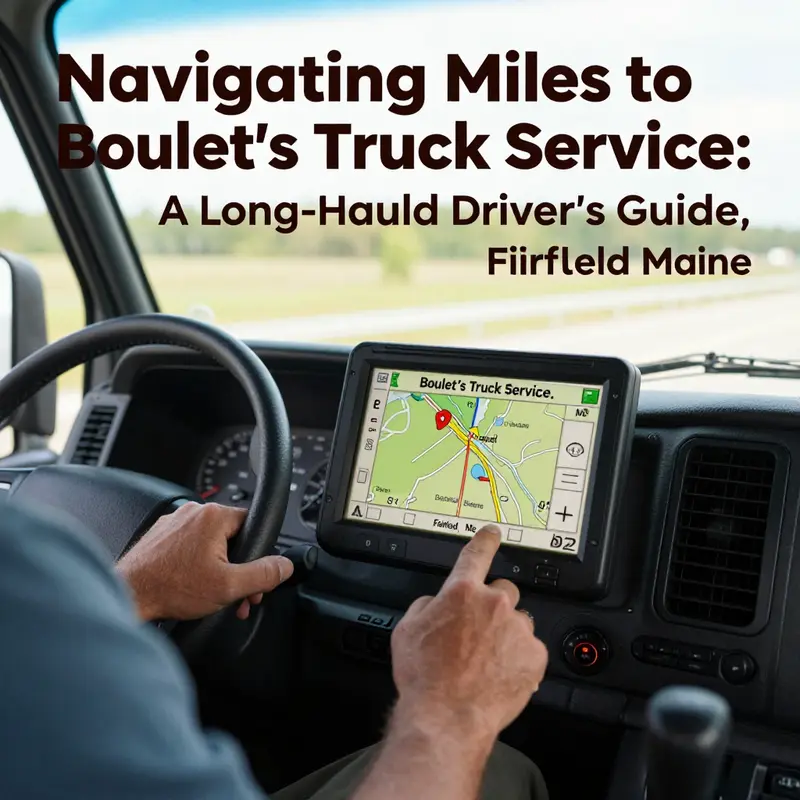
Distance is not a single number when planning a trip to Boulet’s Truck Service. It depends on your starting point, the route you choose, and the time you depart. The service is located at 223 Skowhegan Rd, Fairfield, ME 04937, and the miles you drive are calculated by the map you open. The most reliable way to pin down distance is to pull up a mapping app and enter your current location and the destination. The app will show the miles, estimated travel time, and turn by turn directions.
Different map tools offer different strengths. Google Maps provides broad data coverage and live traffic. Apple Maps integrates well with iOS devices. Waze shines when you want alternative routes due to incidents or slowdowns. In practice you are choosing a method to translate a simple question into a dependable answer that fits your schedule and vehicle.
How the process works: open your preferred tool, enter the destination 223 Skowhegan Rd, Fairfield, ME 04937, and enter your origin. The app calculates miles and minutes, with the option to view fastest or shortest routes. Departure time affects traffic and total time. The miles are a moving value that can shift slightly with the chosen route.
For fleets and larger vehicles there can be route suggestions that avoid tight turns or low bridges. A detour of a few miles may save time and fuel in the end. If weather is a factor, you can choose routes that minimize exposure to adverse conditions while preserving the shortest feasible distance.
Direct links can simplify reuse of a route. A one click link to Google Maps for Boulet’s Truck Service opens a map mode with the destination prefilled and options for driving or walking. You can adjust the starting point and recalculate mileage and duration.
In the broader sense, the miles to Boulet’s Truck Service are a practical part of planning that supports on time arrival and efficient fleet operations. By using your preferred mapping tool, you gain a reliable sense of when to depart, how long the trip will take, and whether to allow a buffer for contingencies. This approach keeps you prepared for service visits, parts pickups, or any schedule that depends on accurate routing information.
Miles, Maps, and Maine: Navigating Your Way to Boulet’s Truck Service in Fairfield
When you plan a visit to Boulet’s Truck Service in Fairfield, Maine, the distance you travel isn’t a fixed number on a map so much as a measured path shaped by where you start, which roads you choose, and the conditions you encounter along the way. The service center sits at 223 Skowhegan Rd, Fairfield, ME 04937, nestled in central Maine among small towns, woodlands, and the slow rhythm of rural travel. The question of how many miles separate you from this address becomes meaningful only when you identify your starting point and consider the typical influences that bend a route in Maine. There is no universal mile count that fits every reader, and that realization is as practical as it is reassuring for anyone planning a trip to a repair shop or maintenance facility in a landscape where distances feel both generous and intimate at the same time. The core truth is simple: distance is a function of origin as much as it is of destination, and the most reliable way to capture that number is to consult a live navigation tool that can account for your specific starting point and the day’s road conditions.
From the nearby town of Skowhegan, the journey to Fairfield often lands in the 15–20 mile range, depending on the exact starting point and the route chosen. You move from a community that sits along broad rural corridors into a central Maine setting where state and local roads converge toward Fairfield. Those miles feel different when you’re traversing gentle hills and long straightaways than they do when weather or roadwork alters the typical flow. And if your point of origin is farther away—say, the state capital city that anchors the region’s administrative heart—the mileage tends to extend into the mid-30s or higher, with estimates hovering around 35–40 miles. Those numbers are approximate, but they create a practical framework for planning. They give you a sense of the scale involved when you need timely repairs, routine maintenance, or a quick vehicle check before a longer drive.
What matters most in real time, though, is not just the number of miles but the conditions that will shape your drive. A road that looks straightforward on a map can present surprises: seasonal weather patterns that plug rural lanes with snow, ice, or slush; late-afternoon glare that makes a two-lane stretch seem longer; or a construction project that nudges you onto a detour that adds several miles and a few minutes to your ETA. Maine’s inland geography amplifies these factors: rolling terrain can subtly widen or narrow a route, and small towns along the way often have variable traffic patterns that shift with the workday or a local event. All of these elements interact with your starting point to determine the day’s actual mileage. The best way to capture those details precisely is to input your location and Boulet’s Truck Service address into a GPS navigation app or a similar routing tool that updates in real time. You’ll receive the exact miles, a realistic travel time, and step-by-step driving directions that respond to current conditions rather than yesterday’s typical patterns.
In a practical sense, the act of measuring distance becomes part of smarter travel planning. If you’re a resident or a fleet operator visiting this shop for maintenance or repairs, you’ll appreciate the way a live route reflects not only mileage but the likely time required for a visit. It’s not just about arriving at the door; it’s about arriving prepared. That preparation includes knowing the best arrival window to minimize wait times, considering the vehicle’s load and how that affects your braking and acceleration on rural roads, and factoring in a margin for weather or traffic. With these considerations, the miles you plan to cover become part of a broader plan that keeps your schedule intact while ensuring your vehicle receives the care it needs.
As you map out the trip, you’ll likely think about the kind of information that makes a difference beyond the numbers. You’ll want to confirm the service offerings at Boulet’s Truck Service so you can anticipate the kinds of maintenance or evaluation that may be most relevant to your needs. The service center’s own site provides insights into the services they provide, which can help you decide, before you depart, whether a stop there will cover your immediate requirements or whether you should arrange for a return visit based on the scope of work. This kind of advance planning—knowing not just the mileage but the service capabilities available at the destination—transforms what could be a simple point-to-point drive into a purposeful, efficient outing. If you’re coordinating a fleet, you may also want to connect the trip to broader maintenance strategies: how distance, downtime, and service cycles inform the lifecycle of your vehicles and the costs tied to keeping them on the road. In that context, it’s useful to consider resources that discuss procurement and maintenance planning in emergency-apparel and truck fleets, which can provide a framework for translating a single service-stop into a smarter fleet-wide approach. For readers seeking a broader perspective on procurement and maintenance planning in similar contexts, this linked resource offers guidance on best practices: fire apparatus procurement.
To complete the picture, think of this visit not as a solitary mile count but as a small part of a larger ecosystem of maintenance, reliability, and readiness. A service location’s address anchors the journey, but the miles traveled—whether short or long—are a reminder of the importance of timely vehicle care in sustaining performance. If you’re preparing for a trip that is partly about travel time and partly about the service experience, consider also the value of a simple pre-trip checklist: verify the vehicle’s basic condition before departure, ensure you have any needed paperwork, and plan for contingencies such as fuel needs or weather-related delays. In Maine, those contingencies are not mere hypotheticals; they are realities that shape every drive and every decision along the route. The result is a travel plan that respects the miles while staying flexible enough to adapt to the moment.
As you finalize your route, you may find yourself returning to the sameQuestion with slightly different numbers depending on your starting point and the day’s conditions. That is the practical virtue of distance when it exists in the real world: it is dynamic rather than fixed. The best practice remains straightforward—use a GPS navigation tool to obtain real-time mileage and ETA, input the precise Boulet’s Truck Service address, and then proceed with the journey only after checking the day’s forecast and any local advisories. In doing so, you turn a potential uncertainty—the exact number of miles—into a reliable piece of your travel plan, one that complements the broader aims of maintenance, readiness, and timely service. For those who want to explore related topics tied to the broader world of service, maintenance, and procurement in fleet operations, there are resources that dig into how modern fleets approach efficiency, uptime, and reliability. And when it is time to reach out to Boulet’s Truck Service directly for details about their offerings, exploring the service’s official site can provide a fast, practical briefing about what to expect when you arrive. External resources can frame your visit within a context of professional maintenance and readiness that extends beyond a single trip.
In short, the miles to Boulet’s Truck Service in Fairfield are not just a number; they are a gateway to thoughtful itinerary planning, safe driving, and well-timed service. The exact figure will come into focus the moment you use a live routing tool from your starting point to 223 Skowhegan Rd, Fairfield, ME 04937. The tool will factor in current traffic, road conditions, and any detours, giving you a precise mileage and an estimated travel time. Whether your trip is motivated by routine maintenance, unexpected repairs, or a planned inspection, the journey itself becomes part of a disciplined approach to vehicle care in a rural, community-centered region. And as you navigate toward the shop, you’ll carry with you the awareness that those miles are more than distance—they are part of the ongoing effort to keep your operations dependable, your fleet healthy, and your work moving forward. For those who want to delve deeper into related topics on fleet maintenance and procurement, a linked resource on the broader subject of procurement practices can provide a complementary perspective to the practical realities of maintenance planning and service relationships. See the following resource for broader context: fire apparatus procurement.
External resource: Boulet’s Truck Service official site for service details and offerings: http://www.bouletstruckservice.com
Internal resource for broader procurement context (formatted as anchor text): fire-apparatus-procurement.
Final thoughts
In summary, knowing the distance to Boulet’s Truck Service in Fairfield, Maine, is not merely a matter of calculating miles; it’s an essential part of maintaining operational efficiency for long-haul drivers and fleet managers alike. The tighter these logistical considerations are managed, the better the performance of your fleet, leading to increased profitability and smoother operations. By understanding how location impacts service access, leveraging navigational tools, and considering all practical aspects in route planning, you can ensure that each journey is as efficient and timely as possible. As the trucking industry moves forward, these insights into distance and service will remain critical to success.