
When the dashboard of your truck displays a ‘Service Airbags’ warning, it’s a signal to take immediate action. This warning can mean a variety of issues with the airbag system, which plays a critical role in your safety and that of your passengers. Long-haul truck drivers, trucking company owners, fleet managers, and maintenance specialists need to understand the implications and costs associated with addressing these warnings. In the chapters that follow, we will break down the considerations regarding the costs of repairs, emphasize the importance of timely interventions, and compare the benefits of OEM versus aftermarket solutions. This comprehensive approach will ensure that you make informed decisions about your truck’s airbag system and overall safety.
The Price of Safety: Decoding the ‘Service Airbags’ Warning and What You May Be Asked to Pay
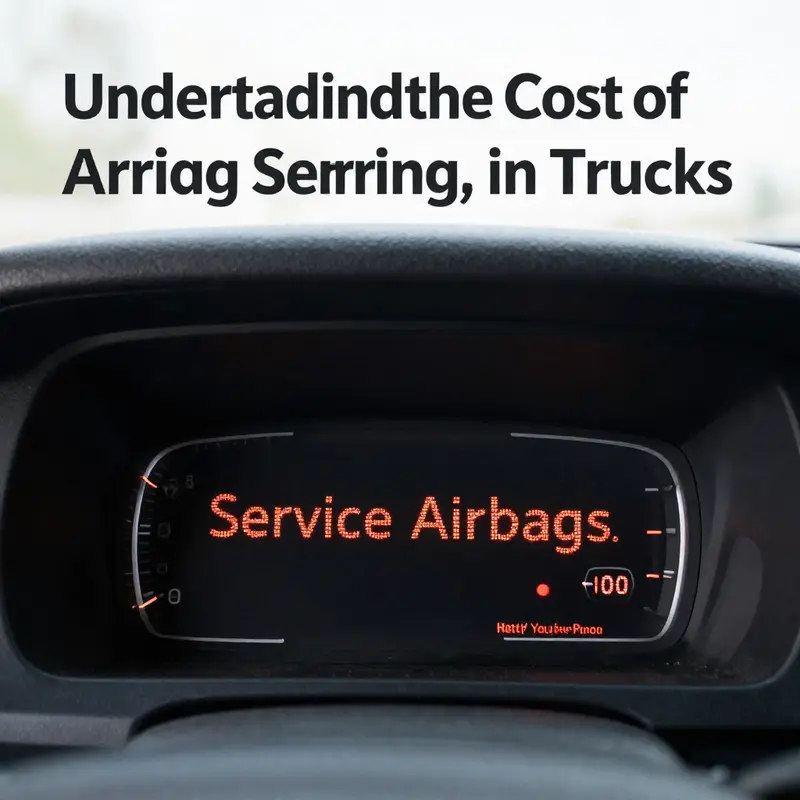
When a big dashboard light suddenly announces “Service Airbags,” the reaction is rarely calm. The phrase itself sounds technical and distant, yet it sits at the center of a very concrete question: should you have to pay to fix a system that is meant to keep you and your passengers safe in a crash? The short answer is often yes, and the longer truth is that the cost reflects the complexity of the vehicle’s safety network, the exact fault, and the conditions under which the problem developed. The airbag system, part of the Supplemental Restraint System (SRS), is not a single component you can glance at and replace with a new knob or switch. It is an integrated web of sensors, modules, wiring, a controller, and, when needed, the airbags themselves. A warning light means a fault somewhere in that web, and a failure in this system isn’t a cosmetic issue. It can affect whether airbags deploy correctly in a crash, or even deploy unintentionally, which can be dangerous in its own right. So while the idea of a paid diagnostic or repair can feel frustrating, the underlying safety logic is simple: a fault in the SRS is not something to ignore or defer for a more convenient time.
To begin with, there is a practical logic to how these costs accumulate. A truck’s airbag system varies in its complexity depending on the make and model, the presence of advanced sensing features, seat-mounted sensors, pretensioners, and the electronic control unit that coordinates deployment. In plain terms, diagnosing a Service Airbags warning is not a matter of swapping one part and driving away. It requires software checks, sensor testing, wiring inspections, and sometimes a careful replacement of components that have worn out or been triggered by a crash. The exact path from warning to repair is heavily contingent on what lights up the diagnostic screen and what condition the parts are in when a technician probes deeper. High-end models with more rapid-sensing airbag systems may require more time and more specialized parts, which translates into higher costs. A driver might observe that a single airbag, such as the driver-side module, could be the problem, or the fault could cascade into multiple airbags, seat sensors, and related wiring. Either route demands careful work to ensure the entire system remains coherent and effective.
Beyond the central airbag modules, it is important to recognize the role of seatbelts and pretensioners in the SRS. Seatbelt pretensioners tighten the belt during a crash, and if they fail or send incorrect signals to the system, they can trigger the warning. The wiring under seats is particularly vulnerable. It endures constant vibration, shifting weight, and exposure to moisture. Over time, connections can loosen, corrode, or degrade enough to disrupt the signals that tell the airbag controller whether or not to deploy. A blown fuse is another common and accessible fault source that can illuminate the warning. Unlike a dramatic sensor failure, a fuse issue often points to an electrical problem that is easier to correct, but not necessarily cheap, because the fix may require more than simply replacing a fuse if the fault also damaged related wiring or components.
Given the stakes, the diagnostic process is not something to shortcut. A certified technician uses a diagnostic scan tool to read trouble codes stored in the SRS controller. Those codes guide the technician to the likely culprit—whether it is a faulty sensor, a degraded connection, a short in the wiring, a failed airbag module, or a combination of issues. The path to repair then unfolds: replacement of a defective sensor or module, re-wiring where necessary, reflashing or reprogramming the airbag control unit, and finally a careful reset of the system. This process is not like routine maintenance; it demands precision, careful testing after each step, and a final verification that all safety features behave as designed. The engine might be off or on, but the technician’s goal remains the same: ensure the SRS will perform properly if a crash occurs.
From a cost perspective, several levers shape the final bill. Vehicle make and model is the first. Luxury or newer heavy-duty trucks with advanced safety features tend to cost more to diagnose and repair because the parts are specialized, the labor is more time-consuming, and the service network may be less common outside major cities. The number of airbags and involved sensors directly influences the price. If only one airbag needs replacement or a single sensor is at fault, the expense might be contained within a modest range. If the fault involves multiple airbags, seat sensors, and the harnessing, the price can escalate quickly. Labor rates and geographic location play a significant role as well; authorized dealerships generally charge higher hourly rates than independent shops, and urban centers tend to be pricier than rural locations. Finally, whether parts are OEM or aftermarket matters. OEM parts offer a higher reliability net, which many owners value for safety, but they come at a premium. Aftermarket equivalents may be cheaper and sometimes perfectly adequate, but the risk of compatibility issues or variable performance exists in safety-critical systems.
Because the price can vary so much, the prudent approach is to view the diagnostic and repair as a package of safety obligations rather than a simple line-item repair. If you have a warranty that still covers your truck, the fault may be handled at little to no cost if it stems from a manufacturing defect rather than normal wear and tear. This distinction is not always obvious at first glance. Warranties typically exclude issues arising from neglect, improper maintenance, or modifications that alter the original design. In other words, if ignoring warning signs extended the problem or if modifications compromised the SRS, you may be responsible for the costs even while the warning is taken seriously. This is not about punishment for a mistake; it is about ensuring the system is restored to its intended safety standard, with all the checks and balances needed to keep occupants protected.
The logos of responsibility are not just about the truck owner’s wallet. They also reflect a legitimate public-safety dimension. Driving with a known airbag fault is not only risky; in some jurisdictions it can violate safety regulations designed to protect road users. The correct behavior when the Service Airbags warning appears is to treat it as a critical repair need rather than a mere inconvenience. The vehicle should be inspected promptly by a qualified technician, with no compromises about the quality of parts or the thoroughness of testing after the repair. A quick, shallow fix might address the symptom, but it could leave the root cause unaddressed, with the possibility of continued alerts, poor deployability, or unexpected deployment in a non-crash event. This is the kind of scenario where patience, proper diagnosis, and a well-documented repair path pay off in long-term safety and fewer surprises on the road.
As a practical matter, drivers and fleet operators considering such a repair should request a clear, itemized estimate from the service provider. The estimate should separate parts and labor, and it should specify whether the parts are OEM or aftermarket. The shop should also explain the diagnostic steps, the codes found, and the recommended course of action. If a dealer or a specialized shop is proposing a more aggressive repair, ask for alternatives and a timeline. If a fault appears to be driven by a simple wiring issue, you might save money by clarifying whether a targeted repair could restore functionality without a full airbag replacement. On the other hand, if the fault is tied to a deployed airbag that has not been reset, the cost will inevitably include replacement of the bag itself, which is one of the costliest parts of an SRS repair.
In addition to costs, there is value in knowing the practical realities of timing. A diagnostic scan can identify the fault quickly, but the replacement or repair may require a technician to wait for parts, especially in models that use hard-to-source airbags or sensors. The best approach is to align expectations on both sides of the counter: the technician explains the fault precisely, and the owner asks for a realistic schedule and a contingency plan if multiple parts are involved. While some owners gravitate toward the cheapest route, safety should never be compromised for the sake of a smaller initial bill. It is not only about making the system operational again; it is about ensuring it remains reliable under extreme conditions when it is needed most. That reliability comes from high-quality parts, thorough testing, and a careful revalidation of the entire SRS after any repair.
Exploring the decision consciously also means recognizing the value of credible maintenance resources. For drivers who want to educate themselves about common causes and appropriate responses, a structured battery of explanations helps put the repair in perspective. A reliable overview points to loose or corroded wiring under seats, sensor or pretensioner faults, and blown fuses as frequent culprits, while underscoring that an accurate diagnosis is essential before any replacement. The emphasis on prompt action is not merely a matter of financial relief; it is a life-safety discipline. The work done today may prevent a failure tomorrow, which is particularly critical when you are operating in remote areas or on long-haul routes where service options are few and far between.
To bring this together, a practical, safety-forward mindset governs the discussions around who pays and how much. If your vehicle is under warranty and the fault aligns with a covered defect, you should expect coverage for diagnostic time, parts, and labor related to that defect. If not, the ownership of the cost falls to the owner, subject to the specific terms of maintenance records, past neglect, or previous warnings. The distinction between wear and tear and a defect can be subtle, and the safest path is to treat any Service Airbags warning as a signal requiring professional assessment rather than a DIY mistery. The technician’s role is not just to fix a light; it is to restore a system that guards lives, and that obligation shapes the value and necessity of each repair.
Within this broader frame, it can be useful to anchor the discussion in a broader maintenance culture for trucks. Regular, proactive checks of seat wiring, fuses, and connectors can catch issues before they escalate into a warning. A proactive approach—documented inspections, timely maintenance, and a clear record trail—helps fleets manage financial risk while preserving safety. It also helps to view the repair as part of a continuum of responsibility: ensuring the safety features work as intended today, while sustaining the protection they are meant to provide in the heavy-load, high-risk contexts in which trucks operate. For readers who want to deepen their practical knowledge of maintenance philosophy and how it relates to safety-critical systems, a resource focused on disciplined maintenance practices offers a helpful scaffold: fire-truck-maintenance-training-importance.
In sum, the price you pay when a truck says Service Airbags is not merely a fixed sum. It is a function of the fault’s breadth, the vehicle’s complexity, and the safety standard you choose to uphold. It is reasonable to expect a diagnostic fee, and it is common to incur substantial costs if multiple components must be replaced. Yet this is a market where the investing in safety now pays off in reliability later. The upfront expense is a hedge against the consequences of a faulty deployment in a crash, which could be far more costly in human or financial terms. The guidance that emerges from careful consideration is straightforward: treat a Service Airbags warning as a safety-critical signal, seek a thorough diagnosis from a qualified technician, insist on a clear, itemized estimate, and weigh warranty coverage and part quality in your decision. By aligning your approach with professional standards and a clear understanding of fault pathways, you minimize risk and create a transparent path through what can otherwise feel like a murky financial decision. For readers seeking a concise, research-supported overview of the causes and solutions, a well-regarded external reference provides an informative companion piece: Autocar’s explanation of airbag light causes and remedies. We leave that resource for readers who want to compare expert perspectives and terminology as they prepare for a diagnostic session and a potential repair.
External reference: Autocar – Airbag Light On: Common Causes and Solutions Explained.
The Price Behind the Service Airbags Warning: Do You Really Have to Pay When a Truck Says Service Airbags
When a truck dashboard lights up with a Service Airbags warning, it can feel like a moment of detour in an otherwise steady ride. The message is not a mere courtesy alert; it signals a fault in the airbag system that protects occupants in a crash. The practical implication is simple but consequential: until the system is diagnosed and repaired, you are driving with a safety feature that may not respond when it matters most. A responsible owner treats this warning as a real maintenance issue rather than a nuisance light. The path from warning to safe operation is not a single, uniform journey, because airbags and their control systems are a mesh of sensors, wiring, modules, and memory that vary by truck make, model, year, and even the specific fault detected. Understanding what the warning likely means, what it costs to fix, and who pays helps prevent a vulnerable situation from becoming a financial shock after a collision. In practice, you will find that the cost to diagnose and repair a Service Airbags fault can range widely, depending on the fault’s nature and the truck’s hardware. A basic diagnostic scan may reveal a sensor miscalibration or a wiring fault and might cost a few hundred dollars. If a single component—the driver side airbag, for instance—needs replacement, the bill can land roughly in the middle of the spectrum, perhaps between five hundred and fifteen hundred dollars. However, when the issue involves multiple airbags or sensors, or when the repair requires replacing the airbag control module, the price can move up quickly. In more complex installations, or in cases where the airbag has deployed and requires a full reset or replacement, total costs can exceed two thousand dollars. These estimates reflect typical shop rates in many markets, with higher costs in urban areas or at authorized dealerships where labor clocks are steeper and OEM parts are standard practice. The bottom line is that the warning should be treated seriously, not as a reason to press through a quick fix or to delay a proper diagnosis. The airbag system is a critical life-saving feature, and its failure can be more than a safety issue; it can contravene safety regulations in some jurisdictions and may void warranty protections if the fault is traced to improper maintenance or aftermarket modifications. The diagnostic process begins with a certified technician who uses specialized scanning tools to pull fault codes from the airbag control unit and to run a sequence of checks on the system. The codes pinpoint whether the fault lies with a sensor, a wiring harness, a connector, the airbag module itself, or a deployed airbag that needs resetting. In some cases, a light on the dash may reflect a non-deployed fault that has a straightforward repair, such as a loose connection or a damaged sensor. In others, the issue is more stubborn and requires a deeper inspection, including continuity tests on wiring harnesses that can stretch through the steering column, under the seats, or along the vehicle’s chassis where vibration and temperature changes can take a toll over years of service. A decent diagnostic will separate the signal from the noise, allowing the technician to propose an explicit repair plan with an itemized estimate. Speed and accuracy in this phase matter because a misdiagnosis can lead to replacing parts that do not address the root cause, wasting time and money and potentially leaving the truck with the same warning reappearing after a short period. The price tag attached to repairs is rarely a flat figure because it depends on the componentry involved and the labor required to install it. The average repair costs form a broad corridor: on the low end, a simple diagnostic with minimal part replacement might be around three hundred dollars. On the high end, more involved work such as replacing a sensor assembly or a single airbag unit can push costs toward twelve hundred dollars. And where the issue is more intricate—such as replacing the airbag control module or performing extensive rewiring—the totals can climb beyond two thousand dollars. These numbers reflect typical outcomes in many repair shops, but they can shift based on a few key factors. The make and model of the truck, the year of manufacture, and the specific airbag system architecture all influence price. Some modern or high-end trucks use more complex safety networks, with multiple microprocessors and advanced crash sensors that require more specialized parts and longer labor times. The number of airbags involved also matters. If the fault is localized to a single seat airbag, you’re generally looking at a smaller bill than if several airbags or related sensors are implicated. If the problem involves a sensor that sits in a hard-to-reach place, or if the wiring harness is damaged along a long route, technicians may spend more time tracing the fault, and that translates into higher labor costs. The choice between OEM parts and aftermarket components can swing the total as well. OEM parts tend to be more expensive, but they often come with stronger assurances of compatibility and reliability, which matters for a system as safety-critical as airbags. Aftermarket parts can reduce the sticker price but may have implications for warranty coverage or long-term reliability. In many cases, the diagnostic phase is the most informative and least expensive portion of the journey. A clear fault code can guide a targeted repair rather than a broad, expensive replacement campaign. It is also common to encounter situations where the airbag light is triggered by a non-safety-critical issue, such as a loose connector that can be resolved with a simple reseating of a harness. Yet a diagnosis that focuses on the greet of symptoms—an intermittent fault, a non-deployed warning, or conflicting codes—requires careful navigation by a skilled technician. When the truck is under warranty, the story changes. If the Service Airbags fault is due to a defect in materials or workmanship that falls within the scope of a manufacturer warranty, the repair should be performed at no cost to the owner. The exact terms of coverage depend on the warranty agreement and the vehicle’s age, but the general principle is that a genuine manufacturing defect should be repaired or replaced without charge. Conversely, if the fault arises from aftermarket modifications, improper maintenance, or damage from an accident, the owner is likely responsible for the repair costs, possibly including diagnostic fees. This highlights the importance of maintaining a detailed service history and ensuring that any modifications to electrical or safety systems are performed by qualified technicians using approved procedures. Recalls add another layer to the cost question. In some instances, manufacturers initiate recalls for airbag systems, especially in models affected by high-profile defects such as those seen with certain Takata airbag designs. When a model is subject to an active recall, manufacturers are legally required to perform the corrective work at no charge to the owner, and the work should be performed at an authorized facility. The process is not automatic; you should verify whether your truck is included in an active recall through the official safety agency database. The National Highway Traffic Safety Administration maintains a recall database that is the best resource for this inquiry, and owners are encouraged to search by VIN or model to confirm recall eligibility. This aspect of the wallet is as much about safety as it is about compliance with safety regulations. The practical implications for the vehicle owner are clear: if your truck is under warranty for this specific issue, expect the repair to be covered; if a recall applies, the repair should be performed with no out-of-pocket cost and with the assurance of regulatory backing. If neither warranty nor recall applies, you should be prepared for a payment that reflects the fault’s root cause and the parts involved. The diagnostic phase will reveal whether you are dealing with a sensor fault, a wiring issue, a deployed airbag that needs resetting, or a malfunctioning airbag control module. Each scenario maps to a different cost trajectory, and a transparent, itemized estimate is essential before committing to work. It is prudent to request a breakdown that lists the parts, labor hours, and labor rate, along with any diagnostic fees that may be charged even before parts are replaced. Ask about the use of OEM versus aftermarket parts and whether any portion of the work might be eligible for warranty consideration or recall repair. If you are responsible for the bill, there is still room to manage the financial impact. Some shops may offer alternatives such as refurbished sensors or remanufactured modules, though this raises questions about reliability and warranty. The choice between repairing the smallest possible subset of the system and replacing larger assemblies should be guided by the fault’s root cause and the likelihood of a long-term fix. For the everyday truck owner, one of the most effective strategies is proactive maintenance and early diagnosis. When a driver notices the Service Airbags warning, it should trigger an immediate appointment with a qualified technician—ideally one who regularly handles safety systems. Waiting can lead to a situation in which the fault worsens, potentially triggering more expensive repairs or safety compromises later. The road to a solution often involves a conversation about expectations and constraints. Understanding the potential costs helps frame that conversation. A reasonable timeline for repair begins with diagnostic testing, followed by an assessment of exact part needs, and then a repair plan that prioritizes safety and reliability. In some cases, you may discover that a simple fix—such as reseating a connector—addresses the warning, returning the system to proper function with a modest bill. In other cases, you may be looking at replacing the airbag module, a sequence that can push the total into the thousands, especially if multiple airbags are affected. Throughout this process, balance is essential: weigh safety, regulatory compliance, and financial feasibility. In the end, while you may not always have to pay for repairing a Service Airbags issue, the question is less about paying or not paying and more about paying correctly and paying wisely. A cautious approach is to treat the warning as a legitimate maintenance event and proceed with a diagnostic that clearly identifies the fault and its cause. Work with a trusted mechanic or authorized service center that can provide an honest, transparent estimate with an explanation of each cost component. This approach minimizes the risk of surprise charges and helps safeguard the vehicle’s safety features for years to come. To further support a well-informed decision, consider how maintenance resources and maintenance philosophy might echo beyond passenger trucks into broader heavy-duty fleets. Reading about consistent maintenance practices and proactive risk mitigation in related trucking topics can provide context for the value of regular system checks and planned upkeep. For readers who want to dive into more on the maintenance mindset and best practices, explore related content in the broader maintenance library of the site. fire-truck-maintenance-training-importance. The takeaway is straightforward: prompt, informed action pays off in safety and in cost control over the life of the vehicle. Finally, the question of whether you will pay when a Service Airbags warning appears is answered by considering warranty coverage, recall eligibility, and the underlying fault. A simple light on the dash can become a larger issue if ignored. The diagnostic information shapes the financial outcome, and the owner who asks pointed questions—about OEM versus aftermarket parts, about the scope of repair, and about recall status—will typically arrive at a fair resolution. For recall information and current safety notices, the National Highway Traffic Safety Administration maintains a database that is a reliable first stop for owners seeking official guidance and eligibility details. Accessing this resource helps ensure that any recalls are addressed promptly and that the repair, when required, is performed at no cost if the recall covers the fault. You can consult the NHTSA recalls database for authoritative, up-to-date information on whether your model is affected and what steps to take to secure timely recall repairs. External resource: NHTSA recalls. https://www.nhtsa.gov/recalls
When the Dash Says Service Airbags: Urgency, Costs, and Responsibility

The moment a truck’s dashboard lights up with a Service Airbags warning, the vehicle ceases to be a calendar of bells and whistles and becomes a warning beacon for safety. This is not a vague advisory to maybe get around to someday. It is a live signal that the vehicle’s passive safety system—the airbag network—has detected a fault that could alter its function in a crash. The SRS, or Supplemental Restraint System, operates continuously in the background, running checks that ensure sensors, wiring, modules, and, if necessary, the airbags themselves will deploy correctly when a collision occurs. When the light comes on, it means something in that chain has been compromised. The fault could be as simple as a loose connector shaken loose during a rough ride, or as complex as a failed sensor, a faulty airbag module, or a miscalibrated crash sensor that no longer communicates correctly with the rest of the system. In practice, every such fault is a signal to pause, diagnose, and repair. Driving with an untrusted airbag system is risking the one safety feature you hope will save lives at the moment of impact. The cost, in both money and safety, follows from how and why the warning appeared, and that makes the decision to repair urgent, not optional.
The diagnostic path begins with understanding the nature of the warning. A simple loose wire can trigger the light without indicating a dangerous failure elsewhere. Yet the same warning can also reflect a deployed airbag that has not been properly reset, or a degraded sensor that feeds erroneous data to the system computer. The underlying principle is the same: the system must be read with precision, and the fault should be isolated with tools designed specifically for SRS diagnostics. This is not a fix you can gamble on with a generic scanner or a best-guess approach. A certified technician will use a specialized diagnostic scan tool that can access airbag fault codes, read freeze frames from prior incidents, and verify the integrity of the crash sensors, steering wheel clock springs, seat belt pretensioners, and the airbag modules themselves. The ability to distinguish between a sensor warning and a deployed module is crucial; a deployed or damaged airbag will require replacement and a reprogramming step to ensure the system recognizes the new components and does not display a fault again after repair.
From there, the repair options unfold in a way that underscores why costs can vary sharply from one truck to another. The cost envelope for airbag-related work depends on the vehicle’s make and model, as well as how many airbags or sensors are involved. A single airbag replacement—driver or passenger side, for example—may fall in a range where parts and labor are manageable, but even at the lower end it can escalate quickly if the repair requires a specialized module or a precise wiring harness that must be integrated with the vehicle’s body control module. If multiple airbags or several sensors are implicated, the bill tends to rise substantially. In modern trucks, the airbag system can be tightly integrated with other safety and vehicle control systems, and some models use more sophisticated sensors and higher-speed data communication networks, all of which increases both the part cost and the labor time. The dealership route routinely carries premium pricing because dealerships must stock OEM components and use technicians trained specifically on that brand. Independent shops, conversely, may present more competitive rates but might have varying access to the latest factory-level diagnostics. The range you see on the bill, therefore, is not random; it reflects the fidelity of the diagnostic process and the critical nature of the parts involved.
Labor costs also play a decisive role. Urban areas, busy service centers, or authorized dealerships tend to charge more per hour than smaller, independent shops. A higher labor rate doesn’t automatically mean worse service; it often signals access to original equipment parts, factory-level diagnostic tools, and technicians with verified certifications. The decision between OEM and aftermarket parts further shapes the total price. OEM parts are typically more expensive, but they offer guaranteed compatibility with the vehicle’s software and sensors and align with the original design intentions. Aftermarket parts may reduce upfront cost but can carry questions about long-term reliability or the exact fit for a complex system like an airbag network. For an owner trying to balance safety with budget, these choices should be guided by a clear understanding of the tradeoffs and a trusted professional’s recommendation after a precise diagnosis.
As part of this decision, the notion of warranty is not a mere footnote. If the truck is still within the manufacturer’s warranty period, many airbag system failures will be covered, at least in part, by the warranty. A fault that arises from a defect in a component can be repaired without an out-of-pocket expense beyond any applicable deductibles. However, warranties have limitations. Pre-existing faults, improper maintenance, or damage from an accident can complicate coverage and reduce or void it. The coverage can also differ by the exact element of the system involved. An airbag module that failed due to a factory defect may be covered, while a wiring fault caused by an impact or improper handling might not. The prudent path is to consult the warranty documentation and a certified service center that can interpret the terms with respect to your specific truck and its history.
Out of warranty, the economics of airbag repair can feel daunting. The complexity of the system, the need for specialized tools, and the requirement for precise calibration all push the price upward. A diagnostic scan to identify the fault is rarely a one-off cost; it often serves as the starting point for the repair plan. The service team must verify that the fault codes correspond to the actual hardware condition and not to a transient sensor fault or a data misread. When the diagnosis is complete, the repair plan may include replacing a sensor, a passenger airbag module, or the steering-wheel clock spring, followed by reprogramming or coding to ensure the new components talk to the vehicle’s safety network correctly. Any misstep in this process can leave the system in a faulted state or even create new problems, so technicians move carefully through verification steps after replacement.
An important practical reality is whether an insurer will help shoulder the cost. Insurance coverage for airbag repairs varies by policy and by whether the airbag fault is deemed pre-existing or collision-related. If an accident caused damage, or if the accident exposes a latent weakness in the system that the insurer agrees contributed to the risk, some or all repair costs might be recoverable under the policy. However, if the warning stems from a pre-existing fault that never involved a collision, most policies do not cover the repair. In such cases the financial responsibility falls to the owner, the warranty terms, or possibly a manufacturer recall program if one exists for the model. To avoid ambiguity, it is wise to confirm with the insurer how airbag repairs are treated before committing to major work, and to obtain a written estimate that itemizes parts and labor.
The balance of cost versus safety is not merely financial. The decision to delay or proceed with repairs carries safety implications that extend beyond a single trip. A Service Airbags warning means the vehicle’s most critical passive safety system is being compromised. Airbags are designed to work as part of a coordinated network that includes seat sensors, pretensioners, and the harnessing system. A fault can degrade the system’s readiness to deploy in the exact sequence required during a crash, or even prevent deployment altogether. In a world where every mile may present a collision risk, the choice to investigate promptly is also a choice to protect occupants. The risk of ignoring the warning—in addition to potential legal consequences if the vehicle is deemed unsafe to operate—should push owners toward a quick diagnostic and an evidence-based repair plan.
As you weigh the options and the costs, remember that the guidance offered here benefits from a careful diagnostic approach. A reputable shop will begin with a precise code read and a physical inspection of connections and harnesses. They will verify whether the issue is a sensor fault, a wiring problem, a deployment that has not been reset, or a failed airbag module. They will then present a repair plan with clear stages, including the possibility of a calibration reset and the reestablishment of communication with the vehicle’s central safety controller. The aim is not merely to fix a light but to restore confidence that the airbag system will perform as intended when it matters most. To support this process, many technicians emphasize transparency: they will show the fault codes, explain what they found, and provide options with and without OEM parts, plus a realistic timeline for completion. This careful approach protects you from surprises and aligns your spending with safety and reliability.
For those who want a broader perspective on how maintenance and safety readiness intersect in heavy-duty vehicles, consider exploring resources that focus on upkeep and reliability. A good starting point is to engage with practice-based training and maintenance guidance, such as fire-truck maintenance service training, which emphasizes the discipline of preventive checks and system integrity. This kind of resource underscores a central idea that runs through any discussion of Service Airbags: the goal is readiness, not just repair. By thinking about maintenance as a continuous, proactive discipline, owners and operators can reduce the likelihood of unexpected faults and can make smarter, safer decisions when a warning does appear. See fire-truck maintenance service training for insights into structured maintenance thinking and how it translates into real-world readiness.
In the end, the question of “Should you pay?” rests on a blend of safety priority and financial planning. If the fault is covered under warranty or insurance, the path forward can be clearer and less burdensome. If the fault is outside warranty, the decision may hinge on the number of airbags involved, the parts required, and the shop’s diagnostic and repair capabilities. The safest choice is to treat the Service Airbags warning as a non-optional alert demanding professional assessment. Seek a diagnostic report that explains the fault, a repair plan that outlines parts and labor, and a clear estimate that reflects the actual scope of work. When you understand the specific components at risk and the repair steps required, you can make a responsible financial decision without compromising safety.
For authoritative information on airbag systems and their maintenance, refer to the National Highway Traffic Safety Administration (NHTSA): https://www.nhtsa.gov. This resource provides official guidance on airbag safety and the importance of timely service, reinforcing the message that a Service Airbags warning is a driver’s cue to act, not a cue to delay.
External resource: https://www.nhtsa.gov
When a Dash Says ‘Service Airbags’: Navigating Costs, Compliance, and Safety in Truck Maintenance
A warning light on a truck’s dashboard can feel like a blunt hammer, but it’s telling you something precise and non-negotiable: the airbag system has detected a fault that could undermine safety in a crash. This is not a signal to ignore or to wait until a more convenient moment. The risk isn’t merely about a sudden failure to inflate during a collision; it’s about the entire system’s integrity, including sensors, wiring, control modules, and the way the system is recalibrated after any incident. The decision to pay for service airbags, and what you end up paying, depends on a tangled mix of factors that extend far beyond the sticker price. To navigate this correctly, you must treat the warning as a safety-critical maintenance issue, not as a cosmetic or cosmetic-like feature that can be deferred without consequence.
First, it helps to anchor the discussion in the core distinction between OEM and aftermarket airbags. OEM airbags are manufactured to the exact design specifications of the original equipment in your truck, by the same maker that produced the vehicle. They are designed to fit precisely, work with the same control modules, and deploy in the same way as the parts that left the factory. This precise integration matters because airbag safety depends on the entire system’s calibration—sensors, wiring harnesses, the module, and even the timing of deployment. When a fault triggers the warning, a diagnostic scan is necessary to locate the source. It could be a sensor failure, a wiring issue, or a degraded connector, and it can involve a single airbag or multiple components. The price tag grows quickly as more parts are involved and as the work requires specialized equipment and trained technicians who understand the vehicle’s specific safety architecture.
On the other hand, aftermarket airbags—produced by third-party manufacturers—can be less expensive at the point of sale. Yet their safety performance, reliability, and compatibility vary widely. The risk isn’t only about whether the bag will inflate; it’s about whether the deployment timing is correct, whether the airbag will fit and function with the vehicle’s current modules, and whether the system will pass safety inspections or satisfy an insurer’s expectations. In many jurisdictions, post-collision repairs require airbags to be replaced with parts that meet manufacturer specifications or at least meet the safety standards recognized by local regulators. The line between affordable and prudent can blur quickly when the long-term costs—inspections, recertifications, potential liability—are added to the initial price difference.
The decision about what to buy and who should perform the work hinges on a few simple truths about safety and compliance. First, a faulty airbag system is, by design, a critical safety feature, not a hobbyist upgrade. The airbag control module relies on a precise calibration with the sensors and with the wiring network. Any misalignment can result in a failed deployment or a deployment at an incorrect time, possibly causing injury rather than preventing it. Second, many laws and insurance policies assume that safety-critical systems have been repaired to the vehicle’s original specification or a specification that has been certified as equivalent. This is why the cost discussion often lands on OEM versus aftermarket: OEM parts carry a built-in assurance of compatibility and regulatory acceptance, while aftermarket parts demand careful scrutiny of the part’s origin, the quality standards it meets, and the warranties backing it up. In some cases, insurers may require OEM parts to preserve coverage, while in others, they may allow certified aftermarket parts if they meet the same performance criteria. The bottom line is that the decision is rarely solely about price; it’s about safety, legality, and the long-term implications for the truck’s uptime and the driver’s protection.
The price ranges you’ll encounter reflect both the breadth of the problem and the local market realities. Replacing a single airbag can run from roughly five hundred to fourteen hundred dollars, depending on the vehicle’s make and model, how quickly the fault is diagnosed, and whether the part is OEM or aftermarket. If the fault involves multiple airbags or sensor clusters, or if the fault requires replacing the entire airbag system module, total costs can escalate to two thousand to four thousand dollars or more, particularly when performed at an authorized dealership. Labor rates are a major driver of price, and shop location can push the total up or down. Urban areas and dealer service centers typically command higher labor rates than independent shops. OEM parts, while costlier, tend to deliver a smoother fit, fewer compatibility issues, and a higher likelihood of maintaining warranty protections and insurance integrity after repairs.
It is also essential to recognize why a diagnostic scan is a prerequisite. A Service Airbags warning does not always mean that a bag has deployed in a previous crash. It can indicate a sensor fault, a blown fuse, a compromised wiring harness, a degraded connector, or even a miscalibration of the airbag module. A certified technician uses specialized diagnostic tools to identify the exact cause, then confirms whether replacement is necessary. In some cases, a reset after a non-deploying fault might be possible, but that reset must not be performed without confirming that the fault is resolved. Resetting an unresolved fault can mask a real danger and may lead to the failure of the system when it is most needed. Careful testing, correct part selection, and proper calibration are non-negotiable steps in restoring a system that can protect lives under high-stress conditions.
From a safety perspective, the case for paying for a properly executed airbag repair is straightforward. The system’s ability to protect occupants depends on the integrity of the entire chain—from sensor input to deployment timing. Delivering money into OEM parts can provide a higher level of confidence because the design intent, testing standards, and calibration processes are aligned with what the vehicle originally required. It also reduces the risk of regulatory complications down the road. If you value long-term reliability and predictable performance, OEM airbag replacements are typically the safer bet, even though the upfront cost is higher. Aftermarket parts can be appropriate in some circumstances, especially when they come from reputable manufacturers that meet or exceed regulatory and safety standards, but they require thorough due diligence. You should ask questions about certificates of conformity, performance testing, and the warranties that accompany the part.
Cost considerations, therefore, should be balanced with practical concerns about downtime and future reliability. A warehouse or fleet that depends on trucks daily may prioritize uptime and predictable servicing, which can push the decision toward OEM parts and certified technicians who can deliver a robust, traceable service record. A private owner, facing an immediate repair budget, might contemplate aftermarket solutions and may be more flexible about timelines, but should still demand clear assurances about safety and compliance. Either path benefits from shopping around, obtaining multiple quotes, and ensuring that the quoting body includes diagnostic fees, part costs, labor, calibration, and any necessary post-repair testing. Without a transparent, itemized estimate, it’s easy to overlook hidden costs, such as reprogramming the airbag control module or recalibrating the crash sensors, both of which are central to the system’s correct function.
An important step in the decision process is to assess the broader implications for safety inspections and insurance coverage. A repair that does not restore the airbag system to its original specification can fail a post-repair safety inspection or undermine a claim should another collision occur. Even if a warning light disappears after a reset, it doesn’t guarantee that the system is functioning correctly. A failure to meet regulatory expectations can jeopardize vehicle registration or result in penalties, depending on the jurisdiction. Therefore, beyond the immediate repair price, you must factor in possible costs tied to regulatory compliance and potential insurance implications. If a technician recommends OEM parts and proper calibration, the long-term benefits—reliability, regulatory peace of mind, and a maintenance history that supports insurance claims—often justify the higher upfront investment.
For those navigating this with fleets or company vehicles, taking a structured approach to maintenance can help manage risk and costs. Establish a standard operating procedure that prioritizes prompt diagnostics when a Service Airbags warning surfaces. Maintain relationships with trusted service centers that have experience with the truck’s make and model, and insist on a transparent plan that outlines the steps to resolution, including whether OEM or certified aftermarket parts will be used, the anticipated down time, and any required recalibration procedures. When selecting a service partner, review their track record for safety-critical repairs, the warranties they offer on parts and labor, and their ability to provide a documented service history. In this context, the decision is less about a single dollar amount and more about sustaining a level of safety and reliability that protects drivers and preserves the vehicle’s value over time.
To support a more informed choice, consider leveraging resources that focus on maintenance excellence and uptime. For example, a credible maintenance program or trusted guidance on uptime and product support can help a fleet manager align repair decisions with overall safety and performance goals. Maximize Fire Apparatus Uptime and Product Support offers a perspective on sustaining critical systems and ensuring that repairs contribute to steady, predictable operation. While the context here centers on fire apparatus rather than road trucks, the underlying principle—prioritizing dependable, well-supported services for essential safety systems—translates well to any fleet that relies on those controls for safety and compliance. The core takeaway is consistent: investments in robust maintenance and qualified technicians pay dividends in uptime, safety, and peace of mind.
In practice, the path you choose should begin with a clear assessment of risk, an understanding of the parts involved, and a plan for ongoing safety checks after the repair. After the diagnostic phase confirms the fault source, the choice between OEM and aftermarket should be revisited in light of the latest regulatory guidance and your insurer’s stance on coverage for post-repair safety components. You should demand a precise, written estimate that includes diagnostic fees, part costs, labor, calibrations, and post-repair testing. Ask whether the quoted price assumes OEM parts or certified aftermarket parts and what warranties accompany each option. If you’re ever uncertain, obtain a second or third opinion from technicians who specialize in airbag systems and who can provide an independent assessment of safety, fit, and compatibility with the control module. Safety, after all, is not a negotiable line item; it is the baseline expectation for any vehicle that moves with passengers aboard.
Ultimately, whether you pay more for OEM or less for an aftermarket option, the essential rule remains: never compromise on the diagnostic process or on the post-repair validation. The Service Airbags warning is a signal that demands attention, not a cue to delay. Prioritize a service plan that emphasizes proper fit, calibrated deployment, and compatibility with the vehicle’s safety architecture. In the end, the decision should reflect a thoughtful balance of safety, legal compliance, long-term reliability, and total cost of ownership. By acknowledging the trade-offs and engaging with qualified professionals, you can restore the protective function of the airbag system and keep your truck on the road with confidence—even when the dashboard emails a clear warning that safety matters more than price alone.
External resource for authoritative guidelines: For regulatory and safety standards pertaining to airbag replacements, refer to the National Highway Traffic Safety Administration’s guidance on airbags: https://www.nhtsa.gov/vehicle-safety/airbags.
Final thoughts
Addressing the ‘Service Airbags’ warning in your truck is not just about financial costs; it’s fundamentally linked to safety. Understanding the implications, potential repair costs, and the necessity of timely intervention plays a critical role in your decision-making process. Furthermore, the choice between OEM and aftermarket parts can influence both your wallet and the reliability of your vehicle’s airbag performance. Remember, being informed empowers you—make choices that prioritize both your safety and financial well-being.