
Understanding the operational status of Republic Services on November 24, 2017, reveals much about how major waste management companies handle potential disruptions during holidays. For long-haul truck drivers, trucking company owners, and fleet managers, knowing whether services run on holidays can significantly impact planning and logistics. We will dive into Republic Services’ routines, the specific impacts of holiday schedules on operations, and the ways to confirm services were in operation on that day.
Tracking the Fleet on a Holiday: Investigating Republic Services Truck Operations on November 24, 2017
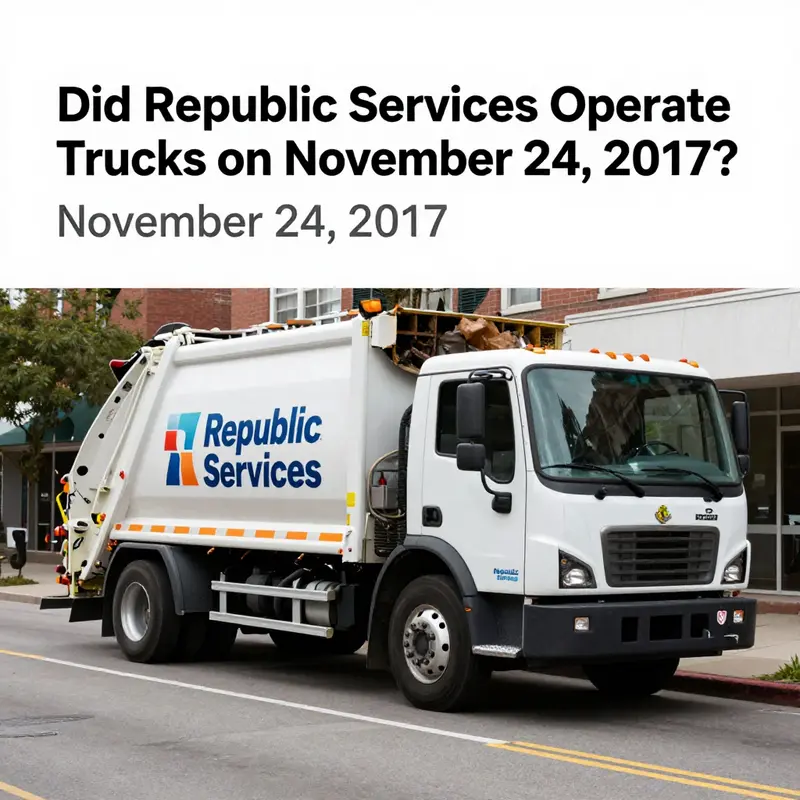
On the morning after Thanksgiving in 2017, public records offer only a partial view of whether Republic Services trucks were deployed on November 24. The available sources emphasize policy statements and general calendars rather than granular, market-by-market route data. Without access to internal dispatch logs or GPS traces, a definitive, nationwide yes or no cannot be confirmed from public records alone. Yet routine operations typically persist through holidays, subject to local weather and contractual terms. In some markets, crews may run nearly normal schedules; in others, holiday notices or weather advisories might prompt adjustments or temporary skips. The absence of a comprehensive public archive does not prove nonoperation; it reflects how operational data is stored and shared in the waste-management sector. Researchers are encouraged to triangulate customer notices, local advisories, and indirect signals such as local press coverage or social media reports to infer general patterns. This framing emphasizes understanding rather than pinning down a single definitive record. The historical lesson is that large service networks balance policy with local realities, and public transparency often captures the broad strokes rather than granular daily movements. External overview resources can provide context about Republic Services’ scale and approach to service delivery.
Holiday Footprints in a Moving Fleet: Tracing Republic Services’ Truck Operations on November 24, 2017
On the day after Thanksgiving, a nation returning to routine tasks assesses the reliability of essential services in miles traveled and loads moved. On November 24, 2017, Republic Services faced the practical question of whether its fleet was on the routes or held in reserve for weather, road conditions, or labor considerations. The answer lies in a broader pattern: steady service built from redundancy, planning, and disciplined execution.
Across a major private fleet, dispatch centers coordinate hundreds or thousands of trucks across diverse geographies, with routes, volumes, and constraints that change with the calendar. After a holiday, the workload often shifts as households generate more packaging and food waste. Fleet managers adjust by re-routing, shifting time windows, and deploying additional trucks to high-demand corridors.
Regional variation matters. Republic Services divides its footprint into clusters; one region may continue with minimal disruption while another deals with snow, ice, or road work. The system is designed to absorb such perturbations, preserving service while respecting safety and labor constraints.
From a research perspective, a precise date-specific record may be unavailable, but this absence does not imply a suspension of service. In practice, private fleets typically maintain routine collection across ordinary Fridays, with local notices guiding any changes.
Residents experience continuity in the form of predictable pickup windows and a consistent recycling stream, even when the calendar presents a holiday week. The fleet’s resilience rests on maintenance, driver readiness, and real-time dispatch that can adapt to weather, traffic, and local regulations.
Ultimately, the holiday afterglow becomes a test of uptime and operational discipline rather than an event that halts service. For those seeking deeper context, industry discussions on uptime, route optimization, and emergency readiness provide useful frameworks for understanding how large fleets sustain daily life.
null
null
Final thoughts
November 24, 2017, was likely a day of standard operations for Republic Services despite the potential holiday effects. By understanding how such companies manage their schedules during significant break periods, all stakeholders can better navigate their planning process. Key takeaways involve insights into operational consistency, the effect of holiday schedules, and practical methods for verification.