
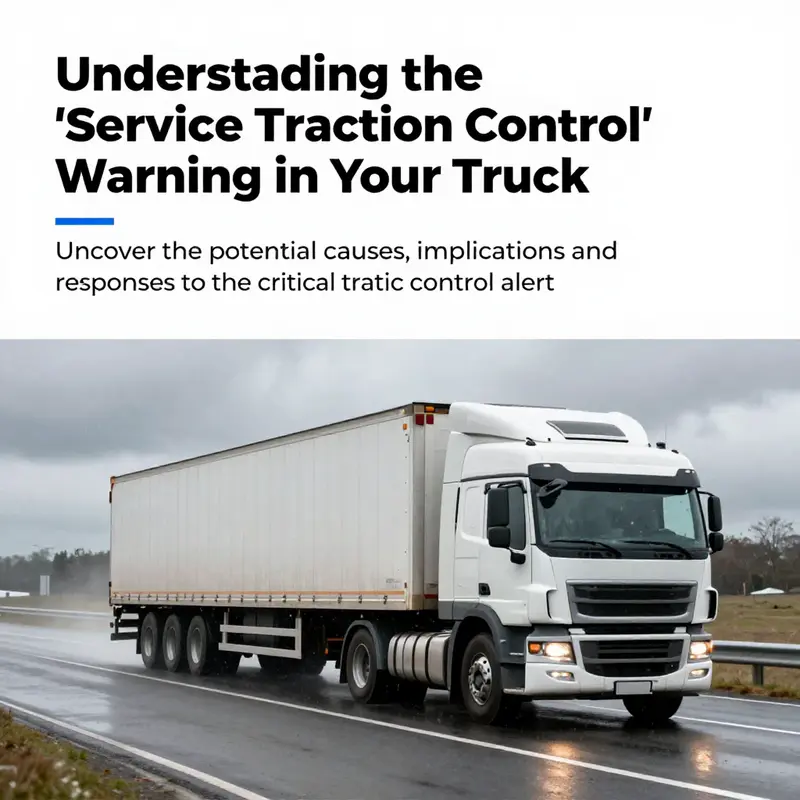
When you see a “Service Traction Control” message on your truck display, it’s a sign that your vehicle’s Traction Control System (TCS) needs immediate attention. This alert serves as an essential warning for long-haul truck drivers, trucking company owners, and fleet managers alike, emphasizing the importance of understanding traction control systems for safe and efficient vehicle operation. In this article, we delve deep into the reasons behind this warning, explore common mechanical issues that may trigger it, discuss the safety implications of ignoring this alert, provide technical insights into how TCS functions, and outline immediate actions to take when you encounter this warning. Together, we will ensure you’re well-equipped to maintain your truck’s safety and performance.
null
null
Under the Hood of Traction Control: Common Mechanical Causes Behind the Service Traction Control Message
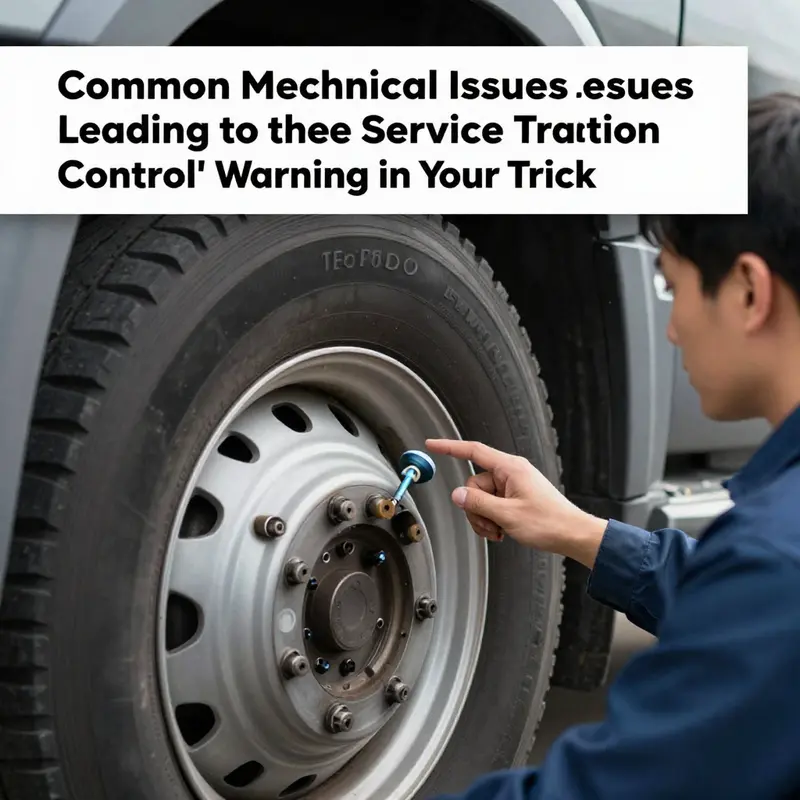
Service Traction Control is a safety warning that appears when the traction control system detects a fault or abnormal condition affecting wheel grip. It usually indicates that the system may not respond as designed, and it may interact with ABS and stability controls. The warning calls for careful inspection rather than a quick reset. Common causes include faulty wheel speed sensors or ABS sensors, wiring issues between sensors and control modules, and moisture or debris in connectors. Electrical harnesses can become loose or corroded, grounding points may be compromised, and intermittent faults can trigger the warning before a permanent failure occurs. Engine and transmission health also influence TCS behavior; irregular power delivery, rough idle, or transmission slip can be interpreted as loss of traction. Brake system health matters as worn pads, uneven brake fluid levels, or warped rotors can create inconsistent braking signals that feed the TCS data stream. Module failures in the engine control unit or ABS/TCS control module can produce false positives or misinterpretations of wheel speed data. Changes to tires or wheels, such as mismatched diameters or improper mounting, can throw off wheel speed calculations and trigger warnings. Routine exposure to moisture or debris can temporarily disturb sensor faces or connectors, though persistent exposure demands inspection. When faced with the warning, drivers should minimize risky maneuvers, avoid sudden acceleration or hard cornering, and seek professional diagnostic help. A first diagnostic step is an OBD-II scan to pull fault codes related to wheel speed sensors, ABS, or traction control modules, and then follow manufacturer guidance for sensor replacement, harness inspection, or module recalibration. For more context, reference official safety resources from authorities and the vehicle maker for guidance on traction control maintenance and safe driving under varying road conditions. If in doubt, arrange a professional inspection to ensure the data and control logic are trustworthy and that power delivery and braking behave predictably in the road environment.
The Real Stakes Behind a Service Traction Control Alert: Why Ignoring It Endangers You and Your Truck
A warning light on the dash doesn’t always scream danger in a loud, obvious way. In the case of Service Traction Control, the message is more of a whisper with a loud warning label attached to it: the system meant to keep you from losing grip is not functioning the way it should. For a driver, this isn’t a minor inconvenience or a cue to blame the weather on a rough morning. It is a signal that the road, the tires, the drivetrain, and your own response time are all involved in a complex safety equation. Traction control is designed to prevent wheel spin during acceleration and to help stabilize the vehicle when the surface loses grip. When that safety net malfunctions, the very conditions that usually demand care—the moment you press the accelerator from a stop, the moment you crest a patch of wet paint in a turn, or the moment you encounter a patch of ice under a thin layer of melting rain—become moments of heightened risk. The warning is not a nuisance; it is a warning about the potential for reduced control at the exact times when control matters most. Ignoring it is not an act of bravado or a test of your patience. It is inviting a loss of stability into your driving routine, and that risk compounds quickly the moment you’re navigating a curve, a lane change, or a slick ramp on a rainy day. The system’s job is to monitor and respond, and when it is compromised, the responsibility falls heavier on the driver to adapt, to slow, and to seek professional diagnosis before conditions worsen. This is particularly true for a truck, whose weight distribution, power, and tire contact with the road are calibrated for performance under specific conditions. A truck’s traction control interacts with its anti-lock braking system and other stability controls, creating a network of interdependent safety features that work best as a coordinated whole. When any part of that network shows fault or partial failure, the entire balance can shift. The warning light, then, becomes a beacon—not a sign that the vehicle will suddenly break down, but a signal that its stability system is not reliable in the way it should be. The driver’s task is to respect that signal, not to override it with a casual shrug or a sense of routine familiarity with adverse conditions. The act of driving is a constant negotiation between vehicle capability and road reality. A Service Traction Control alert marks a pivot point in that negotiation: either the system is fully functional again after a temporary hiccup, or there is a fault that requires attention to restore the intended safety margin. The difference between proceeding with caution and proceeding with compromised safety is not merely a matter of preference; it is a matter of possible consequence. The road offers no guarantees, and traction is a finite resource that depends on proper sensor readings, clean connections, and a functioning control module. When one of these elements fails or behaves erratically, the driver’s attention must rise accordingly. The path from warning to resolved risk is not complicated by mystique; it is an engineering, diagnostic, and maintenance sequence that, in practice, begins with respect for the warning and ends with a professional check that can restore confidence on every drive. The moment a driver feels that something is off—perhaps wheelspin during acceleration on a wet surface, or a sudden twitch in steering response when the road is not truly slick—the prudent choice is to treat the light as a real signal rather than a decorative indicator. The tendency to delay action often grows from a wish to avoid downtime, but the cost of that delay can be higher than the time and money required for a proper diagnostic. In a practical sense, the warning should prompt a shift in your planning: plan routes and speeds to minimize the risk until a technician can verify the system’s integrity; avoid steep grades, slick surfaces, and unpredictable road conditions where grip is essential; and reserve the vehicle for routine, lower-risk trips until service can restore the full range of traction control protections. When a light like this appears, the first step is to treat it as a safety-critical indicator rather than a minor fault. That approach aligns with how professional drivers and service technicians assess warning messages that interact with steering, braking, and acceleration. The system relies on a web of sensors and computational logic that must be in harmony for optimal performance. Any misalignment—whether from a dirty sensor, a loose connection, or an aging control module—can degrade how the system senses wheel speed and manages torque distribution. Consider the wheel speed sensors, which are designed to monitor the rotation rate of each wheel to detect slip. If a sensor is dirty, damaged, or sending skewed data, the traction control system cannot accurately interpret a wheel’s behavior under acceleration or turning. The ABS sensors, closely tied to the traction control system, can create a cascade of false readings if they themselves are compromised. A tangled web of wiring adds another layer of risk: corrosion at connectors, frayed insulation, or poor ground paths can introduce noise or complete signal loss to the module that governs traction control. A malfunctioning electronic control unit (ECU) can produce software glitches or fail to apply the intended torque adjustments. Even conditions like recent tire changes, mismatched tires, or incorrect tire pressure can confuse the system by altering wheel circumference or grip characteristics, prompting fault codes that illuminate the warning. Moisture or debris near critical sensors can generate transient faults that vanish with a dry spell or a wash, only to return later. The consequences of ignoring the warning are not always immediate or dramatic. In a perfectly dry, well-maintained scenario, the truck may seem to operate normally for a while. But the subtle lack of traction control becomes apparent whenever grip is challenged: a brief spin of a driven wheel upon acceleration, a minor drift during a corner, or a longer braking distance in emergency maneuvers. In harsher conditions—rain-slicked pavement, snow, or gravel—the system’s compromised state translates into real danger. The possible manifestation of the problem in the engine’s performance is also a consideration. In some vehicles, the stability system and the engine control logic share protective responses. When a fault is detected, the vehicle might shift into a reduced-power or “limp” mode to prevent drivetrain damage. That protective measure, while beneficial to the engine and transmission in the long run, reduces acceleration and responsiveness at exactly the moments when you might need the most power to regain control. The interplay between system protection and driver capability is delicate. A warning light is not just a symbol; it is a cue that the vehicle’s safety architecture requires a check. The recommended approach is clear and supported by safety guidelines: do not ignore the warning, check for other indicator lights—especially ABS or ESP—consult the diagnostic tools, and rely on qualified technicians who can interpret fault codes and perform the necessary repairs. A professional diagnosis using an OBD-II scanner can reveal specific fault codes, such as those associated with wheel speed sensors, ABS sensor issues, or ECU faults. The codes guide the technician to the exact component or connection requiring attention. In practice, this means that a trip to a trusted repair shop is not simply about replacing parts; it is about ensuring the entire signal chain—from the sensor to the ECU to the torque-distribution logic—operates in harmony again. The aim is to restore the full protective function of traction control, rather than attempting to drive through a system that may be compromised. For drivers who are responsible for heavy-duty vehicles or trucks operating in challenging environments, the stakes are higher. A compromised TCS can translate into a higher probability of wheel spin at the moment you need traction least, a longer stopping distance in an emergency, and a reduced ability to maintain a stable path through a curve or a lane change. The risk is not confined to a momentary loss of grip; it extends into day-to-day driving, where small incidents compound into larger safety concerns. That is why the recommended path is not to gamble with the risk, but to act decisively: acknowledge the warning, arrange a diagnostic session, and implement the necessary repairs before continuing with regular operation. In a broader sense, alert systems like the Service Traction Control warning are part of a larger safety culture in modern trucking. They reflect an ecosystem where sensors, control modules, wiring integrity, tire performance, and road conditions all feed into a driver’s decision-making. When one component falters, the whole system relies on human judgment to bridge the gap until repairs restore full capability. The right approach blends caution with timely professional support. It also benefits from ongoing maintenance practices that reduce the odds of sensor contamination or misreadings. Clean, well-maintained wheel wells, correct tire selection and pressure, and proper wheel alignment prevent many intermittent faults from becoming persistent issues. Regular inspections of braking and stability-related components support a safer driving experience and lower the likelihood of being surprised by a fault during a critical maneuver. In this context, prevention matters as much as response. The knowledge foundation behind Traction Control and its warning system is well established by safety authorities, and drivers benefit from aligning their actions with official guidance. The National Highway Traffic Safety Administration offers a clear framework on how traction control systems operate, why they matter for safety, and what drivers should do when warnings appear. This resource serves as a dependable baseline for understanding the stakes involved and for translating the warning into concrete, protective steps rather than into anxiety or distress. For readers who want to explore further, an authoritative overview of traction control and related safety considerations is available through the NHTSA. In navigating a Service Traction Control alert, remember that the system’s presence is a testament to design intent: it exists to keep you on the road and to prevent a minor misstep from becoming a major incident. The warning is an invitation to engage with the vehicle’s safety architecture, not a prompt to abandon caution. With the right approach—recognizing the seriousness, seeking diagnosis, and using professional expertise—you can preserve stability, maintain control, and protect yourself and others on every trip. For further context on how these warnings fit into broader vehicle safety standards and driver guidance, refer to the trusted information from official safety authorities linked in the resources section. Internal exploration of well-structured maintenance programs can also support long-term reliability, and practitioners in the field emphasize the value of proactive maintenance for wheel speed sensors, ABS components, and their electrical connections. A practical mindset combines attention to the warning with a plan for timely service, so that a vehicle can regain its designed performance. In the end, the Service Traction Control alert is not an obstacle but a reminder: a reminder that road conditions evolve, that vehicles are complex systems, and that the safest choice is to verify integrity before continuing. The chapter’s focus remains consistent with the broader aim of understanding why your truck might say service traction control, what that message implies for safety, and how drivers can respond in a way that sustains grip, stability, and predictable handling when it matters most. If a reader takes away one practical takeaway, it should be this: treat the warning as a safety-critical signal, pursue professional diagnosis promptly, and maintain a disciplined approach to maintenance and repair so that the system can do its job when you need it most. For those seeking a practical path to ongoing maintenance and training that supports these outcomes, explore maintenance resources and professional guidance as part of a comprehensive safety program. As you plan future drives, keep the knowledge of how traction control interacts with your tires, your braking system, and your steering in mind, and let that understanding shape safer decisions on every road you travel. External resource: https://www.nhtsa.gov/vehicle-safety/traction-control-systems. Internal resource: Learn about maintenance best practices and training in tire and sensor care through fire truck maintenance service training, which emphasizes routine checks that help prevent sensor and wiring faults from triggering warning lights. fire truck maintenance service training.
Trust and Traction: Technical Insights into How Your Truck Manages Grip Under Pressure
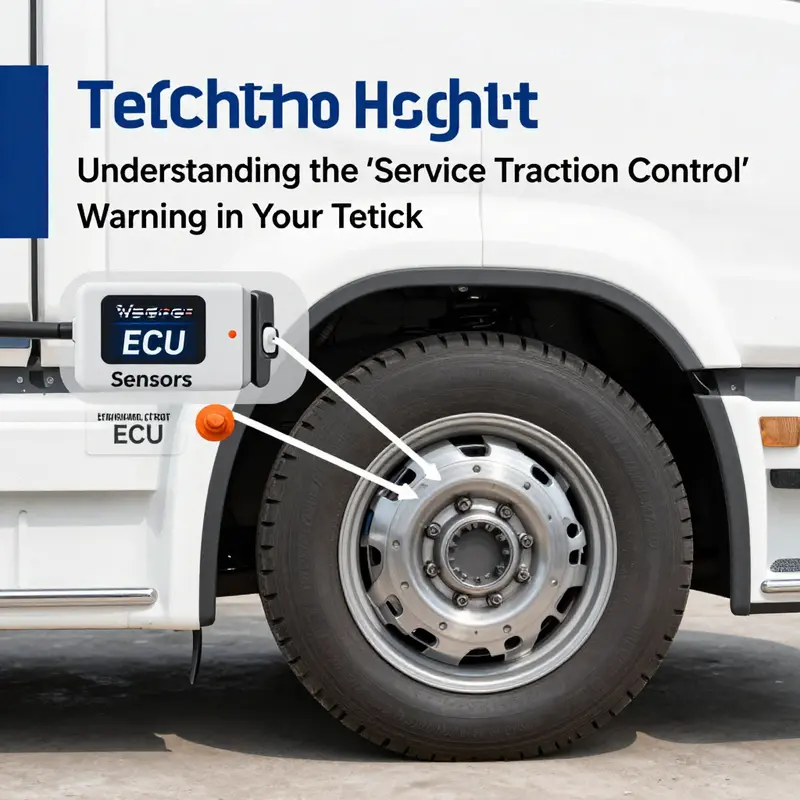
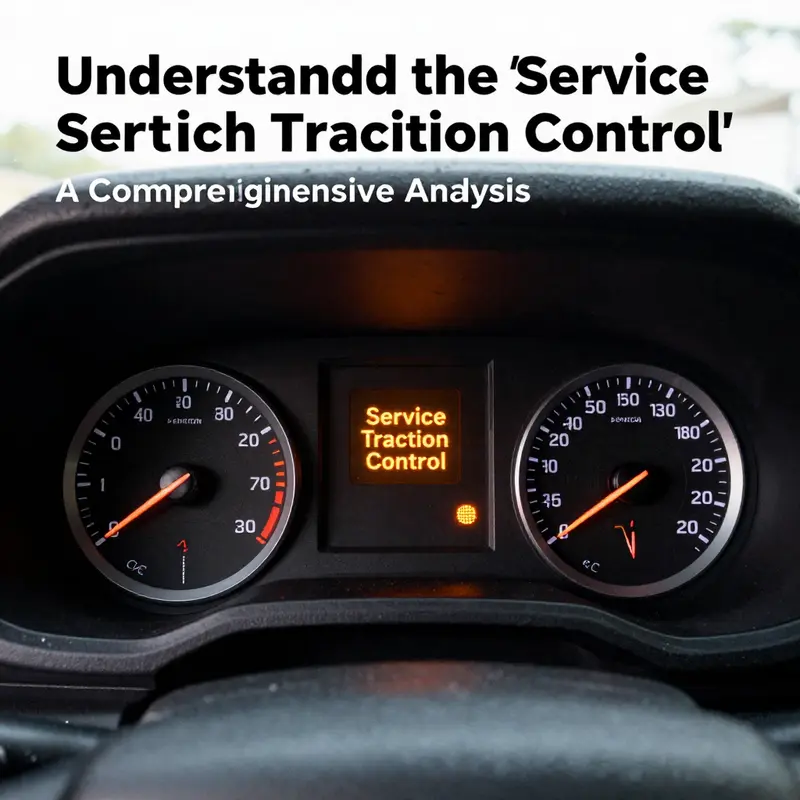
Traction control systems operate behind the scenes to keep a vehicle from losing grip when road conditions threaten to spin a wheel. When you see a Service Traction Control message on the dash, it signals a safety critical function has detected data or grip reaching a threshold that requires attention. On a good day the system works so quietly you forget it exists; on a bad day its absence is felt immediately. The warning invites you to pause, assess, and address a condition that could deteriorate as soon as rain or a slick surface appears.\n\nAt the core of the system are wheel speed sensors that report how fast each wheel is turning to the vehicle control module. The system also communicates with the ABS sensors because both share data and goals: prevent wheel lock and maintain directional control. If data from any sensor looks suspect a sensor fault, a wandering wire, or a misread can trip the indicator even when the tires do not appear to slip. A temporary readout issue caused by moisture or road spray can also trigger the light, only to vanish after conditions change or the system reinitializes. The nuance matters because it frames how you respond: not every flicker is catastrophic, but every fault deserves careful validation rather than a quick shrug.\n\nThe fault pathway is practical and reveals how fragile a high tech safety net can be if one strand breaks. Loose or damaged wiring such as frayed harnesses, corroded connectors, or exposed conductors can disrupt communication between wheel sensors and the control module. In some cases the electronic control unit that runs TCS may itself fail or suffer a software glitch. A malfunctioning control module can misinterpret sensor data, leading to unnecessary or mis timed interventions. A driver factor also enters here such as recent tire changes, mismatched tread depths, or tires with different wear patterns that confuse the system; even tire pressure variations can translate into odd data if the system expects a calibrated profile. Moisture or debris near sensors can cause a temporary fault that clears once the housings dry. In short, a Service Traction Control warning often points to a data path issue rather than a single failed wheel, and that distinction matters for how you fix it.\n\nWhat makes the TCS function meaningful is how it responds when it detects slip. The system aims to restore traction without sacrificing forward momentum. It can reduce engine torque by trimming fuel delivery or altering throttle position to ease the demand on the slipping wheel. If reducing power is not enough, the TCS can apply brake pressure selectively to the slipping wheel. That targeted brake actuation helps transfer torque toward wheels with better grip, effectively rebalancing traction in favor of controlled acceleration. The choreography is delicate: too much intervention can stall progress, too little can allow a slide. The system relies on precise, up to date data from a network of sensors to decide when and how to intervene.\n\nThe Traction Control System does not operate in isolation. It is part of a broader safety ecosystem that includes Electronic Stability Control ESC. When ESC is active, TCS sharing data with ESC can optimize steering and braking in a coordinated way. In modern vehicles this partnership makes the anti slip response less abrupt and more predictable for the driver. The net effect is a safer, more confident drive in conditions where grip is precarious. The evolution of these systems reflects a shift from simple anti spin logic to integrated data driven control that informs throttle, braking, and steering decisions in concert. This is why the current generation of traction control feels less like a separate feature and more like a central piece of the vehicle safety brain.\n\nUnderstanding the likely culprits behind a Service Traction Control message helps drivers and technicians approach the repair with a clear map. Wheel speed sensors are the most common fault point. If a sensor misreads, the system loses its baseline for what constitutes slip and can misfire with a fault code or warning. ABS sensor issues follow closely because ABS and TCS share critical information used to modulate braking and torque. Wiring problems such as loose connections, frayed cables, or corrosion can disrupt data channels and create intermittent faults that annoy the driver and complicate diagnostics. A malfunctioning control module is another plausible root cause; software bugs or hardware failures can corrupt how data is interpreted and translated into action. Recent tire changes add complexity: mismatched tires on front and rear axles, incorrect tire sizes, or inconsistent pressures all undermine the TCS reference framework, producing warnings even if traction remains adequate. Moisture, mud, or debris near sensors can cause transient anomalies that disappear after a drive, only to return in damp or dirty conditions. Each of these causes underscores a simple truth: the warning is not random but signals that the data environment surrounding traction control has shifted in an actionable way.\n\nThe prudent course when the light comes on is an informed pause rather than a quick sigh of relief. Do not ignore the warning, even if the truck seems to drive normally. If possible, note whether other lights accompany the TCS warning. The ABS light, ESP or ESC indicators, and a Check Engine light can signal a broader fault requiring attention. A diagnostic appointment with a trained technician and an OBD II scan will reveal fault codes tied to the traction control and ABS systems. Codes such as C0030 or C0040 can point to a sensor, a harness, or the control module that needs repair or replacement. The diagnostic process might involve measuring sensor resistance, verifying sensor alignment, performing live wheel speed tests, or applying software updates to the traction control logic. The goal is to restore a clean data stream that the TCS can rely on to calculate slip and decide when and how to intervene.\n\nUntil the repair is complete, prudent driving choices matter. Avoid driving in hazardous conditions where traction matters most. If you can, postpone trips on wet roads, icy surfaces, loose gravel, or steep grades. When you do need to drive, use smooth, deliberate inputs: gradual acceleration, gentle braking, and steady steering to reduce the odds of provoking wheel spin while the system is offline or recalibrating. Tire maintenance becomes especially critical in this window. Ensure tires are correctly sized and matched, with uniform wear and consistent pressures across all four corners. Regular inspections by a qualified technician should include checks of sensor housings, wiring harnesses, and connection integrity. If a fault recurs, treat it as a sign that deeper issues exist such as a drifted sensor, a failing control module, or a network problem. Fleet operators will find value in documenting tire histories and maintenance intervals, so that sensor readings stay interpretable and the system can respond with appropriate alacrity when grip conditions change.\n\nFor readers seeking a broader safety context, consider how safety architectures in heavy duty vehicles translate into real world outcomes. Modern safety systems are designed to work together as an integrated safety net rather than as isolated features. The takeaway is simple: treating the warning as a signal rather than an endpoint keeps you aligned with best practices for vehicle health and road safety. If you want to deepen your understanding beyond practical steps, look to authoritative sources that explore the physics of traction control and the logic of its algorithms.
Immediate Actions to Take When Your Truck Displays Service Traction Control
When a dashboard message like “Service Traction Control” lights up, it is more than a minor nuisance. It signals that the Traction Control System (TCS), the safety feature designed to prevent wheel spin and help you keep control, has detected a fault or malfunction. The distinction between a temporary glitch and a true failure matters. Even if the truck still feels ordinary to drive, the absence of reliable traction control increases the odds of wheel slip on slick surfaces, quick throttle responses on damp pavement, or a sudden shift in handling when you need power to climb a grade. The moment you see this warning, the vehicle shifts from a routine driving state to a precautionary situation. The goal is not to panic, but to engage a sequence of deliberate actions that protect you, your passengers, and the vehicle while you determine the source of the problem and arrange professional service.
To begin, the immediate actions should be calm, methodical, and conservative. Sit up straight, keep a steady grip on the wheel with both hands, and maintain a light but consistent pace. Abrupt moves—hard braking, sudden acceleration, or sharp swerves—can trigger or worsen a loss of traction when the system isn’t available to modulate wheel slip. Your first instinct should be to secure control of the vehicle, not to chase performance. The road condition awareness that you routinely exercise becomes even more critical when the TCS is compromised. If the road is wet, icy, snowy, gravelly, or uneven, reduce speed and plan for longer stopping distances. The safest option is to treat the truck as if it has reduced stability and proceed with greater caution, especially in traffic or at highway speeds where a single misstep can escalate quickly.
As you adjust your speed, take a quick inventory of other warning indicators on the dash. Look for the ABS light, the Electronic Stability Program (ESP) or ESC indicator, or a Check Engine light. The presence of multiple warning lights can point to a broader electrical or sensor-related issue, not just the traction system. If you notice additional lights, you should be even more cautious and prioritize getting off the road to a safe place where you can diagnose or seek assistance without blocking traffic or putting others at risk. The TCS works in concert with ABS to manage braking and grip, and a fault in one part of the system often correlates with a fault elsewhere in the network of sensors and actuators that monitor wheel speed, brake pressure, and steering input.
Understanding what can trigger the message helps in communicating with a technician. Common culprits include faulty wheel speed sensors, which monitor each wheel’s rotational rate. If a sensor is dirty, damaged, or failing to report accurate data, the system can’t detect wheel slip accurately, and the fault may be flagged. A malfunctioning ABS sensor can have a similar effect because the traction system relies on the ABS subsystem for robust data about wheel velocity and braking behavior. Loose or damaged wiring in sensor circuits or control modules is another frequent cause. Corrosion, frayed insulation, or loose connections can disrupt communication between sensors and the electronic control unit (ECU) that manages TCS logic. A failing or glitchy control module itself can also trigger the warning, as can software issues within the ECU or chassis network. Even seemingly minor changes—installing mismatched tires, incorrect tire pressure, or wheels that aren’t properly calibrated—can confuse the system enough to light the warning. Moisture intrusion or debris near sensors, such as after washing the undercarriage or driving through deep water, can cause temporary sensor errors that self-resolve once the environment dries out, but a warning may linger or recur if a fault persists.
With the warning present, it is prudent to plan for professional diagnosis rather than wide-ranging improvisation. Do not assume the truck is safe to drive indefinitely. The risk of losing traction, particularly during acceleration, on wet pavement, or when starting from a standstill, is nontrivial during a TCS fault. Some vehicles may enter a limp mode to protect the drivetrain, reducing engine power or limiting speed. While limp mode can help prevent further damage, it also signals that the vehicle’s active safety controls are significantly compromised. Your driving goals should be to reach a safe location, avoid high-risk conditions, and schedule diagnostic service as soon as possible. If you must move the vehicle to a secure area, do so slowly and with extreme care, avoiding steep grades or heavy load conditions that require precise traction control to manage torque and braking.
When you’re ready to seek help, a professional diagnosis becomes your next crucial step. An OBD-II scanner used by a qualified mechanic will read fault codes stored in the vehicle’s computer. Codes can point to components such as wheel speed sensors (for example, C0030 or C0040 variants in some makes and models), ABS sensors, or issues within the TCS/ECU network. However, fault codes provide a starting point, not a definitive diagnosis. A technician will perform a broader inspection that includes sensor data live streams, wiring continuity tests, and a check of the control module software. Depending on the vehicle’s age and configuration, updating or reprogramming the TCS software, re-calibrating sensors, or replacing a failed sensor may be necessary. In some cases, a simple fix such as cleaning a dirty wheel speed sensor or repairing a damaged connector is all that is required; in others, multiple components may need attention. The important thing is to trust a trained professional to interpret the codes in the context of observed symptoms and the vehicle’s maintenance history.
There is also a practical, user-facing dimension to this issue. If you have recently replaced tires or altered wheel setups, it’s plausible that the TCS has become temporarily confused by mismatched tire sizes, inconsistent tread depths, or improper inflation. Mismatches can mislead the system about actual wheel speed, causing it to misinterpret grip levels and trigger a fault. For this reason, maintenance records and recent service history become valuable tools in the diagnostic process. When you bring the vehicle in, share any recent work like tire replacements, changes in wheel size or type, or even minor repairs near the wheel wells. The more precise your account of the truck’s condition leading up to the warning, the faster a technician can narrow down the root cause.
Beyond the mechanical and sensor considerations, there is a preventive dimension worth highlighting. Regular checks of tire pressure, tread depth, and wheel alignment help keep the data the TCS relies on accurate. Consistent tire brands and models across all four corners reduce the risk of unexpected behavior when the system finally detects wheel slip. The maintenance philosophy should extend to wiring harness inspections, especially in areas exposed to road salt, mud, or moisture. A routine undercarriage inspection, particularly after winter months, can uncover frayed cables or compromised connectors before they escalate into an intermittent fault that confuses the TCS. This is where a proactive maintenance mindset translates into real safety gains. A straightforward practice in the routine you can adopt is to schedule periodic sensor and module inspections together with brake system service. Some service intervals naturally align with brake fluid checks, pad wear, and ABS performance tests. In this integrated approach, you treat traction control not as an isolated feature but as part of a holistic safety and performance ecosystem that keeps the truck reliable under conditions that demand grip and stability.
For professionals and enthusiasts alike, there is value in discussing the broader preparedness that accompanies a TCS warning. The moment the message appears, you’ve engaged a safety system that, while protective, is not immune to faults. The right response blends caution with informed action: reduce risk on the road, verify other warning indicators, and seek qualified diagnostic support promptly. Keeping the maintenance and inspection momentum going—especially around sensors, wiring, and the control modules—helps ensure that when the road throws a curve, the system is ready to assist rather than obstruct. The practical takeaway is simple: treat a service traction control warning as a signal to slow down, gather information, and get a precise diagnosis rather than hoping the system will reassert itself on the next trip. And while you navigate this process, you can lean on established resources and professional networks that emphasize the importance of system integrity for vehicle safety.
For readers who want to deepen their understanding of the maintenance and safety implications, this topic sits at the intersection of sensor reliability, braking systems, and electronic control logic. A comprehensive overview of how traction control systems operate, why they matter for everyday driving, and what drivers should do when warnings appear can be found in authoritative sources that discuss the function and safety benefits of TCS in modern trucks. These resources detail the safeguards built into traction control, the typical failure modes, and the steps drivers should take to protect themselves and others when the system reports a fault. The intent is to empower drivers with practical knowledge that translates into safer, smarter decisions on the road, not to induce unnecessary alarm. The overarching message remains consistent: when service traction control appears, treat it as a serious indicator of a potential safety fault and respond with caution, professional verification, and proactive maintenance to restore full system reliability.
In the spirit of ongoing readiness, consider the value of keeping up with maintenance practices that help prevent TCS faults in the first place. A recommended approach involves regular sensor and wiring inspections, timely brake system checks, and calibration of sensors after tire changes or wheel alterations. Training and education play a meaningful role here; consistent maintenance training, tailored to the needs of drivers and maintenance personnel, strengthens the knowledge base that reduces downtime and enhances safety. For organizations that want to invest in continuous improvement, integrating maintenance training into routine schedules can yield tangible benefits, such as fewer unexpected faults and quicker turnaround times when issues arise. If you are exploring resources focused on the maintenance and reliability of critical vehicle systems, one practical angle is to engage with targeted training programs and maintenance guides that address the realities of heavy-duty and emergency-service fleets. Fire-truck maintenance training, for instance, emphasizes the integration of safety-critical systems with operational readiness, reminding readers that keeping trucks in top form is essential to protecting communities when it matters most. https://5startruckin.com/fire-truck-maintenance-training-importance/.
Ultimately, the aim is clear: know what to do the moment you see the warning, understand the potential causes, and pursue a methodical path to diagnosis and repair. While the specifics of a given fault code will vary across makes and models, the core discipline remains constant—drive with caution, minimize exposure to hazardous conditions, and rely on professional diagnostics to restore full traction control capability. As you navigate this process, remember that the issue may be multifaceted, involving a sensor, a circuit, or a software condition that requires careful correction rather than a quick, improvised workaround. The result you want is a system that not only lights up when it should but also functions reliably when you actually need it most. For authoritative information on this issue, refer to official safety resources from trusted authorities, which explain how traction control systems work and what drivers should do when warnings appear. External resource: NHTSA Traction Control Systems overview.
Final thoughts
Understanding the ‘Service Traction Control’ warning on your truck is critical for both safety and performance. This warning isn’t merely a suggestion—it’s an alert that demands immediate attention to ensure your vehicle runs smoothly and safely. By recognizing the common mechanical issues that lead to this message, acknowledging the severe safety implications that arise from neglecting it, and familiarizing yourself with the technical details of TCS functionality, you’re better prepared for any challenges that may arise. Prompt and decisive action can make all the difference in ensuring both the integrity of your vehicle and the safety of your operations on the road.