
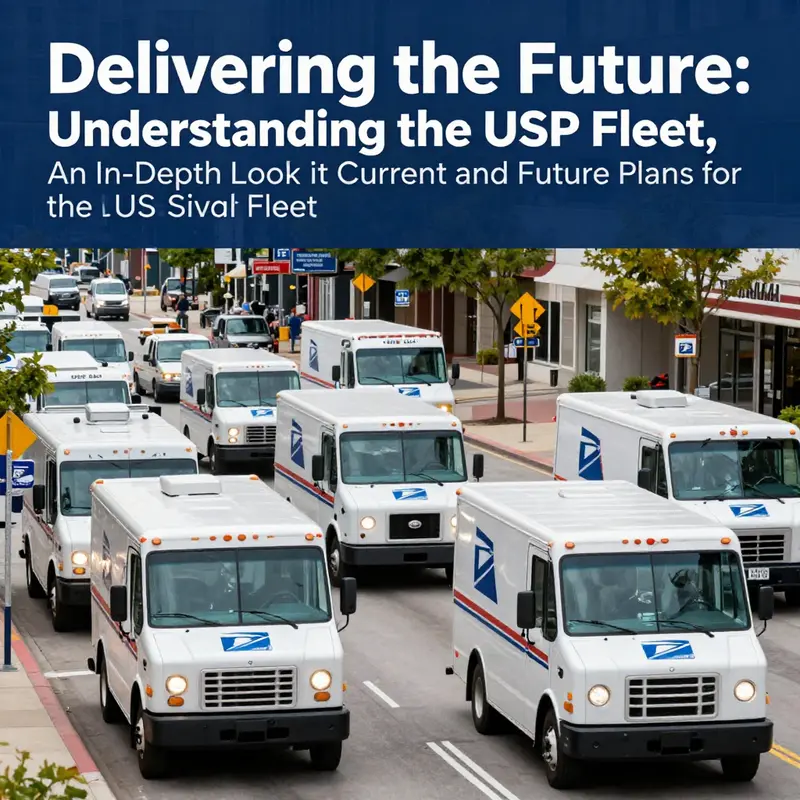
As the backbone of the United States Postal Service (USPS), the delivery fleet plays a pivotal role in logistics and customer satisfaction. Currently, USPS operates a vast fleet comprising approximately 230,000 vehicles. This overview highlights the importance of USPS trucks, especially as the service embarks on a monumental fleet modernization effort involving an investment of $9.6 billion for 106,000 new vehicles. Long-haul truck drivers, trucking company owners, fleet managers, and aspiring truck drivers will find insights into how this fleet impacts service efficiency and sustainability. Each chapter will explore the current fleet’s state, upcoming modernization initiatives, and the resulting economic implications for stakeholders across the logistics spectrum.
Counting the Nation’s Carriers: A Deep Dive into the USPS Truck Fleet and Its Road to Modernization

Ask most people how many United States Postal Service trucks there are, and the response is almost always a guess. Yet the scale of the USPS’s rolling fleet is more akin to a mobile infrastructure than a mere collection of vehicles. The most recent official tallies place the fleet at 257,894 vehicles, a figure that underscores both the sheer breadth of the service area and the logistical complexity of delivering to every corner of the United States and its territories. That total is not just a number; it is a map of routes, depots, and schedules that unfolds every day as mail, packages, and the occasional urgent parcel travel from facility to facility and ultimately to customers’ doorsteps. To understand what that fleet looks like today—and what it is becoming—requires a closer look at how the fleet is composed, how it moves, and how a planned modernization aims to reshape its miles, energy use, and reliability in the years ahead.
The composition of the USPS fleet is a tale of contrasts and complements. A substantial majority of the vehicles are long-distance and delivery platforms used to shuttle mail between sorting facilities and distribution networks across vast distances. Roughly 163,000 of the fleet are long-distance vehicles, which function as the arteries of the postal system, carrying heavy loads between processing hubs, regional facilities, and rural mail centers. These aren’t the flashy showpieces of urban delivery; they are the workhorses that keep the national network connected, often traversing overnight corridors and weather-worn back roads alike. The long-haul orientation makes the fleet’s maintenance and scheduling a nationwide puzzle, where the downtime of a single tractor or trailer can ripple outward into performance gaps at the most critical moments.
Hidden in the same ledger are the surface delivery and field service vehicles—the ones that actually move mail and packages to the customer. Their numbers are not as dramatic as the long-haul fleet, but they are the front line in everyday delivery. Within this mix, a specialized subset administered by the Postal Vehicle Service (PVS) stands out for its operational focus and uniformed workforce. The PVS oversees a cadre of more than 12,000 uniformed operators who manage a specific balance of vehicle types: 98 Sprinter vans, 2,202 cargo vans, 2,364 tractors, and close to 7,351 trailers. These figures illuminate how the USPS distributes its capabilities across the spectrum of local routing, parcel handling, and interfacility movement. They also hint at the governance structure behind the fleet—how operations are segmented, how training is allocated, and how maintenance is prioritized across different vehicle classes.
Taken together, the numbers reveal a fleet that is not static but a living system designed to evolve. In routine terms, the USPS drives more than a billion miles annually; in 2024 alone, the organization logged approximately 1.9 billion miles on surface transportation. That level of activity translates into an enormous energy footprint, coverage area, and demand for reliability. It also sets the stage for a strategic shift toward modernization that is both ambitious and methodical. The core of that shift is a planned upgrade of the delivery fleet: the rollout of 106,000 new vehicles by September 30, 2028, as part of a broader $10 billion initiative. Among these, 45,000 are planned to be battery-electric next-generation delivery vehicles, signaling a decisive pivot toward sustainability alongside performance improvements. The electrification portion, while technically straightforward in its intent, is deeply complex in execution. Infrastructure needs, charging availability, vehicle supply, and maintenance ecosystems must all align to realize the promised benefits. The pace of this electrification has, to date, been slower than hoped, with about $3 billion of taxpayer funds already spent as of December 2025. That funding outcome matters not only for balance sheets but for the practicalities of fleet replacement: planning for depots, installation of charging docks, and the retraining of personnel who must operate and service a more electronic and interconnected fleet.
The scale of the modernization should not obscure the day-to-day realities that the numbers reflect. People who work in account management, maintenance, and scheduling see a fleet that is simultaneously a national network and a collection of local nodes. Each depot houses its own roster of vehicles, each with its own maintenance schedule, spare-parts stock, and charging requirements. The long-distance vehicles and trailers fleet, for example, demands a deep inventory of tractors, trailers, and support equipment designed for interfacility movement with predictable timetables. Meanwhile, the delivery and local operation fleet—comprising vans and light trucks—requires nimble maintenance protocols and rapid turnaround capabilities to keep municipal routes on schedule. In that sense, the modernization program is not simply about adding new hardware; it is about reengineering the service’s operating rhythm to reduce downtime, improve fuel and energy efficiency, and sustain service quality as the network grows more electric and more data-driven.
The electrification plan offers a window into the strategic thinking driving the transformation. The USPS’s emphasis on electrified next-generation delivery vehicles embodies a broader commitment to reducing the environmental footprint of mail and parcel delivery while pursuing quieter operation, smoother performance, and potential long-term cost savings. Yet the realities of large-scale procurement mean trade-offs and delays. Batteries, charging infrastructure, and service support have to scale in tandem with the vehicles themselves. The plan’s 45,000 BEV units would, in effect, shift a sizable share of daily driving onto electric power, altering peak energy demand, maintenance profiles, and the logistics of depot charging. The reality of the current pace—where progress has lagged behind the original timetable—reminds readers that modernization is not a single purchase but a multi-year, multi-stakeholder effort that must synchronize procurement, policy, and on-the-ground operations across thousands of routes and millions of daily miles.
This context helps explain why the number 257,894 feels so large—and why it is already a moving target. Fleet counts rise with replacement cycles and new deployments, but they also fall when older units are retired or redeployed. The USPS is balancing a near-term imperative to replace aging, less-efficient vehicles with a longer-term plan to build a more capable, more sustainable network. The scale of the current fleet is the baseline for measuring progress toward the modernization goals, just as the miles driven and the operating costs are the baselines against which new efficiency measures and charging strategies will be judged. In the daily tempo of mail delivery, these numbers translate into a living system where a single delay at a critical node can cascade into postponed deliveries, missed windows, and corrective actions that ripple through processing centers, delivery routes, and customer service. The fleet’s footprint, therefore, is not simply about the sum of vehicles; it is about the reliability of a nationwide service that thousands of communities rely on every day.
A closer look at the PVS and its vehicle mix also tells a story about roles and responsibilities within the broader fleet ecosystem. The 12,000 uniformed operators who work within this framework perform essential tasks beyond mere driving. They are part of a network that includes route optimization, equipment readiness, and safety oversight. The distribution of vehicle types—nearly 7,351 trailers, 2,364 tractors, 2,202 cargo vans, and 98 Sprinter vans—reflects a deliberate pattern of specialization. Trailers and tractors dominate the long-haul segments, where heavy loads and interfacility transfers demand consistent power and towing capability. Cargo vans and Sprinter vans, by contrast, are the domestic, door-to-door workhorses that support urban and rural neighborhoods, often with tight street constraints and rapid unloading requirements. Maintenance regimes for these fleets differ as well. Trailers and tractors call for heavy-duty mechanical systems, tire management, and routine hitch and coupling inspections, while cargo vans require more frequent, smaller-scale service interventions and preventive maintenance to minimize unexpected downtime. The human element—drivers, technicians, dispatchers, and fleet managers—binds these components into a functioning system that keeps the country’s mail moving forward, even when weather or traffic challenges test the network.
The modernization plan also sheds light on how the USPS views risk and resilience. The vast fleet represents a potential single point of vulnerability if it were to be treated as a static asset. By pursuing a program of ongoing renewal and electrification, the USPS clearly signals a strategy geared toward resilience: newer vehicles should reduce maintenance surprises, battery-electric options offer alternative power sources with potentially lower operating costs, and the replacement cadence helps mitigate the risk of sudden, unscheduled downtime due to aging components. The broader implication is that fleet modernization is inseparable from reliability guarantees and service speed—two capabilities customers have come to expect as standard. In a system that drives billions of miles each year, even small improvements in efficiency or uptime multiply across thousands of routes, affecting delivery times and customer satisfaction. The challenge is to translate the promise of newer technology into a measurable improvement in daily operations, while simultaneously expanding charging or fueling infrastructure, training personnel, and coordinating with suppliers, facility managers, and policy authorities—all across the United States.
From a policy and funding perspective, the modernization program illustrates a typical public-utility-like transition: a large-scale capital injection aimed at long-term dividends in efficiency, safety, and environmental performance. With roughly $10 billion allocated and a goal of introducing 106,000 new vehicles by the 2028 deadline, the program is undeniably ambitious. It is also iterative. The electrification portion—45,000 battery-electric vehicles—demands not only vehicle supply chains but a robust charging ecosystem capable of supplying power where and when it is needed. The current pace has required adjustments as planners contend with procurement constraints, vehicle availability, and the complexities of retrofitting or expanding depot infrastructure to accommodate faster charging, grid demand, and the telemetry needed to monitor performance. In practical terms, this means that the USPS is reshaping both its physical assets and its operating culture, from how technicians are trained to how routes are scheduled and how maintenance is logged and analyzed.
One consequence of the modernization push is a heightened emphasis on data as a driver of efficiency. A fleet of this magnitude produces an immense stream of telemetry—vehicle health, charging status, route dwell times, maintenance cycles, and utilization patterns. Aggregating and interpreting this data helps fleet managers identify bottlenecks, schedule preventive maintenance with greater precision, forecast energy needs, and plan depot upgrades in cost-effective increments. It also enables more transparent reporting on miles driven, energy use, and emissions reductions associated with the BEV rollout. The data-centric approach complements the physical upgrade by turning the fleet into a more adaptive system that can respond to changing conditions—fuel prices, weather patterns, traffic dynamics, and customer demand—without sacrificing service reliability.
In contemplating the current state of the USPS truck fleet, the number 257,894 is more than a tally; it is a window into a distributed, high-stakes operation that quietly supports daily life. The long-haul fleet moves national commerce and communications across time zones, while the local delivery fleet touches neighborhoods with the immediacy of a doorstep encounter. The PVS shows how governance and workforce design translate into practical mobility, with a precise mix of van, tractor, and trailer assets matched to the demands of different segments of the network. The modernization program, while still unfolding, is framed by a clear set of objectives: higher efficiency, lower emissions, improved reliability, and a scalable path toward a predominantly electric delivery future. Yet the story is also about patience and adaptability. Electrification is a landmark ambition that requires time, investment, and coordination across a federal agency, contractors, utility partners, and local facilities. The slower-than-expected progress underscores a fundamental truth about large-scale infrastructure upgrades: success is measured not only by headline numbers but by the steady, visible gains in uptime, route performance, and customer satisfaction that accumulate with every mile driven under safer, cleaner, smarter conditions.
For readers seeking the most current snapshot, the official figures remain the best starting point. The number of postal vehicles, alongside the detailed breakdown by vehicle class and the progress of the BEV rollout, is periodically refreshed by USPS offices and documented in U.S. Postal Facts and related updates. In the broader sense, the fleet’s evolution—toward more capacity, more efficiency, and more sustainable operation—reflects a national service reimagined for the next era of mail and parcel delivery.
External resources provide a further lens on this topic. For the latest official figures and updates beyond this discussion, see the U.S. Postal Facts – Number of postal vehicles, which consolidates the fleet metrics, breakdowns, and recent changes in a single, authoritative reference. https://about.usps.com/production/facts/number-of-postal-vehicles.htm
Rounding Up the Fleet: Inside USPS’s Bold Modernization Drive Toward a Modern, More Efficient Delivery Truck Fleet

The United States Postal Service stands at a pivotal moment in its long history of delivering letters, packages, and promises across a sprawling and diverse landscape. What looks at first like a simple count of trucks soon reveals itself as a more intricate story about national logistics, fleet refurbishment, and the stubborn complexity of transforming a 230,000-strong vehicle backbone that stretches from sea to shining sea. At the heart of that story is a deliberate, institution-wide wager: that modern, better-performing vehicles can lift service reliability, cut operating costs, and curb emissions without disrupting the universal reach that Americans rely on every day. The boldness of this wager is not just in the direction of travel but in the scale of the journey. A multi-year, multi-billion-dollar upgrade is unfolding, and the road is as instructive as the destination. The plan, the progress, and the inevitable detours together illuminate how many trucks the USPS really has in service, and how many it will have as its modernization efforts mature across the decade ahead.
The broader initiative sits under the umbrella of Delivering for America (DFA), a transformation program launched in 2021 with one clear imperative: to modernize the fleet, renew aging assets, and embed greater efficiency into every mile of mail movement. DFA is not merely a fleet replacement program; it is a comprehensive recalibration of operations designed to service a digitizing, expectation-rich customer base while tending to financial sustainability. Central to DFA is a substantial commitment to the vehicle fleet itself. The agency has outlined a plan to roll out 106,000 new vehicles as part of a $9.6 billion upgrade. That figure is not a simple tally of additions; it is a marker of a broader intention to retire older, less efficient models and replace them with a mix that emphasizes reliability, safety, and fuel efficiency—ultimately a fleet that can better absorb the pressures of growing package volumes and tighter service windows. The magnitude of that commitment highlights the scale at which the USPS operates, as well as the audacity of attempting to modernize a nationwide network in a way that does not interrupt the daily rhythm of mail and parcel delivery.
As the modernization narrative has unfolded, several strands of progress and challenge have emerged in parallel. On one hand, the tangible proof of forward motion has become increasingly visible. By late 2025, the USPS had deployed more than 35,000 new vehicles onto its streets and byways. That number includes approximately 8,500 battery-powered electric vehicles (EVs), a meaningful foothold in the agency’s transition toward a cleaner and more efficient fleet. The geography of that rollout tracks across urban corridors and rural routes alike, reflecting a deliberate effort to demonstrate gains in both capacity and sustainability. The shift toward electric propulsion is not a mere nod to environmental objectives; it is a strategic response to long-term operating costs, maintenance cycles, and the evolving expectations of customers who increasingly favor faster, more predictable delivery windows. The EV presence underscores a core aspect of DFA: the willingness to embrace new technology at scale, even within the complex, safety-sensitive universe of postal delivery.
Yet, even as these newer vehicles begin to populate the fleet and prove their mettle on real-world routes, the process is not without friction. By December 2025, reports noted that while taxpayers had poured substantial resources into the EV program—approximately $3 billion—the conversion pace had not kept pace with ambition. Only 612 electric trucks had been built by that moment, a figure that sounds modest against the backdrop of a multi-year plan intended to reshape hundreds of thousands of miles of daily service. Several factors contribute to this gap. First, the scale of production required to equip a nationwide postal network is immense, extending beyond standard vehicle procurement into the realms of supply chain resilience, battery production capacity, and the integration of charging infrastructure into thousands of post offices and processing facilities. Second, the process of adapting maintenance, training, and on-road operational practices to an electric fleet is necessarily methodical. It involves retraining technicians, revising maintenance schedules, ensuring spare parts availability, and aligning charging strategies with peak demand periods and route variability. Third, each electric truck introduces new considerations for route planning, telematics, and fleet management systems that must be harmonized with decades of legacy processes. Taken together, these realities help explain why progress, though measurable, can feel uneven when viewed against headline goals. The outcome is a story of measured acceleration rather than a straight line to a completed transition.
The current snapshot of the USPS fleet, like any large, publicly documented fleet, sits within a broader context of historical scale and future ambition. Official framing traces the agency’s size to a remarkably steady core: in fiscal year 2020, the USPS was operating around 230,000 vehicles. This figure, drawn from Statista data cited in the supporting materials, serves as a baseline—the gravity well around which modernization maneuvers must occur. It is a reminder that even as the fleet evolves, the underlying mission remains constant: to deliver reliably to every address, every day, in all weather and all terrains. The modernization plan does not necessarily seek to maximize the number of vehicles on the road; rather, it aims to replace aging assets with newer, more capable models while preserving the capacity to carry the daily cadence of mail and parcels. In that sense, the modernization trajectory is as much about the quality of the fleet as it is about its size.
Integral to this evolution is the recognition that the fleet’s evolution will be gradual and iterative. The 106,000-vehicle roll-out is a long-term program that must coexist with retirements, replacements, and upgrades of aging assets that remain serviceable and necessary for the breadth of operations—from bustling urban centers to the most remote rural routes. The practical implications are straightforward: the USPS will continue to operate a mixed fleet for the foreseeable future, with a growing portion of the fleet embracing newer technologies while a substantial baseline remains in conventional propulsion for reasons of cost, supply, and mission-critical continuity. In other words, the question “how many trucks does the USPS have?” becomes, in effect, a question about how many trucks it will have after the full DFA epoch—an answer that evolves with every procurement decision, every vehicle retirement, and every maintenance investment.
Within this evolving landscape, the strategic emphasis on replacing older, less fuel-efficient vehicles sits alongside the imperative to modernize the network’s operational fabric. The modernization plan is not a single, one-off event but a multi-threaded program that intertwines vehicle procurement with upgrades in infrastructure, data analytics, and workforce development. The EV component, while a symbol of aspirational sustainability, is also a practical test bed for the broader transition to cleaner, smarter logistics. It requires a reimagining of energy procurement, charging logistics, and vehicle maintenance in a way that non-electric fleets do not demand. The experience to date—35,000 new vehicles on the road, including 8,500 EVs, as of late 2025—offers a sober, empirical baseline for what this transition can achieve when it is backed by sustained funding, clear governance, and a patient, across-the-network rollout. It also signals the scale of the task ahead: the fleet modernization is not a sprint; it is a marathon that demands continuity, adaptability, and a willingness to learn from each incremental milestone.
The practical realities of implementing such a fleet overhaul illuminate why the path forward looks different from a simple line-item budget. The 9.6 billion price tag and the 106,000-vehicle target imply a carefully staged program designed to minimize disruption to daily service while gradually extending the use of advanced technologies. In the near term, careful attention must be paid to the balance between new acquisitions and the retirement of older assets. As older vehicles exit the fleet, they must be replaced not only in number but in capability. The goal is a net improvement in reliability and fuel efficiency across the network, not merely a higher count of new models. That nuanced objective matters for communities across the country, because even a small improvement in vehicle reliability can translate into more predictable delivery times, fewer delayed routes, and improved safety for drivers who traverse a broad spectrum of highways, byways, and rural lanes.
In this light, the stable, long-term picture of the USPS fleet becomes less about a fixed headcount and more about a dynamic, evolving inventory of capability. The current cadence—hundreds of thousands of miles per day, a heavy dependence on a mixed propulsion mix, and a continuing commitment to modernization—suggests that the total number of vehicles on the road will remain substantial for years to come. Yet the emphasis on replacing older assets indicates a steady turnover, with a gradual tilt toward more energy-efficient technology, even as supply chain realities complicate a rapid scale-up of EV production. The result is a fleet that remains large and vital, but also progressively more modern, with a growing share of its miles driven by vehicles that bring improved performance, safer operation, and lower emissions. This is not a vision of a freshly minted, uniform fleet—but rather a strategic, phased upgrade that preserves service while building capability for the future.
The broader context helps explain why the USPS’s modernization plan commands attention beyond its own hub of operations. A national mail and package system that touches every household and business is, by design, a logistical spine of American life. Any substantial upgrade—whether it is to fleet efficiency, maintenance practices, or route optimization—has ripple effects on rural accessibility, regional economies, and the daily rhythms of communities. The decision to pursue a large-scale EV rollout is equally a reflection of the evolving energy landscape and the growing expectations around sustainability. It is also a test of resilience: can a vast, dispersed network of post offices, processing facilities, and distribution routes absorb a new class of vehicles that require different charging patterns, different maintenance cycles, and different driver training? The early returns from the 8,500 EVs deployed so far suggest that the model is workable, but the slower-than-anticipated growth in the EV segment underscores the complexity of turning aspiration into routine, scalable practice across a national footprint.
In contemplating what the future holds, it helps to anchor expectations in the concrete milestones that define the present and shape the trajectory ahead. The DFA roadmap remains the north star, guiding decisions about where and how new vehicles are deployed, how maintenance capacity is expanded, and how the USPS can sustain financial stability while pursuing modernization. The fact that the overall fleet size has shown relative stability in recent years—without a publicly stated, fixed target number—reflects a pragmatic approach. It signals a recognition that, in a network as large and complex as the USPS, the value of modernization lies not just in the total count of new units but in a holistic upgrade that improves reliability, durability, and cost efficiency across the entire system. The ongoing momentum, reinforced by the deployment of thousands of new vehicles and a growing, though uneven, EV share, suggests that the modernization program will continue to unfold over the next several years. The conversation about “how many trucks” thus remains open-ended, a live indicator of a program that is actively replacing, upgrading, and reconfiguring its essential assets.
From a policy and governance perspective, the USPS must balance modernization with stewardship of public funds and the safeguarding of service obligations. The DFA narrative frames modernization as a disciplined, transparent process: procurements, retirements, and upgrades aligned with a shared objective of improved service and long-term fiscal health. The emphasis on replacing aging vehicles with newer models—across both conventional and electric lines—reflects a deliberate strategy to minimize total cost of ownership over the life cycle of the fleet, even as upfront investment remains substantial. In this sense, the numbers illuminate not just inventory but strategy: a planned cadence of renewal that respects the practical realities of maintenance needs, route demands, and the realities of a nationwide network balancing peak seasonal workloads with the daily cadence of delivery.
For readers who circle back to the central question—how many USPS trucks are there?—the answer within the context of this chapter is: the fleet is both large and in flux. The headline figure of roughly 230,000 vehicles in service in 2020 provides a baseline against which modernization advances can be measured, but the real story is the ongoing substitution of those assets with more capable, efficient models. The rollout of 106,000 new vehicles as part of a $9.6 billion upgrade signals a long horizon of renewal; the milestone of 35,000 newly deployed vehicles by late 2025 demonstrates tangible progress; the milestone of 8,500 EVs on the road represents a meaningful, if incomplete, shift toward electrification; the gap of 612 electric trucks built by December 2025 exposes the stubborn challenges of scaling production and implementing new technologies across a nationwide network. Taken together, these data points sketch a dynamic, evolving portrait of a fleet that is steadily modernizing while still serving the millions of Americans who count on timely, reliable mail and package delivery every day.
In the end, the USPS’s modernization program is less about arriving at a static number and more about managing a continuous process of upgrading a national fleet. It is a story of incremental gains, technical learning, and organizational adaptation that aims to deliver more dependable service with greater efficiency and a smaller environmental footprint. The fleet’s current composition—thousands of newer vehicles alongside a still substantial base of older, conventional-power units—reflects the balance that every large public system must strike when undertaking such a sweeping transformation. The question of “how many trucks?” thus evolves into a quest for a moving target: a fleet that becomes steadily more capable, gradually cleaner, and better suited to the realities of 21st-century logistics. And as DFA proceeds, with every procurement decision and every retirement, the USPS continues to write the next chapter in its long tradition of nationwide service, one that looks, increasingly, toward a future where the weight of the nation’s mail and packages is shouldered by a fleet that is not only bigger and faster, but wiser, more resilient, and more sustainable.
Across the Nation in a Fleet of Change: The USPS Vehicle Modernization and Its Path to Efficiency and Sustainability

The United States Postal Service stands at a defining moment in how the nation receives, processes, and moves its mail and packages. A substantial fleet modernization, backed by a multi billion dollar investment plan, is reshaping the backbone of delivery. The initiative contends with a simple but far from simple question: how many trucks does a national postal operation need to meet universal service obligations, while also steering toward greater efficiency and a lighter environmental footprint? The conversations around this question are not merely about numbers; they are about how a sprawling logistics network can adapt its scale, its habits, and its technologies to align with evolving expectations from customers, policymakers, and the planet. In this context, the broader frame is clear. The USPS is pursuing an aggressive mix of fleet growth, replacement, and electrification that seeks to stabilize service delivery, reduce long term costs, and curb greenhouse gas emissions, even as the operation contends with procurement challenges, supply chain fluctuations, and complex regulatory considerations that accompany any large public program.
To understand where the fleet stands and where it is headed, it helps to anchor the discussion in the current scale before turning to the transformative ambitions. As of fiscal year 2021, the USPS operated a total of roughly 231,541 vehicles. This figure serves as the baseline for planning, indicating the magnitude of daily operations that must be supported from coast to coast, in urban centers and rural corridors alike. The fleet’s composition, while not static, underscores how the service must balance varied roles: delivery vehicles that traverse streets with tens of thousands of daily routes, and a broader vehicle ecosystem that includes trailers, tractors, and specialized support units. History shows fluctuations but an enduring scale roughly in the low three hundred thousand range, with 2019 at about 228,940 and 2018 at about 232,602. Those numbers translate into a network that can absorb weather, seasonal peaks, fleet maintenance cycles, and the inevitable churn of new technology introduction. They also illuminate a challenge: any meaningful change to the fleet must be scalable enough to preserve universal service while allowing the agency to pursue modernization without sacrificing reliability.
The modernizing arc is anchored in a long view of both economics and service outcomes. The economic logic behind maintaining and renewing such a fleet rests on several intertwined strands. Fuel costs, maintenance, labor for a large driving force, and the capital and operating costs of infrastructure all weigh heavily on the USPS budget. Collectively, these costs shape the path forward. The Delivering for America strategy, launched in 2021, embodies a deliberate turn toward a more efficient, more reliable, and more financially sustainable delivery ecosystem. This transformation aims to raise service quality and timeliness, reduce overhead associated with aging assets, and create a stable financial trajectory that can weather broader fiscal pressures. The strategy is not simply about replacing old hardware; it is about rethinking how the fleet supports every stage of the delivery process—from rural routes where a single vehicle can determine access to a small town, to high density corridors where efficiency directly translates into on time performance for millions of households and businesses.
In tandem with the push to renew and optimize, the sustainability dimension has become a focal point. The modernization plan recognizes that environmental stewardship and public accountability are inseparable from long term performance. The electrification component of the fleet is where the narrative gains new momentum. By December 2025, the USPS reported that more than 8,500 battery powered vehicles were in use, signaling a meaningful shift toward reducing greenhouse gas emissions and decreasing reliance on fossil fuels. Yet the progress has not progressed in a straight line. The same period has shown that the rollout of electric vehicles faces real world constraints. Reports indicate that only a fraction of planned electric trucks have been manufactured relative to the scale envisioned, even after a substantial investment of taxpayer funds. The figure cited—612 electric trucks produced in a period of ramping up supply and demand—highlights the complexity of deploying new technology in a system as large and diverse as the USPS. The gap between ambition and achievement in the EV segment does not undermine the strategy; it rather illustrates a natural, if frustrating, pace of large scale public sector modernization, where procurement, production timelines, testing, maintenance readiness, and lifecycle planning all must align.
Underpinning the equipment side of the transformation is a broader logistics and operations network that supports internal movement as well as front line delivery. The Vehicle Service Operations, commonly known as PVS, constitutes a crucial layer of the USPS machinery. This internal network sustains the broader fleet through a robust support system that includes thousands of trailers and tractors and a sizable cadre of uniformed motor vehicle operators. Specifically, the PVS inventory includes about 7,351 trailers and 2,364 tractors. The people who drive and maintain these assets—over 12,000 uniformed motor vehicle operators—are the operational heartbeat that keeps mail moving amid variable daily demands. In a typical year, PVS drivers collectively cover tens of millions of miles; the figure cited is more than 184 million miles in a single year, reflecting both the physical scale of operations and the logistical complexity of getting mail from processing facilities to the last mile. The miles traveled by these assets do not simply translate into wear and tear; they stand as a proxy for the network’s reach and the service’s resilience during peak periods, natural disasters, or other disruptions that test capacity,
The implications of the fleet size for service efficiency and sustainability unfold across several interwoven threads. On the service front, scale matters because it determines how consistently the USPS can meet delivery windows, maintain street level coverage in rural zones, and preserve speed-to-delivery benchmarks that customers increasingly expect. A large, well-maintained fleet provides redundancy and flexibility. It allows the agency to phase in new technologies, restructure routes, and pilot new operating models without jeopardizing daily service. Electrics and hybrids bring potential efficiency dividends, notably in fuel savings and reduced maintenance burdens associated with older internal combustion powertrains. But these benefits hinge on the capacity to reconfigure maintenance practices, retool training programs, and rewire the electrical grid that supports fleet charging across thousands of facilities. The environmental dividend is clear in principle: electrified fleets can strip a portion of direct emissions from day to day operations, particularly in urban and suburban zones where vehicle density and idling times are highest. The practical reality, however, demands attention to charging infrastructure, power management, battery durability, and the logistics of replacing a large share of aging assets with new electric units—while still keeping the universal service promise intact.
What does the road look like from a sustainability and economic lens? The numbers tell a story of scale and transition. The procurement of 106,000 new vehicles as part of the broader upgrade signals a deliberate attempt to refresh the fleet with both conventional and alternative powertrains. That number, while ambitious, is not just a stock count; it is a signal about capacity for service improvement and long term cost control. In a fleet of more than two hundred thousand vehicles, even modest improvements in fuel efficiency, maintenance cycles, or dispatch algorithms can translate into meaningful savings over a multi decade horizon. The DFA program is designed not only to replace old assets but to recalibrate the entire delivery network. The objective is to improve reliability, shorten transit times, and reduce the variance that individual routes experience from day to day. The economics of the plan reflect a balancing act: up front capital investments are large, but they are paired with the expected long run savings in fuel costs, maintenance expenditures, and downtime associated with aging assets.
Within this economic frame, the sustainability effort has to contend with the realities of large scale public procurement. The EV portion of the grid is a promising but uneven path. The presence of more than 8,500 battery powered vehicles in operation demonstrates a meaningful pivot away from fossil fuel dependency, but the limited rate of EV production relative to the agency’s ambitions highlights supply chain and manufacturing frictions. The number 612 electric trucks manufactured after a substantial investment underscores a crucial point: the public sector’s scale magnifies any mismatch between policy intent and industrial capacity. This gap does not negate the strategy; it emphasizes the need for patient, steady coordination with manufacturers, infrastructure planners, utility providers, and workforce development teams to ensure the EV transition is sustainable and resilient. It also invites a broader conversation about how to structure ongoing investments, lifecycle planning, and risk management so that the fleet modernization remains aligned with service expectations and budgetary discipline.
The Vehicle Service Operations network adds an important dimension to the discussion of efficiency. The PVS layer is not merely a support function; it is a strategic enabler of delivery performance. Trailers and tractors form the backbone of interfacility movement, allowing mail and packages to flow from processing centers toward the farthest corners of the country. The tens of millions of miles traveled by PVS drivers in a single year illustrate both the physical reach of the system and the scale of the maintenance and safety challenges inherent in moving assets across diverse terrains and climates. In this context, electrification and modernization must consider not just the units that hand mail to customers but also the support fleet that keeps the network running. A holistic approach to vehicle uptime, maintenance staffing, and spare parts availability becomes a prerequisite for a successful transition. The interface between new electric delivery vehicles and traditional PVS assets must be managed with care, because the efficiency of one part of the network influences the performance of the other. When the system runs smoothly, the universal service obligation is reinforced; when it falters, rural access, delivery timeliness, and customer satisfaction all suffer.
The policy and administrative architecture surrounding the fleet upgrade further shapes its outcomes. Substantial public funding supports the transition, reflecting the enduring priority placed on universal service and the public trust in the USPS as a nationwide delivery system. The economic case for this investment rests not only on immediate savings in fuel and maintenance but also on the longer run benefits of more predictable service quality and reduced downtime due to fleet reliability. Yet the path forward requires meticulous governance: transparent progress reporting, adaptive procurement strategies, and a clear escalation path for addressing bottlenecks in manufacturing, parts supply, and workforce readiness. The agency must manage expectations about timelines while maintaining rigorous standards for safety, performance, and environmental compliance. In other words, fleet modernization is as much about organizational capability as it is about new hardware. It asks the USPS to synchronize procurement, maintenance, training, and route planning in a way that keeps the system moving without gaps in service or safety concerns.
From an external perspective, the scale and pace of the transformation invite comparisons with other large public fleets that have pursued electrification and modernization. The USPS case highlights a distilled lesson: the magnitude of a national network makes speed challenging, but it also creates the opportunity for clear, measurable wins in reliability and sustainability when the project is pursued with disciplined program management. The data from the DFA era suggest a careful, incremental approach—one that prioritizes pilot programs, data driven adjustments, and the building of internal capacity for charging infrastructure management, battery lifecycle oversight, and maintenance modernization. The electric vehicle component, while still evolving, is a forward looking signal about how a century old institution reconceives its relationship with energy, technology, and environmental stewardship. It is a reminder that large public fleets are not monolithic relics of the past; they can be engines of change when underpinned by clear governance, adequate funding, and a long horizon for return on investment.
To understand the practical contours of electrification in this context, industry observers emphasize the importance of planning for charging infrastructure that can support thousands of vehicles across a nationwide footprint. The infrastructure question is not incidental; it is central to realizing the efficiency and reliability improvements that electrification promises. For readers seeking a deeper dive into the infrastructure planning dimension of electrified fleets, resources such as Electric Fire Truck Charging Infrastructure Overview offer a useful, non technical perspective that translates well to the USPS context. This cross domain reference helps illuminate how charging strategies, grid readiness, and maintenance scheduling interact in a large public fleet operating under diverse geographic conditions. Electric Fire Truck Charging Infrastructure Overview
The broader takeaway is that the USPS fleet position is both strategic and precarious in equal measure. The sheer scale means even incremental improvements in efficiency, maintenance, or route optimization can yield outsized benefits over time. The modernization plan, including the anticipated replacement and new vehicle deployment, signals a commitment to sustaining service levels while also reducing environmental impact. Yet the pace of electrification remains tied to external constraints—manufacturing capacity, supply chain resilience, and the readiness of the supporting electrical and maintenance ecosystems. In this environment, the agency’s ability to manage capital investments prudently, align fleet renewal with workforce development, and coordinate interdependent components of the logistics network will determine how quickly and how effectively the sustainability goals are realized. If the transformation succeeds, the USPS can maintain nationwide service with modern, energy efficient assets that drive down operating costs and deliver measurable environmental improvements without compromising the universal service obligation that forms the core of its public mandate.
For readers who want to situate these developments in the most up to date context, the repository of official statistics and independent assessments remains essential. The Government Accountability Office has produced reports that monitor electric vehicle fleet progress and related cost and performance metrics. These analyses provide a critical external check on the pace and outcomes of modernization, clarifying how policy choices translate into practice on the ground. While numbers and milestones will continue to evolve, the underlying narrative remains consistent: a national fleet like the USPS’s is not just a collection of units; it is a systems problem with social, economic, and environmental dimensions that require integrated thinking, disciplined execution, and transparent accountability. The DFA journey, with its substantial investment and its ambitious electrification targets, embodies a test case for how a large public service can adapt to a rapidly changing energy and technology landscape while maintaining its core mission of universal delivery.
External resource for further context and updates: https://www.gao.gov/products/gao-26-105986
Final thoughts
The USPS truck fleet is more than just a series of delivery vehicles—it’s a vital component of the national logistics network. With around 230,000 trucks in operation and a robust plan for modernization, USPS aims to enhance service efficiency and sustainability. For long-haul drivers, trucking company owners, and those aspiring to work in trucking, understanding this evolution can inform better practices and strategies in the industry. As USPS continues to modernize, the ripple effects will reach every corner of the logistics market, inspiring innovation and adaptation from all stakeholders involved.