
What “Out of Service” Really Means in Trucking
An out-of-service designation means an authorized safety official has barred a commercial motor vehicle (CMV), a driver, or a whole motor carrier from operating on public roads. Inspectors apply it when a roadside inspection turns up defects or violations serious enough that letting the unit keep moving would risk a crash. Faulty brakes, dead lighting, a driver past the hours limit – any of these can put a vehicle or driver out of service on the spot. The restriction lifts only after the problem is corrected and the status is officially cleared.
A single out-of-service violation can cost a carrier a delivery window, the revenue from an idle truck, and points on its CSA scores. Repeat violations can escalate to an FMCSA Out-of-Service Order that shuts down part or all of the operation.
Carriers that know the rules keep their operating authority. It is part of running reliable, compliant trucking operations and staying on the road.
Below: how FMCSA Out-of-Service Orders work, which defects and violations trigger them at roadside, and the process for getting cleared and returning to service legally.
What Is an FMCSA Out-of-Service Order?
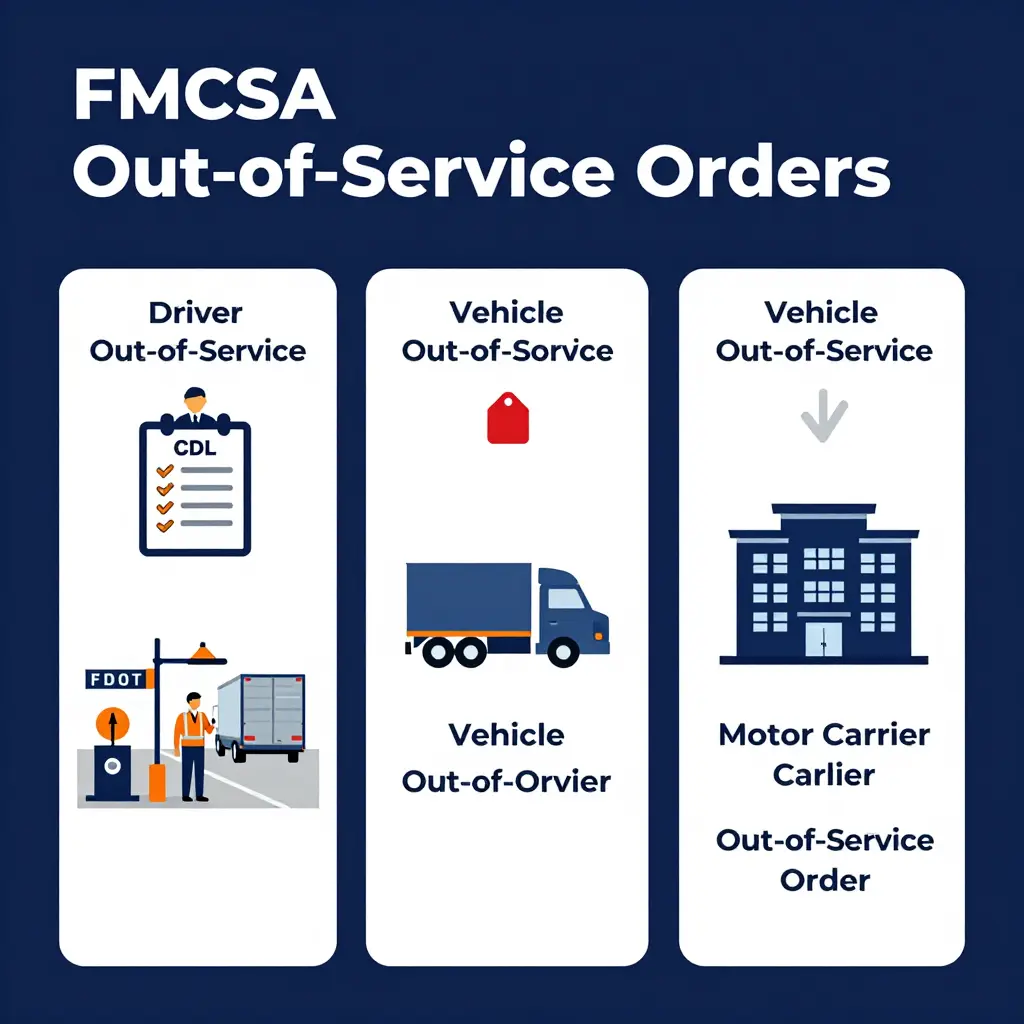
An FMCSA Out-of-Service Order (OOSO) is a formal directive from the Federal Motor Carrier Safety Administration. It prohibits a driver, a vehicle, or an entire motor carrier from operating until specific safety deficiencies are corrected. Because the order can carry legal, financial, and reputational consequences, it helps to know how one is triggered, how far it reaches, and what lifts it.
The Regulatory Framework Behind the Order
Out-of-service authority comes from the Federal Motor Carrier Safety Regulations (FMCSRs), chiefly 49 CFR Parts 390-399. Part 395 covers hours of service, Part 396 sets inspection, repair, and maintenance standards, and 49 CFR 392.7 requires that drivers be satisfied a vehicle is in safe operating condition before they drive it. Violate those standards and enforcement begins.
The Commercial Vehicle Safety Alliance (CVSA) turns that framework into practice. Its North American Standard inspection procedures and Out-of-Service Criteria give roadside inspectors one consistent basis for placing drivers and vehicles out of service during a DOT inspection. Roadside inspections, weigh stations, and compliance reviews apply those written standards every day on the highway.
Driver Out-of-Service vs. Vehicle Out-of-Service
The two conditions are frequently confused, but they carry different consequences and different paths to clearance.
| Out-of-Service Condition | Applies To | Typical Trigger | Who Clears It |
|---|---|---|---|
| Driver OOS | Individual CDL driver | Alcohol/drug violation, hours-of-service breach, unqualified driver | Driver completes required corrective steps |
| Vehicle OOS | Power unit or trailer | Brake, lighting, tire, or load-securement defect under CVSA criteria | Certified repair, then re-inspection |
| Motor Carrier OOSO | The carrier entity | Pattern of noncompliance or unfit safety rating | FMCSA rescission |
A driver out-of-service condition removes the person from duty, and a properly qualified relief driver can often keep the load moving. A vehicle out-of-service condition sidelines the equipment regardless of who is behind the wheel, so the defect must be repaired and verified before the truck returns to service. The remedy depends on which one you are dealing with.
When an Out-of-Service Order Targets the Carrier
An OOSO can also apply to a motor carrier as an entity. When FMCSA identifies a systematic failure of safety management – chronic maintenance neglect, repeated violation patterns – it can issue an order that effectively grounds the carrier’s entire operation. That is the most severe outcome, which is why disciplined fleet reliability and preventive maintenance practices are a carrier’s best defense.
The framework spans three levels – driver, vehicle, and carrier – and knowing which one applies is what speeds up clearance when an out-of-service situation arises.
The table below lists the major out-of-service violation categories that roadside inspectors apply, with an example defect, the threshold that triggers an out-of-service condition, and the FMCSA severity weight range those violations carry in the SMS.
| Violation Category | Example Defect | Out-of-Service Trigger | Severity Weight Range |
|---|---|---|---|
| Vehicle Maintenance | Defective brakes, inoperative lights, tires below tread limit, cracked wheels, steering defects | Brakes defective on 20 percent or more of the service brakes, inoperative required lighting, or any tire, wheel, or steering defect that impairs safe operation | 1 to 10 (brake, wheel, and steering defects commonly weight 4 to 8) |
| Driver Qualification and Licensing | Expired CDL, missing required endorsement, invalid medical examiner’s certificate, disqualified driver status | Operating a CMV without a valid CDL or endorsement for the vehicle, or carrying an expired or otherwise invalid medical certificate | 1 to 10 (licensing and medical violations frequently weight 5 to 10) |
| Hours of Service | Driving beyond the 11 or 14 hour limits, no current record of duty status, falsified logbook | Operating a CMV after exceeding allowed driving or on-duty hours, or driving after being declared out of service for an HOS violation | 1 to 10 (post-out-of-service driving weights 10; falsified logs typically weight 7) |
| Controlled Substances and Alcohol | Positive drug or alcohol test, use of a prohibited substance, possession while on duty | Any detection of alcohol at 0.04 BAC or higher, or drug use or possession while on duty | 10 |
| Hazardous Materials | Improper placarding, leaking packages, missing emergency response information, undeclared shipment | Shipping or transporting undeclared or leaking hazardous materials, or operating without the required placard for the load | 1 to 10 (packaging and placarding defects range widely by code) |
Severity weights feed directly into the CSA Safety Measurement System, so a single high-weight violation can push a carrier’s percentile upward and trigger targeted intervention. Knowing which defects create an out-of-service condition, and how heavily each is weighted, is what protects a fleet’s safety scores and operating authority – the same focus behind quality service and reliability on the road.
Distinguishing Out-of-Service Violations from Non-Out-of-Service Defects
Not every entry on a roadside inspection report carries the same consequence. For motor carriers, the critical divide is between an out-of-service (OOS) violation and a non-out-of-service defect. Which side a finding falls on shapes the correction deadline, the CSA score, and ultimately the operating authority.
What Counts as an Out-of-Service Violation?
An out-of-service violation is a condition serious enough that FMCSA requires the vehicle or driver to be pulled from service on the spot. During a roadside inspection, an inspector who finds a critical safety defect – a brake failure, a defective tire, a driver who has exhausted legal hours – will place the unit out of service. Neither the vehicle nor the driver can continue until the problem is fixed and the violation is cleared.
What Is a Non-Out-of-Service Defect?
A non-out-of-service defect is still a violation, just a lesser one. It is recorded on the inspection report, yet it does not stop the driver from continuing the trip – a cracked mirror, a minor lighting issue. Even though the driver keeps rolling, the defect still lands on the carrier’s record and feeds into its CSA score.
How Severity, Timelines, and DataQs Differ
- Severity weights: Out-of-service violations generally carry higher severity weights and are flagged as out of service, which magnifies their impact on your CSA score. Non-OOS defects carry lower weights and are treated as routine, but they still accrue.
- Correction timelines: An OOS violation is corrected immediately – the unit stays grounded until repairs are verified. A non-OOS defect lets the driver proceed, but fixing it promptly keeps it from escalating.
- DataQs: Both kinds of finding can be challenged through the DataQs process when the record is inaccurate. An OOS violation needs faster attention because it already halted the operation and its data is more heavily scrutinized.
| Factor | Out-of-Service Violation | Non-Out-of-Service Defect |
|---|---|---|
| Vehicle status | Removed from service | May continue |
| Severity weight | Higher, flagged OOS | Lower |
| Correction | Immediate and verified | Prompt, not blocking |
| CSA impact | Significant | Moderate |
| DataQs | Contestable | Contestable |
Why the Distinction Matters
The distinction decides how long a truck sits idle and how quickly a CSA score climbs. A cluster of OOS violations signals systemic safety problems to FMCSA and can trigger interventions, audits, or worse. Non-OOS defects are less dramatic, but they still accumulate, and enough of them can quietly erode your standing. Track both categories, and challenge inaccurate entries early, to keep your compliance record clean and your fleet on the road.
How a Roadside Inspection Flows, Step by Step
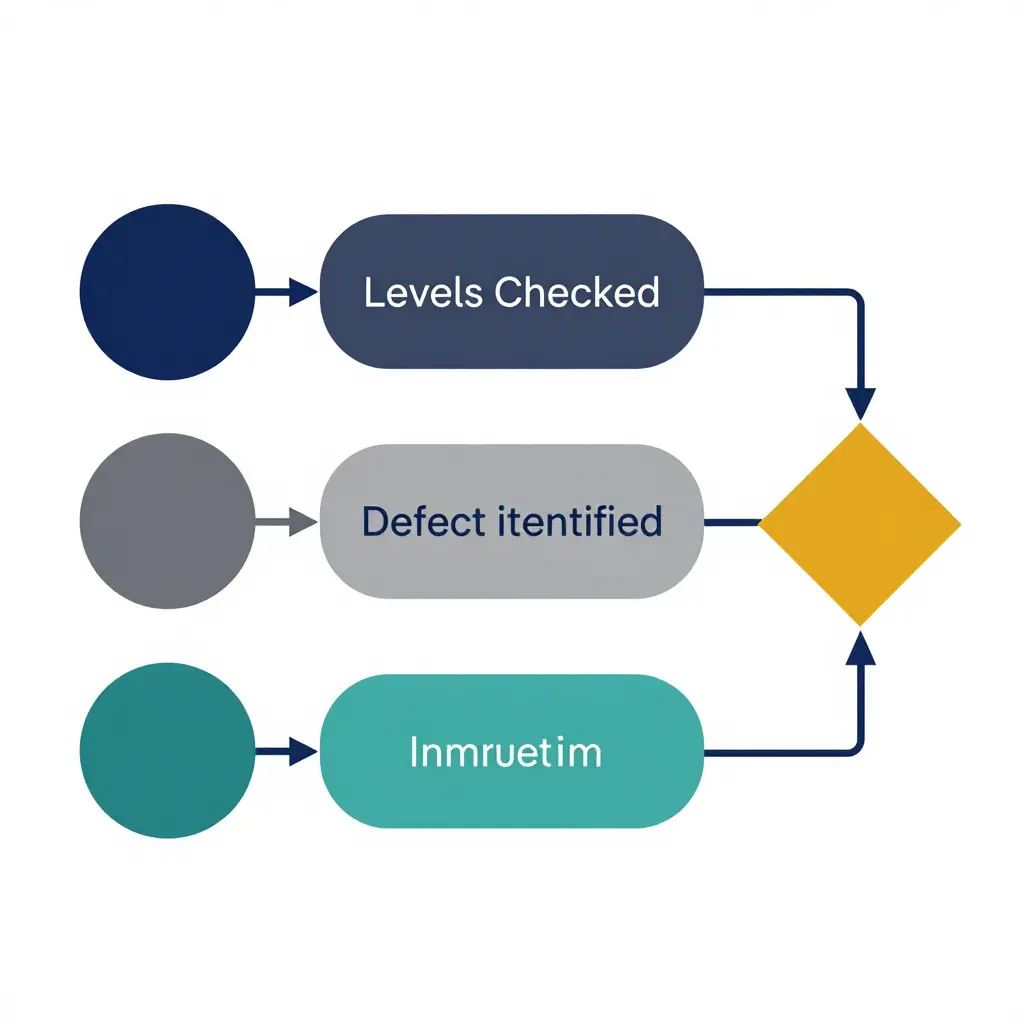
Every roadside inspection follows the same rough sequence. The diagram below maps it: the inspection begins, the officer works through the inspection levels, any defect is identified and evaluated, and then comes the decision point that determines whether the truck continues or is placed out of service.
Read left to right, the flow captures the logic that underlies the entire compliance system. Each stage builds on the one before it, and the decision point at the end is where a routine checkpoint can suddenly shift into a formal Out-of-Service situation. Knowing this order helps carriers and drivers anticipate what comes next – and respond faster when something goes wrong.
What Each Stage Represents
- Inspection begins – The officer selects the vehicle and starts the standard inspection protocol.
- Levels checked – The inspection moves through increasingly detailed levels, from a quick driver and paperwork review to a full mechanical examination.
- Defect identified – Any violation found is classified by severity, ranging from minor issues to critical safety defects.
- Decision point – Based on the defect’s severity, the officer decides whether the vehicle stays in service or is placed out of service.
That final branch is where the outcome is decided. A minor defect may result in a warning or a notice to repair, while a critical violation triggers an Out-of-Service Order that halts the vehicle until it is fixed and cleared. Which is why prevention at the earliest stages – dependable equipment and steady quality service and reliability on the road – matters more than reacting at the end of the line.
The Most Common Roadside Inspection Defects That Lead to Out-of-Service Status
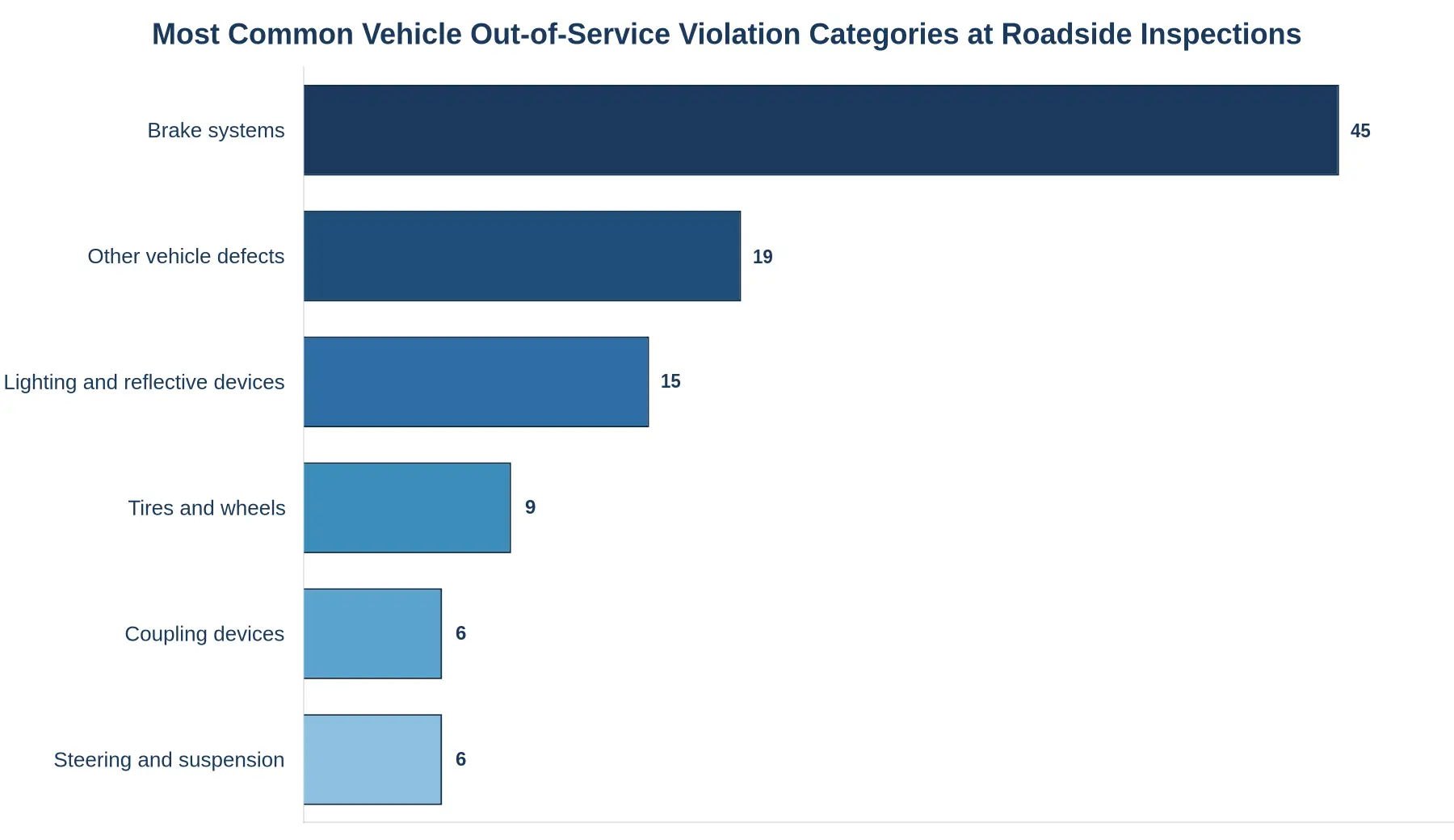
When an inspector finds a critical violation, they issue an out of service (OOS) order, sidelining the vehicle or driver until the defect is fixed and, in many cases, a certified repair is verified. Inspectors check dozens of items, but a handful of roadside inspection defects account for the overwhelming majority of OOS conditions. Catching them – and eliminating them before they surface – is the fastest way to stay compliant and keep freight moving.
Brake System Violations
Brakes are the single largest driver of vehicle OOS orders, and for good reason: they are the primary system that stops a 40-ton rig.
- Out-of-adjustment brakes / pushrod stroke beyond the allowed limit.
- Air leaks exceeding the pressure-loss threshold.
- Cracked, worn, or contaminated linings and pads.
- Inoperative or missing ABS on a unit that requires it.
When the brake system is compromised, the unit is placed out of service because an unsafe stopping distance endangers everyone on the road. There is no quick roadside fix for most brake failures – the truck stays grounded until it is repaired.
Lighting and Reflective Devices
Lighting defects are the second-most common category and often the easiest to prevent. Missing, cracked, or inoperative lamps and torn reflective tape make a vehicle hard to see and its intentions hard to read. Because a combination vehicle can stretch up to 80 feet, conspicuity is a safety issue, not a cosmetic one. Inspectors routinely flag broken turn signals, stop lamps, marker lamps, headlamps, and required reflective sheeting. These defects reliably trigger an OOS condition because visibility failures directly contribute to rear-end and sideswipe crashes.
Tires and Wheels
Neglected tires and wheels are failures waiting to happen. Frequent roadside inspection defects here include tread depth at or below the legal minimum, sidewall bulges, exposed cords, audible air leaks, and loose, missing, or corroded wheel fasteners.
- Under-inflation builds heat and risks blowouts.
- Mismatched or mismounted tires compromise handling.
- Cracked rims or missing lug nuts can shear off under load.
A tire or wheel failure can cause a catastrophic loss of control, so any critical defect grounds the unit immediately.
Coupling Devices
Fifth wheels, kingpins, pintle hooks, safety chains – the coupling devices are what keep the trailer physically attached to the tractor. Defects like a worn fifth-wheel jaw, insecure mounting, a mismatched kingpin, or a bent locking handle are treated as OOS because a dropped trailer or separated combination unit is among the most dangerous events on the highway. Inspectors scrutinize this category closely because coupling failures tend to be sudden and total.
Hours-of-Service and Driver-Related Violations
Not all OOS conditions are mechanical. Driver-related defects, especially hours-of-service violations, are among the most frequent reasons a driver is placed out of service.
- Driving beyond the allowed 11- or 14-hour limits.
- Failing to maintain records of duty status (RODS) or falsifying an ELD.
- Missing or invalid CDL, endorsements, or medical certification.
Fatigue is a leading crash factor, so regulators treat exhausted drivers as an active hazard – often more dangerous than a defective component. When the driver is placed OOS, the truck stops with them, and the carrier’s CSA scores take the hit.
Quick Reference: Why These Categories Trigger OOS
| Category | Common Defect | Why It Triggers OOS |
|---|---|---|
| Brake systems | Out-of-adjustment, air leaks, worn friction | Cannot stop within a safe distance |
| Lighting and reflective devices | Inoperative lamps, missing reflective tape | Reduced visibility and higher crash risk |
| Tires and wheels | Low tread, bulges, loose fasteners | Blowouts and sudden loss of control |
| Coupling devices | Worn jaws, insecure mounting, bad kingpin | Trailer drop or unit separation |
| Driver / HOS | Over hours, falsified RODS, invalid CDL | Fatigue and unqualified operation |
The defects that trigger an out of service order are the ones tied directly to a vehicle’s or driver’s ability to operate safely. A disciplined pre-trip and post-trip inspection routine catches most of them before an inspector ever does. Carriers that pair rigorous maintenance with reliable operations – the kind that build their reputation on quality service and reliability on the road – set the standard for staying cleared, compliant, and moving.
Top Out-of-Service Violation Categories, Ranked
Roadside inspectors don’t nitpick at random. They check against a national list of critical defects, and any item bad enough to make the vehicle or driver unsafe triggers an out-of-service violation that stops the trip cold. Here are the categories that ground commercial vehicles most often, ranked by how frequently they appear in CVSA and FMCSA inspection data.
-
Brake Systems – The biggest single reason trucks get placed out of service. Air leaks, worn pads or linings, cracked drums, or pushrod travel beyond the limit mean the vehicle can’t stop safely, so it stays parked until repaired.
-
Lighting and Lamps – Missing, cracked, or non-working headlights, brake lights, turn signals, and clearance lamps are easy to spot and quick to flag. Lighting feeds directly into a driver’s visibility and signal to others, so a dead required lamp is enough to earn an out-of-service violation.
-
Tires – Tread depth below the legal minimum, sidewall cuts, exposed cords, or improper inflation all compromise grip and load capacity. A tire at risk of blowing out is an immediate hazard, so inspectors will not let the truck roll.
-
Hours of Service (HOS) – This one is about the driver, not the rig. Exceeding driving limits, running past the 14-hour window, or falsifying logs shows a fatigued driver is behind the wheel, which is treated as a serious safety and compliance failure.
-
Driver Qualification and Licensing – A missing CDL endorsement, expired medical card, suspended license, or incomplete qualification file makes the driver ineligible to operate. Without valid credentials, the trip is illegal regardless of how sound the truck is.
-
Securement and Steering – Loose or damaged cargo tie-downs and worn steering components round out the list. Poor securement risks shifting loads, while steering play makes the truck hard to control, both landing drivers in out-of-service status until corrected.
For more on how professional operations stay inspection-ready, explore our premier trucking solutions.
Which Defects Get Trucks and Drivers Placed Out of Service Most Often?
Not all violations carry the same weight. When a DOT inspector uncovers a defect serious enough to sideline a vehicle or driver, that’s an Out-of-Service (OOS) violation – and some categories trigger it far more frequently than others. The bar chart below shows representative OOS rates across the five most frequently cited inspection categories, giving carriers a clear picture of where to focus preventive maintenance and driver coaching.
Chart title: Out-of-Service (OOS) Rates by Violation Category
What the bars represent: Each bar shows the percentage of inspections in that category that result in an out-of-service order. The taller the bar, the more often that defect type pulls equipment or a driver off the road.
| Violation Category | Out-of-Service Rate (%) |
|---|---|
| Brakes | 30 |
| Lighting | 18 |
| Tires | 15 |
| Hours of Service | 12 |
| Driver Qualification | 8 |
Key takeaway: Brake systems and lighting dominate, together accounting for the largest share of sidelined trucks. Because these defects are typically catchable during a pre-trip inspection, a disciplined daily walk-around and a documented preventive maintenance schedule remain the fastest, cheapest ways to protect your fleet’s safety score. HOS and driver-qualification violations, while lower in raw rate, point to recordkeeping and fatigue management gaps that no wrench can fix – they demand proactive compliance oversight. For a broader look at the standards behind these numbers, you can explore quality service and reliability on the road.
How CSA Severity Weights and Out-of-Service Events Shape a Carrier’s Score
FMCSA’s Compliance, Safety, Accountability (CSA) program does not simply count violations – it grades them. Every defect logged during a roadside inspection flows into the Safety Measurement System (SMS), which builds a CSA score for each Behavior Analysis and Safety Improvement Category (BASIC). Two multipliers drive that math: the severity weight and the time weight.
Severity Weight: Not All Violations Are Equal
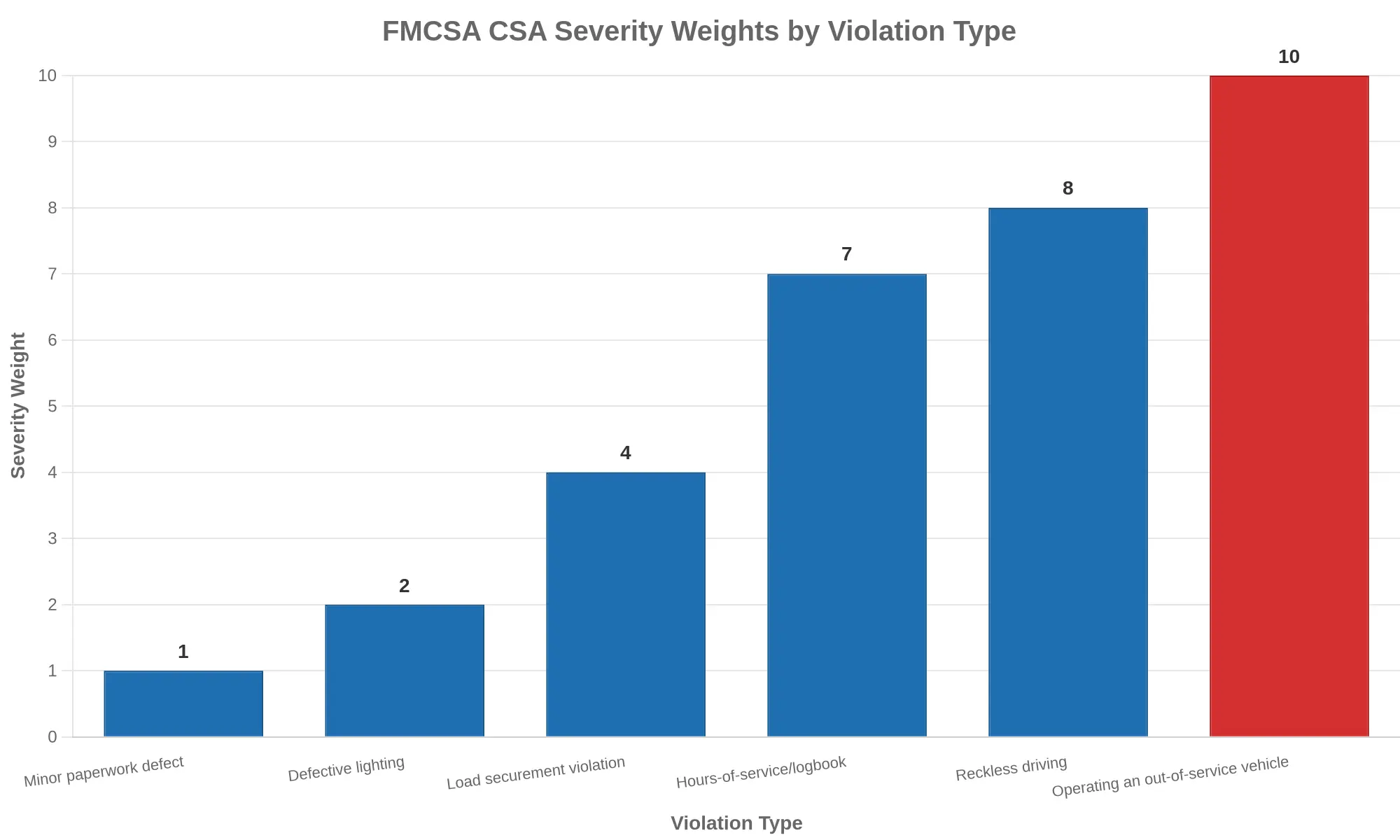
The severity weight assigns each violation a value from 1 to 10 based on how closely it correlates with crash risk. A defective marker lamp might carry a weight of 2, while an hours-of-service falsification can carry a 7. Violations tied to an out-of-service condition sit at the top of the scale.
Time Weight: Recency Counts
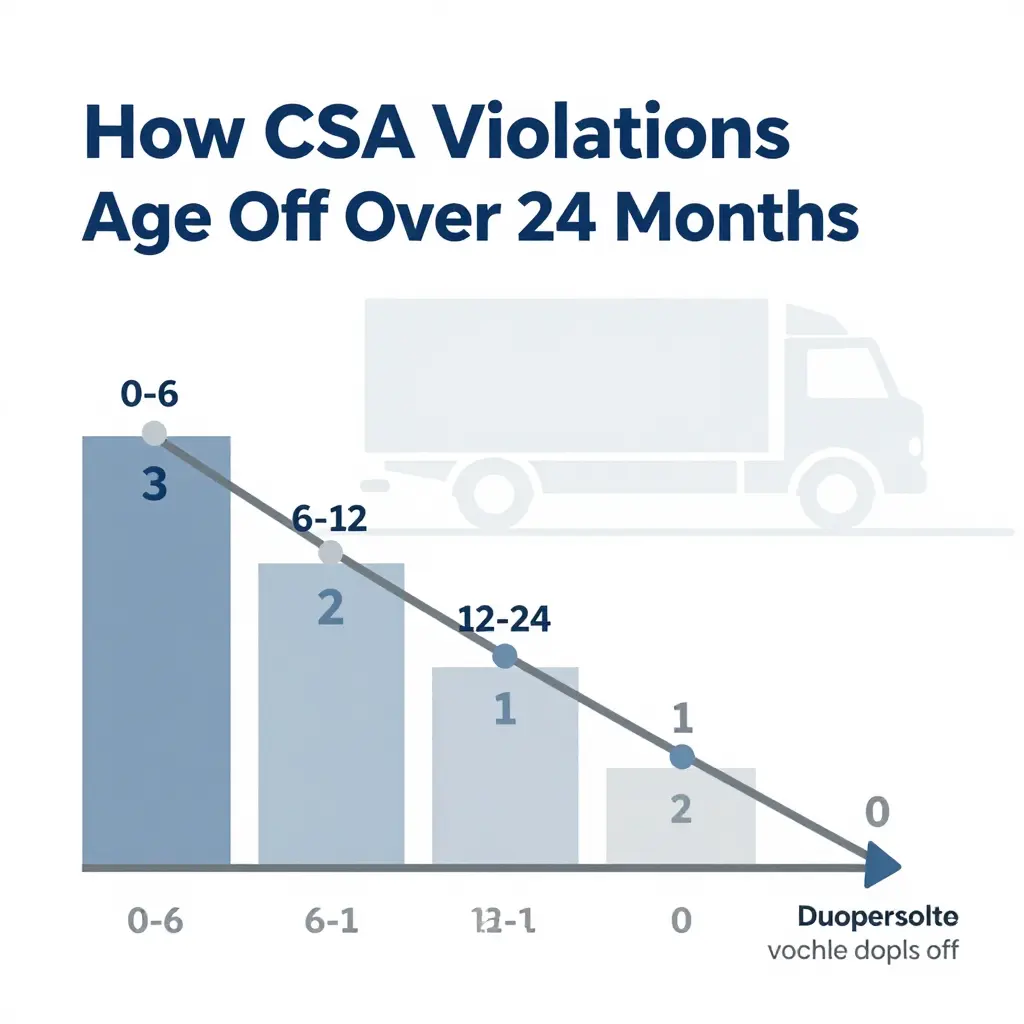
The time weight multiplies the severity weight based on how recently the violation occurred. Because the SMS looks back over a rolling 24-month window, a fresh violation hits harder than an older one.
| Age of Violation | Time Weight |
|---|---|
| Within the last 6 months | 3 |
| 6 to 12 months ago | 2 |
| 12 to 24 months ago | 1 |
| Older than 24 months | 0 |
How an Out-of-Service Event Raises the Score
When an inspection results in an FMCSA Out-of-Service Order, the underlying violation keeps its severity weight and picks up an additional out-of-service weight inside the relevant BASIC. Operating a vehicle that has already been placed out of service carries the maximum severity weight of 10 and can trigger further penalties. The result: a single serious defect can move a carrier’s CSA score more than a stack of minor paperwork issues.
How Violations Age Off
Violations do not linger forever. They stay in the SMS for a 24-month window, losing influence as their time weight steps down from 3 to 2 to 1, then dropping off entirely. That is precisely why consistent, proactive correction matters – clearing an issue and preventing a repeat is the fastest route to a lower score.
Why Proactive Correction Protects Your Operation
CSA data feeds directly into a carrier’s Safety Rating and its intervention thresholds. A rising score can lead to audits, conditional or unsatisfactory ratings, higher insurance premiums, and even loss of operating authority. Carriers that treat compliance as a core operating discipline – much like operators who pursue premier trucking solutions – protect both their safety rating and their ability to stay on the road. For motor carriers and fleet managers making compliance decisions, the move is the same: prevent the defect, clear the out-of-service quickly, and let the clock work in your favor.
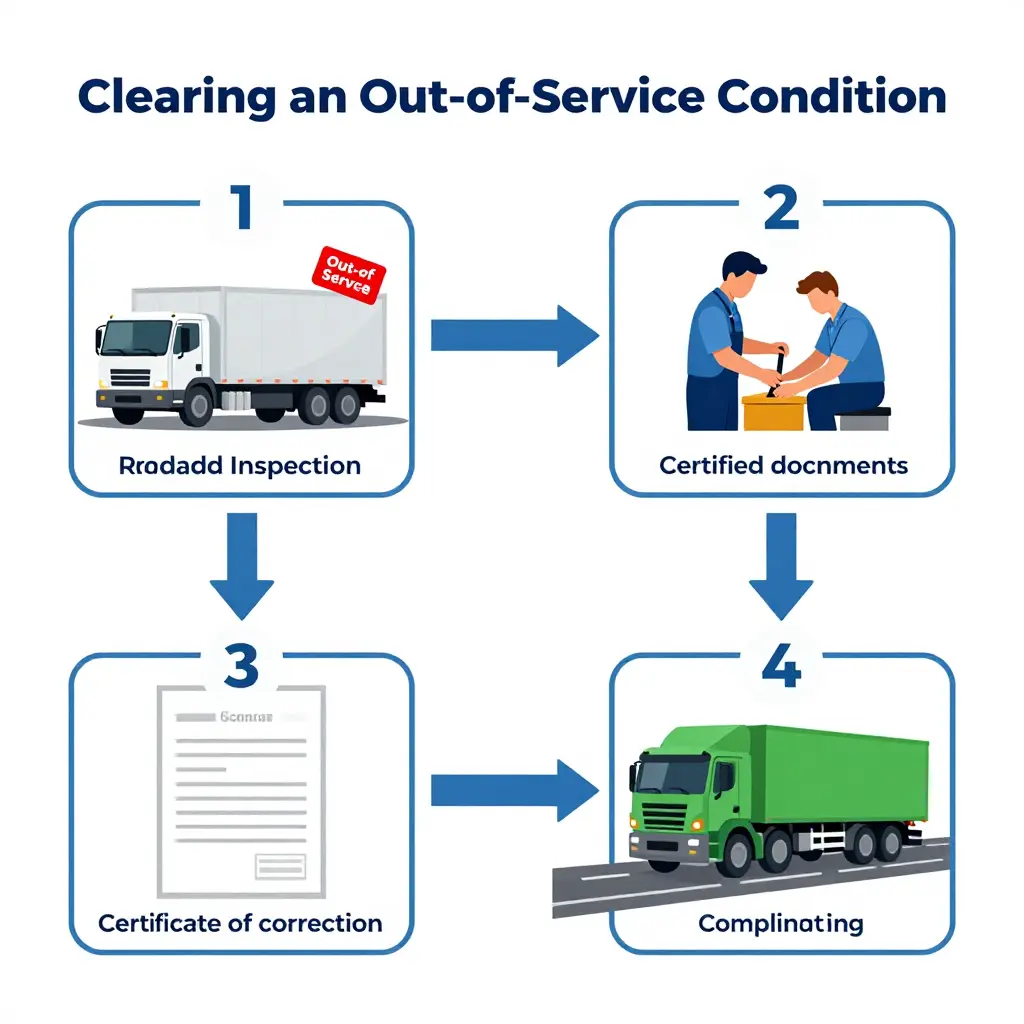
Steps to Get Cleared After an Out-of-Service Order
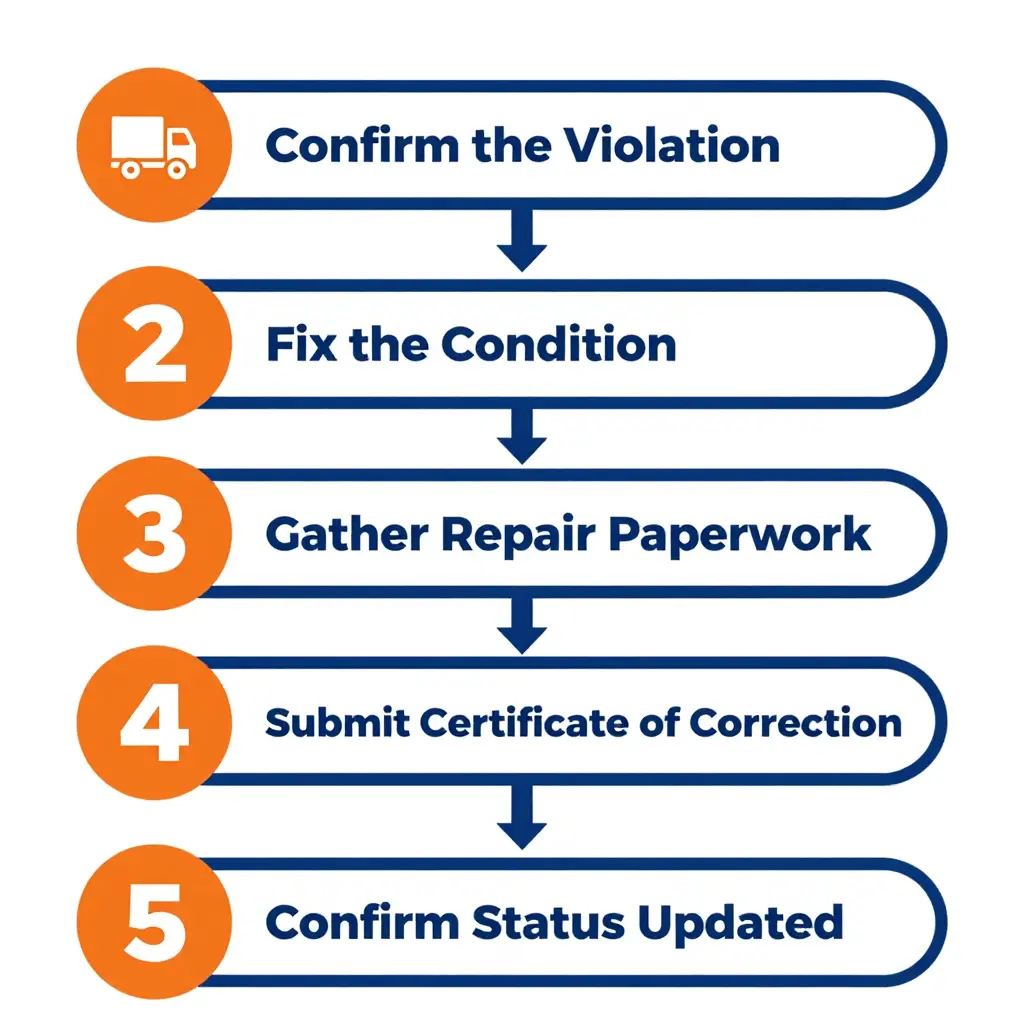
An out-of-service order feels like a red light you can’t run. It is almost always temporary, and the path back to the road follows a predictable, fixable sequence. Whether the issue is a broken brake component or a driver who ran out of hours, the steps to get cleared are the same: identify the problem, correct it, document it, and confirm the record reflects the fix. Work through the steps below in order, and keep every document in your compliance file.
Step 1: Confirm the Exact Nature of the Violation
Before you touch a wrench, pull the roadside inspection report (Form MCS-63) and read the specific out-of-service code. A single fault can trigger multiple codes, and you must clear every one. Confirm whether the order applies to the driver, the vehicle, or both, and note the issuing jurisdiction and the exact deadline for correction. Misreading the citation is the most common reason carriers waste a week on the wrong repair.
Step 2: Address the Driver Condition or Arrange Corrective Repairs
Now fix the root cause. If the order is driver-related, this means resolving the condition itself. A failing hours-of-service status requires the driver to complete a reset; a drug or alcohol violation triggers the return-to-duty process. For vehicle defects, schedule certified repairs at an authorized shop, and if the defect is serious enough to normally place the truck out of service, the repair must bring the unit back to legal, safe condition. Reliable service providers make this step faster, and the right partners in fire truck maintenance service and training show how scheduled, proactive care prevents downtime in the first place.
Step 3: Obtain Proof of Correction or Certified Repair Paperwork
Clearance is only as strong as your documentation. Ask the repairing mechanic for an itemized invoice listing the parts replaced and the defect corrected, and confirm that the shop is qualified to certify the repair. The invoice should match the exact violation code from Step 1. Without this certified repair paperwork, the authority has no way to verify the fix, and your submission will stall.
Step 4: Submit the Certificate of Correction to the Relevant Authority
Send the proof to the agency that issued the order, which is typically the state DOT or FMCSA. Many states require a specific certificate of correction form rather than a plain invoice, so download the correct template. Submit within the required window (often 15 days) by the accepted method, and retain a timestamped copy. Missing the deadline can extend the order and add penalties, so file early.
Step 5: Confirm the Violation Status Is Updated
Do not assume the system updates itself. Log into the FMCSA SAFER or your state portal, or contact the issuing officer, to verify the out-of-service status has been lifted. Check both the vehicle and driver records. If the flag remains, follow up in writing. Once cleared, feed that data back into your process, and consider company-wide improvements like standardizing your fleet so one defect never snowballs into repeated downtime.
Getting cleared is a documentation discipline as much as a mechanical one: confirm, correct, document, submit, verify. Lean on strong product support and uptime planning so your next inspection is a formality, not an emergency, and keep your trucks rolling where they belong.
Documentation and Repair Verification Requirements
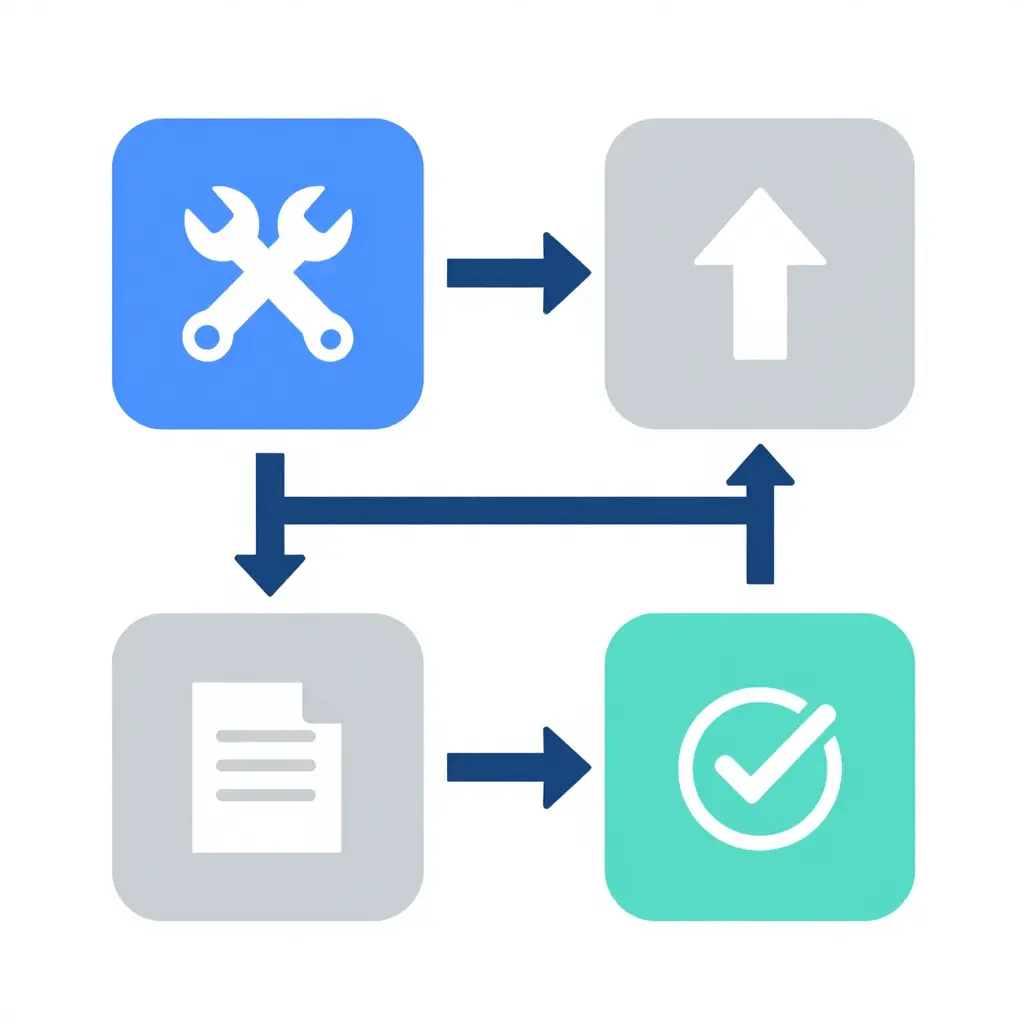
When a roadside inspection results in an out-of-service (OOS) violation, the defect must be corrected and proven before the vehicle or driver can legally return to service. The FMCSA does not simply take your word for it. A clear, complete paper trail is what converts a fix into a cleared condition. Without it, a corrected defect can still be treated as unresolved during an audit.
Certificates of Correction
A certificate of correction is the formal record proving that a specific violation has been repaired. For mechanical defects, this is typically a signed statement – often on company letterhead – that identifies the vehicle, the exact violation, the repair performed, and the date it was completed. Many states also accept a Repair Certification completed directly on the roadside inspection report. Whatever format is used, the document must tie the repair back to the original citation.
Certified Mechanic Repair Records
When a qualified mechanic performs the work, retain the invoice or work order. It should list the mechanic’s name, certifications, the parts used, and a plain-language description of the repair. These records demonstrate that a competent professional addressed the defect and provide verifiable evidence if the repair is ever questioned.
Driver-Related Documentation
Driver OOS violations – such as hours-of-service or license issues – require their own paperwork. Keep updated logs, valid medical certificates, and proof of any remedial action. Records must show the underlying cause was resolved, not merely logged.
Why Accurate Records Matter
Accurate records are the backbone of audits, data reviews, and CSA disputes. During a DOT compliance review, investigators follow your documentation trail to confirm that defects were corrected and that unsafe practices did not repeat. If a violation is later challenged, organized records let you contest inaccurate data and protect your safety scores.
Good recordkeeping is not just about avoiding penalties – it reflects the dependability that defines well-run fleets, much like the quality service and reliability on the road that strong carriers build their reputations on. Store every certificate, invoice, and log in one accessible system, review them routinely, and you turn a stressful OOS event into a manageable, well-documented process.
Frequently Asked Questions About Out-of-Service
What does “out of service” mean on a trucking inspection report?
When an inspector marks a driver or vehicle as out of service, it means they are prohibited from operating until the specific safety defect or violation is fixed. The condition is recorded on the roadside inspection report (MCMIS/Inspection Report) and flags the vehicle or driver as unsafe to continue. For motor carriers, this is an immediate compliance red flag that must be resolved before the unit moves again.
How long does an out-of-service order last?
A vehicle out-of-service condition typically lasts only until the defect is repaired and the vehicle is verified as safe, which can take minutes or hours depending on the fix. A driver out-of-service order usually holds until the disqualifying condition is resolved or the prescribed rest period is met. An FMCSA Out-of-Service Order issued to a carrier (such as an imminent hazard order) can last much longer and stays in force until formally rescinded by the agency.
Can an FMCSA Out-of-Service Order be appealed or corrected through DataQs?
Yes. If you believe an out-of-service violation is inaccurate or the result of a data error, you can file a challenge through the FMCSA’s DataQs system. DataQs handles data-quality disputes, such as an incorrect violation code or a defect attributed to the wrong vehicle. Keep in mind DataQs corrects records, not the underlying roadside enforcement action, so serious citations may require a separate adjudication process.
Does an out-of-service violation stay on a carrier’s record?
Yes, out-of-service violations remain in the carrier’s inspection history and feed into the CSA Safety Measurement System for a set period. They can influence your safety scores, affect your Inspection Selection System (ISS) rating, and increase the likelihood of future roadside inspections. Over time, older violations age off the scoring window, but the record itself does not simply vanish.
What is the difference between a driver and a vehicle out-of-service condition?
A vehicle out-of-service condition involves a mechanical or equipment defect, such as faulty brakes, bad tires, or lighting failures, that makes the truck unsafe to drive. A driver out-of-service condition relates to the person, including hours-of-service violations, expired medical cards, or disqualifying offenses. The distinction matters because the remedies differ: one requires repair, the other requires rest, documentation, or a status correction.
What happens if a driver operates while out of service?
Continuing to drive while out of service can lead to severe penalties, including civil fines, additional citations, and increased scrutiny for both the driver and the carrier. Repeat offenses can escalate to a formal FMCSA Out-of-Service Order and even safety-fitness downgrades. The goal is simple: never move until the defect is corrected and the condition is lifted.
How does a vehicle get cleared to return to service?
In most cases, the defect must be repaired and the repair documented, sometimes by a certified mechanic, before the vehicle is released. An inspector may re-inspect and sign off on the report to confirm the fix. Reliable maintenance and a well-run fleet make this process faster, which is why quality trucking support and service is worth prioritizing.
Where can I check my out-of-service status or inspection history?
Carriers can review inspection and violation history through the FMCSA’s portal and the CSA Safety Measurement System. Verifying your records helps you catch errors early and respond before scores climb. Staying proactive with compliance keeps small issues from becoming out-of-service headaches.