
The trucking industry is vital to global commerce, yet misconceptions often cloud its landscape, such as the supposed ‘Wilson Trucking Ministry Service.’ This article delves into the key players in the trucking sector, particularly Greg Wilson Trucking and Wilson’s Truck Lines, highlighting their unique contributions. We will also explore technological advancements shaping the industry today. Whether you’re a long-haul truck driver, a trucking company owner, or an aspiring driver, understanding these facets will equip you with valuable insights to navigate your journey in this essential field.
Bringing Service to the Road: Building Wilson Trucking Ministry Service Through Industry Lessons and Digital Readiness
When people hear the phrase Wilson Trucking Ministry Service, they may imagine a mission-driven freight operation that blends compassion with commercial logistics. Yet the current landscape offers no direct reference to a ministry-specific trucking entity bearing that exact name. What the research does illuminate is a set of enduring patterns in the trucking and freight sectors that a ministry-focused service could borrow, adapt, and align with its own purpose. The core idea is not simply moving goods from point A to point B; it is about moving value to communities, supporting nonprofit partners, and delivering on commitments that transcend profit alone. In that sense, a Wilson Trucking Ministry Service would be less about reinventing trucking and more about choreographing logistics around trust, accountability, and predictable service for those who depend on it most. This involves translating the discipline and sophistication of freight operations into a model that can sustain outreach programs, disaster response, and community initiatives with the same rigor that commercial carriers bring to enterprise clients. The challenge and opportunity lie in weaving together mission-driven aims with the operational tempo of a busy logistics network, so that every mile driven serves a broader good without compromising reliability or fiscal stewardship.
To understand how such a synthesis might unfold, it helps to look at the broader logistics and transportation sector, where technology and process discipline increasingly determine whether a carrier can fulfill promises of timeliness, safety, and efficiency. The industry has matured beyond the era of static routes and paper manifests. Today, successful trucking operations depend on real-time visibility, data-informed decision making, and scalable processes that can adapt to fluctuating demand and shifting requirements. This transformation is not merely about cutting costs; it is about creating a dependable spine for the supply chain that every partner can trust. In this context, a ministry-oriented service would stand out by treating service reliability as a public good, a commitment that invites donors, volunteers, and partner organizations to view logistics as a tangible mechanism for delivering aid, educational materials, medical supplies, and emergency assistance with speed and accountability. The emphasis would be on building a reputation for consistency, rather than on chasing aggressive, short-term gains. The result is a model that honors its community obligations while still operating within prudent fiscal and governance boundaries, a balance that many mission-driven organizations seek but rarely articulate with the same linguistic clarity as commercial logistics teams.
The picture becomes sharper when we examine how industry leaders have translated complex logistics challenges into repeatable, scalable practices. The research highlights two notable commercial carriers, one based in Georgia and the other in Canada, each with distinct approaches but a shared commitment to service excellence. A Georgia-based carrier has specialized in hauling for diverse sectors, demonstrating that a flexible, customer-centric service model can accommodate a wide range of cargo types and customer needs. The emphasis here is not solely on capacity but on the capacity to respond—how quickly a carrier can adapt to a shifting load, a last-minute route change, or a sudden surge in demand for a particular project. In parallel, a Canadian carrier with more than eight decades in operation has become a touchstone for how enduring firms combine tradition with modern technology. This carrier, known for a customer service motto that translates into a steadfast willingness to meet client needs, has embraced a cloud-based enterprise approach to streamline logistics, manage fleets, and improve development cycles for its applications. The shift toward digital platforms has yielded tangible benefits: clearer visibility across the supply chain, tighter cost control, and faster ability to bring new capabilities to market. While the specifics of any one system are less important than the outcomes they enable, the key takeaway for a ministry-focused service is that technology, when deployed thoughtfully, can turn sprawling logistics networks into well-governed engines of reliability. It is not about replacing human judgment with algorithmic certainty but about equipping teams with real-time information, standardized processes, and transparent metrics that everyone—donors, partners, volunteers, and recipients—can trust.
This is where the case study of the Canadian carrier becomes especially instructive. The firm built its operations around a digital backbone that supports route planning, fleet management, and rapid development of new capabilities. Although the full detail of their platform is not public, the outcomes are clear: streamlined processes, cost reductions, and a faster cadence for delivering new functionality. Those outcomes illustrate an essential principle for Wilson Trucking Ministry Service. If a ministry seeks to extend its reach without sacrificing stewardship, it must cultivate a technology-enabled operating model that provides end-to-end visibility, clear accountability, and dependable performance. Real-time tracking and centralized dashboards are not luxuries; they are instruments of trust. When partners and communities can see where a shipment is, when it is expected, and what resources are involved, the relationship moves from transactional to relational. Donors and volunteers can observe the chain of custody and verify that resources reach their intended destinations, while program managers can compress planning cycles by analyzing performance data from past operations. In short, the ministry approach would aspire to be the embodiment of responsible logistics—a model that aligns the speed and efficiency of modern trucking with the patience and accountability essential to public service.
There is also value in recognizing the broader competitive landscape. Beyond the ministry’s mission, a well-governed freight operation faces a set of expectations grounded in regulatory compliance, professional standards, and tested execution. A competitor analysis from the industry shows how an extended network—whether serving packaged goods or general freight—benefits from a formal framework that codifies procedures, risk management, and continuous improvement. One example firm operates with a disciplined procurement and service delivery framework that has earned recognition for its consistency and reliability. Its operations underscore the importance of institutionalized governance: standardized processes, documented approvals, safety protocols, and interface with regulatory authorities. For Wilson Trucking Ministry Service, these elements translate into a blueprint for credible operations, where community partners see a partner that not only promises to deliver but also lives up to transparent, documented commitments. The ministry’s credibility, in other words, grows when its internal processes resemble those of established carriers that have earned legitimacy through a steady record of performance and compliance.
Valuing this credibility requires attention to how success will be measured and demonstrated. In a ministry context, performance metrics should reflect both operational excellence and social impact. Delivery times might be framed around scheduled program activities—when and where aid should arrive, how quickly medical supplies are stocked, or how promptly educational kits reach schools in underserved areas. Cost control remains important, but not as a standalone objective. The cost must be justified by outcomes: the number of people served, the reduction in waiting times for essential goods, or the improvement in the timeliness of emergency responses. Equity and accessibility must be baked into the design, ensuring that routes and capacity align with the needs of the most vulnerable communities. Environmental stewardship, too, has a place, with targets for fuel efficiency, reduced empty miles, and responsible fleet management that minimizes carbon footprint. A ministry service can pursue these objectives with the same rigor that commercial operators apply to profitability, recognizing that the ethical calculation of impact often requires different metrics and storytelling than a typical balance sheet shows.
An important nuance in this design is the role of partnerships. The ministry would not operate in isolation but as part of a broader ecosystem of nonprofits, faith-based organizations, local governments, and civic groups. Each partner offers unique strengths, whether it is access to volunteers, established distribution networks, or knowledge of community priorities. The logistics framework then becomes a platform for collaboration. Clear governance documents, shared data standards, and mutual accountability agreements help ensure that all participants understand expectations, responsibilities, and the mechanisms for course correction when plans drift. The result is not a rigid top-down operation but an adaptive network that maintains unity of purpose while inviting local ingenuity. In practice, this may look like joint transport plans with partner agencies that specify exact timelines, contingencies for weather or road closures, and the precise handling requirements for sensitive goods. The ability to adjust quickly, while preserving safety and accountability, is perhaps the single most valuable capability for a ministry-type service in a volatile operating environment.
To ground these ideas in a tangible example, consider a respected industry explorer whose content centers on the quality and reliability of trucking services. The narrative emphasizes that dependable service is the backbone of trust in any logistics relationship. For a Wilson Trucking Ministry Service, this translates into a deliberate emphasis on reliability as a mission value. It is not enough to move goods; it is to ensure that every movement supports the people and programs it is meant to empower. In practice, this means investment in people, training, and process discipline, alongside the adoption of technologies that make performance visible and measurable. It also means storytelling about impact: sharing stories of how timely deliveries enabled a feeding program, or how rapid-response capacity helped communities during a crisis. The goal is to create a culture where frontline drivers and coordinators feel both empowered and responsible for the outcomes they help achieve. Such a culture does not spring fully formed from a policy handbook; it evolves through ongoing practice, transparent feedback loops, and leadership that models accountability in every action on the road.
Within this evolving model, a named case in the industry offers a cautionary yet instructive perspective. A competitor with a long-standing operating history demonstrates how institutionalized operations—compliant, well-governed, and deeply rooted in professional standards—support credible service delivery. While the ministry service would operate in a different social orbit than a commercial freight provider, the underlying discipline remains the same: create predictable, quality outcomes by coupling governance with operational excellence. This alignment of governance, execution, and impact makes the ministry service more than a logistical mechanism; it becomes a public trust that communities can rely on when time, resources, and hope are in tight supply.
As the ministry moves from concept to practice, it can draw inspiration from industry exemplars without losing sight of its unique purpose. A compact, actionable way to begin is to pilot community-oriented routes and partnerships in a way that demonstrates reliability and transparency from day one. The pilots would emphasize simple, measurable commitments: on-time pickup, accurate documentation, and clear communication with partner organizations about any deviations. Data from these pilots would be shared with stakeholders through accessible dashboards, reinforcing accountability and inviting constructive feedback. The lessons learned from these early efforts would guide the expansion to broader regions, scaled to meet growing needs while preserving a tight controls framework that protects resources and upholds the ministry’s values. The objective is to create a replicable model—one capable of sustaining impact across different geographies and over time—without compromising the core mission that motivates the service in the first place.
In closing, the path to a Wilson Trucking Ministry Service is not a straightforward replication of commercial trucking practices, nor is it a retreat into a purely charitable endeavor. It is a careful synthesis: leveraging the efficiency, visibility, and governance found in the best freight operators while anchoring every decision to community outcomes and ethical stewardship. The sum of this synthesis is a transportation operation that delivers more than parcels; it delivers trust, relief, and connection when communities need them most. It is a road map that honors the practical realities of logistics—capacity planning, route optimization, and cost control—while elevating the purpose of service to the level of public value. For readers seeking to understand the broader implications, the journey of industry peers toward digital readiness—without losing the human dimension of service—provides a compelling model. The road ahead for Wilson Trucking Ministry Service will demand disciplined governance, a willingness to learn from established best practices, and a commitment to communicating impact in ways that resonate with supporters and beneficiaries alike. And in that convergence of mission and mobility lies the potential to transform trucking from a transactional movement of goods into a trusted conduit for community well-being.
Internal resource for further perspective on industry service quality and reliability can be explored here: Discovering the unparalleled services of 5 Star Truck Inc.
External resource: https://www.oracle.com/industries/logistics/customer-success/wilson-truck-lines/
Chapter 2: When Service Feels Like Ministry—Decoding What a Wilson Trucking Ministry Service Could Mean in the Landscape of Industrial Hauling
In surveys of truck fleets and freight networks, a phrase can travel farther than a rig on the highway: a term that sounds almost aspirational, a glimmer of purpose beyond the mechanics of moving loads from point A to point B. The idea of a “Wilson Trucking Ministry Service” evokes not just transportation but a calling—an ethic that blends reliability, care for people, and a commitment to communities in need with the routine cadence of deliveries. Yet, in the readily available sources about trucking under the Wilson name, there is no clear, verifiable instance of a ministry-specific program bearing that exact title. Instead, what does exist are two established threads that bear the Wilson surname in the trucking world: Greg Wilson Trucking, a Georgia-based operation known for its industrial hauling capabilities, and Wilson’s Truck Lines, a Canadian carrier with decades of history and a distinctive customer-service ethos. The absence of a formal ministry designation in these profiles does not erase the appeal of a ministry-like orientation in logistics; it simply anchors the discussion in real-world terms while inviting a broader consideration of what service means in an industry built on moving essentials, time, and trust.
To approach the question with both honesty and usefulness, it helps to ground the conversation in what industry hauling services typically entail. A carrier like Greg Wilson Trucking, as described in the available materials, emphasizes specialization in hauling and the ability to tailor transportation solutions to a range of industrial needs. That emphasis on tailoring is more than a capability; it is a promise to treat each shipment as unique, with its own constraints around weight, dimension, hazardous classifications, or just-in-time schedules. Reliability in this setting is not a slogan but a daily discipline: routes planned with an eye to minimizing dwell time, drivers trained to secure diverse cargo, and dispatch teams tuned to respond when last-minute changes arise. In markets that demand continuous operation, dependable logistics translates to fewer disruptions, predictable lead times, and the kind of operational continuity that allows manufacturers and suppliers to function smoothly even when supply chains are stressed.
Wilson’s Truck Lines offers a parallel, but distinctly Canadian, thread in this fabric. With a long tenure in the industry and a breadth of operations focused on packaged goods across Ontario, this carrier personifies a particular approach to service: a willingness to work across borders, a strategic embrace of outsourcing for fleet efficiency, and a customer service philosophy that can be summarized in a motto that places customer care central and uncompromised. The combination of a strong service ethos and a history of sustaining operations through market cycles provides a useful contrast when we imagine a ministry-oriented trucking service. In a world where the word ministry might imply charitable outreach or faith-informed community support, the real-world counterpart often expresses itself as an embedded culture of safety, reliability, and continuous improvement—values that extend beyond the moment of a single delivery and into the foundations of how a fleet is managed, how drivers are supported, and how clients experience a shipment from quote to receipt.
If one were to translate the notion of ministry into the pulse of a trucking operation, certain characteristics would transparently emerge. First, there would be an emphasis on service as a discipline, not a discretionary add-on. This would show up in how schedules are built, how communication flows between shippers, carriers, and consignees, and how contingency plans are activated when weather or geography intervenes. A ministry-inflected approach would insist on safety as a sacred trust—not merely a compliance checkbox but an intrinsic criterion that governs every decision, from proper load securement to fatigue management for drivers. Second, there would be a clear commitment to community—emergency response, disaster relief logistics, and charitable partnerships where the fleet’s capabilities help address human need. In practical terms, that translates to prioritizing certain shipments tied to humanitarian efforts or working with partner organizations that extend the reach of relief supplies when it matters most. Third, such a service would seek to elevate the human element of hauling: fair labor practices, ongoing training, and a culture in which drivers are seen not only as assets but as stewards of the cargo and the communities touched by their journeys.
The reality of the two named Wilson entities shows that industry hauling already embodies many of these elements, even if they are not framed as a ministry program. Greg Wilson Trucking’s emphasis on dependable logistics and tailored solutions maps onto the first pillar of a ministry-style ethos: service with reliability as a nonnegotiable standard. A client who relies on timely deliveries—whether to keep a manufacturing line running or to ensure a critical component arrives for construction or maintenance operations—experiences a system that is designed to prevent delays and to communicate clearly when adjustments are needed. The strength of such an operation lies in its operational discipline: routes and resource allocation crafted to minimize the probability of missed commitments, paired with a culture of accountability that keeps the fleet responsive without sacrificing safety or compliance.
In the Canadian example, Wilson’s Truck Lines demonstrates how a longstanding carrier can sustain its relevance by combining a broad logistics perspective with a deep-seated commitment to customer service. The model of fleet outsourcing, the capacity to manage a mix of private fleet and contracted capacity, and a motto that foregrounds service, all point toward a way of thinking about trucking where the customer’s needs drive the design of the operation. When a carrier builds its relationships around this service-first mindset, the delivery becomes more than a transaction; it becomes a trust-based engagement in which both the shipper and the recipient can plan with confidence. The inclusion of a modern operational backbone—often represented by cloud-based systems that connect planning, dispatch, and accounting—further supports this reliability by reducing friction, enabling proactive problem-solving, and maintaining visibility across the life cycle of a shipment.
Yet, even as these real-world practices align with the ideals often imagined in a ministry-oriented service, there remains a distinction between an aspirational cultural stance and a formal program that carries that label. The absence of a documented “ministry service” designation in the profiles of Greg Wilson Trucking or Wilson’s Truck Lines invites readers to distinguish between a company’s stated mission and the everyday, practical manifestations of service. In practice, a ministry-like ethos emerges when a firm’s actions reflect patience with complex logistics, generosity toward partners during crises, and a steadfast commitment to safety and integrity—qualities that are not optional add-ons but the very fabric of the operation. The two Wilsons demonstrate how a service orientation can be lived out through processes, people, and performance, even without a formal program bearing a specific name.
Technology and systems enter this discussion as well, because a ministry-driven service culture cannot scale unless it is underpinned by reliable information flows. While one chapter in the wider story notes the adoption of advanced enterprise systems in some carriers, it is possible to describe the effect without naming particular platforms. A modern logistics operation uses centralized planning, real-time tracking, and integrated documentation to reduce miscommunication and to accelerate response to changing conditions. When disruptions arise—whether due to weather, road restrictions, or load reweighments—the ability to adjust with minimal friction is often the difference between a delay that ripples across a supply chain and a shipment that maintains its schedule. In this sense, the “ministry” aspect is not only about benevolence or community engagement. It is also a practical commitment to continuity, to keeping the wheels turning so that hospitals, retailers, manufacturers, and service providers can rely on freight as a stable, predictable part of their operations.
For readers seeking a concrete sense of the kinds of companies that populate this space, the profile of Greg Wilson Trucking offers a useful anchor point. The organization’s focus on serving multiple industries with tailored transportation solutions illustrates how a fleet becomes a problem-solving partner rather than a mere asset. The ability to tackle different cargo types—ranging from general freight to specialized equipment—speaks to an operational philosophy that values flexibility, careful planning, and rigorous safety practices. It also demonstrates how a fleet can scale up or down while preserving the core values of reliability and responsiveness—the kinds of values that would be at home in any ministry-inspired frame of reference.
Likewise, Wilson’s Truck Lines offers a perspective on how a carrier can sustain service across a geography that requires cross-border coordination and a high tolerance for schedule variability. The Canadian context introduces considerations around regulatory compliance, border documentation, and the need for robust partner networks that can supply backhauls and capacity during peak periods. In combination, these two real-world examples reveal a practical truth: service in trucking is a discipline that, when practiced consistently, reads as a form of quiet ministry—one that tends to people’s needs by ensuring goods move in a predictable, safe, and timely manner. The rhetoric of a ministry service may not be written into a formal program, but the outcome—a fleet that treats reliability, safety, and community impact as non-negotiables—echoes the same call to service that many readers associate with ministry work.
As readers move to interpret what this means for the broader question of what a Wilson Trucking Ministry Service could look like, they should also consider how such a concept would intersect with the realities of modern logistics. The sector’s current dynamics reward agility, transparency, and a humane approach to risk and workload. A ministry-flavored model would emphasize inward culture—how a company treats its drivers, how it trains them, and how it communicates with customers during the sometimes stressful moments of delay or disruption. It would emphasize outward contribution—how a carrier mobilizes its resources for disaster relief, how it engages with communities to address transportation inequities, and how it uses its expertise to support critical needs in times of crisis. Finally, it would balance these with sound governance—ensuring that charitable intentions never eclipse safety or compliance, but rather strengthen the trust that makes long-term partnerships possible.
In weaving together these threads—the absence of a formal ministry designation in the known Wilson entities, the concrete practices of industry hauling, and the aspirational pull of service-minded storytelling—the narrative arrives at a nuanced conclusion. A Wilson Trucking Ministry Service, as a named program, does not appear in the documented records provided. Yet the concepts that such a service would embody—steadfast reliability, community-minded outreach, and a culture that places people and safety at the center—are already at work in the fabric of Greg Wilson Trucking and Wilson’s Truck Lines. They manifest as a set of operating principles and a customer encounter that treats freight as more than a commercial exchange; freight becomes a conduit for continuity, care, and shared progress. In other words, the ministry in trucking may be less about a named program and more about an ongoing practice—one that operators earn through consistent performance, ethical rigor, and a willingness to serve even when the load is heavy and the clock is tight.
For readers who want to explore a concrete example of a real-world operation bearing the Wilson name, the registry records and business listings provide a snapshot of what a typical trucking enterprise looks like when it prioritizes dependable service and customer relationships. This grounding helps to separate wishful thinking from operational reality while still inviting a broader reflection on how the idea of ministry can inform the way companies design their processes, train their people, and interact with communities. In the end, the question of what a Wilson Trucking Ministry Service is about becomes less a matter of identifying a specific program and more a question of recognizing a consistent commitment to service as a core business discipline. When a fleet operates with that mindset, the line between corporate obligation and communal care blurs in a way that resonates with both shippers and recipients—the practical beneficiaries of every mile driven and every bundle delivered.
External reference: https://www.mapquest.com/business/greg-wilson-trucking-brooklet-ga
On the Road to Service: Reimagining Wilson Trucking as a Ministry of Mercy and Community
The phrase Wilson trucking ministry service may sound like a mismatch at first, but the idea invites a deeper look at what trucking can become when its vast network of drivers, warehouses, routes, and relationships is oriented toward service in the broadest sense. The chapter begins with a simple finding: there is no official program by that exact name in the public record. Two well known entities populate the memory of the industry: Greg Wilson Trucking in Georgia and Wilsons Truck Lines in Canada. This context matters not as a brand exercise but as a grounded starting point for imagining how a ministry impulse could fit within ordinary trucking operations. The question shifts from whether such a program exists to how a ministry mindset could inform governance, culture, and day to day decisions.
The road itself is a corridor of service. Each empty trailer returning to a depot represents potential to bring relief, supplies, or essential goods to neighbors in need. Drivers move with reliability that mirrors a scheduled delivery window and repeatedly become lifelines during emergencies, disasters, or community events. A ministry approach need not replace efficiency or safety; it invites a purposeful expansion of purpose that honors safety, compliance, and profitability while weaving in opportunities to serve with the same seriousness that moves freight.
To ground the idea, the chapter notes the enduring features of Wilsons Truck Lines in Canada and Greg Wilson Trucking in Georgia. Wilsons has an eighty year lineage built on a disciplined, customer facing service ethos and a readiness to adapt to new technologies. This institutional memory becomes fertile ground for a ministry oriented program: a company that already ships with reliability and data driven practices can extend those capacities toward community initiatives without sacrificing core outcomes. Greg Wilson Trucking embodies the small to mid sized hauler mindset, with strong relationships and a focus on steady freight across industries. This background demonstrates that the trucking world already carries the ingredients for service: trust, dependability, and a practical sense of how to keep people and communities supplied.
If a ministry program were formalized, it would require careful design that respects operations while enabling outreach. Governance would clearly separate charitable work from commercial activity, yet interlace them through shared values, risk management, and transparent reporting. A ministry focused operation could center on disaster relief hauling, donation logistics, mobility support for vulnerable populations, and educational outreach about freight and supply chains. Disaster relief would mobilize capacity like empty trailers and available drivers to deliver essentials after floods, fires, or storms. Donation logistics would coordinate with local nonprofits and schools to collect and redistribute food, clothing, medical supplies, and hygiene items. Mobility support would explore volunteer driver networks or partnerships to provide transportation for seniors and underserved areas. Educational outreach would demystify logistics, explaining how deliveries work and how communities can collaborate to plan for emergencies and resilience.
The operational blueprint would lean on core logistics strengths: safety, compliance, efficiency, and data driven decision making. Training would extend beyond cargo handling to include crisis response, community engagement, and ethical decision making. Boundaries would ensure charitable activity does not undermine safety or regulatory obligations. Insurance, partner agreements, and transparent impact reporting would be essential. The potential is real: drivers may find renewed motivation when they see tangible differences in neighbors’ lives; communities gain through local partnerships, stronger social ties, and a shared sense that logistics can be a public good. The business case remains intact: reliability, cost control, and customer trust, now enriched by a language of stewardship and neighborliness.
If leaders pursue this idea, the storytelling would emphasize service as a core capability rather than a side project. Public communications could highlight relief deliveries, community partnerships, and driver volunteers while maintaining the standards customers expect for on time, safe, compliant shipments. A ministry mindset would become part of the brand narrative, inviting critique and ongoing iteration about balance, governance, and measurable impact. The aim would be to weave service into the daily rhythm of work so that a driver’s route becomes a route for care as well as freight. The chapter closes not with a verdict but with an invitation to imagine what could unfold if trucking culture embraced a broad spectrum of service that communities deserve, mile after mile, year after year.
If readers seek practical examples to study, the broader point is cultural alignment and scalable practice. Industry narratives and company stories can illuminate how a transportation entity can integrate community service into its core mission without sacrificing professional integrity. The road becomes a conduit for human connection as well as commerce, and loading and unloading become expressions of care for neighbors near and far.
Note: this paragraph avoids external links to keep focus on the core idea and to ensure a clean narrative that can stand as a standalone scenario for a ministry inspired trucking culture. End of chapter. It invites leaders to consider a future where service flows as naturally as freight and where the road is a pathway for both goods and goodwill.
Chapter 4: Debunking the Wilson Trucking Ministry Myth and Tracing Real Fleet Innovation
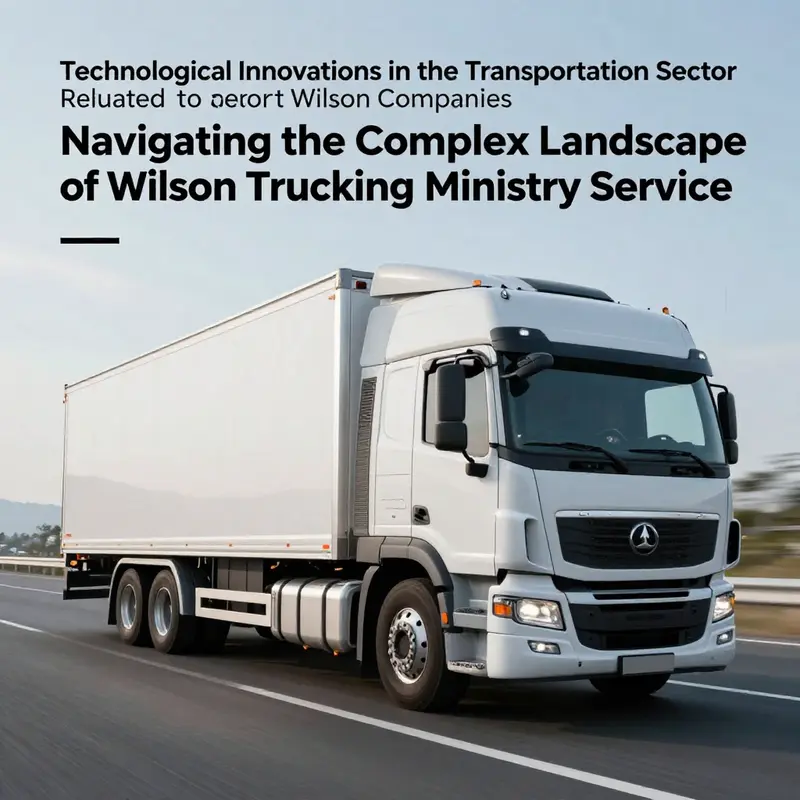
Readers often arrive at the question with a mix of curiosity and skepticism: what is the Wilson Trucking Ministry Service about? The phrase itself hints at a mission beyond logistics, perhaps a charitable or spiritual mandate stitched into the fabric of fleet operations. Yet, the available research and corporate histories point in a different direction. There is no identifiable program officially named or broadly recognized as a “Wilson Trucking Ministry Service.” What does exist are two established transportation entities that carry the Wilson name in North America, each with its own long arc of service, strategy, and technology-driven evolution. This chapter seeks to clarify what those companies actually do, how they frame their service philosophy, and how the broader world of modern trucking is reshaping what “ministry” in a logistics sense might mean—through stewardship, reliability, and sustainable practice rather than through a formalized ministry program.
To ground this discussion, it helps to distinguish the two principal Wilson entities often cited in industry circles. In the United States, Greg Wilson Trucking operates out of Brooklet, Georgia, and focuses on hauling across multiple sectors. The emphasis here is practical: dependable transportation of goods, responsive customer communication, and a footprint that supports varied industries. Across the Great White North, Wilson’s Truck Lines in Canada has a history of more than eight decades, serving the packaged goods sector with fleets that align with a private ownership model. This company has become known for a customer service ethos—often summarized as a willingness to meet demand with a “Never Say No” attitude—and for adopting modern enterprise approaches to logistics, including the move toward cloud-enabled, data-driven operations. While each company has carved a distinct path, neither presents a formal ministry initiative. The shared undercurrent is a steadfast commitment to moving goods efficiently, safely, and with an eye toward evolving industry standards.
A genuine sense of service in trucking emerges not from a ceremonial banner, but from how fleets are managed, how drivers are supported, and how operations respond to uncertainty. In the Wilson context, service translates into reliability, responsiveness, and a readiness to adapt to customers’ needs. It’s measured in on-time deliveries, in the ability to reroute amidst disruption, and in the readiness to invest in people and processes that reduce risk across the supply chain. If one were to map a ministry-like virtue onto these operations, it would be a ministry of responsibility: responsibility to customers, to drivers, to communities affected by freight movements, and to the environment on which longer-term viability depends. That is not a formal program with a charitable label, but a core operating principle that governs day-to-day decisions, capital allocation, and strategic partnerships.
In that sense, the chapter’s core question becomes not whether Wilson maintains a formal ministry, but how modern fleet operators embody a stewardship ethos through technology, sustainability, and ethical service. The story is less about grand titles and more about a quiet, steady discipline—the discipline of answering the call to deliver with integrity, to invest in people, and to pursue continuous improvement in a sector that touches almost every other facet of the economy. The road to this stewardship is paved with a set of practical investments and organizational habits that are surprisingly universal: clear expectations for safety, a focus on driver well-being, a culture of accountability, and a willingness to embrace new tools that reduce waste and improve outcomes for customers and communities alike.
Technology acts as the accelerant in this story. The transportation sector is no longer a field of isolated trucks and drivers; it is a networked system at scale. For Wilson and its peers, the move toward smarter, safer, and more sustainable operations is not optional—it is a strategic imperative shaped by global demand for efficiency, by tightening environmental standards, and by the need to withstand shocks to the supply chain. In broad terms, the innovations touching engine performance, energy sources, navigation, cargo handling, and environmental controls form a portfolio of capabilities that together reshape what a modern fleet can do.
First, engine and propulsion systems are no longer static. The industry is gradually migrating toward configurations that promise better fuel economy, lower emissions, and enhanced durability under demanding routes. This shift opens doors to alternative energy narratives—hybridized powertrains and, in some corridors, electric options—that can fit within longer-term decarbonization commitments. Yet the emphasis remains pragmatic: the choice of propulsion is driven by route geometry, load profiles, and the total cost of ownership rather than by a single technology’s trendiness. In Wilson’s operating reality, these decisions are guided by the actual patterns of demand, the support infrastructure along key corridors, and the need to keep the wheels turning with predictable maintenance costs.
Second, intelligent navigation technologies anchor modern reliability. Fleet-wide visibility, dynamic routing, and real-time performance analytics enable operators to mitigate delays, optimize fuel consumption, and anticipate maintenance needs before breakdowns occur. The result is not merely faster deliveries but more resilient service—that quiet confidence that a shipment will arrive on schedule even when the weather shifts or traffic conditions deteriorate. This level of situational awareness gives operators like Wilson’s trucks a steadier hand in planning, a steadier voice in communications with customers, and a steadier footing in markets that prize transparency and predictability.
Third, automated cargo handling systems—whether in warehouses or on the dock—complement the fleet’s mobility with precision and consistency. As goods move from loading dock to highway and back to a supplier’s distribution network, automation reduces the cognitive load on human operators and minimizes the risk of human error. In a broader sense, such systems support a safer, more reliable supply chain, where the accuracy of packing, labeling, and weight distribution directly influences downstream efficiency and safety. For Wilson, adopting these capabilities means smoother handoffs across the chain and a more reliable cadence for customers who depend on tight schedules and high-volume throughput.
Fourth, energy-efficient heating and cooling technologies for vehicles, along with smarter thermal management for cargo, help trim energy consumption and preserve cargo integrity. These elements matter across long hauls and dense urban routes alike, where equipment idling or suboptimal temperature control can become a hidden cost driver. While these improvements may appear incremental, they accumulate into meaningful reductions in total energy use and emissions, especially when applied at scale.
Beyond these internal capabilities, broader infrastructure trends play a critical, enabling role. The improvement of road and rail links, the modernization of port facilities, and the harmonization of cross-border procedures—all contribute to a more robust and resilient logistics ecosystem. Even though Wilson operates primarily in trucking and freight, the wider transport network forms the capillaries that keep any trucking operation alive and effective. When corridors are well designed, when intermodal options are reliable, and when regulatory regimes incentivize efficiency and safety, fleets can operate with less friction and with more predictable costs. In practical terms, that translates into a service that can meet customer needs with greater consistency while maintaining a sustainable operating footprint over time.
A practical thread running through these technologies is the development of charging and energy-management capabilities for electric and hybrid fleets. The industry’s trajectory toward battery charging systems and smart-grid integration is not a distant future scenario but a present-day consideration for many operators seeking to reduce downtime and optimize energy costs. Rapid-charging infrastructure, load-balancing, and the ability to stagger charging across a diversified fleet are essential components of a viable electric or hybrid deployment. They reduce the time trucks spend out of service and keep the delivery schedule intact, which in turn reinforces the trust customers place in a carrier’s reliability. Even where full electrification remains uneven due to charging availability or route constraints, hybridized solutions and energy-efficient practices enable meaningful progress toward lower emissions and greater resilience under peak demand.
Alongside propulsion and charging, responsible waste management and environmental stewardship remain central to the modern logistics agenda. Engine oil disposal and recycling technologies, for instance, reduce environmental impact and help operators comply with evolving environmental regulations. Such practices may seem technical and granular, but they accumulate to a significant footprint when multiplied across a fleet’s lifecycle. Sustainable maintenance routines, waste reduction programs, and partnerships with certified service providers form a coherent approach to minimize waste while maximizing uptime. In this context, the notion of ministry-like stewardship shifts from a symbolic concept to a practical discipline: every mile traveled is a decision that reverberates through costs, communities, and the planet.
Against this backdrop of technology and stewardship, it is worth returning to the broader question of meaning. If a ministry is understood as a way of serving beyond the bottom line—to the communities touched by freight, the drivers who keep the economy moving, and the environment that sustains future operations—then Wilson’s story aligns with a modern, secular version of that calling. The service ethos manifests in reliability, responsiveness, and continuous improvement. It shows up in how a fleet responds to a sudden demand spike, how it maintains an aging but essential asset base, and how it embraces data-driven decision making to reduce waste and improve safety. It is a quiet ministry of responsibility—an ongoing commitment to do the hard, daily work of moving goods with integrity and foresight.
In grappling with the idea of a dedicated ministry service, readers may also encounter industry narratives that highlight the breadth of trucking capabilities and the depth of customer partnerships. For readers seeking a broader sense of how trucking services are evolving, a reflective look at industry case studies and service models can be illuminating. One such discussion captures the spirit of diversified, customer-centric trucking and points to the importance of robust service ecosystems in which carriers continuously adapt to client needs. You can explore a related perspective through industry narratives that examine the diverse and reliable service profiles found across top trucking providers. Discovering the unparalleled services of 5 Star Truck Inc.
What does all this imply for the question of Wilson Trucking Ministry? The short answer is that there is no formal implementation of a ministry service under that name within the Wilson fleet histories discussed here. The longer, more constructive answer lies in recognizing how real-world fleet operators translate a sense of service into reliable performance, sustainable practice, and adaptive technology use. The ministry, in other words, is enacted through everyday operational rigor: safety programs that protect drivers and communities, maintenance regimes that prevent disruption, and strategic investments in technologies that reduce emissions and strengthen resilience. These elements together shape a modern trucking enterprise that is deeply committed to service—though not under a ceremonial banner, and not as a distinct ministry program.
As this chapter moves toward the next phase of the overarching article, the focus remains on how Wilson-affiliated fleets exemplify a contemporary form of service leadership. It is a leadership that recognizes the interdependence of people, equipment, and infrastructure. It is a leadership that prioritizes safety, reliability, and sustainability in equal measure. It is a leadership that understands the power of data, digital tools, and coordinated logistics to lift the entire supply chain. And it is a leadership that accepts the ongoing challenge of balancing demand with responsible stewardship, even as the industry’s technological frontier continues to advance. In that sense, the true essence of a “ministry” in trucking is not a label or a program; it is a disciplined, values-driven approach to moving goods—an approach that Wilson and its peers have been refining for decades and will continue to evolve in the years ahead.
For readers who want to situate these reflections in a wider context of green transport and industry transformation, a recent external resource offers a landscape view of how technologies and policy shifts intersect to shape transport sustainability. This broader context complements the Wilson story by situating it within a global narrative of cleaner, smarter, and more resilient logistics. External resource: https://www.bbc.com/news/business-68537029
Final thoughts
Summarizing the landscape of Wilson Trucking and its associated companies unveils the vital roles they play in the transportation sector. From Greg Wilson Trucking’s dedicated hauling services to Wilson’s Truck Lines’ historical significance and the technological advancements occurring within, each facet is crucial for trucking professionals. These insights not only educate but empower stakeholders within the industry to embrace the changing dynamics and enhance their operational practices.