
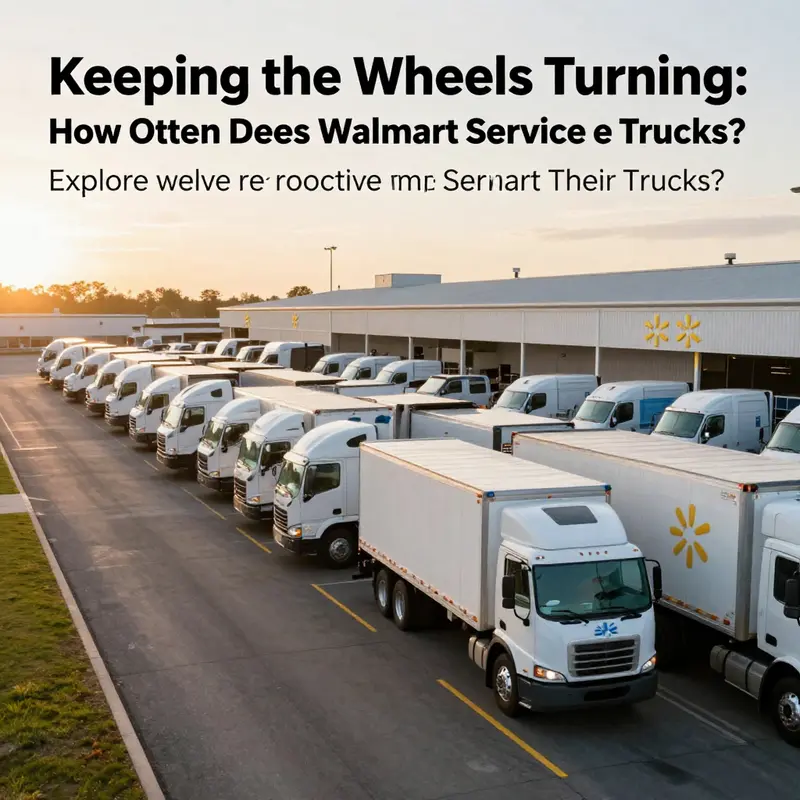
In the competitive realm of long-haul trucking, maintaining operational efficiency and vehicle reliability is paramount. For Walmart, the nation’s largest retailer, keeping its fleet on the road requires a unique focus on regular vehicle servicing. This article delves deep into Walmart’s fleet maintenance program, providing insights into how often they service their trucks and the methodologies behind it. We’ll explore their maintenance intervals, the cutting-edge technology employed for monitoring vehicle conditions, the efficiency implications of their servicing schedules, and the robust training culture that supports these practices. In each chapter, we aim to present a holistic view of how Walmart ensures their trucks remain safe and efficient while appealing to long-haul truck drivers, trucking company owners, fleet managers, and aspiring truck drivers alike.
Rolling, Ready, and Predictively Maintained: Inside Walmart’s Constantly Serviced Truck Fleet
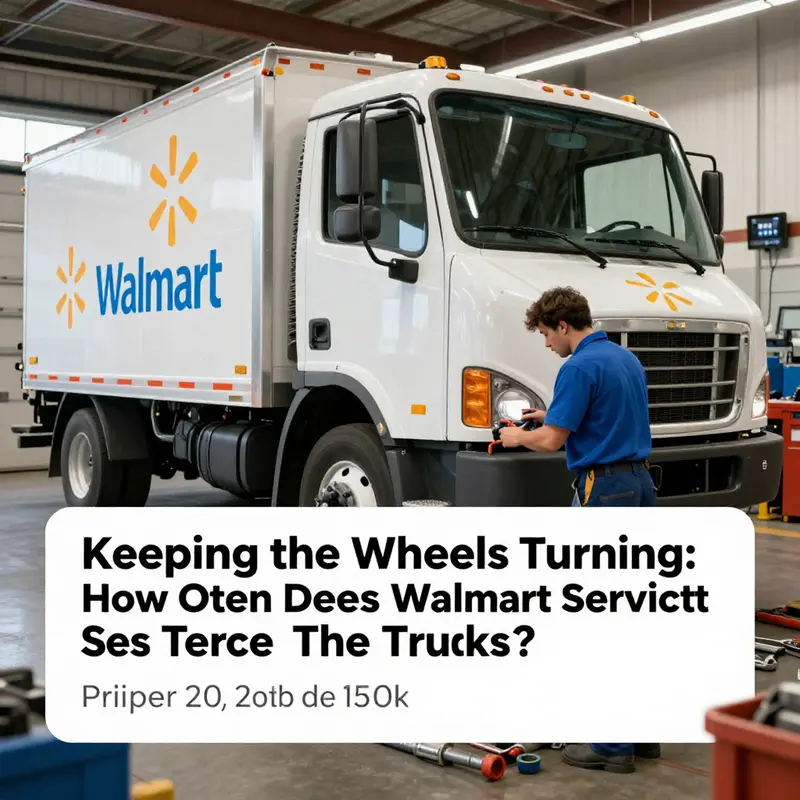
The backbone of Walmart’s logistics is a fleet that stays on the move with minimal disruption, and the chapter that follows in this volume explores how a company of this scale keeps its trucks in near-constant service. What stands out in the practical reality of Walmart’s operations is a relentless adherence to a proactive maintenance philosophy. Instead of treating servicing as a fixed calendar ritual, the fleet operates with a continuous cycle of care driven by real-time data, driver input, and manufacturer guidance. The result is not a single, rigid interval but a living maintenance rhythm that responds to the truck’s actual condition, its miles, and the daily demands of the route. This approach embodies a broader shift in fleet management, where uptime is a product of insight, responsiveness, and disciplined execution rather than a one-size-fits-all timetable. It also aligns with the reality that the road presents a spectrum of wear and stress—from the long, steady pull of regional routes to the stop-and-go precision of last-mile delivery—that can only be met through adaptive service strategies. In Walmart’s case, this adaptive mindset is supported by three pillars: an instrumentation-heavy view of vehicle health, a culture that elevates preventive practice, and a flexible service framework that keeps the trucks rolling with minimal idle time.
At the heart of the maintenance philosophy is real-time monitoring. Modern fleet operations rely on telematics and diagnostic data streams that capture engine performance, transmission behavior, brake wear, tire condition, fluid levels, and an array of other wear indicators. The practical upshot is predictive maintenance: service decisions are informed not by the mere mark of a fixed mileage milestone but by actual wear patterns and operating context. When a sensor or diagnostic signal suggests a developing issue, the maintenance team can intervene before the fault becomes symptomatic or induces downtime. That capability reshapes what it means to service a truck. Rather than a series of episodic checkups scheduled in advance, maintenance becomes a continuous conversation between the vehicle and the fleet operations center, with alerts, trend analysis, and timely interventions guiding the next best action. This is the kind of data-driven discipline that turns uptime into a competitive asset, preserving time that would otherwise be spent chasing breakdowns and unscheduled repairs.
This data-driven approach does not stand alone. Walmart’s fleet maintenance ethos also rests on human judgment and trained expertise. Drivers are empowered to report issues promptly, and technicians operate within a culture that prizes reliability and safety above all. The collaboration between on-road personnel and maintenance teams is not an afterthought; it is a core workflow. Regular inspections—whether scheduled around mileage, route type, or component wear—are performed with a focus on the elements most likely to influence performance and safety. The discipline extends to routine servicing: fluids are checked and replenished, brakes are inspected and serviced as needed, tires are rotated and aligned according to wear patterns and manufacturer recommendations, and other essential tasks are carried out with a methodical, evidence-based approach. In a large operation, it would be easy to fall into a ticking-clock mindset, but Walmart’s practice emphasizes outcome over routine, ensuring that every task contributes to a truck’s reliability, fuel efficiency, and regulatory compliance.
The frequency of servicing, however, is not a public schedule one can reference in a single document. The company does not publish universal intervals that apply uniformly across all truck models or all operating contexts. Instead, the maintenance cadence is governed by the combination of vehicle type, usage pattern, and the insights yielded by real-time data. Regional fleets, long-haul units, and local delivery vehicles each experience different wear profiles, and the maintenance protocols are calibrated accordingly. In practice, this means some vehicles may experience more frequent inspections or targeted services in response to higher engine load, greater idle time, or harsher operating conditions. The goal is not to maximize the number of service events but to optimize the timing of those events so that every repair or replacement is timely and necessary. When the fleet is treated as a dynamic system rather than a collection of individually scheduled machines, the value of predictive maintenance becomes evident: repairs occur before a failure, the risk of unplanned downtime is reduced, and the overall lifecycle cost of the fleet is managed more effectively.
In addition to the high-tech core of predictive maintenance, Walmart also leverages a practical, customer-facing service ecosystem that reinforces uptime. The company’s Auto Care Centers and related service pathways offer convenient, on-demand appointment options that can be scheduled around a driver’s timetable. This flexibility helps minimize downtime by aligning service windows with operational needs, so a truck can be serviced during a driver’s layover or between legs of a route without creating significant delays in delivery timelines. The service model emphasizes that maintenance should be a seamless part of the daily workflow, rather than an interruption that forces the vehicle off the road whenever a procedure is due. When combined with continuous data monitoring, this service framework supports a maintenance cadence that is responsive to real-world driving patterns while providing predictable, reliable turnaround times.
An important aspect of this approach is the explicit integration of internal protocols with advanced diagnostics and telematics. Internal Walmart Fleet Maintenance protocols provide the guardrails within which everyday decisions are made. They shape how data is interpreted, when service actions should be triggered, and how maintenance work is scheduled and tracked. The systems in use enable a more nuanced, condition-based approach to servicing: rather than replacing parts on a fixed timetable, technicians evaluate wear indicators, operational conditions, and historical performance to determine optimal timing. Every service action is documented, creating a transparent history of maintenance that can be consulted for audits, safety reviews, or ongoing optimization. Such traceability is essential in a fleet of this scale, where the cost of downtime is measured not just in minutes but in the velocity of goods moving through the supply chain.
The reputational and operational benefits of this approach extend beyond the individual vehicle. A fleet that stays consistently in service bolsters Walmart’s promise to deliver goods reliably and on time, even as consumer demand evolves and routes shift. It also supports fuel efficiency and environmental performance by ensuring engines run within their optimal parameters and by preventing excessive wear that would erode efficiency. In practice, the predictive maintenance mindset reduces the incidence of dramatic, unplanned failures, minimizing the disruption that such events would cause across a sprawling logistics network. In turn, drivers experience fewer unplanned delays, customers see steadier delivery performance, and warehouse operations can plan with greater confidence around inbound windows and outbound shipments.
For readers seeking a deeper sense of how these concepts translate into organizational practice, consider the knowledge embedded in industry resources that discuss uptime, maintenance support, and the value of standardized, proactive care in fleet contexts. A practical, story-driven exploration of how uptime is achieved through concerted maintenance and smart product support can illuminate similar principles in different sectors, including the fire service and other high-stakes operations. By examining those discussions, one can appreciate how the same core idea—maintaining readiness through timely, informed care—shapes decision-making across diverse fleets. To connect with this broader perspective, you can explore materials on the topic of uptime and maintenance support embedded in industry perspectives such as the discussion at the linked resource about unlocking uptime through essential product support secrets. unlocking-fire-apparatus-uptime-essential-product-support-secrets.
In sum, Walmart’s maintenance rhythm is less about a single frequency and more about a disciplined, data-driven cadence. The trucks are serviced frequently enough to preserve safety, reliability, and efficiency, yet flexibly enough to accommodate the realities of operation, vehicle diversity, and evolving demand. Real-time diagnostics, coupled with a well-coordinated service framework and a culture that values proactive care, enables the fleet to stay rolling with minimal downtime. While the precise intervals remain internal and model-specific, the overall pattern is clear: maintenance follows usage and condition, not merely the calendar, ensuring that the delivery network stays resilient under pressure and continues to meet the expectations of customers who rely on it every day.
External reference for readers seeking broader context on fleet maintenance practices and the kind of organizational investment that underpins these capabilities can be found in Walmart’s own fleet maintenance career resources, which offer a window into how the company organizes, trains, and deploys its maintenance workforce. For more details on Walmart’s fleet maintenance approach from an employer perspective, see the official career page focused on fleet maintenance positions: https://careers.walmart.com/career-finder/positions/fleet-maintenance
Real-Time Telematics and Predictive Maintenance: How Walmart Keeps Its Truck Fleet Servicing in Sync with Use
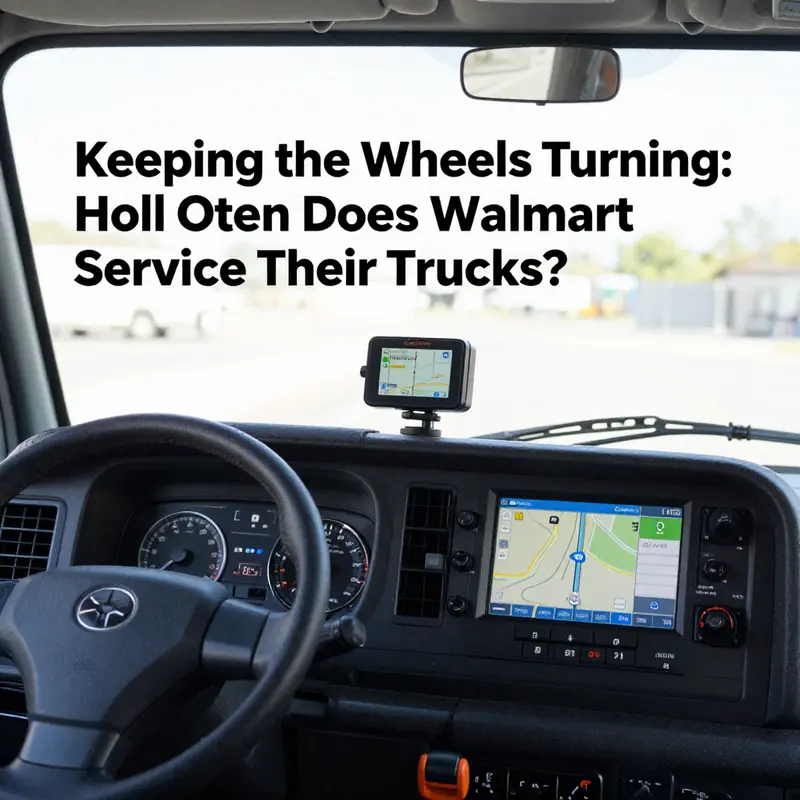
Across Walmart’s freight operations, there is a quiet but relentless discipline that keeps thousands of trucks moving safely and efficiently: maintenance that happens not on a rigid calendar, but in rhythm with how the vehicles are used. The company treats servicing as an ongoing, data-led process. Instead of counting down days on a maintenance calendar, its teams read the road as a living indicator of when a truck needs care. This approach, rooted in real-time telemetry and predictive analytics, turns service from a reactive obligation into a strategic capability that protects drivers, preserves uptime, and sustains the velocity of a vast supply chain. The centerpiece of this discipline is the proactive use of telematics, where each truck becomes a node in a larger, intelligent network. Walmart relies on advanced tracking devices that provide continuous insight into engine health, mileage, and other indicators of wear and performance. In practice, these devices stream data back to a central system, where software flags anomalies, tracks trends, and predicts when a component will require attention. The technology isn’t about chasing a fixed interval; it’s about watching for departures from the vehicle’s normal operating state. When engines run hotter than usual, or fuel efficiency starts to slip, the system sounds a preventive alarm. The emphasis is on preventive maintenance that catches issues before they become costly breakdowns. In the real world, this means trucks can be serviced for a fault long before it leaves a skid mark on the highway. The result is fewer unexpected outages, steadier delivery schedules, and a fleet that remains in peak condition longer. A concrete illustration of this mindset is the integration of diagnostics with day-to-day operations. Real-time data helps planners align service windows with delivery routes, ensuring that maintenance does not disrupt the flow of goods. If a truck is required to complete multiple long hauls within a week, the service schedule can be adjusted to a moment that minimizes downtime and preserves route integrity. The optimization is not purely mechanical; it’s logistical. Every service decision is weighed against the needs of the network, the safety of nearby communities, and the reliability expected by suppliers and customers alike. The heart of Walmart’s approach is the predictive maintenance strategy that emerges when technology and process meet. Telematics systems track engine performance, mileage, and driving behavior with a fine-tuned granularity that allows maintenance teams to see the earliest signs of deterioration. Abnormal engine temperatures, for example, may indicate cooling system wear or a developing leak, while declining fuel efficiency can reveal issues with combustion efficiency, air intake, or exhaust aftertreatment. Each of these signals becomes a data point in a broader pattern that points toward a forthcoming service event. The predictive model is built on a history of vehicle usage, repair histories, and real-time indicators, generating recommended service windows that align with when a truck can be serviced with minimal impact on operations. The model’s strength lies in its ability to translate noisy, complex data into actionable scheduling. Rather than waiting for a part to fail, Walmart’s fleet managers anticipate when a component will likely need attention and preemptively plan the maintenance around ongoing routes and shipment commitments. This condition-based maintenance approach extends the lifespan of vehicles by optimizing the timing and nature of every service. It also reduces the risk of catastrophic failures that could strand a driver or halt a critical supply line. The days when fleets relied on routine, time-based maintenance are giving way to a more responsive, data-informed practice. The modern maintenance cycle is anchored by close collaboration between technology, maintenance personnel, and operations. Service scheduling is not an isolated activity; it is integrated with the daily rhythm of departures, arrivals, and restocking. Service windows are negotiated in the context of service bays, parts availability, and technician capacity, with analytics helping to choose the sequencing that minimizes idle time. The overall effect is a fleet that stays in nominal condition more consistently, delivering improvements in reliability alongside gains in fuel efficiency. In this environment, drivers play a crucial role. They are encouraged and empowered to report issues promptly, whether it’s a change in unusual noises, an unexpected vibration, or a subtle shift in vehicle handling. This culture of reporting closes the loop between real-time monitoring and actionable maintenance. When a driver flags a problem, the telematics data can be cross-checked against historical patterns to determine whether the issue merits immediate attention or can be scheduled within the next service window. Training underpins this culture. The Fleet Maintenance team emphasizes continuous learning and the use of modern diagnostic tools to interpret data accurately. Technicians are equipped to translate sensor readings into practical actions, and drivers receive guidance on what early warning signs to monitor and how to communicate anomalies efficiently. This collaborative, data-driven approach is not merely about keeping trucks rolling; it is about building a predictable, resilient system. Accurate information is the lifeblood of the process. The real-time health checks, mileage tracking, and performance analytics feed into dashboards that executives and local managers use to understand fleet health at a glance. From a macro perspective, Walmart’s maintenance program demonstrates how large-scale logistics can benefit from condition-based maintenance. It is a model of how real-time data collection and analytics translate into tangible operational outcomes: less downtime, steadier service, improved safety, and lower total cost of ownership. The exact cadence of servicing is not publicly detailed, and for good reason. Schedules are intentionally fluid, shaped by vehicle type, operating conditions, and the particular demands of a given distribution network. A long-haul tractor performing heavy-duty routes in extreme weather will have different maintenance triggers than a regional vehicle making frequent short trips. The same predictive logic that triggers a service for one unit can be deferred for another if the vehicle’s condition and operational context permit. What remains clear is the emphasis on frequent, timely maintenance driven by condition and usage rather than rigid intervals. This is not maintenance by guesswork but maintenance by informed, continuous observation. The result is a fleet that not only adheres to safety and compliance standards but also maintains higher levels of performance. The benefits accrue across multiple dimensions. Operational reliability improves as unplanned downtime declines and service can be scheduled to protect the continuity of deliveries. Fuel efficiency benefits come from maintaining optimal engine and drivetrain performance, which in turn reduces operating costs. Environmental factors, particularly emissions and compliance with evolving standards, are addressed proactively as well. The learning loop deepens as maintenance data feeds into driver training and fleet optimization. Trends in driving behavior, accelerations, and braking patterns can inform targeted coaching that further enhances efficiency and reduces wear. In this ecosystem, technology acts as both the lens and the lever. It reveals the signs of wear early and provides the leverage to act decisively. The chapters of Walmart’s fleet management are written not by manuals but by dashboards, alerts, and the steady practice of maintenance teams who interpret signals with training and collaboration. For readers who want a broader perspective on how technology is transforming trucking, the ongoing conversation in industry publications offers valuable context about the pace and direction of change. External resources that explore technology in trucking illuminate the landscape in which Walmart operates. As with any large-scale fleet, the principles at play—real-time diagnostics, predictive maintenance, and integrated scheduling—are shared across operators who seek to maximize uptime while minimizing risk. External resource: https://www.trucking.com/technology-in-trucking-2024/
The Rhythm of Reliability: How Often Walmart Serves Its Trucks and Why It Matters
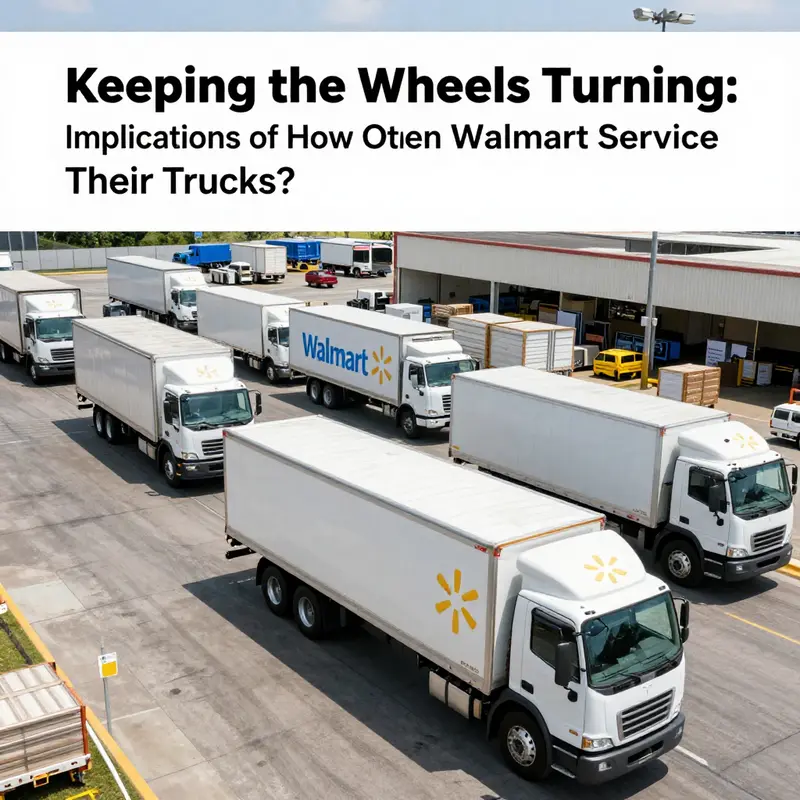
The rhythm of reliability in Walmart’s logistics is less a fixed cadence and more a living practice that blends data-driven insight with skilled hands on the shop floor. Its fleet operates under a guiding premise: service is a continuous obligation, not a sporadic fix. This expectation shapes decisions from the moment a vehicle enters a depot to when it leaves for a long-haul assignment or a short, urban delivery route. The goal is simple in articulation and formidable in outcome—keep the trucks moving with minimum downtime, protect safety, and uphold a promise of fast, dependable shipping that threads through every corner of the supply chain. In practice, this translates into a maintenance culture that treats every mile as a data point and every driver report as a potential signal. Rather than aligning maintenance to a rigid calendar, Walmart leans into condition-based servicing, anchored by a discipline of proactive care. The result is a system that feels almost anticipatory, where problems are nipped in the bud before they become disruptions and every repair is a step toward sustaining momentum across an expansive network. This philosophy—rooted in preventive care and agile response—works its way through the entire fleet, from the large over‑the‑road tractors to the trailers and the ancillary equipment that keeps the operation lubricated and ready for action. What drives this practice is a belief that uptime is not simply a measure of availability but a competitive advantage, the backbone of a supply chain that must support millions of decisions daily. In a retail landscape defined by margin pressure and consumer expectations, the choice to service trucks with vigilance and flexibility is a strategic asset as much as a safety protocol. It is a quiet discipline, carried out through datastreams and dashboards, hands-on expertise, and a culture of continuous improvement that never rests on yesterday’s gains. The public-facing cadence—how often a truck is serviced—is less important than the underlying capability to sense wear, stress, and performance in real time and to translate those signals into timely action. That capability is built on systems that monitor engine health, transmission behavior, brake wear, tire integrity, and fluid quality, among other indicators. In Walmart’s ecosystem, each sensor reading is a thread in a larger tapestry of evidence about a vehicle’s readiness to carry freight over long distances or through congested urban corridors. The practice of frequent servicing is thus an investment in predictability: when a truck remains in top form, it contributes to reliable delivery windows, higher asset utilization, and the confidence that stores and customers place in the company’s ability to stock shelves when needed. And because the fleet is part of a broader network that includes distribution centers, cross-docking facilities, and a growing e-commerce footprint, the consequences of maintenance decisions ripple outward. A well-timed service can prevent a delay that would cascade into late replenishment or a missed delivery, which in turn affects inventory levels, customer satisfaction, and even labor planning at the store level. In this light, the frequency of servicing becomes a strategic variable, not merely a routine. It is tuned to the realities of the road, the age and condition of the equipment, and the evolving demands of peak seasons, weather, and regional routing. The overarching logic is not to chase a one-size-fits-all schedule but to sustain a fleet that remains nimble, capable, and safe across myriad operating conditions. The narrative around servicing, therefore, centers on reliability, longevity, and the capacity to meet service-level commitments with a high degree of confidence. The maintenance program is designed to minimize surprises, to shorten the pothole‑ridden pathway from diagnosis to repair, and to keep the backbone of the network—its trucks—steady and dependable. A key feature of this approach is the integration of diagnostic capability with human judgment. Real-time data streams feed into an analytic workflow that helps fleet managers anticipate issues before they translate into breakdowns. This predictive lens allows service teams to stage parts, schedule crew time, and coordinate with distribution centers so that a repair can be performed with minimal disruption to the vehicle’s assigned duty. It also encourages a culture where drivers and technicians are encouraged to report concerns promptly, knowing that the sooner a condition is identified, the sooner a fix can be mapped and implemented. Technical teams with access to advanced diagnostic tools and modern repair equipment can perform maintenance with precision and speed. This means more than just replacing worn components; it means validating that integrated systems—the engine, the cooling loop, the braking system, the suspension, and the electrical architecture—are harmonized for optimal performance. The emphasis on high‑quality maintenance underscores a broader commitment to safety that has earned industry recognition for Walmart’s over‑the‑road fleet. A safer fleet is not only about avoiding incidents; it’s about reducing the risk and cost associated with mechanical failures that could compromise driver safety and public road safety. And safety, in turn, supports reliability. When a vehicle is consistently reliable, it contributes to safer driving conditions, fewer emergency repairs, and more predictable route performance. From a logistical standpoint, frequent servicing enhances fleet utilization by reducing the time a vehicle spends out of service for unscheduled repairs. Each successful, timely intervention adds to a longer, steadier service life for assets, which translates into lower lifecycle costs and a more stable capital budget for the fleet. This financial dimension matters in a company that moves vast volumes of goods across a sprawling network. It’s not just about keeping the engine running; it’s about orchestrating a balance between preventive maintenance and the need to reallocate resources efficiently when demand spikes or when new equipment enters service. The human element—Fleet Maintenance technicians, shop supervisors, and route planners—plays a critical role in translating data into action. Technicians bring hands-on expertise and a professional discipline to the bay that is essential for achieving durable repairs. They rely on a well‑organized service workflow, where parts readiness, technician availability, and the timing of maintenance windows are aligned with the ongoing operations at distribution centers and regional hubs. This coordination is what makes a scheduled maintenance moment feel seamless within a continuously running system. Drivers, in turn, act as the frontline sensors of the fleet. Their experience on the road informs the maintenance cycle in two important ways. First, routine feedback from the cab can confirm the early signs highlighted by telematics. Second, their day-to-day observations of performance—handling, braking response, and energy efficiency—provide qualitative context that complements quantitative data. The fusion of these perspectives strengthens the reliability of maintenance decisions. Across the fleet, there is also a recognition that the frequency of servicing cannot be traced to a single policy or a public timetable. Variation exists across vehicle types, route profiles, weather exposure, and duty cycles. A tractor that routinely travels long hauls on rough highways may demand different attention than a city shuttle truck that endures frequent stop-and-go cycles. Even within the same class of vehicle, aging, prior maintenance history, and load patterns can shift the optimal servicing cadence. The practical upshot is a condition-based approach, one that adapts to the fleet’s evolving complexion instead of conforming to a fixed cadence. It is this adaptability that preserves fleet integrity over years, while still delivering the consistent reliability customers expect. The effectiveness of Walmart’s approach is reflected in outcomes beyond pure uptime. When trucks return from a service bay with all systems calibrated and verified, the fleet’s performance in fuel economy, tire wear management, and brake life tends to improve. Those improvements compound, yielding cost savings that can be reinvested in the network—more training, better parts availability, and smarter scheduling. In a competitive retail environment where the tempo of delivery defines the customer experience, the maintenance cadence is a silent driver of trust. It underpins the company’s ability to meet tight delivery windows, maintain stock availability, and sustain the velocity that underwrites sales and service levels. It also supports the scalability of operations as the company grows its distribution footprint and expands its e-commerce capabilities. The chapter on servicing frequency thus reveals a broader truth: maintenance is not merely an expense or a compliance checkbox. It is a strategic capability that stabilizes the backbone of a vast, dynamic logistics network. Readers should take away that the exact gap between service events is not fixed in public view, but the alignment between data, people, and process is clear. A truck may be serviced more often in particular contexts, and less often in others, but the driver of cadence remains the same—the drive to keep the network moving, safely, efficiently, and with consistent reliability. In the larger arc of the article, this focus on maintenance cadence connects with the patterns that enable timely deliveries, accurate inventory placement, and the enduring promise of dependable shipping. It speaks to a broader discipline of operations that treats fleet health as a strategic resource, a resource that makes the difference between a near-miss and a smooth, on-time distribution cycle. The story of how often Walmart services its trucks, then, is a story of how a company crafts resilience through maintenance—built on real-time insight, skilled craftsmanship, and a culture that refuses to let age or distance erode the essential trust customers place in its service. External resource: https://www.walmartcareers.com/jobs/distribution-center-jobs
The Rhythm of Readiness: How Walmart Keeps Its Trucks Service-Ready Through Tech-Driven Maintenance and Culture
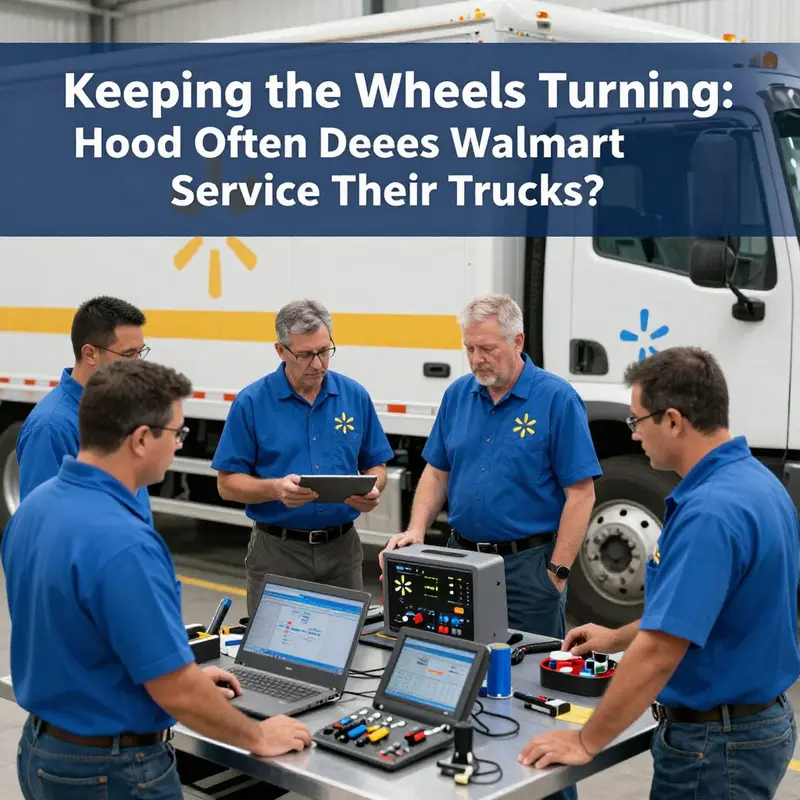
The fleet that powers Walmart’s distribution network operates with a cadence that looks less like a fixed clock and more like a living system. In chapters of a larger logistics story, the question of how often Walmart services its trucks centers on a philosophy as much as a schedule: maintenance is continuous, data-informed, and driven by the realities of usage, road conditions, and regulatory obligations. The result is not a single, universal interval but a dynamic pattern in which prevention, detection, and rapid response intertwine. Service cycles are shaped by the type of vehicle, the miles it travels, the loads it carries, and the routes it completes. What remains constant is the enterprise ambition to keep trucks safer, more reliable, and ready to meet demand with minimal downtime. In practice, this means a proactive maintenance approach that treats every mile as data and every issue as a signal rather than a setback.
Central to this approach is the shift from rigid time-based servicing to condition- and usage-based maintenance. Walmart’s fleet maintenance program integrates real-time monitoring with predictive analytics to forecast when components will degrade or drift out of specification. Instead of waiting for a calendar date or a fixed mileage marker, maintenance teams assess the ongoing health of each truck through live indicators. Engines, transmissions, brakes, tires, and auxiliary systems generate streams of information that technicians translate into actionable work orders. This is not a lone technician peering at a dashboard. It is a coordinated, data-informed workflow that connects drivers, shop technicians, and logistics planners in a continuous loop of check, fix, and verify.
The emphasis on real-time diagnostics is not about replacing human judgment with machines. It is about expanding the technician’s toolkit so they can intervene before a fault becomes a fault that halts a route. The diagnostics encompass core performance metrics such as engine health, mileage accumulation, fuel efficiency, and the emergence of warning signs that historically might have escalated into unexpected downtime. When data shows a potential issue, the maintenance team can schedule interventions that minimize disruption to operations. The operational model also recognizes that some maintenance needs arise from the nature of the job itself. Heavy freight, long-haul cycles, or frequent urban stops can accelerate wear in certain subsystems. In those cases, the team prioritizes preventive tasks that align with the truck’s current duties, rather than sticking to a one-size-fits-all timetable.
What makes this approach particularly effective is how it blends technology with people. The maintenance organization invests in training that stays current with evolving vehicle technology, telematics, and diagnostic tools. Technicians learn to interpret the signals, but they also learn to communicate with drivers about what the data means in real-world terms. This collaboration between field crews and drivers is essential. Drivers, who observe nuances in handling, braking feel, and vibration, provide frontline insights that complement data streams. They can report anomalies promptly, enabling a faster cycle from detection to diagnosis to corrective action. This culture of proactive reporting reinforces a reliability standard across the fleet and underpins the safety and efficiency goals that matter most for a high-volume retailer shipping goods across a wide geography.
From a systems perspective, the maintenance program leverages a layered architecture of monitoring, analysis, and execution. At the node of monitoring, sensors and trackers—implemented across the fleet—collect operational data in real time. The analysis layer interprets this data, flagging anomalies and predicting when components may require service. Finally, the execution layer translates insights into practical maintenance activities. It schedules shop visits, coordinates parts and labor, and sometimes deploys mobile teams to address issues at distribution centers or along the network. This seamless integration reduces the time between a signal and a service action, a critical factor when every mile matters for on-time deliveries and cost efficiency.
An aspect that often goes unseen outside the maintenance corridors is the governance that accompanies this technology-forward approach. Walmart’s fleet maintenance team fosters a culture of safety and accountability. Technicians receive ongoing training that keeps them adept with newer powertrains, braking systems, and diagnostic software, which in turn elevates the quality and speed of service. The culture encourages curiosity and rigor: questions about why a reading is trending in a particular direction, testing assumptions about component life, and validating maintenance decisions through post-service checks. This mindset matters because it translates to fewer surprises on the road and more predictable asset performance across the network.
The practical implication of such a system is that servicing frequency is often driven by the observed condition of the vehicle rather than a fixed schedule. While certain classes of trucks or specific routes may require routine, scheduled tasks—such as standard inspections, tire replacements on a planned horizon, or brake service as part of a maintenance window—the overarching framework uses condition-based triggers to deploy more or less service intensity as needed. In high-demand seasons, the condition-based approach scales with workload, ensuring that maintenance keeps pace with the network’s tempo rather than being throttled by a calendar. In slower periods, resources can be redirected to longer-term preventive work and system-wide improvements that reduce the probability of surprises when demand peaks again.
A practical thread in this narrative is the way data informs planning without constraining operational flexibility. The company’s maintenance analytics can reveal patterns across fleets, types of duty cycles, and geographic clusters that suggest where preventive investment yields the greatest uptime gains. For instance, routes with frequent idling, stop-and-go traffic, or extended highway runs may present different wear profiles than urban-only duties. The maintenance plan adapts to these realities, ensuring that service windows fit into the operational calendar with minimal impact on delivery schedules. In short, service frequency becomes a living metric—adjusted for each vehicle’s life story, not a fixed script applied uniformly to all trucks.
To connect the theory to the human experience on the floor, this approach rests on the integration of technicians, drivers, and managerial staff into a single reliability-focused ecosystem. The technicians bring the hands-on expertise and the interpretive skills to translate data into action. Drivers supply the experiential observations that catch what sensors sometimes miss. Managers align maintenance activities with network objectives, balancing uptime with safety, regulatory compliance, and cost control. The result is a maintenance culture that treats service acts as preventive investments rather than reactive costs. It is a culture that recognizes that the most reliable fleet is not built from occasional, forced service but from a steady cadence of informed, timely interventions that keep trucks in service longer and safer.
For readers curious about the human side of this ecosystem, the maintenance training programs illustrate how the culture solidifies into practice. Training emphasizes not just the technical steps of servicing but the reasoning behind maintenance decisions, how to interpret diagnostic signals, and how to communicate findings across teams. This emphasis on continuous learning helps sustain a responsive maintenance cycle where issues are flagged early, analyzed thoroughly, and addressed with appropriate speed. It also cultivates a sense of shared responsibility for safety and reliability that resonates from the shop floor to the dispatch desk. In this way, training is not a single phase but a continuous thread that reinforces the company’s commitment to keeping its trucks road-ready whenever needed.
The broader takeaway is that Walmart’s servicing frequency is not a rigid timetable but a dynamic practice rooted in real-time insight and reinforced by a culture of prevention. Exact intervals may vary by vehicle type and operational demand, but the underlying principle remains clear: keep the fleet in a state of readiness by sensing what the road demands and acting before wear turns into downtime. This combination of predictive thinking, collaborative culture, and ongoing training creates a resilience that serves the company’s vast logistics network and the customers it serves.
For a deeper look into maintenance training within high-stakes fleets, see fire-truck-maintenance-training-importance. The idea is that disciplined training and a shared language around maintenance help teams translate data into timely action, a principle Walmart mirrors in its own fleet operations. As you explore the full scope of Walmart’s approach, you can consult the official Walmart Careers page for detailed insights into distribution and truck driving roles and how those roles contribute to the maintenance ethos across the network: https://www.walmartcareers.com/jobs/1053694/distribution-and-truck-driving-jobs. This external resource offers perspective on how a large retailer structures its recruitment and development to sustain the kind of maintenance culture described here.
In sum, the frequency of service in Walmart’s fleet is best understood as an iterative practice shaped by condition, usage, and operational tempo. It is a system that respects the limits of technology while elevating human expertise and shared accountability. The trucks are not serviced on a solitary timetable; they are kept in a state of readiness by a living maintenance program that learns, adapts, and improves with every mile traveled. The result is a fleet that remains safe, efficient, and dependable, even as complexity grows and demand shifts across the network. The rhythm may be variable, but the commitment to readiness is constant, and that difference matters when every delivery hinges on keeping the wheels turning smoothly.
Final thoughts
In summary, Walmart’s approach to truck servicing is marked by its emphasis on proactive maintenance, cutting-edge technology, and a deeply embedded training culture. Fleet managers and drivers can learn valuable lessons about the importance of regular servicing and the integration of real-time monitoring tools to optimize operational efficiency. By prioritizing vehicle health, Walmart not only ensures the safety of their trucks but also enhances overall performance, aligning with best practices in the trucking industry. For those in the field, understanding these methodologies presents opportunities to implement similar strategies in their own operations to drive success on the road.