
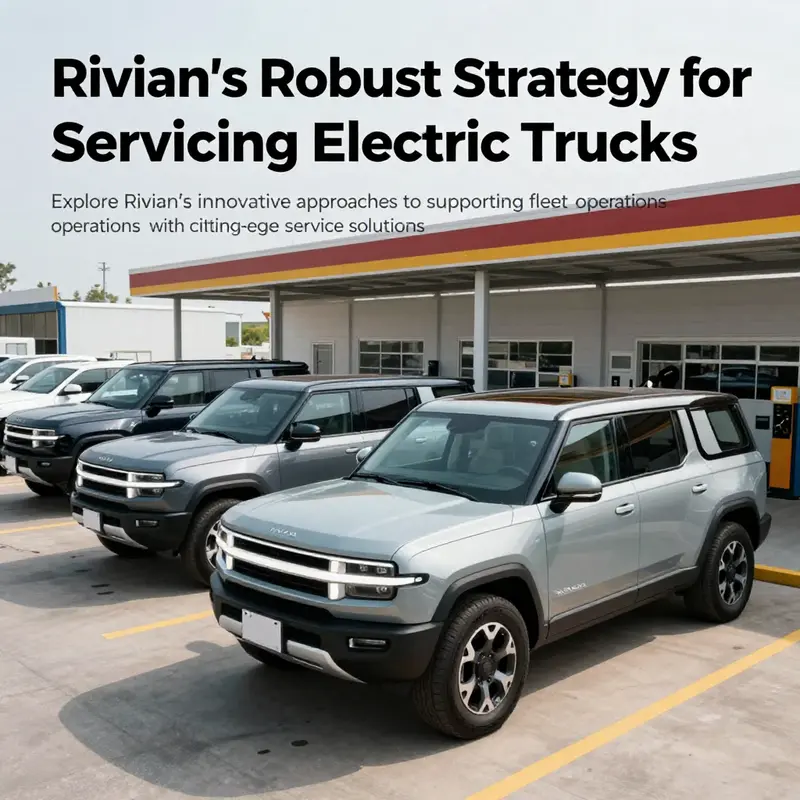
As electric trucks pioneer the shift towards sustainable logistics, Rivian recognizes the unique demands of long-haul transport. This article delves into Rivian’s comprehensive service strategy for their electric delivery trucks, emphasizing their direct service network, fleet-centric support, and advanced diagnostic systems. By understanding these elements, long-haul truck drivers, trucking company owners, fleet managers, and maintenance specialists can appreciate how Rivian is tailored to ensure efficient operations, minimize downtime, and enhance reliability in this evolving industry.
Direct Service Footprint, Mobile Teams, and the Fleet-First Equation: How Rivian Plans to Service Trucks at Scale

Rivian’s emergence as a major player in electric delivery is inseparable from how the company truly keeps its trucks moving. The axis of reliability rests not only on battery tech or drivetrain efficiency but on a service philosophy designed to protect uptime for fleet operators. As Rivian scales from a single, Amazon-backed fleet to a broader commercial market, the service strategy must be scalable, precise, and tightly integrated with digital insight. What emerges is a hybrid approach that blends independent service centers, agile mobile repair capability, and a software-driven backbone. It is less about a single, monolithic “direct service network” and more about a flexible, direct-to-customer service model that emphasizes speed, standardization, and proactive maintenance—attributes that a fleet-driven business relies on if it is to promise predictable total cost of ownership and rapid return on investment.
At the heart of this approach is a distributed service footprint. Rivian has invested in independent service centers and on-road mobile service technicians who can reach customers where they operate. The geographic layout is deliberate: centers and mobile units positioned across North America to shorten response times, reduce vehicle downtime, and mobilize expertise near high-demand lanes. Unlike older, purely dealer-based networks, this strategy prioritizes proximity and responsiveness. It allows a central, fleet-centric operations team to coordinate dispatch, diagnostics, and scheduling with a visibility that translates directly into uptime metrics. The result is a service system that behaves like an extension of a fleet’s internal maintenance department rather than a detached afterthought.
Where the service centers truly shine is in consistency of quality. In fleet operations, technicians must navigate the unique demands of high-mileage, high-utilization trucks, where every hour of downtime translates into lost productivity and widened service costs. Rivian’s model leans into standardized procedures and digital diagnostics to ensure that a visit or a mobile call yields the same diagnostic rigor and repair quality no matter which center or technician is on site. The emphasis on standardization helps overcome the variability that can plague a scattered service ecosystem. For a fleet operator, this translates into reliable throughput: a well-trained technician group following a shared playbook, backed by real-time data from each vehicle.
A crucial enabler of this reliability is the mobile service capability. When a truck is in service away from a center, a mobile unit equipped with high-voltage safety tools, specialized diagnostic equipment, and the ability to perform many routine maintenance tasks onsite becomes a lifeline. Mobile technicians operate with an equivalent standard of care as their stationary counterparts, ensuring that remote locations or high-demand routes do not become bottlenecks in the maintenance cycle. The mobile model also helps in managing peak demand, when scheduling complexity and fleet utilization patterns create more pressure on the system. Fleet managers gain a degree of flexibility that is otherwise impossible with a purely fixed-location service network.
Yet the service system is not a patchwork of human beings and hardware alone. It is underwritten by a digital spine that gives fleet managers and technicians a common language for vehicle health and service planning. Rivian’s trucks are built with sophisticated onboard computer systems and networked architecture that facilitate real-time health monitoring. This digital layer enables remote triage: issues can be diagnosed and, in many cases, resolved or scheduled for maintenance before they become urgent. Remote diagnostics reduce unnecessary trips and minimize time-to-repair, which is crucial when every hour of truck availability matters for a delivery schedule. In effect, the vehicle itself becomes a proactive partner in its own upkeep, signaling potential faults and prompting preventative action rather than waiting for failures to surface during a critical delivery window.
From a fleet-management perspective, the combination of direct engagement, rapid-response capability, and software-first maintenance is a logical alignment with the economics of delivery. Scheduled maintenance drops into a predictable cadence, parts can be pre-staged for common wear items, and professionals trained in electric drivetrain nuances can minimize the risk of misdiagnosis. The maintenance equation shifts toward uptime optimization where the total cost of ownership hinges not only on purchase price and energy cost but on the cost per mile of operation. In such an equation, a service model that focuses on minimizing downtime—through near-term triage, swift on-site work, and preemptive software updates—becomes an efficiency lever with tangible financial impact.
A closer look at the operational rhythm reveals how the service system is designed to stay in step with fleet needs. Remote software updates—over-the-air or OTA—play a central role. These updates can address calibrations, bug fixes, and performance optimizations without a vehicle visiting a center. OTA updates are particularly valuable for high-velocity fleets that require minimal disruption to their routing and scheduling. They provide a non-intrusive mechanism to improve reliability and, in some cases, unlock new capabilities that improve utilization. When remote updates cannot fully address a defect, the digital diagnostics feed into a more traditional service workflow. A diagnostic report travels through a secure channel to the centralized operations center, where technicians assess the severity, prioritize interventions, and dispatch a mobile unit or schedule a center visit as needed. The end goal is a seamless, invisible layer of support that keeps trucks in motion and out of workshops whenever possible.
This integration of OTA diagnostics with a network of service centers and mobile units also informs how Rivian trains its technicians and calibrates its external partnerships. The company relies on a blend of in-house expertise and carefully certified partner networks. For hardware-related problems, especially those related to high-voltage systems or electric drivetrains, trained technicians perform the heavy lifting. But the reach of service is extended through partnerships that bring in additional specialists who can adhere to standardized procedures and digital diagnostics. The training emphasis is not merely about repairing parts; it is about validating the diagnostic data, understanding the vehicle’s software-defined behavior, and ensuring that any intervention preserves safety and reliability. The result is a service ecosystem with scalable reach and consistent quality.
To be sure, the labels used to describe Rivian’s service architecture can be slippery. The term often parroted in popular summaries—“Direct Service Network”—is not a formal designation widely documented in public materials. What is clear, from the pattern of operations described by the company and observed industry practice, is a robust, customer-facing service model built on independence, mobility, and software-enabled maintenance. Rivian leverages independent service centers rather than a centralized, proprietary repair network as a way to balance control with flexibility. In practice, this means a fleet operator can contact a central service team to coordinate a repair plan, while relying on a nationwide map of centers and mobile units to deliver the service where it is needed most. The emphasis is on direct customer engagement and agile service delivery, rather than on a rigid, top-down service delivery architecture. This distinction matters because it shapes how quickly fleets can recover after interruptions and how predictably maintenance costs can be managed across a growing and geographically dispersed operating base.
The practical implications for fleet operators are significant. A direct engagement model streamlines the service experience, reducing the friction often associated with third-party repair logistics. When a truck reports a fault, the centralized coordination layer can quickly determine whether an OTA fix is possible or whether a field visit is necessary. If a visit is required, a nearby independent center or a mobile technician is dispatched with the right parts and the appropriate safety gear for high-voltage work. Because the diagnostics are standardized and digitally shared, the technician can access vehicle history, recall status, and recent updates before arrival. This coherence in data and process reduces redundancy and accelerates service delivery. For fleets, that speed translates directly into more predictable miles per day and fewer unplanned downtime events, which is the currency of efficiency in delivery operations.
The human element—the technicians who bring the system to life—receives particular attention in this model. Training standards are designed to be portable across a wide array of service locations. In practice, this means a tiered training progression, a clear set of diagnostic procedures, and a shared knowledge base that technicians can consult in the field. The aim is a consistently high standard of workmanship, regardless of the technician’s point of entry into the network. This consistency, in turn, supports the fleet’s calculus around maintenance windows and downtime costs. It also helps ensure that when a vehicle moves into a repair phase, the team has a thorough understanding of how software and hardware interact in an electric powertrain, how battery management influences performance and safety, and how to interpret telemetry streams that signal a need for preventive care rather than reactive repair.
The servant role of software in this ecosystem cannot be overstated. OTA updates, remote diagnostics, and data-driven maintenance scheduling create a feedback loop that informs both the service team and the customer’s operations planners. This loop allows fleets to align servicing with the production schedule, engineering changes, and real-world driving conditions that shape wear patterns. Fleet managers can project maintenance windows with greater confidence, schedule routes to accommodate service intervals, and adjust procurement plans for parts on a just-in-time basis. In turn, service technicians are able to prepare more effectively, arriving with the right tools and components for the specific vehicles in their queue. It is a digital-first approach braided into every layer of field service, from the central operations desk to the last-mile technician.
From a narrative perspective, it is tempting to think of Rivian’s service architecture as a single, unified force. In practice, the strength lies in the diversity of its delivery options and the clarity of its standards. The independent centers provide a physical, local presence that understands the local operating environment—driving conditions, heat, snow, and maintenance cycles particular to a given region. Mobile technicians bring that same competency to the road, meeting trucks where they operate and preventing minor issues from becoming major stoppages. The OTA and diagnostics layer keeps these teams in alignment with the truck’s evolving software and hardware state. Together, these elements form a cohesive system that is not bound by a single label but bound by outcomes: high uptime, predictable costs, and a service experience that reinforces the reliability promises a fleet customer expects from an electric-power future.
For readers tracking the evolution of service models in the commercial vehicle space, Rivian’s approach offers a practical blueprint for balancing control and reach. It acknowledges that fleets demand rapid, reliable maintenance without sacrificing the safety and expertise required for high-voltage systems. It relies on a distributed operational model that scales with demand and geography while leveraging digital diagnostics to shrink the distance between fault and fix. The overarching theme is not a slogan about a direct network, but a disciplined architecture of service delivery grounded in proximity, standardization, and data-enabled decision-making. In that sense, Rivian’s strategy aligns with the core driver of modern fleet maintenance: uptime is the product, and every element—from center location to OTA patch and technician training—coheres to optimize it.
For readers seeking more official information and ongoing updates about service resources and support channels, a dedicated portal provides access to the latest guidance, diagnostics tools, and support options. Rivian’s service ecosystem remains a work in progress as the company expands into new commercial markets, and its emphasis on a fleet-centric, digitally integrated model suggests a future where service responsiveness keeps pace with the demands of a rapidly growing electric delivery fleet. External readers can explore the official support resources to understand the current capabilities, schedules, and contact workflows that accompany the strategy described here. External resource: https://www.rivian.com/support
Internal link reference (for contextual navigation): For direct access to service resources and help articles, visit the Rivian Support Portal.
External readers may also be interested in broader coverage of fleet uptime and maintenance best practices in the heavy-duty and emergency-vehicle sectors, which offer transferable principles for how service networks can optimize availability in demanding environments. External resource: https://www.rivian.com/support
Keeping the Line Moving: Rivian’s Fleet-First Service Model for Electric Trucks
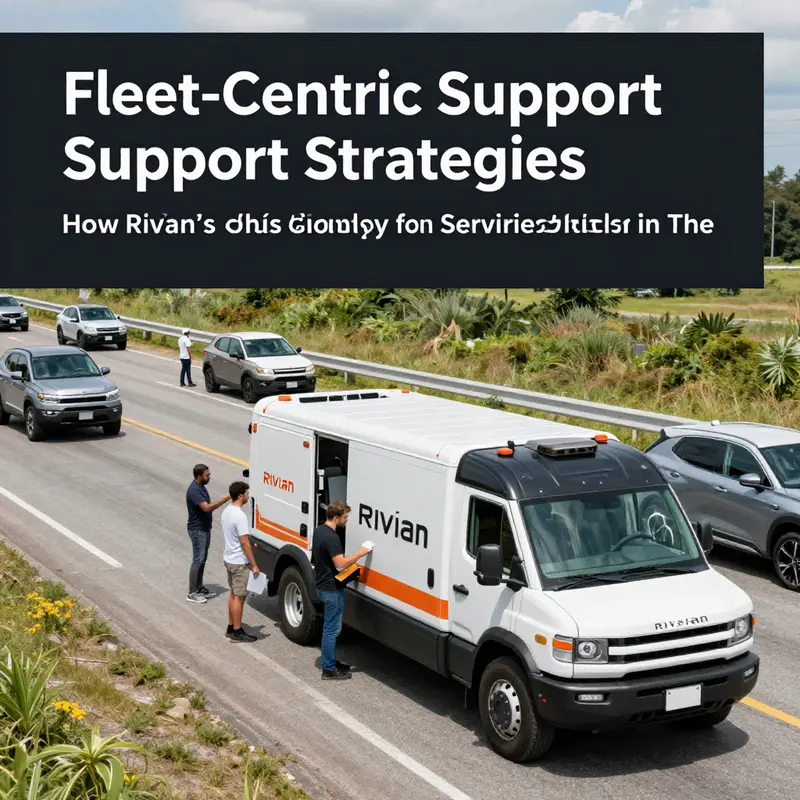
When a fleet relies on a steady cadence of deliveries, every hour of downtime translates into lost revenue and frustrated customers. In this light, Rivian’s approach to servicing its electric trucks is not merely a maintenance plan; it is a systems engineering effort aimed at maximizing uptime across a growing commercial footprint. The company’s strategy blends a direct service network with digital intelligence and fleet-focused support, all designed to translate vehicle health data into faster, smarter interventions. It is a model built around continuity—continuity of service, continuity of data, and continuity of operations for the customers who depend on these vehicles to keep supply chains moving. The shift from an exclusive partnership with a single large customer to broader commercial outreach only intensifies the importance of a scalable, predictable maintenance framework that can serve fleets of varying sizes and in different geographic contexts, without sacrificing the reliability that large operators require. The essence of Rivian’s fleet-centric service model lies in three intertwined pillars: a dedicated, scalable service network; proactive, data-driven maintenance enabled by advanced diagnostics; and a comprehensive training and partnerships program that extends capabilities without compromising standards. Each pillar reinforces the others, creating a cohesive ecosystem designed to minimize downtime, lower total cost of ownership, and deliver a service experience that fleet managers can rely on as part of their core operations.
From the outset, Rivian appears committed to a direct-service philosophy. Rather than relying solely on third-party technicians who may work across multiple brands and platforms, Rivian has erected a network of its own service centers and mobile units. These mobile units are not mere stopgap solutions; they are integrated into the core service cadence, arriving at warehouses, distribution centers, or even job sites as part of a scheduled maintenance window or a rapid-response visit. The advantage of this approach is straightforward: it enables standardized service quality and faster turnaround times when compared with a model that depends entirely on sporadic third-party availability. It also creates a predictable service experience for fleet operators, who can coordinate maintenance around their operational calendars, rather than contending with inconsistent provider networks. In practical terms, this means fleet managers can plan preventive maintenance, component checks, and software updates with a high degree of confidence that the service will be delivered on time and to the same set of specifications across locations. As the fleet expands, the geographic distribution of Rivian’s service resources becomes a strategic asset, reducing travel time for technicians and minimizing the distance a truck must cover for standard service procedures.
Integral to this direct network is the emphasis on remote diagnostics and over-the-air software updates. Modern electric trucks are essentially rolling data centers, streaming telemetry from onboard control units and networked subsystems to a centralized diagnostic stack. Rivian’s design leverages this architecture to monitor vehicle health continuously, flag anomalies early, and schedule proactive interventions before a fault translates into downtime. Fleet operators benefit from a service loop that can anticipate issues and arrange maintenance during off-peak hours or coincide with already planned downtime, such as shift changes or warehouse loading windows. Remote diagnostics also serve as a first line of triage; when a fault is detected, fleets and Rivian’s technicians can stage the right parts and assign an appropriate mobile unit or center visit, reducing the time between diagnosis and repair. This integration of software intelligence with field service is essential for fleets that depend on high utilization and predictable delivery timelines. The total cost of ownership narrative in this context extends beyond purchase price and depreciation. It includes the quantifiable impact of uptime, the minimized disruption of service, and the cost-efficiency of targeted interventions—characteristics that are central to the appeal of a fleet-first service model.
The human dimension of Rivian’s approach rounds out the technical framework. The company foregrounds training for both fleet managers and technicians, recognizing that the success of a digital-first service strategy hinges on people who can interpret and act on data. Training programs are designed to streamline preventive care, empower drivers with essential diagnostic awareness, and elevate routine maintenance to a level where it becomes predictable rather than reactive. By arming frontline technicians with Rivian-specific knowledge—especially around high-voltage battery systems and electric drivetrains—the company ensures that every touchpoint in the service lifecycle meets a consistent standard. Partnerships with established automotive service providers further extend reach while preserving quality. These collaborations are not a substitute for internal capability; they are a force multiplier that enables the fleet-support network to scale with the same rigor that the core service infrastructure demands. Through standardized processes, shared diagnostic tools, and continuous training, Rivian aims to preserve the integrity of each vehicle and minimize the variability that can erode uptime in large-scale operations.
Where a fleet manager might previously calculate risk by the reliability of a single vehicle, Rivian’s model invites a broader perspective—risk assessment through data-driven insight. Real-time vehicle health data become a shared value proposition. The fleet operator gains visibility into the health of entire vehicle groups, while Rivian gains a better understanding of aggregate failure modes, parts lifecycle, and repair queues. Predictions about component wear, battery thermal management, or drivetrain alignment can inform inventory planning for spare parts and the allocation of mobile service units. This two-way information flow is more than a convenience; it is the backbone of a proactive service environment that keeps delivery schedules intact. In practice, that may look like scheduled maintenance aligning with rest periods or down times when a warehouse is closed, or as a coordinated maintenance window that minimizes disruption to peak operation hours. The predictive logic is anchored in continuous data streams, but the value emerges when those streams translate into timely, practical actions—parts on hand, technicians pre-briefed, appointment slots reserved, and digital work orders ready to execute on arrival.
To meet the demands of a broader market, Rivian’s service model also relies on a carefully designed physical and digital backbone. The physical backbone consists of strategically located service centers complemented by an adaptable fleet of mobile repair units. The mobile units provide the flexibility to operate where the fleet already lives—at distribution centers, at customer hubs, and even at remote job sites. This reduces the need to transport trucks over long distances for routine checks and urgent repairs, a factor that can dramatically shrink downtime and associated costs. The digital backbone is the diagnostics and communications layer—the cloud-connected health data, the OTA update stream, and the work-order orchestration that ties together customers, technicians, and parts logistics. It is a system that rewards efficiency: the faster a fault is detected, the sooner a technician can intervene, replace a faulty component, or perform a software patch that eliminates the fault’s manifestation. It also reduces the margin for human error because the work orders, part specifications, and service steps are standardized and trackable across the entire network.
In contemplating the end-to-end service experience for a fleet customer, it is helpful to consider the lifecycle of a typical issue from detection to resolution. A fault is detected by the vehicle’s diagnostics or reported by a fleet operator. The data is analyzed, and a maintenance plan is proposed with a prioritized sequence of actions. The first action is often a remote software update or configuration adjustment that can mitigate or even eliminate the problem without physical intervention. If a hardware fault is identified, a mobile unit may be dispatched to perform on-site repair or replacement, or, if necessary, the vehicle is directed to a nearby service center with the right tooling and rare parts staged for the repair. The objective at every step is to preserve uptime and to ensure that vehicles return to service with minimal disruption to the fleet’s operation. This approach fits neatly into a broader business narrative for fleet operators who must optimize utilization, predict maintenance budgets, and avoid the cascading costs that follow unscheduled downtime. The focus, therefore, is not merely on keeping vehicles on the road but on shaping a dependable maintenance ecosystem that aligns with the operational realities of large-scale logistics and delivery networks.
A practical reflection on this ecosystem reveals how it scales. Early partnerships and a narrow service footprint can offer excellent service quality, but as Rivian expands into broader commercial markets, the service architecture must accommodate greater variety in fleet sizes, operating environments, and geographic distribution. The direct-service network and the digital diagnostic stack are designed with scalability in mind. Standardized training across technicians allows new partners to join the network without diluting service quality. The mobile units are inherently scalable—the fleet can add more units to cover new regions or adjust existing routes to match seasonal demand or supply chain shifts. Part of the growth equation is inventory management: ensuring that spare parts inventory is aligned with the most common failure modes and that logistics for replenishment support the just-in-time needs of on-site repairs. These operational choices are not mere details; they are the mechanics by which a fleet can be supported at scale without compromising reliability or cost efficiency. The result is a maintenance paradigm that integrates hardware, software, and human resources into a singular capability: the ability to keep electric trucks in service when and where customers need them most.
Even as this fleet-centric model drives uptime, it also raises questions about how best to communicate value to a broad set of customers, from regional parcel operators to national distribution networks. The storytelling around service quality matters as much as the technical design. Fleet managers must see a clear link between proactive maintenance, rapid diagnosis, and the reliability they require to meet service-level agreements. This means transparent scheduling, predictable parts availability, and consistent performance metrics across the network. It means a service experience that feels unified rather than piecemeal, even though it may involve a constellation of service centers, mobile units, and partner technicians. The roadmap for such a system is iterative. Early learnings from the Amazon partnership likely inform how Rivian calibrates its service KPIs, how it staffs its centers, and how it balances the use of mobile units against fixed facilities in response to evolving demand. The fleet program, in this light, is a living system—one that adapts as data accumulate, scales with new customer cohorts, and refines its approach to preventive care and fixed-asset downtime.
The narrative of Rivian’s fleet-centric servicing also intersects with broader industry practices around uptime optimization. Across sectors where fleet reliability is paramount, the combination of direct service delivery, predictive analytics, and workforce training has proven to reduce unplanned maintenance events and shorten repair cycles. Rivian’s alignment with these practices is evident in the emphasis on remote diagnostics, OTA updates, and a service topology that emphasizes rapid, on-site interventions when required. Yet the distinctiveness of this model lies in how it binds these elements together into a cohesive, fleet-aware architecture. It does not treat maintenance as a one-time event but as a continuous performance program—one that evolves as fleets evolve, as routes shift, and as the vehicles themselves become more sophisticated in their software-defined operations. In this sense, the fleet plan is less about a one-off service solution and more about a sustainable operating model that supports long-term fleet health and predictable operation.
For readers exploring this approach further, the integration of fleet data into decision-making is a focal point worth noting. When real-time health signals are integrated with scheduling logic, maintenance can be sequenced to minimize the impact on throughput. That means that preventive maintenance can be embedded into the normal cycle of vehicle usage, rather than treated as a separate, disruptive event. And because the service network is designed around the customer’s location, rather than around centralized hubs alone, the operational friction associated with taking a vehicle out of service for extended periods diminishes. This philosophy echoes the broader industry insights around uptime and product support, which emphasize that reliability extends beyond the components under the hood to the entire ecosystem that keeps a vehicle productive every day. The combination of a scalable, direct service network; advanced diagnostics; and robust training and partnerships makes Rivian’s fleet-centric servicing a compelling proposition for operators who require steady, predictable performance from a growing electric fleet. It is, in essence, a disciplined approach to service that treats uptime as a product in its own right—a product that benefits from data, people, and infrastructure working in concert.
Internal link for further context on uptime-centric service considerations can be found here: unlocking-fire-apparatus-uptime-essential-product-support-secrets. This resource, while focused on a different segment of fleet equipment, underscores the universality of the principles Rivian is applying: proactive diagnostics, field-ready support, and standardized, scalable training that translates into tangible uptime gains. The core takeaway is that the value proposition of Rivian’s fleet model rests on the predictability it delivers to operators who must meet tight delivery windows and customer expectations. The reliability of the service experience becomes a measurable asset, just as the reliability of the vehicle itself is.
Looking ahead, one can anticipate that Rivian will continue to refine the balance between centralized expertise and local responsiveness. As the fleet mix broadens—more customers, more use cases, more geographic spread—the service architecture will likely evolve toward even greater flexibility without compromising the rigor of maintenance standards. This evolution will be guided as much by data insights as by customer feedback, with ongoing investments in predictive maintenance algorithms, remote diagnostic capabilities, and the expansion of the mobile service footprint. The ambition is not merely to service trucks but to sustain a service culture that aligns with the pace and precision demanded by large, efficiency-driven operations. In that sense, Rivian’s fleet-centric approach is less a single solution and more a strategic frame for how electric trucks can remain a reliable backbone of modern logistics over the long term.
External resource: https://www.rivian.com/fleet
Smart Uptime at the Wheel: Rivian’s Diagnostics-Driven Service Model for Electric Deliveries
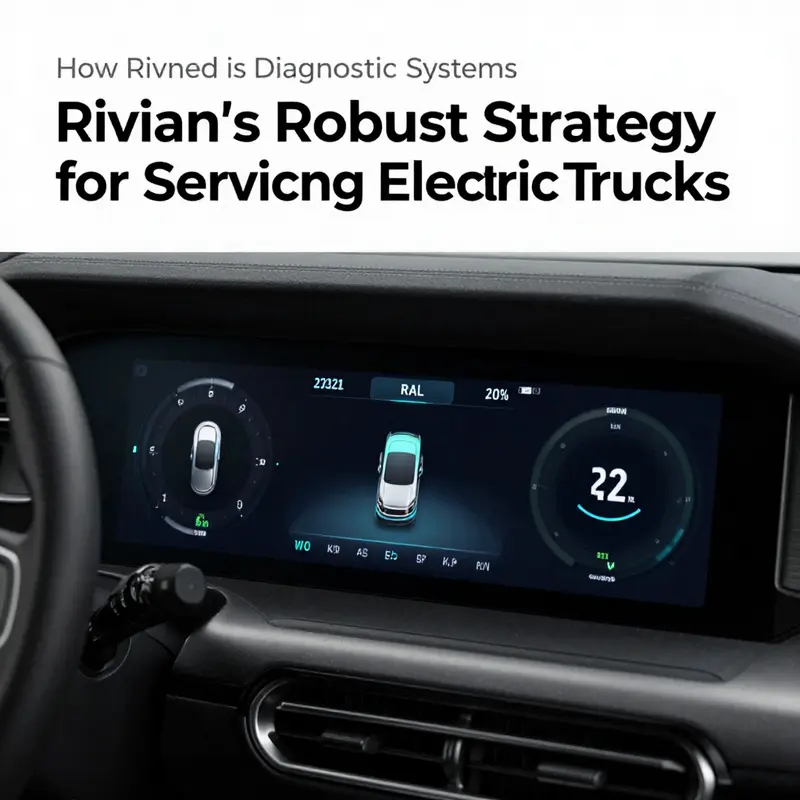
Rivian’s service narrative centers on uptime as a strategic capability, evolving from a single Amazon partnership to a broader, fleet-focused business. The goal is to make maintenance proactive, data-driven, and aligned with the rhythms of commercial delivery rather than reactive repairs after a fault occurs. By treating service as a product feature, Rivian aims to keep trucks moving and delivery schedules intact.
A direct service network sits at the heart of this model. Instead of relying only on scattered third parties, Rivian operates and partners with service centers and mobile units positioned along major logistics corridors and high-utilization regions. This setup facilitates fast, predictable repairs and enforces a common standard of care across locations, from high-voltage battery work to routine inspections. Mobile technicians bring the right parts and tools to the field, reducing cycle time between issue detection and repair completion and translating uptime into tangible delivery gains.
The fleet-centric approach also means regular, predictable maintenance windows and priority access for high-usage vehicles. Telematics feed remote diagnostics, enabling over-the-air updates and smart scheduling so a fault can be addressed before it becomes a disruption. The cloud backbone translates sensor data into actionable events, coordinating maintenance calendars with route patterns and seasonal demand.
A notable accelerant is the integration of advanced analytics into the diagnostic workflow. Edge computing on vehicles, cloud-based analytics, and GPU-accelerated testing support safer, faster software updates that are validated before field deployment. This reduces risk and speeds software evolution, while AI-driven fault detection helps technicians pinpoint the most probable causes with greater confidence.
The human element remains essential. Trained technicians, working through Rivian’s partner network, apply standardized procedures and fault dictionaries to ensure consistent results across centers and fleets. This investment in people, alongside digital tools, creates a scalable service platform that can grow with a widening customer base without compromising safety or quality.
As Rivian scales beyond its initial agreements, the combination of direct service coverage, predictive maintenance, and autonomous diagnostic workflows provides a repeatable, high-velocity model for uptime. Fleets gain visibility, predictability, and control over performance, making total cost of ownership more predictable and delivering on the promise of reliable, on-time deliveries.
Final thoughts
Rivian’s commitment to supporting its electric trucks transcends traditional servicing models, emphasizing reliability, efficiency, and customer-centric strategies. With dedicated service networks, tailored fleet support, and cutting-edge diagnostics, Rivian is actively setting the standard for how electric trucks will be serviced in the future. For long-haul truck drivers, trucking owners, and maintenance specialists, understanding these innovations will be key to navigating the changing landscape and maximizing the potential of electric logistics.