
Finding Truck Parts and Service Near You
A down truck costs money by the hour. For owner-operators, fleet managers, and independent shops, fast access to truck parts and service near you is the difference between a one-day repair and a week of lost revenue.
Those same operators need transparent truck labor rates and dependable mobile truck repair. What a shop charges per hour, and whether a technician can come to the truck, decides most repair calls before the work starts.
Three things make sourcing simpler:
- OEM truck parts stock checks – confirm whether original equipment and diesel truck parts are physically on the shelf before you commit.
- Labor rate comparisons – read quotes, understand rate structures, and compare heavy duty truck repair near me options on equal terms.
- Mobile repair call decisions – when a roadside or on-site visit makes more sense than towing the truck to a fixed bay.
For teams that judge a provider on service and reliability, proven truck service standards are a useful reference. The rest of this article stays practical: check stock, compare rates, then pick the repair channel that fits the job.
Checking OEM Stock Availability Before You Commit to a Repair
A truck sitting in a service bay with no parts to install is the worst kind of downtime. Before you authorize a repair, confirm the exact parts are physically on hand, not just listed in a catalog. Otherwise the truck occupies a bay while you wait on a shipment you assumed was ready to ship.
What OEM Stock Actually Means
OEM truck parts are built to the original equipment manufacturer’s specifications and distributed through authorized dealer networks. Stock availability means a specific part is actually on hand at a dealer, distributor, or heavy duty truck parts supplier at the moment you request it, not merely listed. Aftermarket inventory is different: third parties build those parts to their own tolerances. For brakes, injectors, and emissions components, matching OEM specifications protects warranty coverage and resale value.
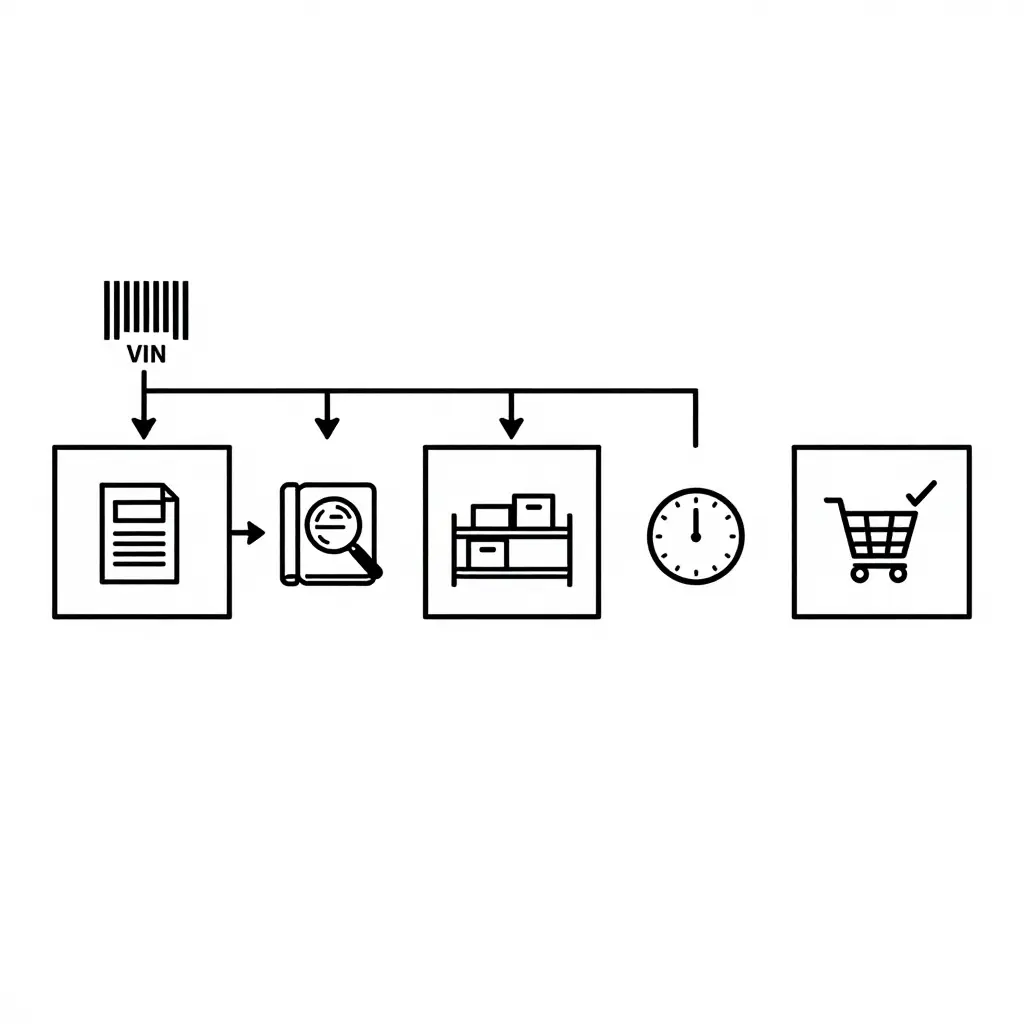
Why Part Numbers and VIN Matching Matter
Truck configurations vary by year, engine, and chassis, and one part number can cover several variants. Pair it with the vehicle identification number (VIN) whenever you request a quote. The VIN pins down the build and assembly, so the supplier pulls the right SKU the first time.
How to Confirm Availability
Verify stock through a supplier’s online portal or by phone. Portals show real-time counts at the warehouse level and often allow instant ordering. A phone call lets you ask about allocation and get verbal confirmation before you tie up a bay.
Either way, confirm these details with the supplier:
- Part number – the exact OEM number, cross-checked against your VIN
- Quantity on hand – units physically available to ship today
- Lead time – expected delivery date, not just a processing window
- Warranty – term, coverage, and whether it is honored nationwide
- Core charge – deposit amount and return requirements for remanufactured parts
How Backorders Affect Repair Timelines
A backordered part cannot ship, and that can stretch a same-day repair into a multi-week job. Ask whether an item is in stock or backordered, and request an estimated release date. If it is backordered, build the delay into your schedule instead of discovering it midway through the repair. A provider known for quality service and reliability on the road keeps parts sourcing and repair on one timeline; checking OEM stock before you commit protects the schedule and the budget.
Understanding Truck Labor Rates
A truck labor rate is the hourly price a shop charges for a technician’s time. It is the first number most people compare when they search for a truck service near me. But truck labor rates are only one part of the story, and treating the posted rate as the total diesel truck repair cost leads to surprises at checkout.
The distinction that matters is posted shop rate versus effective billed hours. The posted rate is the sticker price per hour; billed hours reflect how time is actually applied. Some shops bill the labor guide’s “book time” instead of the clock, so a job quoted at three hours may take two and still bill at three. Others round every task up to the next half hour. A shop with a low posted rate and aggressive billing can cost more than one with a higher rate and tight timekeeping.
Three add-ons reshape most invoices. Diagnostic fees cover the time spent identifying a fault, and many shops waive them if you authorize the repair. Shop supplies are small environmental and consumable charges, often a fixed percentage of labor. Emergency premiums apply to after-hours or roadside calls, and mobile repair visits frequently carry a call-out fee on top of the hourly charge.
Rates also vary by context. Heavy-duty Class 8 tractors cost more to service than light commercial pickups because they demand specialized tooling and certifications. Diesel engine work sits above gasoline work for the same reason: greater complexity and higher technician skill. Region matters too, as urban labor markets, local demand, and travel distance for mobile service all move the price.
Before authorizing any work, ask a shop a short set of direct questions: What is your posted hourly rate, and is it the same for diagnostics? Do you bill actual clock time or book time? Is there a diagnostic fee, and is it credited if I approve the repair? What is your shop supplies charge? What does an after-hours or mobile call cost? Can you provide a written estimate with a not-to-exceed figure? A shop that answers these clearly and in writing is usually the one worth your business.
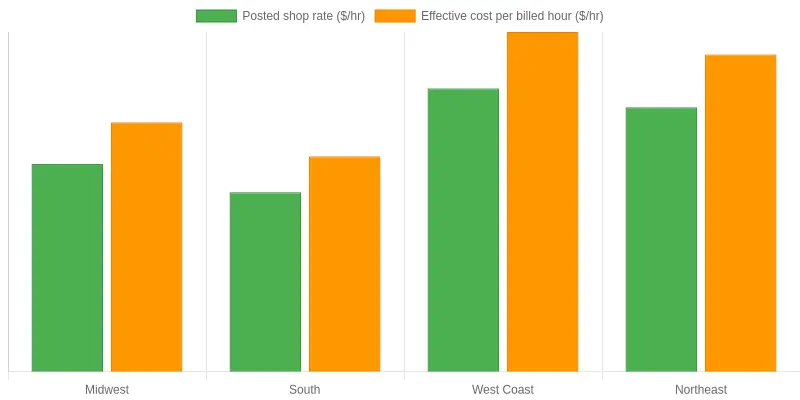
The chart shows why the effective cost per billed hour typically runs above the posted rate in every region. When you compare shops, evaluate the all-in number rather than the headline figure, and confirm the details before work begins.
Truck Labor Rates and Service Charges at a Glance
The ranges below reflect typical North American rates for medium- and heavy-duty trucks, so treat them as a starting benchmark rather than a fixed price. For a shop known for quality service and reliability on the road, expect quotes to land within these bands depending on region, truck make, and job complexity.
| Service Type | Typical Labor Rate Range | Diagnostic Fee | Notes |
|---|---|---|---|
| Routine maintenance | $90 – $150 per hour | $0 – $75 | Oil, filters, and inspections are often flat-rate and bundled |
| Diesel engine diagnostics | $120 – $200 per hour | $100 – $250 | Fault codes and software scans raise the diagnostic fee |
| Brake service | $100 – $175 per hour | $0 – $90 | Air-brake and ABS work costs more than hydraulic systems |
| Transmission repair | $110 – $190 per hour | $75 – $200 | Automatic and automated manual units need specialized labor |
| Electrical diagnostics | $115 – $185 per hour | $90 – $200 | Chasing wiring faults is time-intensive and billed hourly |
| Roadside mobile repair | $150 – $300 per hour | $50 – $150 | Includes travel; after-hours and remote calls add surcharges |
Dealership Service Centers vs. Independent Truck Repair Shops
The first decision on any repair is often the hardest: go to the dealer or hand the keys to an independent shop. For fleet managers weighing dealer vs independent truck repair, the answer comes down to urgency, budget, and how specialized the job is.
Dealership service centers win on OEM access. They carry factory parts, run manufacturer software updates, and hold the specialty tooling that newer emissions and electrical systems demand. That access matters when a warranty is active, because dealer-only repairs can protect coverage and keep documentation clean. The trade-off is cost and speed: dealer labor rates run higher, and appointments can stack up for days, which hurts uptime.
Independent shops typically quote lower labor rates and schedule faster. Many stock common parts and order the rest through suppliers, so a search for OEM truck parts near me can still turn up factory-grade components without a dealer visit. The catch is warranty nuance. Some OEM policies require authorized service for certain repairs, so confirm the terms before routing work away from the dealer.
Specialty tooling is another dividing line. Complex diagnostics, transmission work, and after-treatment systems often favor the dealer or a well-equipped independent with OEM-grade equipment. Routine maintenance, brakes, and tires are usually fine anywhere.
Many operators blend both approaches and standardize on trusted providers. That consistency shows up in partnerships built on quality service and reliability on the road, where teams commit to a single, dependable pipeline for parts and repairs.
The practical rule: match the shop to the job. Use the dealer for warranty work and complex systems, and lean on independents for speed and cost on routine repairs.
What Do Truck Labor Rates Really Look Like?
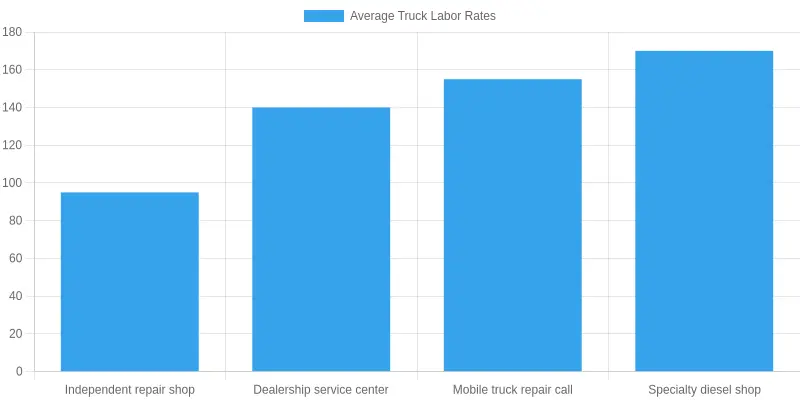
Before you call the nearest shop, know where the numbers typically land. The chart below breaks down average hourly labor rates across four common categories of truck service, from light-duty pickups to on-site mobile repair, and gives you a benchmark for comparing quotes from different providers.
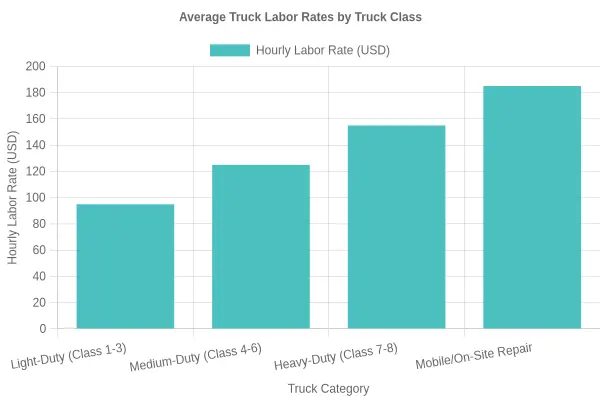
Figure: Average hourly truck labor rates by truck class and service type.
Labor costs climb steadily with vehicle complexity: heavy-duty work runs roughly 60% higher than light-duty service, while mobile repair carries the highest premium because you pay for convenience and travel. These benchmarks help you spot a fair quote, and fleet managers who want predictable, quality work can explore premier trucking solutions built around transparent pricing.
Before you trust a mobile mechanic or a local shop with your rig, ask the right questions. A few minutes of due diligence up front can save thousands in downtime, rework, and surprise invoices.
- What certifications and factory training does your team hold for heavy-duty truck systems?
- Are you fully insured, and can you provide a certificate of general liability and cargo coverage?
- Do you source OEM truck parts directly, and can you show proof of part numbers and origin?
- What response-time guarantee do you offer for mobile repair calls, and is it confirmed in writing?
- What are your warranty terms on both parts and labor, and exactly how long do they last?
- How detailed will my invoice be, including parts used, labor hours, and diagnostic fees?
- Are you available after hours, on weekends, and for roadside emergencies?
- Can you share references from other fleet managers or owner-operators you have served?
Clear answers help you pick a provider known for quality service and reliability on the road, so your trucks stay productive and your costs stay predictable.
OEM vs. Aftermarket Truck Parts: Which Should You Choose?
When a truck rolls into the shop, one of the first decisions a fleet manager or technician faces is whether to install OEM truck parts or aftermarket truck parts. Each option has trade-offs, and the right call depends on the component, the vehicle’s age, and the warranty situation.
Fitment accuracy is where OEM parts usually win. They are engineered to the manufacturer’s exact specifications, so they bolt on with minimal adjustment. Aftermarket parts vary widely: some brands match OEM tolerances closely, while budget options may require shimming, trimming, or extra labor.
Warranty coverage is the second major factor. If a truck is still under a factory or extended warranty, installing non-OEM parts for a covered repair can void that protection. In those cases, OEM is the safe choice. Once a vehicle is out of warranty, aftermarket options become far more attractive.
Price and availability often drive the decision. Operators compare suppliers to find price advantages, especially on high-volume items like filters, brake components, and diesel truck parts near me that need to be sourced quickly. Aftermarket suppliers often stock faster and cost less, which keeps downtime low.
Long-term durability depends on quality tier. Premium aftermarket brands can match or exceed OEM lifespan, while cheap knock-offs often fail early and cost more over time.
| Factor | OEM Parts | Aftermarket Parts |
|---|---|---|
| Fitment | Exact factory specs | Varies by brand |
| Warranty | Protects factory coverage | May void coverage |
| Price | Higher | Usually lower |
| Availability | Dealer-dependent | Often fast and wide |
| Durability | Consistent | Depends on quality tier |
Aftermarket parts make sense for out-of-warranty repairs, routine maintenance, and hard-to-find legacy components. For warranty repairs, safety-critical systems, and vehicles slated for resale, OEM keeps documentation clean and protects value. Fleets that pair the right parts with strong maintenance practices get the best results, and structured fleet maintenance and service training helps teams make those calls confidently.
Mobile Repair or Tow? A Dead-Simple Way to Decide
When your rig quits, the pressure hits fast. Do you wait for a mobile tech to roll up, or eat the cost of a tow and get the truck into a shop? The answer depends on a handful of practical factors, not gut instinct. The flowchart below untangles them.
The diagram walks you through four quick checkpoints, each a yes-or-no question. Answer them in order and you land on one of two paths: call for mobile repair or tow it to a shop.
How to Read the Flowchart
Start at the top node and follow the arrows. Each diamond is a decision; each rectangle is the action you take. The logic the diagram encodes, spelled out:
- Severity of the fault – Is this a minor, self-contained issue (a loose sensor, a bad battery connection, a simple air leak) or a major mechanical failure that needs a lift and heavy tooling? Small problems lean toward mobile repair; big ones lean toward a tow.
- Safety of the location – Can a tech legally and safely work where you are parked, or are you on a live shoulder, a blind curve, or an unsafe yard? An unsafe spot often forces the tow regardless of the fault.
- Tools and capability required – Does the job need a shop-grade diagnostic suite, a welding rig, or heavy lifting gear? If the fix demands equipment a mobile unit cannot carry, the truck has to travel.
- Cost comparison – Run the numbers. A mobile call plus parts is frequently cheaper than a tow plus shop labor, especially when downtime is expensive. For deep repairs, the tow pays for itself.
Mapping it out removes emotion from the call. You stop staring at a broken truck and start making a decision.
Why This Matters for Your Downtime
Downtime is the silent budget killer for owner-operators and fleet managers alike. Every hour a tractor sits idle is a load that is not moving and a customer who is getting nervous. Knowing when to summon a mobile unit, and when to accept a tow, keeps your quality service and reliability on the road predictable rather than panicked.
A Quick Reality Check on Costs
Numbers vary by region and vehicle class, but the pattern holds. Mobile calls tend to win on small, accessible repairs, while tows win once the fault gets deep or the location gets dangerous. The table below gives you a rough mental model of how the trade-offs usually stack up.
| Factor | Lean Mobile Repair | Lean Tow to Shop |
|---|---|---|
| Fault severity | Minor, contained | Major, structural |
| Location safety | Safe and accessible | Unsafe or obstructed |
| Tools needed | Hand tools, basic diagnostics | Lift, welding, heavy gear |
| Typical cost profile | Lower total, faster start | Higher upfront, better for deep fixes |
| Downtime risk | Short if parts on hand | Longer, but proper for big jobs |
The flowchart is a guide, not a rule. Use it to structure the conversation when you call dispatch, and be ready to describe the fault, your location, and the tools you think the job needs. Clear answers get clear decisions, and clear decisions get the wheels turning sooner.
The Bottom Line
Severity, safety, tools, and cost. Run those four factors in order and you will almost always know whether to wait for a mobile truck repair or arrange a tow. Keep this flowchart handy in the cab or on your phone, and the next breakdown becomes a routine call instead of a crisis.
Building a Reliable Local Supplier and Service Network
Keeping trucks on the road takes more than a single good repair. Truck owners, fleet managers, and auto repair shops all benefit from a dependable network of local parts suppliers and service providers. The goal is consistent product support and uptime, which reduces downtime costs and keeps schedules predictable.
Start with a vetted contact list. Search for a “truck parts supplier near me” and confirm each candidate’s inventory depth, delivery radius, and emergency hours before adding them to your records. Document direct contacts for parts managers, mobile mechanics, and dealership service desks so no one wastes time chasing the right person during a breakdown.
Next, negotiate account terms. Ask for net payment windows, clear return policies, and volume pricing on the heavy duty truck parts you order most often. A written account agreement clarifies responsibilities and prevents disputes when urgent orders arrive.
Track performance consistently. Log fill rates, delivery times, and warranty outcomes for every vendor. Those numbers tell you which partners to reward and which weak links in your truck service network to replace.
Finally, build backup options for OEM truck parts. Even strong suppliers face stockouts, so maintain at least two approved sources for critical components. That redundancy supports the consistent product support and uptime your operation depends on.
Frequently Asked Questions: Truck Parts and Service Sourcing
Sourcing the right parts and service is one of the biggest decisions a truck owner, fleet manager, or repair shop faces. Below are answers to five of the most common questions about ordering parts, calculating repair costs, and keeping rigs on the road.
How do I find truck parts near me quickly?
To find truck parts near me fast, start by searching your truck’s VIN through a local dealer’s online catalog, then cross-check independent distributors that stock both aftermarket and OEM truck parts. Give the exact year, make, model, and engine serial number so the counter can confirm a correct-fit part the first time. Many suppliers now show real-time inventory, which lets you verify a part is on the shelf before you drive over. If local stock is thin, ask whether a regional warehouse can ship same-day or overnight.
How are truck labor rates calculated?
Truck labor rates are usually calculated by multiplying a shop’s posted hourly rate by the flat-rate time the manufacturer assigns to a specific job, so you pay for the task rather than the clock. Prices climb with technician certification, regional cost of living, and whether the work happens at a dealer or an independent garage. Specialized diesel diagnostics and heavy-duty systems typically command the highest rates.
When is mobile truck repair worth the cost?
Mobile truck repair is usually worth the cost when a breakdown happens far from a shop, when downtime losses clearly outweigh the call-out fee, or when the fix is a known roadside task such as a hose, belt, or brake adjustment. For short jobs, staying on route often beats the cost of towing and waiting in a service line. For complex engine or transmission work, however, bringing the truck to a full-service facility is more economical.
Are OEM truck parts always required?
OEM truck parts are not always required, but they are strongly recommended for components under warranty or tied to safety, emissions, and electronic systems. High-quality aftermarket parts can match original specifications and cost less once a vehicle is out of warranty. Confirm that any substitute part meets or exceeds the original manufacturer’s specs before installation to protect reliability and resale value.
How do I verify a supplier’s OEM stock?
To verify a supplier’s OEM stock, request the exact manufacturer part number, ask for photos of the packaging and labels, and confirm the seller is an authorized distributor. Cross-reference that number against the manufacturer’s own catalog to make sure it matches your application, and review the supplier’s return and warranty policy. A reputable source will provide documentation without hesitation – and if you want to work with a team known for quality service and reliability on the road, that is a good sign to look for.
Conclusion: Turn Three Decisions Into One Game Plan
Finding dependable truck parts and service near you comes down to three decisions, and each one is easier to make before something breaks on the road. Confirm that OEM truck parts are actually in stock, so you are not waiting days for a critical component. Compare truck labor rates on the all-in cost, because the cheapest hourly quote rarely tells the whole story. Decide when a mobile truck repair call makes more sense than towing your rig to a shop.
For truck owners, that means knowing your local options before you need them. For fleet managers, it means building these checks into routine maintenance planning. For auto repair shops, it means staying transparent about parts availability and pricing so customers keep coming back. Get all three right, and a stressful breakdown becomes a manageable pit stop.
When you are searching for heavy duty truck repair near me and mobile truck repair near me, the goal is the same: less time parked and more miles logged. Reliable partners who understand this, like those focused on quality service and reliability on the road, make the difference.
The practical takeaway is simple: plan ahead. Research your parts, rates, and repair options today, so tomorrow’s downtime is as short as possible.