

Why Service Truck Weight Matters
A loaded service truck is heavier than most operators expect. A full-size pickup-based service body on a Class 3 or Class 4 chassis, with a utility bed and tools aboard, usually weighs between 8,000 and 11,000 pounds. Move up to a medium-duty truck (Class 5 to 7) with a crane, air compressor, and a full tool inventory and the figure reaches 16,000 to 26,000 pounds. Those are operating weights, not showroom numbers, and they decide whether the truck is legal on a public road and whether it will stop when it has to.
Three numbers set those limits: curb weight, GVWR, and tool load.
- Curb weight is the truck’s weight with fuel and fluids aboard but no cargo. It is the figure the manufacturer builds and delivers.
- GVWR (Gross Vehicle Weight Rating) is the most the chassis is engineered and legally allowed to carry: the truck itself plus cargo, tools, and passengers.
- Tool load is everything you add on top: welders, generators, fluid tanks, ladders, shelving, and the tools your technicians use.
Every pound of tool load adds directly to operating weight. Once curb weight, tools, people, and fuel together pass the GVWR, the truck is overweight, and braking distance, steering, tire ratings, axle limits, and legal compliance all change with it.
This guide defines service truck weight, explains how the GVWR caps the total, and shows how added tools push a truck past it. It also covers weighing your own truck and finding the safety margin before a load turns illegal.
For fleet managers, staying under the GVWR is not optional. It is what keeps a fleet compliant and on the road for years.
Core Weight Terminology Every Service Truck Operator Must Understand
The ratings below decide what a truck can legally and safely carry, tow, and stop. Whether you run a single truck or manage a large fleet, mixing them up leads to overloaded axles, voided warranties, roadside fines, and sloppy handling. For fleet managers chasing comprehensive trucking solutions, it all starts here.
Curb Weight
Curb weight is the truck fully equipped for the road: fuel, coolant, oil, a full tank, and all standard equipment, but no cargo, passengers, or driver. Manufacturers establish it by weighing a completed vehicle. Every pound of tools, parts, and people you add stacks on top of it.
Dry Weight
Dry weight strips out the fluids entirely: no fuel, no coolant, no oil. It is mostly a shipping and transport figure rather than an on-road compliance number, useful mainly when you want to know roughly how much a bare truck weighs before operational loads go on.
Wet Weight
Wet weight is the truck with every fluid topped off, including a full fuel tank and often a full DEF tank. On a service truck it comes closest to real-world curb weight and gives you an honest starting point for calculating what is left to haul.
GVWR (Gross Vehicle Weight Rating)
The GVWR is the maximum total weight the truck can safely handle, as set by the manufacturer. It covers the truck, fluids, passengers, cargo, tools, and everything mounted on it. GVWR comes from an engineering analysis of the frame, suspension, brakes, tires, and axles, and it is a hard legal ceiling, not a suggestion.
GAWR (Gross Axle Weight Rating)
GAWR is the maximum weight a single axle can carry, rated separately for the front and rear. The rear GAWR is often the number that trips up service trucks, because heavy tool bodies, cranes, and compressors push weight toward the back. Each rating is set by the weakest component in that assembly: tires, springs, or the axle itself.
Payload Capacity
Payload capacity is what is left for cargo after you subtract curb weight from GVWR. It tells you how many tools, parts, and supplies you can legally load. Exceed it and you can breach the GVWR and a GAWR at the same time.
GCWR (Gross Combined Weight Rating)
GCWR is the maximum allowable weight of the truck plus a trailer and everything on both. It matters whenever a service truck pulls an equipment trailer, and manufacturers set it from powertrain and braking capability.
Gross Vehicle Weight (GVW)
Don’t confuse GVW with GVWR. GVW is the actual, measured weight of your truck right now, at the scale, fully loaded. GVWR is the limit; GVW is reality. Comparing them tells you immediately whether you are running legal.
Quick-Reference Cheat Sheet
- Curb weight: truck + fluids + standard equipment, no cargo or people
- Dry weight: truck with no fluids at all
- Wet weight: truck with all fluids and a full fuel tank
- GVWR: maximum the whole truck can weigh, per manufacturer
- GAWR: maximum weight for one axle (front or rear)
- Payload capacity: GVWR minus curb weight – your usable load
- GCWR: maximum truck plus trailer combined
- GVW: the actual measured weight at the scale today
Service Truck Weight Ratings: A Side-by-Side Comparison
These terms get thrown around at the scale house and the shop, but they describe different things. Here is how each rating looks on a typical mid-size service truck with a utility body, a small crane, and a full set of tools and fluids.
| Rating Term | What It Measures | Typical Example Value | Why It Matters |
|---|---|---|---|
| Curb Weight | Total weight of the truck ready to drive with a full tank of fuel, fluids, and standard equipment, but no cargo or crew | 10,500 lb | Your real-world starting point for every load calculation – it tells you what is already on the axles before you add a single tool |
| Dry Weight | Weight of the chassis and body with no fuel, no coolant, and no fluids | 9,800 lb | Used mainly by upfitters and dealers; it is a bare shell number, so never budget payload against it |
| GVWR | Maximum allowable total weight of the fully loaded truck, including cargo, crew, and fluids | 19,500 lb | The hard legal ceiling for the whole vehicle – exceed it and you are overweight at the scale |
| Front GAWR | Maximum allowable weight carried by the front axle | 7,000 lb | Keeps steering and braking safe; heavy cranes or front-mounted compressors can push you past it |
| Rear GAWR | Maximum allowable weight carried by the rear axle | 13,500 lb | Usually the first limit you hit, since beds, tools, and materials all sit over the rear wheels |
| Payload Capacity | Weight of everything you can legally add once curb weight is already on the truck (tools, parts, cargo, people) | About 9,000 lb | The number that actually decides how much gear you can haul before you are technically overloaded |
| GCWR | Maximum combined weight of the loaded truck plus a fully loaded trailer | 30,000 lb | Governs towing – if you pull an equipment trailer, GCWR caps the total rolling weight |
Quick Takeaways
- Curb weight and GVWR are the two you will use most. Subtract one from the other and you have your real payload headroom.
- Axle ratings are just as legally binding as GVWR. You can be under your total weight limit and still be over on the rear axle.
- GCWR only matters when towing. If you never pull a trailer, focus on curb weight, GVWR, and rear GAWR.
- Weigh your own truck. The examples above reflect a general mid-size setup; every build differs with the tools, fluids, and equipment it carries.
These numbers are the basis of a reliable fleet, and they pair well with sourcing trucks from a premier trucking solution provider that can match ratings to your workload.
How to Calculate Available Payload on a Service Truck
A service truck earns its keep hauling welders, compressors, lube skids, hose reels, and pipe racks, and every pound you bolt on eats into the legal and safety margins. Working out the remaining payload takes about twenty minutes, a certified scale, and some patience, and it is worth doing before the truck goes into service. If you care about keeping service fleets reliable on the road, weight discipline is where it starts.
Here is the method, step by step.
-
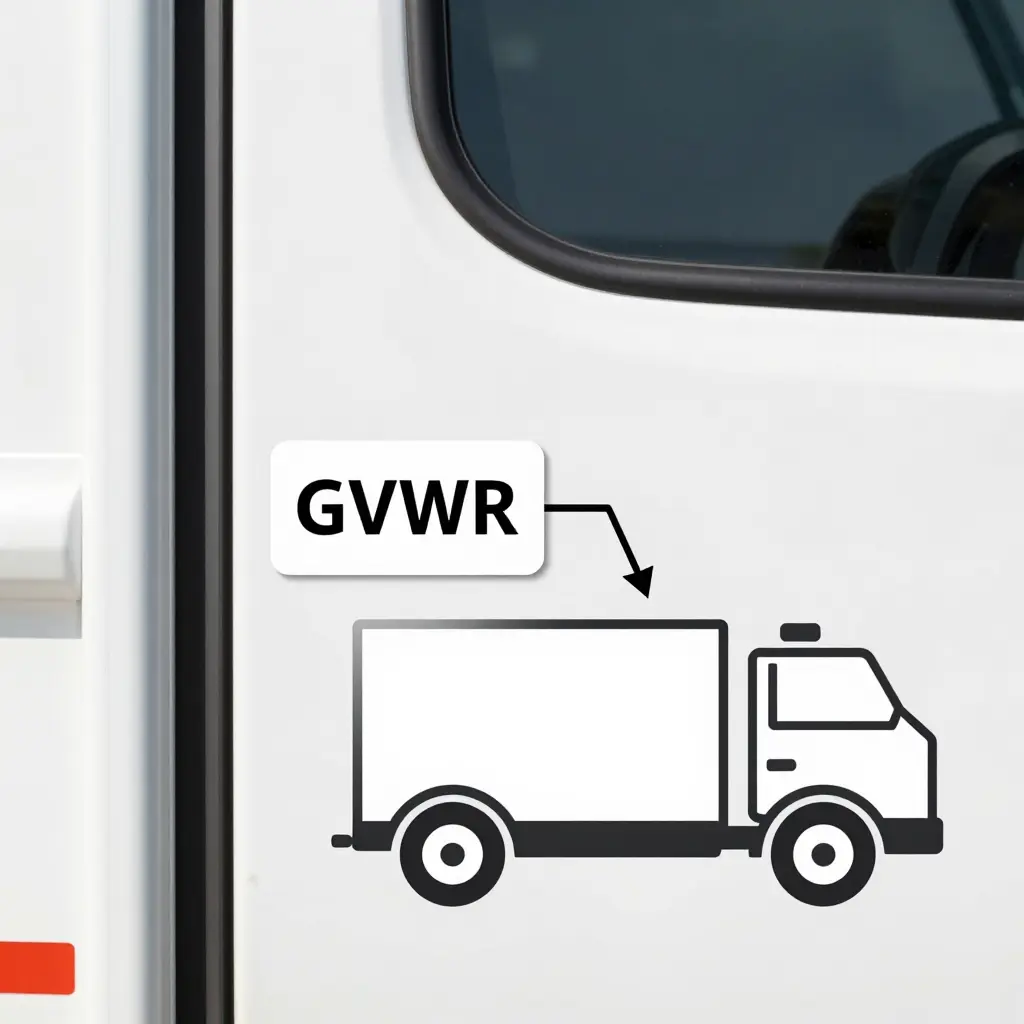
Read the GVWR from the door jamb sticker. Open the driver’s door and find the certification label. The number you want is the GVWR (Gross Vehicle Weight Rating): the maximum total weight the truck is engineered to carry, including the truck itself, fuel, people, tools, and cargo. Write it down. A typical medium-duty service truck lands between 19,500 and 26,000 lbs.
-
Weigh the truck fully fueled and equipped to get true curb weight. Curb weight is what the truck weighs with a full tank and all permanently mounted equipment. Brochure figures are optimistic, so skip the paperwork and take the truck to a certified scale (a CAT scale works). A reliable service truck weight starts with a real number.
-
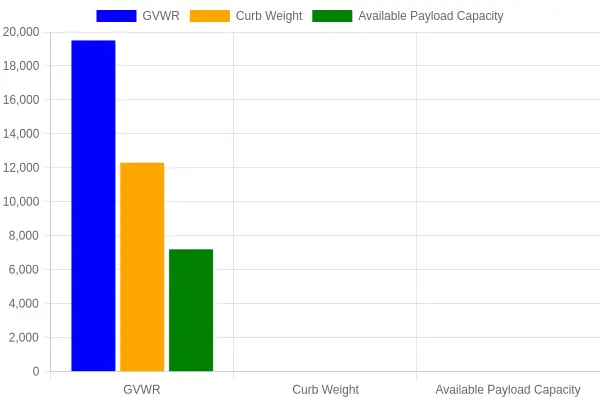
Subtract curb weight from GVWR. That leaves your starting payload capacity: the pounds available for everything that is not permanently attached. Example: 19,500 lbs GVWR minus 12,300 lbs curb weight leaves 7,200 lbs of payload capacity.
-
Account for the driver, passengers, and fuel. People and fuel count against payload. A driver plus two technicians can add 500-600 lbs, and a full tank of diesel adds several hundred more. Budget 300-400 lbs per person when gear is included, and subtract the total from your remaining payload.
-
Weigh each axle against its GAWR. Payload capacity is only half the story. You also cannot exceed the Gross Axle Weight Rating (GAWR) on either axle. Weigh the truck axle-by-axle, front and rear separately. Rear axles on service trucks often max out before the GVWR does, especially with a heavy crane or lube skid hanging off the back.
-
Add the planned tool load to confirm the total. Total up the tools, consumables, and materials you intend to carry: welder, compressor, reels, fluids, parts. Add that to curb weight, people, and fuel. If the grand total stays under the GVWR and each axle stays under its GAWR, you are set. If not, trim the load, redistribute weight, or move to a heavier chassis.
-
Recheck and document whenever the truck changes. Service truck weight is not static. Add a crane or a second tool cabinet and the math shifts. Re-weigh after any major upfit and keep a weight sheet in the cab so drivers know their limits.
Example Calculation at a Glance
| Item | Weight (lbs) |
|---|---|
| GVWR | 19,500 |
| Curb weight (fueled and equipped) | 12,300 |
| Available payload capacity | 7,200 |
| Driver + two technicians | -600 |
| Remaining for tools and cargo | 6,600 |
Run these seven steps once and you will know how much gear the truck can carry without guesswork or an overloaded axle.
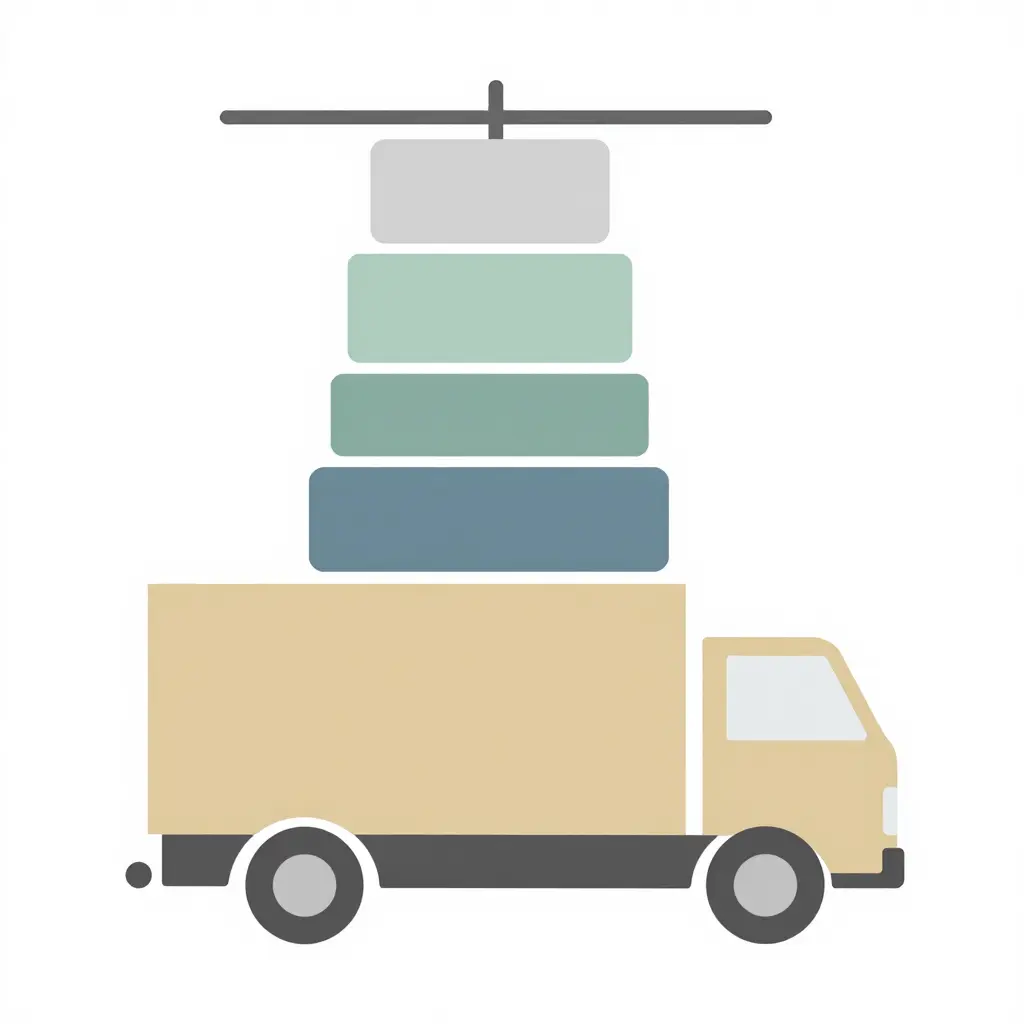
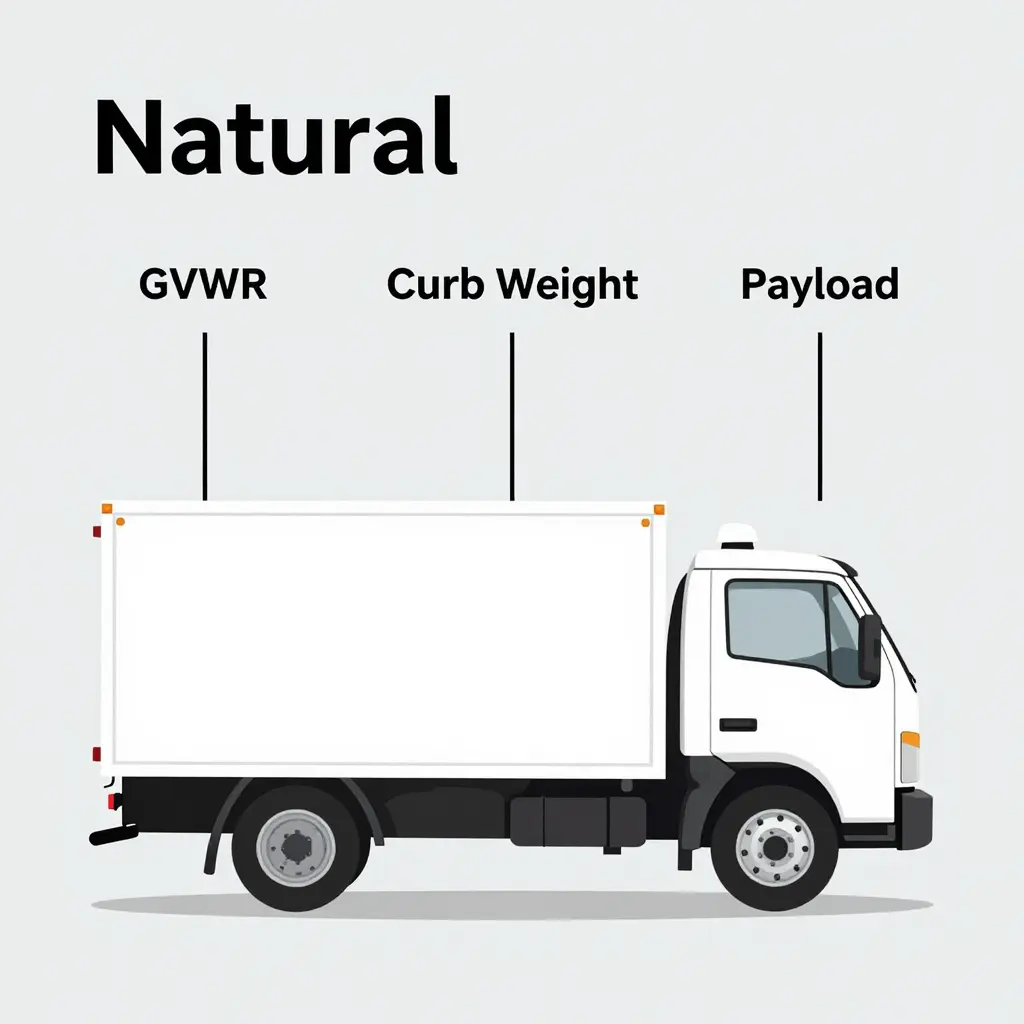
The schematic breaks a service truck’s total weight into its parts. At the bottom is curb weight: the bare chassis, body, and installed equipment it rolls off the lot with. On top sit the fuel, the driver, and the tool load operators add over time. The horizontal line across the top marks the GVWR, the ceiling you cannot cross no matter how useful the extra gear feels.
The Tool Load That Pushes You Over
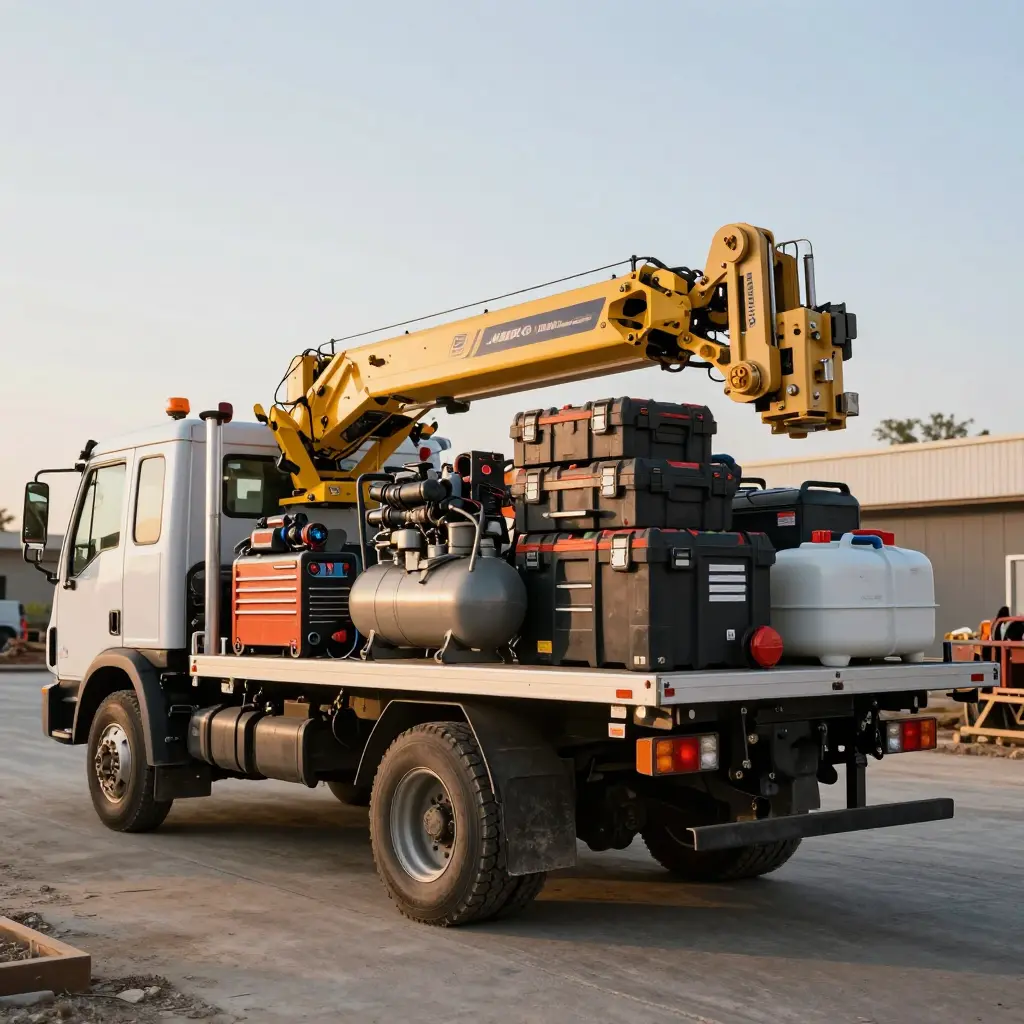
A service truck rarely fails a weight check because of the chassis it left the factory with. It fails because of everything bolted, welded, and stacked on top. That pile of gear, the tool load, is what usually pushes a truck past its GVWR (Gross Vehicle Weight Rating). The service truck weight you start with is seldom the problem; the weight you add is.
Curb Weight Is Only the Starting Point
Every truck leaves the factory with a curb weight: the vehicle plus fluids and a full tank of fuel. The GVWR is the legal ceiling, including cargo, passengers, and all mounted equipment.
The math is simple and merciless:
Payload capacity = GVWR – curb weight
Whatever remains after subtracting curb weight is all you get, and on many light and medium-duty service trucks that margin runs out faster than owners expect.
What the Common Tools Actually Weigh
Few operators stop to add up the numbers. Here is what typical equipment contributes to the load.
| Equipment | Typical Weight Range |
|---|---|
| Engine-driven welder | 400 – 1,000 lbs |
| Air compressor (gas or diesel) | 150 – 500 lbs |
| Generator / air combo unit | 600 – 1,200 lbs |
| Loaded toolboxes | 200 – 600 lbs each |
| Hand and power tools | 100 – 400 lbs |
| Field service crane | 1,500 – 6,000 lbs |
| Lift gate | 400 – 1,000 lbs |
| Auxiliary fuel tank (50 – 100 gal) | 350 – 700 lbs |
| Water tank (50 – 100 gal) | 400 – 850 lbs |
| Spare parts and inventory | 300 – 1,000 lbs |
| Bulk fluids (oil, coolant, DEF) | 200 – 600 lbs |
A welder, a compressor, a loaded toolbox, and an auxiliary fuel tank together add 1,500 to 2,500 pounds, before a crane or a spare part goes on. Nothing on the list looks heavy alone; together they overwhelm the payload rating.
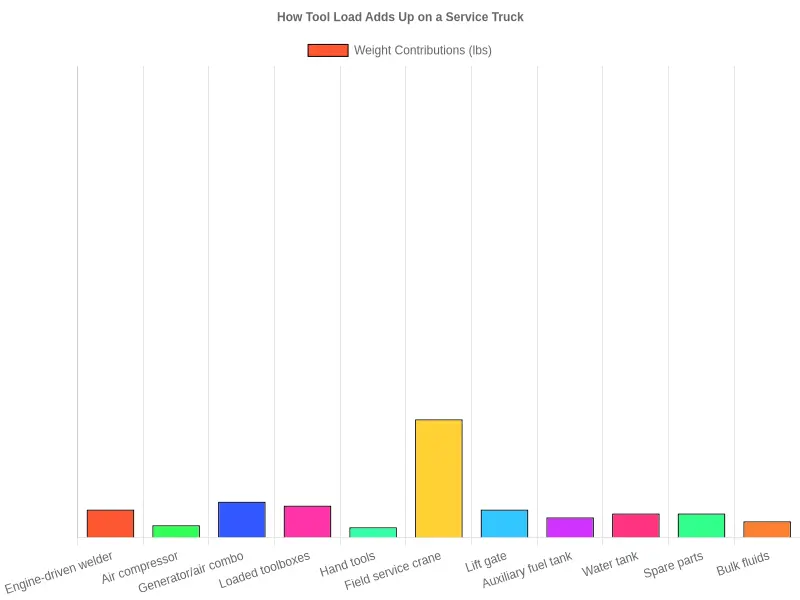
Small Additions Compound
Tool load grows in small steps: a second toolbox, a heavier lift gate, an extra barrel of hydraulic oil “just in case.” Each item feels harmless, and each one takes a bite out of the same fixed margin.
Nothing gets weighed on its own, so nothing triggers a warning. The total creeps up until the truck rides on its bump stops, takes longer to stop, and wears tires and springs ahead of schedule.
The Overload Trap
An overload rarely announces itself. It shows up as sagging rear suspension, longer stopping distances, and a truck that feels unstable in crosswinds. It also shows up at the scale, where a citation or a parked truck can cost more than the equipment that caused it. Staying on top of the margin is part of keeping service trucks reliable on the road.
Because tool load, not curb weight, is what breaks the GVWR limit, the fix starts with awareness. Weigh the truck, weigh the gear, and keep a running total. The numbers add up faster than most people think.
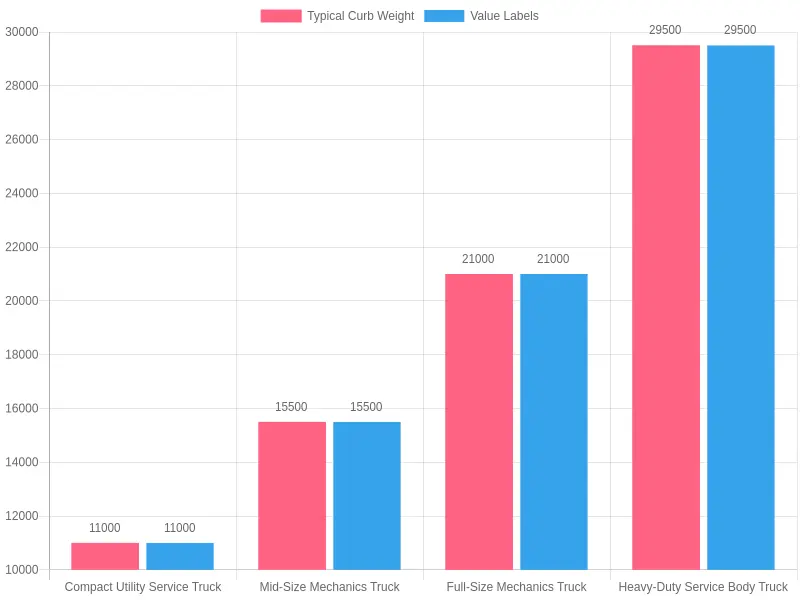
Chart specification
- Type: Bar chart
- Title: Typical Curb Weight by Service Truck Class
- X-axis: Service Truck Class
- Y-axis: Curb Weight (lbs), scaled 0 to 35,000
| Service Truck Class | Typical Curb Weight (lbs) |
|---|---|
| Compact Utility Service Truck | 11,000 |
| Mid-Size Mechanics Truck | 15,500 |
| Full-Size Mechanics Truck | 21,000 |
| Heavy-Duty Service Body Truck | 29,500 |
The chart shows curb weight climbing with truck class and leaving progressively less payload headroom once the service body, crane, and compartments are counted.
What the Industry Data Says About Service Truck Weight and Overload Enforcement
Every welder, crane, and fuel tank on a service truck counts against a legal ceiling. Where that ceiling sits decides whether a workday ends with a finished job or a citation. Here is what the data shows.
The Federal Highway Administration (FHWA) sets the outer boundary: on the Interstate Highway System, the federal gross vehicle weight (GVW) limit is 80,000 pounds, and no single axle may exceed 20,000 pounds while a tandem axle group is capped at 34,000 pounds. Medium-duty service trucks never come close to those figures, but they are the frame your GVWR – gross vehicle weight rating – is engineered against. Exceed your GVWR or a bridge-formula limit and you are legally overloaded, even if the truck drives fine.
Key Statistics
- 80,000 lbs – the federal GVW ceiling on the Interstate Highway System, per the FHWA and 23 U.S.C. 127. It governs the heaviest combinations on the road; a service truck’s ratings sit well below it.
- 34,000 lbs – the maximum allowed on a single tandem axle group under the federal Bridge Formula, per FHWA. This is the figure most often blown by an imbalanced tool load.
- Weight and axle-load violations are written regularly at weigh stations, and the Federal Motor Carrier Safety Administration (FMCSA) tracks axle and gross weight offenses in its violation data. States enforce their own limits on top of the federal caps.
The Numbers Behind the Rules
| Configuration | Typical legal limit |
|---|---|
| Single steering axle | 12,000 – 20,000 lbs |
| Single drive axle | 20,000 lbs |
| Tandem axle group | 34,000 lbs |
| Tridem axle group | 42,000 – 48,000 lbs (state dependent) |
| Federal Interstate GVW cap | 80,000 lbs |
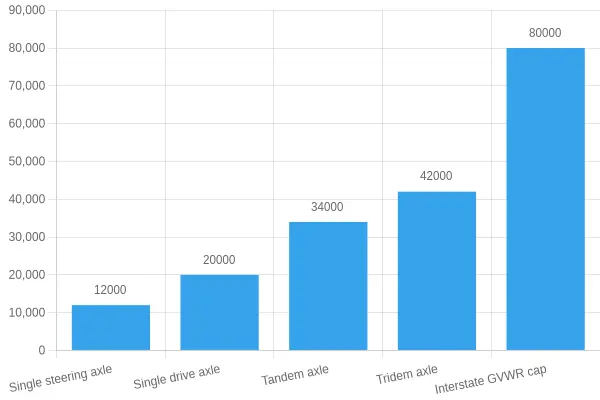
Where Service Truck Weight Trends Are Heading
The commercial vehicle specification market has pushed GVWR ratings higher to accommodate heavier bodies, cranes, and equipment packages. Legal road limits have not moved with them, so the gap between a truck’s rated capacity and its legal capacity keeps shrinking. The practical result: service truck weight discipline matters more than it did a decade ago. Crews routinely carry 3,000 to 6,000 pounds of tools, and an unbalanced load on a single axle can trigger an overload finding long before the truck reaches its rated maximum.
Emergency apparatus face the same math. Fire departments wrestle with GVWR and axle distribution when upfitting heavy bodies, as covered in these notes on pumper fire truck design features.
Weigh the rig loaded, know the axle-by-axle distribution, and treat the GVWR as a hard line rather than a suggestion.
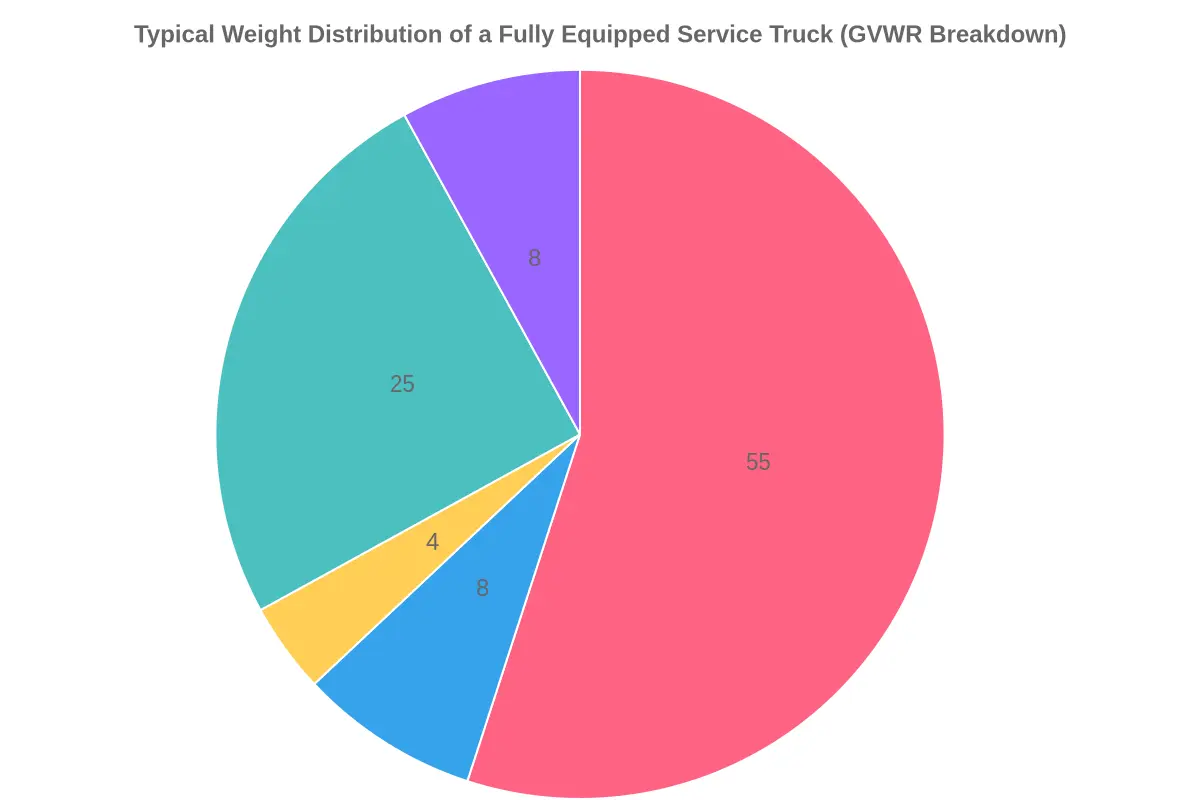
Chart Title: Typical Weight Distribution of a Fully Equipped Service Truck (GVWR Breakdown)
Chart Type: Pie
Data Series (share of total GVWR):
| Category | Percentage of GVWR |
|---|---|
| Curb Weight | 55% |
| Tools and Equipment | 25% |
| Fuel and Fluids | 8% |
| Spare Parts and Materials | 8% |
| Driver and Crew | 4% |
| Total | 100% |
Legend: Curb Weight (55%), Tools and Equipment (25%), Fuel and Fluids (8%), Spare Parts and Materials (8%), Driver and Crew (4%)
Visual Notes: Five-color palette with percentage labels displayed on each slice and a right-aligned legend listing every category with its percentage.
How to Weigh Your Service Truck and Stay Compliant
Keeping a service truck legal is not only about avoiding weigh-station fines. It is also about braking, handling, and whether the tires and suspension can carry the load every day. Compliance comes down to one repeatable weighing routine.
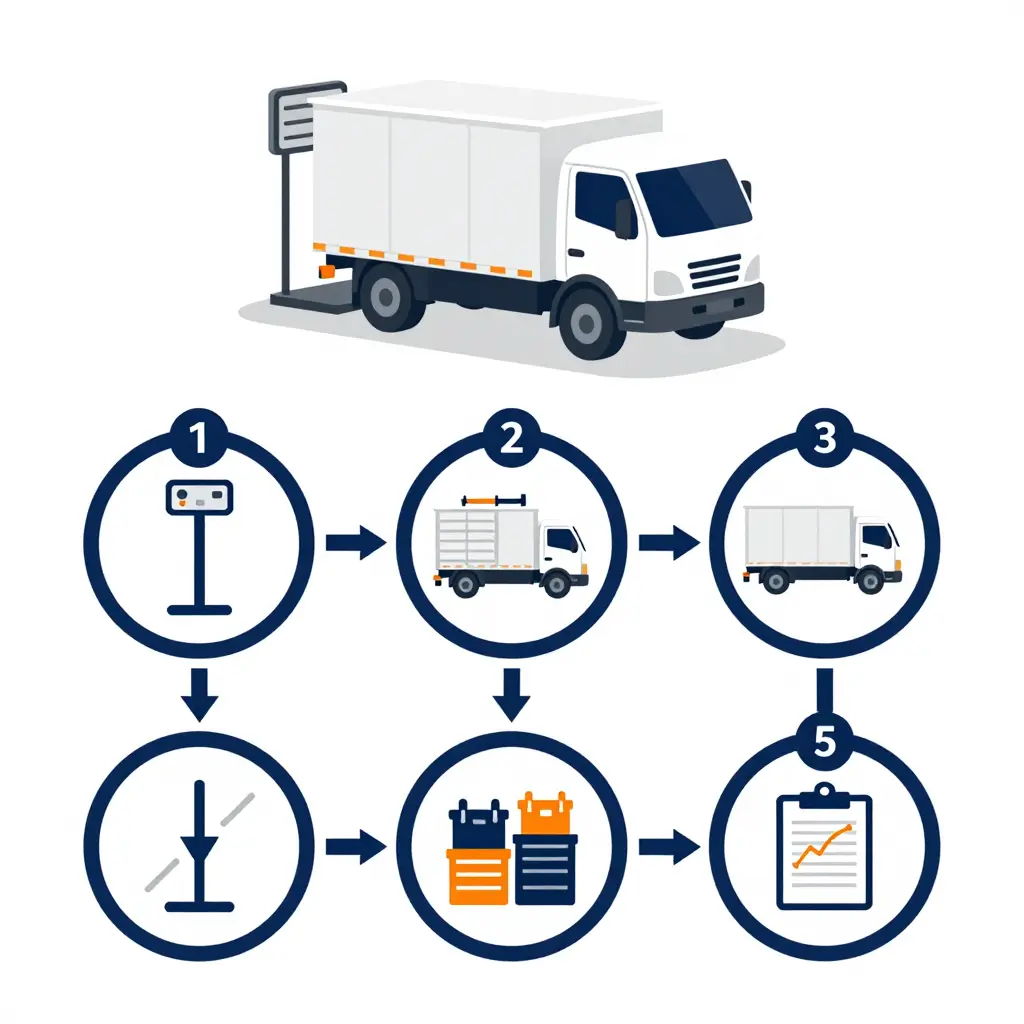
Step 1: Find a Certified CAT Scale
Start with an accurate number. Certified CAT scales are calibrated, public, and available at most major truck stops. Their printed tickets carry legally recognized weights and give you a defensible record, unlike an estimate from a brochure spec sheet.
Step 2: Weigh the Truck Full and Empty
Two readings tell you your true payload capacity. First weigh the truck loaded exactly as it rolls out on a job: tools, welder, compressor, fuel, and passengers. Then weigh it empty. The difference shows how much of your capacity the gear is eating, and the gap is usually where the surprises hide.
Step 3: Compare Front and Rear Axle Weights to GAWR
Total weight is only half the story. Each axle has its own Gross Axle Weight Rating (GAWR), and you can sit comfortably under your GVWR while overloading the front or rear axle. Compare the scale reading for each axle to its GAWR. A legal total with a maxed-out rear axle is a handling and tire risk waiting to happen.
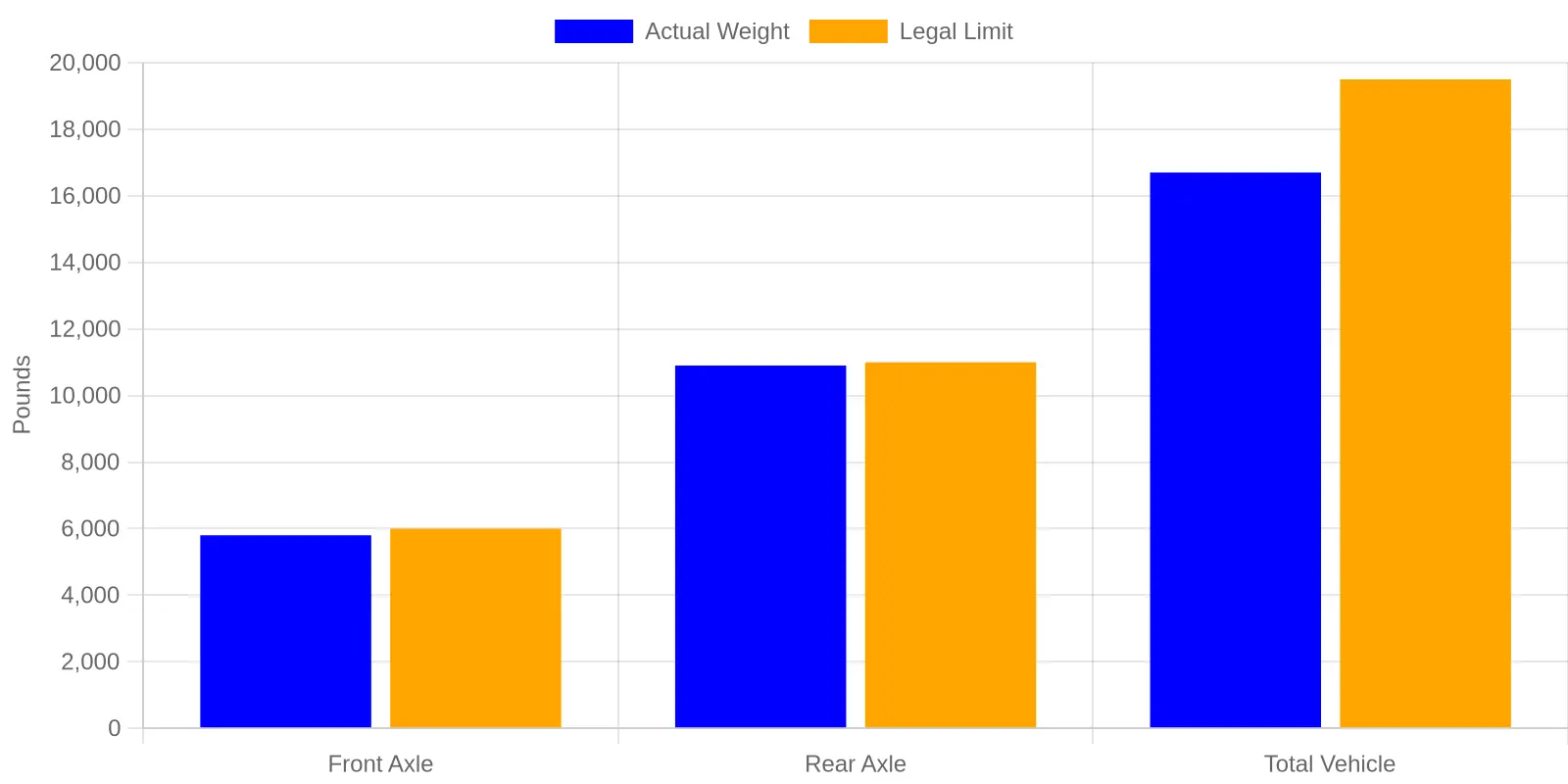
Step 4: Redistribute Tools to Balance the Axles
If one axle is overloaded, move weight rather than adding air to the tires. Shift heavy tools, spare parts, and tanks forward or back to bring each axle inside its GAWR. Even 200 to 300 pounds moved from the rear to the front can change how the truck rides, steers, and stops.
Step 5: Keep Documentation Onboard
Save every scale ticket, note the date, and record what the truck was carrying. This paper trail proves compliance during inspections and gives you a baseline for future weighings. Our team treats that discipline as part of its broader commitment to setting new standards in transportation.
Step 6: Monitor Your Service Truck Weight Over Time
Gear creeps in. A new toolbox here, an extra inverter there, and soon you are over your GVWR. Re-weigh whenever you add equipment, change your setup, or notice the truck squatting under load. Tracking the trend keeps your service truck weight from becoming a surprise at the scale.
Managing your service truck weight is an ongoing habit, not a one-time task. Weigh it, balance it, document it, and repeat.
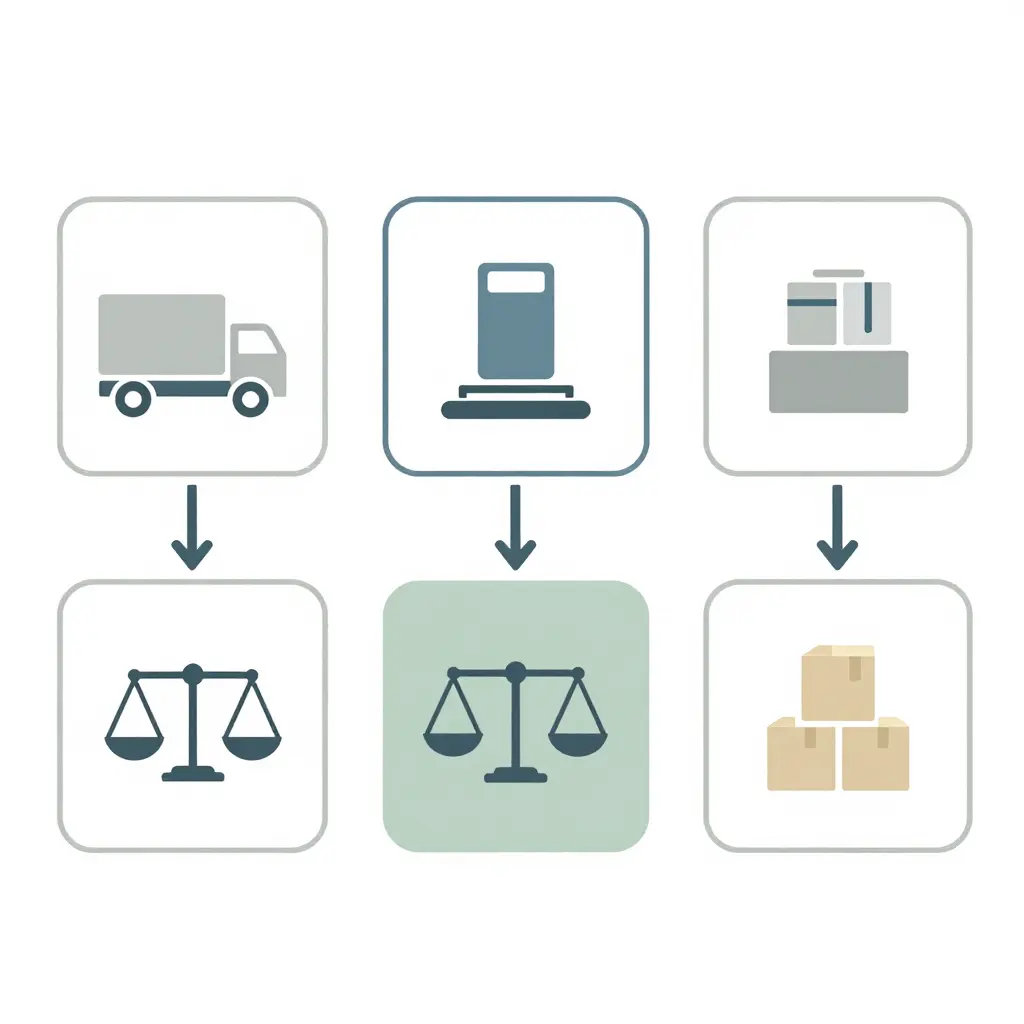
How This Weighing Flow Fits Your Truck’s Numbers
A certified scale is the only way to know what a service truck actually carries, rather than what the spec sheet claims. The diagram above breaks the routine into five checkpoints.
- Arrive at the scale and pull on straight and centered so the platform reads cleanly.
- Weigh the full truck to capture real operating weight with tools, fuel, and crew aboard.
- Weigh per axle so front and rear ratings stay within their individual limits.
- Compare to GVWR and GAWR to see how much legal capacity remains.
- Adjust the load by shifting or offloading tools until every rating lines up.
Treat this as a repeatable habit. A quick reweigh whenever you add a welder, compressor, or new bed keeps a fleet compliant. For teams that want to standardize the process across every unit, see these fleet management resources from 5 Star Truck.
Frequently Asked Questions About Service Truck Weight
The questions below come up most often from fleet managers and operators.
What Does Curb Weight Mean?
Curb weight is the weight of a service truck as it sits before you add tools or cargo: a full tank of fuel, all fluids topped off, and no driver, passengers, or equipment. Think of it as the truck’s “empty” weight, even though it already includes fuel. Because every other weight calculation starts here, curb weight is where you begin when figuring out how much equipment you can legally carry.
How Does GVWR Differ From Payload Capacity?
GVWR (Gross Vehicle Weight Rating) is the maximum total weight a truck is designed and certified to operate at, and it includes the truck itself plus everything you add: fuel, people, tools, and cargo. Payload capacity is what is left for equipment and cargo after you subtract curb weight from GVWR. GVWR is the ceiling; payload capacity is the usable space beneath it. Exceed payload capacity and you automatically exceed GVWR.
How Much Does a Typical Service Truck Weigh?
A typical service truck weight varies widely by class. A light-duty service body on a half-ton chassis may have a curb weight around 6,000 pounds, while a heavy-duty mechanic’s truck on a Class 7 chassis can weigh 15,000 to 20,000 pounds or more. Add loaded toolboxes, cranes, compressors, and welders, and a fully equipped rig can gain several thousand pounds. The service truck weight you actually operate at is what matters for compliance.
Why Can a Truck Be Legal on Total Weight but Over on an Axle?
Because GVWR is only half the story. Every axle also has its own GAWR (Gross Axle Weight Rating), which caps how much weight that single axle can carry. Load heavy tools at the rear and you may stay under GVWR while pushing the rear axle past its GAWR. That is still an overload, and it is often what triggers roadside violations, uneven tire wear, and brake problems. Check both total weight and per-axle weight.
Do Aftermarket Tools Void Weight Ratings?
No. Adding a crane, welder, or drawer system does not erase the manufacturer’s GVWR or GAWR ratings, but it does consume payload capacity. Every pound of aftermarket equipment counts against the numbers printed on the door jamb. Install enough gear and you can push a legal truck into an overloaded condition without changing a single factory rating. Recalculate payload capacity after any major addition.
How Can I Reduce an Overloaded Service Truck?
Start by weighing the truck at each axle so you know where the excess sits. Then move heavy tools toward the center of the vehicle, remove equipment you rarely use, and redistribute or lighten the load. Upgrading to higher-rated components or a larger chassis can also restore a safe margin. A regular weigh-in and a simple inventory of your tools keep your service truck weight within legal limits and protect both your drivers and your equipment over the long haul.