
Whether you’re a seasoned long-haul truck driver, a fleet manager, or an aspiring driver, finding truck stops offering repair services is crucial. Breakdowns can happen at the most inconvenient times, and being prepared can save you both time and stress. This guide will take you through different methods for identifying truck stops with repair services. We’ll explore leveraging navigation apps, utilizing roadside assistance providers, gathering community insights from fellow drivers, and tapping into local business platforms. By the end of this article, you’ll be equipped with the tools you need to get back on the road quickly and efficiently.
Pinpointing Roadside Care: How Navigation Apps Lead You to Truck Stops with Repair Services
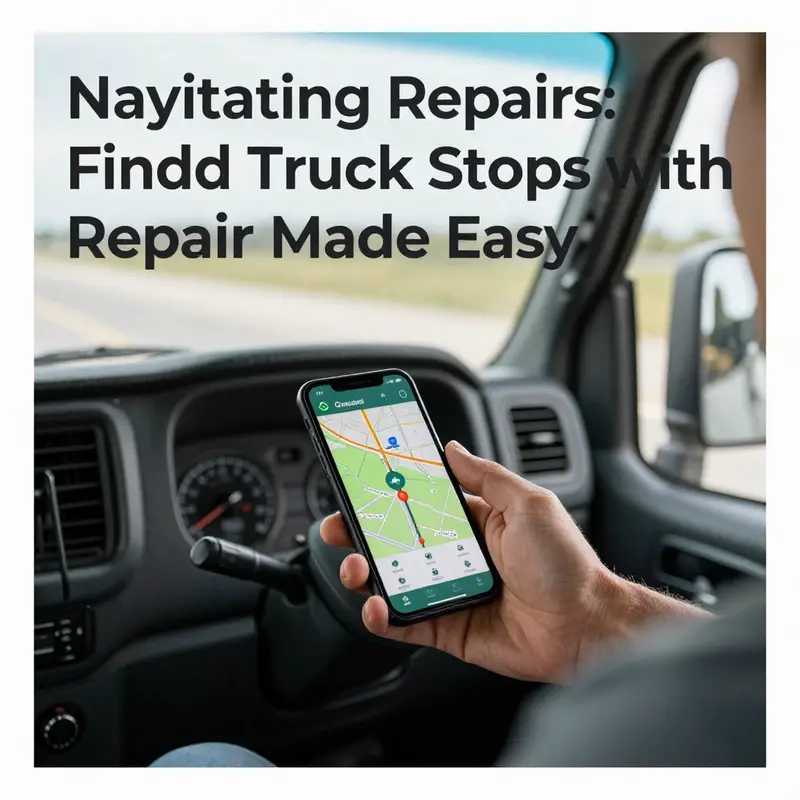
On the long stretch of a trucker life, timing is everything. A breakdown in the middle of a dark corridor between miles of highway can derail a delivery schedule, strain nerves, and magnify every tiny delay into a cascade of cascading decisions. In this landscape, modern navigation apps function not as a simple map, but as a practical co-pilot that can steer a route toward reliable repair support without wasting precious minutes. The value of these tools emerges from their ability to combine location awareness with facility details that matter to heavy haulers. What might feel like a guessing game when a truck stops at random becomes a calculated choice when the map is filtered, weighted, and updated for large vehicles. The goal is not just to find a nearby stop, but to locate a facility capable of addressing a specific problem with speed, competence, and predictable downtime.
At the heart of the approach lies the idea of filters. When a driver opens a navigation platform, a simple search for truck stops with repair services expands into a dynamic set of options. The most useful platforms allow a user to filter results by amenities that matter to heavy duty operations. A driver can prioritize facilities that offer heavy duty maintenance, tire services, or diesel service, and then further sort by whether the shop is open around the clock or has live technicians available at a given hour. The search becomes more than a list; it becomes a short list of viable choices, each with a snapshot of what the facility can deliver and how soon the work can begin. In practice this means a driver can avoid a place that promises emergency help only during daylight hours, and instead pick a shop that can receive a vehicle at a moment that aligns with a delivery window and the physical realities of the payload.
A critical advantage of such navigation tools is the way they map distance and time. The distance to a repair stop matters, but so does the time required to reach it and the time the shop needs to begin work. The best apps display both the driving distance and the estimated travel time, alongside the estimated service start time, and they update in real time if a detour becomes necessary. When a breakdown occurs, time becomes a currency that drivers do not want to waste. A facility that sits just a few miles away, with a short wait for a technician and an efficient intake process, can save more than a few minutes; it can save a shift and a schedule. The slow roll to a facility that lacks the staff to begin on arrival can invert the math entirely, turning a routine stop into a days long delay. The navigation experience therefore has to balance proximity with capability, which means a well rounded search does not only list where to go next, but also assesses whether the place can actually perform the needed work within the constraints of the current load and timeline.
In the modern map view, the user can filter for venues that advertise 24/7 repair services. The presence of a round the clock option changes the risk calculus, especially on routes that cross time zones or go through rural corridors where daytime service is scarce. When the route spans a 24 hour window, the map becomes a planning tool that helps the driver weather a breakdown without the anxious last minute search. The ability to compare several alternatives side by side is equally valuable. A map might show three qualified shops along a corridor, each within a manageable detour, but one offers immediate ramp access and a quick intake, while another provides a better parts inventory and a faster diagnostic. A driver can use this information to decide where to stop based on the likelihood of getting back on the road without further backtracking. The process becomes a tradeoff between minimal downtime and the quality of service that can be delivered at the moment of need.
For a driver facing a mechanical issue, the input of vehicle specifications into the navigation tool matters more than many people realize. A number of trucking oriented platforms invite users to enter truck height, weight, and even length. This data helps the app filter out repair facilities that cannot physically accommodate the vehicle. It also helps route planners avoid detours to places that are structurally unable to handle a heavy truck, such as low clearance bridges or narrow access roads that are acceptable for smaller vehicles but not for a fully loaded tractor-trailer. When a user can pre enter this information, the map becomes more accurate at first glance, saving the time that would be spent pulling into a facility only to discover that the parking lot is too tight or the driveways are too steep. The practical upshot is a more reliable plan that reduces the likelihood of a blocked stop with a vehicle that cannot safely maneuver in or out of a given lot.
Detours are a real part of the driving life. A good navigation tool does not simply avoid traffic; it also anticipates the constraints around a repair stop. Real time traffic data, road conditions, and user reports can influence the choice of a nearby facility. If a repair shop is experiencing a congestion issue due to a nearby accident or roadwork, a driver can be steered toward an alternate shop that has similar capacity and shorter wait times. In this sense the map becomes a dynamic advisor, offering options that reflect the current geometry of the road and the evolving resources at nearby facilities. When a truck is in the middle of a breakdown or a critical repair, the difference between waiting for a shop to clear and saving time by choosing a nearby alternative can be decisive for keeping a schedule intact. The best navigation tools provide this contextual intelligence without turning the driver into a full time logistics planner.
Beyond the basic filters, there is also value in the more specialized features that multiple platforms now offer. Some mapping services connect with trucking oriented databases to highlight facilities that have real world acceptance of heavy loads and routes that consider truck specific restrictions. A few platforms may even display whether a shop has a parts inventory that includes common heavy duty components or if it can perform a particular service such as diesel system maintenance or tire alignment. While not every shop has an expansive parts catalog in the online listing, the ability to see a shop that regularly handles heavy duty fleets can guide a driver toward centers that are more reliable in urgent situations. It is this kind of practical alignment between the reported capabilities and the actual needs of a long haul journey that turns a map into a decision engine rather than a mere waypoint directory.
The beauty of access through a smartphone is that the map can be cross referenced with operational realities. A driver can check in advance whether the shop accepts online bookings or has a practice of confirming appointments by text or call. Some facilities provide direct contact options within the map listing itself, which means a driver can reach out to describe the problem, confirm the service window, and even reserve a time slot. This pre arrival coordination can dramatically reduce idle time once the vehicle reaches the shop. The more information that can be confirmed before arrival, the smoother the actual service encounter tends to be. It is routine for drivers to arrive with a description of the symptoms, the part numbers if known, and the truck’s registration details already ready for the technician, which translates to faster diagnosis and quicker repair throughput. A careful approach is to verify the listing before heading there, since the data in map listings can drift as shops change hours, update capacity, or alter booking procedures.
To maximize usefulness, drivers should keep their apps updated with the latest business listings and service availability. This is not a purely technical act; it is a practical safeguard against wasted miles and wasted hours. When a mapping platform pushes a data refresh and adds new entries for truck friendly repair services, that update can reveal a previously overlooked option that offers better response times or a more generous service window. The habit of checking for fresh listings and reading the most recent reviews helps ensure that the information reflects the current state of the repair ecosystem along the chosen corridor. It is also wise to look for signage within the route that flags truck repair or heavy duty service. While in motion, drivers should not rely purely on new signage; rather, they should combine the presence of physical indicators with the digital signals from the map to confirm an ideal stop. This layered approach creates a robust plan that reduces the likelihood of discovering too late that a relied upon shop is closed or cannot accommodate a vehicle with the load on board.
An additional layer of practicality involves the integration of booking and direct contact capabilities within the map interface. Increasingly, truck friendly facilities list flexible options for scheduling repairs through online portals or in app. If the platform makes it easy to initiate a service request, confirm an appointment, or even arrange a tow handled by a roadside assistance partner, a driver can move from problem to propulsion with minimal handoffs. The ability to set expectations upfront, such as the time a technician will begin, the parts that might be required, and the anticipated duration of the service, translates directly into improved predictability for the rest of the trip. In the midst of a challenging repair scenario, this predictability becomes a vital asset that supports planning for subsequent legs of the journey and the completion of critical deliveries.
There is also a social dimension to these navigation tools. In the culture of long haul trucking, peers in the cab or at truck stops offer recommendations grounded in practice. While professional networks and word of mouth remain valuable, the navigation app layer adds a rapid, scalable way to gather and compare options from diverse sources. The combination of peer feedback with the formal data set in the map yields a more reliable picture than either could provide alone. When a driver uses both forms of information, the probability of locating a shop that can handle the problem promptly increases. This integration of community knowledge with curated data is, in many ways, what makes the map a practical ally rather than a single function with limited utility.
For readers who want a succinct blueprint, the recommended flow is simple. Start with a broad search for truck stops with repair services along the planned corridor. Apply filters to emphasize 24/7 capability and heavy duty maintenance. Input vehicle specifications to ensure compatibility with the facility layout. Review the length of the ride to the shop and the anticipated service window, noting any potential detours. If the app offers an appointment feature or a direct contact option, use it to confirm the estimated start time and the parts that may be required. Compare several options based on proximity, capability, and predicted downtime. When a plan is in place, consider a quick pre-arrival call to verify that the shop can accommodate the load and the truck orientation. A few minutes of proactive communication can save hours later on the road.
It is important to acknowledge that digital tools are most effective when used as complements to established roadside support networks. If the breakdown involves complex diagnostics or parts that must be sourced from a specific depot, it is prudent to have a backup plan that includes a roadside assistance provider or a preferred dealer network. In many cases, the most time efficient strategy is to coordinate a repair facility that aligns with the carrier or lease company guidelines. In the end, the navigation app does not replace professional judgment; it amplifies it by delivering a curated map of options, a pointer to the quickest path through the problem, and a framework for making an informed call about where to repair and how to adjust the route to maintain schedule integrity.
As a practical example, imagine a driver traveling along a major freight corridor and encountering a mid route fault that needs immediate attention. The driver opens the map and reviews the truck stop options nearby. One listing highlights 24/7 diagnostics and a quick intake process, another suggests a shop with a large parts inventory and a later opening window, and a third emphasizes a clean, secure parking area for a long wait. The driver uses the vehicle specifications to rule out facilities that cannot handle the vehicle dimensions, then calls the preferred shop to confirm an accurate ETA for repair initiation. The route is tweaked slightly to minimize downtime, and the driver notes the appointment in the app, confirming the time window with the technician. The result is a streamlined sequence that reduces downtime and keeps the delivery on track. Without the navigation tool, this decision would require more legwork, more phone calls, and more guesswork about whether a particular facility has the capacity to begin work on arrival.
In governing the use of these tools, a discipline emerges. Treat the map as a dynamic ally that can adapt to the realities of the current trip. Recognize that the fastest route to repair is not always the shortest route on the map, and that the best choice sometimes involves a detour to a shop with higher capacity or a better fit for the vehicle type. Cultivating that discernment requires practice, the habit of verifying data, and the willingness to adjust plans as new information becomes available. The payoff is a more resilient operation where a breakdown becomes a predictable, manageable event, rather than an unpredictable crisis. For ongoing reading on industry perspectives, see 5startruckin.com/blog/.
In the larger context of how to find truck stops that offer repair services, navigation apps are an essential tool that integrates with the broader network of resources described in this chapter. They do not work in isolation. They rely on data fed by shops, road authorities, and user reports, and they feed back to the driver in real time to inform decisions. In this way, the digital map becomes a living guide that supports safe vehicle operation, efficient problem solving, and reliable service delivery across the road network. It is not a replacement for good practice. It is a catalyst for better planning, quicker response, and a more stable balance between downtime and uptime on long haul routes. For drivers who want to deepen their knowledge beyond the basics, the external resource provided at the end of this chapter offers a practical overview of how to locate truck stops with repair services when a breakdown occurs in unfamiliar territory.
External resource: https://www.truckstop.com/blog/trucking-tips/find-truck-stops-with-repair-services
Beyond the Tow: Harnessing Roadside Assistance to Locate Repair-Ready Truck Stops
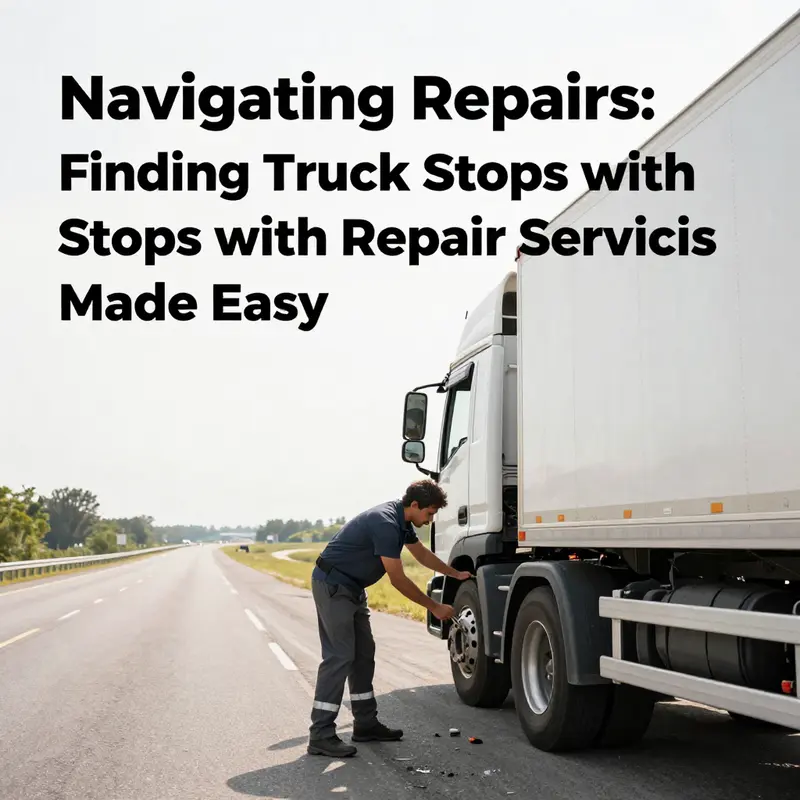
When a heavy rig starts shuddering on a remote highway or stalls near a crowded distribution hub, the first instinct is to move toward the nearest repair facility. Yet in long-haul operations, “nearest” can be a moving target. Roadside assistance providers have evolved from simple tow trucks to a strategic nerve center for uptime. They are not just the backup plan for a broken down truck; they are a proactive, connected network that helps drivers pinpoint repair-capable truck stops, coordinate on-site diagnostics, and line up the right level of repair without unnecessary downtime. Understanding how these providers operate, what to look for in a partner, and how to leverage their capabilities can transform a breakdown from a sudden crisis into a managed, predictable process that keeps goods moving and fleets on schedule.
To appreciate the value of roadside assistance in locating repair-ready truck stops, it helps to picture the landscape of modern commercial-vehicle maintenance. A truly capable provider is not limited to towing. They deploy mobile repair units equipped with hydraulic lifts, diagnostic tools, and in some cases on-board welding capability. They bring trained technicians who understand the peculiarities of heavy-duty engines, transmissions, brake systems, air systems, and the harsh operating conditions that come with heavy loads, long miles, and varied climates. When a driver encounters a failure that cannot be solved with a jump, a simple tire change, or a quick battery replacement, the provider should be able to triage the issue on the spot and decide whether repair is feasible at the roadside or if a controlled tow to a repair-friendly facility is the smarter course. This distinction matters because the difference between a roadside fix and a tow to a distant shop often determines whether a truck will be back on the road that day or sit idle until a repair window opens.
The backbone of effective roadside assistance lies in the combination of experience, network reach, and the right tools. Providers with proven experience in commercial vehicle repair train their technicians specifically for heavy-duty systems. They maintain certifications that are recognized within the industry, and they continually update their skill sets to reflect evolving technologies across diesel engines, emission-control systems, transmissions, and electronic diagnostics. When you look for a partner, you are not just choosing a service; you are selecting an extension of your maintenance department that operates on the road. The best options come with a national or regional footprint. A broad coverage map matters because a driver never really stops traveling the moment they cross a state line. Rural, mountainous, or less-traveled corridors can be particularly unforgiving if there is no nearby repair capability. A network that spans both urban hubs and outlying areas ensures relief is not far away when an incident occurs far from familiar wrenching shops.
One of the most practical advantages of roadside assistance in the context of locating repair-ready truck stops is the integration of mobile diagnostics with dispatch accuracy. When a diagnostic scan reveals a problem that cannot be cleared with a roadside fix, the service can determine the closest stop equipped to handle the repair. They can then route the vehicle, arrange a time window, and provide the driver with a reliable ETA. Real-time GPS tracking on the service vehicle adds another layer of visibility, letting fleet managers monitor progress, adjust routes if necessary, and keep customers informed of expected arrival times. This level of transparency is not just about comfort; it translates directly into operational control. A fleet manager who can see exactly when a technician will arrive can adjust fueling, reloads, or inbound appointments to minimize downstream disruptions.
The decision criteria that steer which provider to engage are practical and grounded in the realities of trucking operations. Experience in commercial vehicle repair is non-negotiable. But beyond the general know-how, look for evidence of specialized training or certifications that speak to heavy-duty maintenance competence. Certification from recognized industry bodies or manufacturer-backed training programs signals that the technicians are not merely familiar with jargon; they are validated specialists who can interpret symptoms, interpret fault codes, and execute field repairs with a disciplined approach. A national or regional network matters too, because a truck that travels across state borders needs support that travels with it. Infrequent or patchy coverage can leave a driver stranded in a location where the nearest shop is miles away, and every mile of delay compounds cost, risk, and driver fatigue.
Another critical factor is the capability to perform meaningful on-site work. A mobile unit with a hydraulic lift and diagnostic equipment can address a surprising share of failures without requiring a tow. The more sophisticated the on-site toolkit, the greater the chance that a troublesome fault can be diagnosed quickly and resolved in the field. This is especially important for issues that stall operation during peak driving windows or in high-demand markets where shops are crowded and parts are scarce. Part supply is not an afterthought; reputable roadside providers often maintain strategic parts inventories or have rapid access to parts through established partners. This reduces the time spent waiting for a replacement component and accelerates the overall repair cycle.
Of course, price transparency matters as much as capability. Fleet operators need to understand upfront what a service will entail, including the type of repair, whether a tow is involved, and the expected labor and parts costs. Ambiguity around pricing is not merely a financial nuisance; it invites disputes and erodes trust in the reliability of the network. The best providers offer clear, upfront pricing for common scenarios, whether it is a flatbed tow, on-site engine diagnostics, brake service, or emergency tire replacement. Some fleets also benefit from subscription-style plans or preferred-partner arrangements that can dampen long-term costs. Transparent pricing supports better decision-making in the heat of an incident and strengthens the relationship between the fleet and the service network.
In addition to immediate repair needs, the value proposition of roadside assistance includes preventive maintenance support. The most forward-looking providers leverage the data generated during breakdowns and repairs to spot recurring issues within a fleet. They can offer digital reporting that tracks fault trends, component wear, and diagnostic history. When a driver encounters a fault, a diagnostic readout can be correlated with a historical pattern to identify persistent problems before they escalate. This proactive approach helps fleets schedule maintenance during windows that minimize downtime, optimize route planning, and extend vehicle life. Integrating this capability with the fleet management system creates a feedback loop: incidents feed maintenance planning, and maintenance insights reduce the likelihood of future disruptions. It is a holistic view of uptime that treats roadside rescue not as a singular event, but as the catalyst for ongoing reliability.
As drivers and fleet managers evaluate whether to rely on roadside assistance to locate repair-friendly truck stops, it is essential to think of the service not as a single service line but as an operating model. The provider should function as a responsive partner who collaborates with local repair facilities, negotiates access when needed, and maintains open channels for communication across the repair continuum. The most effective models embrace technology that connects dispatch, diagnostics, and repair. They provide a way to monitor the status of a rescue mission in real time, send updates, and even approve certain repairs remotely when appropriate. This level of interoperability reduces frictions and aligns the quick response of roadside support with the longer cycle of fixed-location repair. In a world where delays ripple through the supply chain, those extra minutes saved on the road can compound into significant savings in time, fuel, and equipment wear.
For drivers who are uncertain about which route to take after a breakdown, the interplay between roadside assistance and nearby truck stops becomes especially relevant. A good provider will not simply fix the immediate fault; they will help you decide whether it is wise to push toward a repair-capable stop or to wait for a specific service window at a nearby facility. They may have preferred relationships with certain repair stops that are known to handle heavy-duty work with efficiency, proper parts, and quick turnarounds. In practice, this means that a driver and dispatcher can optimize the decision tree in real time: if the field repair is feasible, the truck can be kept on the road with minimal delay; if not, the provider can steer the vehicle toward a facility that is best equipped for the task and that can accept the vehicle within a predictable timeframe. The ability to make these decisions confidently reduces risk, lowers the chance of secondary damage, and preserves precious delivery windows.
A practical approach to integrating roadside assistance into the search for repair-ready truck stops begins with a simple, disciplined workflow. When a fault emerges, the driver should contact the roadside provider and share essential details: exact location, trailer type, load weight, hazard potential, and the symptoms observed. The provider then assesses the situation, communicates an ETA, and explains the likely path—whether it will be on-site repair, a tow, or a guided migration to a nearby stop known for heavy-duty service capabilities. The driver uses this guidance to decide how to proceed, balancing urgency with the reliability of the repair ecosystem in the area. If on-site repair is performed, the driver should request a brief diagnostic summary and a bill-of-work to ensure that the repair is documented for future reference. If a tow becomes necessary, the dispatcher should coordinate with the repair stop in advance, so the facility can prepare bays, technicians, and parts in anticipation of arrival. This level of coordination turns a potentially disruptive event into a finite, controlled process with a defined repair path and an observable outcome.
The technology and logistics of roadside assistance also interact with how truck stops market their repair capabilities. A well-known truth in the industry is that drivers frequently base their routing decisions on the availability of maintenance options along the way. When roadside providers can offer real-time, accurate information about which truck stops are equipped for heavy-duty work and which have spare parts onsite, they effectively expand the driver’s map of reliable repair locations. In turn, repair stops gain visibility as preferred destinations, and fleets learn to value stops that support rapid on-site diagnostics and timely back-to-road service. This ecosystem fosters greater resilience across the trucking network, where a breakdown at one point does not become a long-term obstacle but rather a manageable event with a clearly defined recovery path.
To bring the narrative back to practical steps, consider how a driver can initiate and sustain this approach. First, establish a relationship with a roadside assistance partner that emphasizes heavy-duty capabilities, a broad service radius, and transparent pricing. Second, ensure that dispatch and maintenance teams are aligned on the decision criteria for roadside repair versus tow to a shop. Third, educate drivers on how to collect and relay diagnostic information, including fault codes, unusual noises, and performance anomalies, so the technician can make an informed call quickly. Fourth, when possible, request on-site repairs or a targeted tow to a facility that has a track record for fast turnarounds and quality workmanship. Finally, leverage the integration tools offered by the provider to monitor progress and keep all stakeholders informed, including customers awaiting deliveries and planning teams sequencing reloads and loads.
In the grand scheme, roadside assistance for trucks is not merely about putting a Band-Aid on a breakdown. It is an information-rich, capability-forward ecosystem designed to keep fleets moving through the most challenging conditions. It enables drivers to find repair-capable truck stops with greater confidence, and it gives fleet managers a clearer picture of what it will take to recover from a breakdown and return to service. It aligns the immediacy of roadside repair with the longer-term discipline of preventive maintenance, creating a cycle of learning and improvement. And it does so with technology that makes every step traceable, accountable, and measurable—a critical advantage in an industry where margins, uptime, and safety depend on predictable performance. In short, leveraging roadside assistance providers is an investment in uptime intelligence as much as in emergency response.
For a deeper dive into uptime strategies and product support beyond roadside encounters, you can explore further insights here: unlocking truck uptime and essential product support secrets.
As you think through your own operation, keep in mind that the objective is not simply to survive the next breakdown but to shorten the window between problem detection and road-ready repair. The right roadside partner helps you do that by turning a potentially weak link in the supply chain into a controlled, well-managed event. When drivers have a trusted network that can diagnose, triage, and route repairs efficiently, the experience of breakdowns becomes less about fear of the unknown and more about confidence in the available options. The result is not only faster recoveries but better maintenance planning, smarter dispatch decisions, and a more resilient trucking operation overall.
External reference for broader context on roadside assistance for trucks: https://www.trucking.org/resources/roadside-assistance-for-trucks
Crowd-Wisdom on the Road: How Fellow Drivers Point You to Dependable Truck Repair Stops
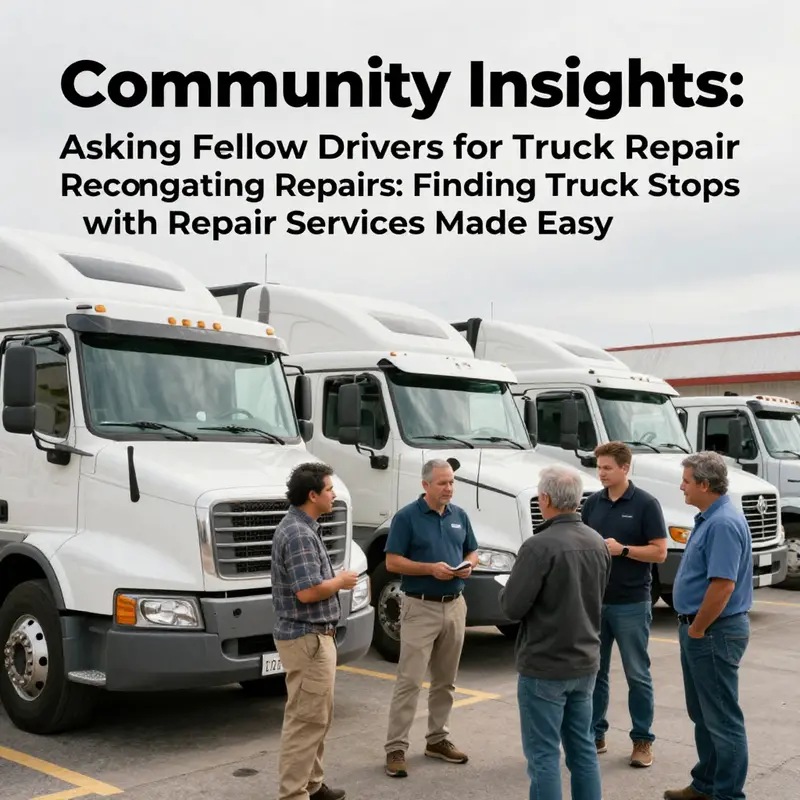
When a tractor-trailer rolls into a stretch of highway that looks darker than the dashboard lights at night, the short, practical truth becomes clear: you don’t want to gamble on a repair facility. You want a place that has earned the trust of real operators who feel the weight of downtime in their paychecks and schedules. The most reliable compass in that search isn’t a glossy advertisement or a perfectly mapped pin; it’s the lived experience of other drivers who have faced the same miles, the same tight timetables, and the same unforgiving weather. In this sense, the route to dependable truck repair stops is less a solo quest and more a conversation—carried on by the communities that the road itself has fostered. Community insights, gathered at a truck stop, a rest area, or an online forum, become a map that translates anecdote into actionable clarity. And because the road changes with every mile, those insights are especially valuable when they are current, specific, and grounded in the realities of long-haul operations.
One of the most immediate benefits of tapping driver networks is the immediacy of practical judgment. When someone you pass at a fuel island or a loading dock tells you about a shop that handled a stubborn brake problem in three hours with a transparent bill, that story carries weight. It’s the difference between hearing about a place in theory and hearing about it in the pressure cooker of a breakdown scenario. Fellow drivers bring a context that online listings often miss: the pace of the work, the shop’s ability to triage, the way technicians communicate when a truck is not a weekend toy but a business lifeline, and whether the shop is equipped to handle the uncertain quirks of a wide range of makes and models. They know what it feels like to wait for parts that aren’t in stock at a moment’s notice, and they observe how a shop manages a hold times, the readiness of a tow, and the fairness of a diagnostic charge when the problem is ambiguous.
The very architecture of trucking culture supports this transfer of knowledge. Drivers form a mobile, open network that thrives on sharing hard-earned lessons. You might encounter peers in a truck stop cycle of chatter—the kind of organic conversation that happens while the engine warms in the pre-dawn hush or while a line of rigs snakes toward the fuel pumps in the late afternoon glare. More and more, those exchanges spill into digital arenas where threads crawl with detail: the shop’s specialization for certain systems, whether the technicians can work on trailers as well as tractors, and whether the crew offers a mobile option when a lie-down repair is a better use of a driver’s time than a full shop visit. These narratives—the balance of speed, price, and trust—become a living repository you can consult when the next breakdown lands on your doorstep miles from the nearest major city.
The value of peer recommendations grows when you start to map your own needs against the responses you hear. For example, a long-distance driver who regularly hauls heavier payloads will place different demands on a repair stop than someone who handles lighter loads and shorter hauls. The experienced driver knows to ask about turnaround times in the middle of the night, or how a shop handles after-hours emergencies when the clock is your only silent partner. They also understand the importance of a shop’s competency with multiple systems and how that translates into downtime. When a driver explains that a particular shop communicates clearly about the problem, provides a realistic prognosis, and offers options—whether it’s a full repair, a temporary fix, or a mobile service—that driver is speaking to operational reliability, not just a one-off repair experience.
Beyond personal anecdotes, there is a growing practice of documenting repair experiences in public forums and discussion boards that are oriented to the trucking life. Websites that host long-running threads of driver reviews often include granular details that go far beyond what you’d find in a five-star rating on a consumer review site. Posts may recount the exact sequence of events, show photos of the work in progress, present a transparent cost breakdown, and offer post-repair follow-up notes months later. This level of transparency—photos, timings, and updates—transforms a single visit into a data point you can analyze in aggregate with similar anecdotes. It helps you gauge consistency: does the shop deliver reliable results across different problems, or does it shine only in particular situations? When your own vehicle experiences a complex fault that could involve multiple subsystems, having access to a chorus of driver experiences reduces the sense of risk that often accompanies a repair decision.
An important facet of relying on community-driven recommendations is recognizing the nuance in the information you receive. Not all stories are equally applicable to your situation. A shop that excels with a certain class of heavy-duty equipment might be less effective for a different configuration, or a facility with a strong front-desk rapport might still fall short on technical depth. A driver who values quick communication may prioritize a shop that replies to calls and messages promptly, while another driver may place higher importance on a shop’s diagnostic thoroughness, even if the initial estimate is higher. The beauty of community wisdom is that you can triangulate these preferences. If several drivers converge on one shop for being fast, reasonably priced, and transparent about the work, you gain a strong signal. If multiple drivers warn about hidden fees or about unclear warranty terms, you have a warning that deserves attention before you commit resources.
To turn these insights into practical decisions, it helps to approach the process with a structured but flexible mindset. Start by identifying your immediate needs: is this a simple fix that can be performed quickly, or a more involved repair that requires specialized equipment and parts? If you suspect a complex failure, ask peers about the shop’s capability to diagnose and sequence repairs in a way that minimizes total downtime. In conversations with fellow drivers, seek specifics rather than generalities: what model, what fault code or symptom, how long the repair took, who performed it, and what the bill looked like. You can then compare those specifics to your own truck’s configuration and the expected downtime you can tolerate. This is where the practical art of listening comes into play. You might hear a robust narrative about a shop that has reliable diagnostic practices and respectful staff, and a separate story about another shop that is aggressive with estimates but shows the work quality to back it up. Weigh these signals against your own constraints and risk tolerance.
The online ecosystem surrounding trucking also invites you to cross-validate across sources. In a well-rounded approach, a driver might blend a live conversation with a rest-area peer, a quick search on a route-planning app, and a check of a regional forum thread known for candid, detailed reviews. The advantage of this triangulation is that it not only broadens your pool of potential repair stops but also helps you avoid the pitfalls of a single promotional narrative. It’s easy to be drawn to a shop that appears prominently in search results, yet a chorus of voices that confirms or rebuts that visibility provides far more resilience in decision-making. If you encounter conflicting information, the prudent move is to pick up the phone or send a message to confirm hours, capacity, and whether the shop can accommodate your schedule. A good operator will appreciate being engaged and will respond with clear, concrete details rather than vague assurances.
For drivers who want to deepen their reliance on community wisdom, there is value in documenting your own repair experiences and sharing the outcomes with the network. When you post about a repair, include the truck’s make and model, the nature of the failure, the shop’s diagnostic approach, the time to repair, the personnel involved, and a transparent breakdown of costs. This guidance is not just about your personal benefit; it becomes a reference for peers who will face similar decisions in the future. It can also encourage shops to uphold higher standards when they see that their workmanship will be visible to a broad, informed audience. In this way, the road becomes a feedback loop, where the practices of a few good shops improve through accountability and the appreciation of the many drivers who rely on their services.
In practice, a driver who appreciates the value of community recommendations will adopt a simple, repeatable protocol. At the first hint of trouble, they engage the network by asking targeted questions and sharing their truck’s configuration and the symptoms they observe. They then cross-check the information against up-to-date maps and roadside assistance resources to identify a short list of candidate facilities. If possible, they call ahead to verify hours, parts availability, and the potential need for a tow. They weigh the advice they receive against their own route constraints, the severity of the fault, and the potential downtime. Finally, they plan a contingency: what if the first shop can’t meet the expected turnaround? What other options exist along the route that could keep the load moving, or at least minimize downtime?
The practice of seeking guidance from fellow drivers also circles back to the fundamental realities of highway life: reliability and safety. A repair stop that earns widespread peer trust tends to be one where safety concerns are treated with seriousness, where technicians communicate clearly about what is found and what must be done, and where the parts and labor credentials align with the expectations of professional drivers. In the end, the aim is not merely to fix the problem but to restore confidence—confidence that the truck will perform safely on the next leg of the journey, and that the business of moving goods will proceed with as little disruption as possible. Peer recommendations help you reach that objective by translating the tacit knowledge of day-to-day operations into actionable guidance you can apply across diverse routes and seasons. It is this community-driven approach that often makes the difference between a delay that costs money and a delay that becomes a manageable, unstoppable piece of the long-haul rhythm.
To further explore how communities shape repair decisions on the road, many drivers turn to dedicated online spaces where veterans share detailed narratives. These discussions can illuminate not only which shops tend to maintain a higher standard but also how a shop handles the logistics of a repair, such as coordinating with parts suppliers, prioritizing fleet customers, or accommodating urgent requests when the schedule is razor-thin. The richness of these conversations lies in their specificity: the tone of the communication, the clarity of the explanations, and the honesty about what went well and what didn’t. They teach newer drivers to listen more than they speak, to ask sharper questions, and to approach every decision with a palate refined by experience. In this way, community insights become a continuous education that travels with the driver, until, one day, you are the seasoned voice offering guidance to the next new arrival on the highway.
For those who want to see how such communities crystallize in written form, a robust resource is the collective knowledge shared by drivers in long-running forums. Experiences are archived, threads are updated with new information, and the conversation persists even as roads change and repair shops evolve. The ability to read through a trail of outcomes—what a certain shop did, how quickly the issue was resolved, what the final price looked like, and whether the vehicle remained on the road after months of evaluation—gives you a form of due diligence that is seldom found in a simple directory listing. This is the practical, not just the aspirational, value of community-based recommendations. It is a reminder that, while technology can guide you to a location, it is the human network that validates the decision and reduces the risk of downtime when every mile matters.
In sum, the most reliable way to discover truck stops that offer repair services is to treat the road as a living classroom and to participate in the conversations that happen there. Let peers be your scouts, not your sole authority. Let their experiences become data points that you interpret with your own route, your own constraints, and your own operational priorities. And let online communities serve as a persistent, searchable archive of practical wisdom, where stories about turnarounds and transparent billing become the shared knowledge that keeps you moving. When you blend real-time conversations with up-to-date map checks and a firm understanding of your own truck’s needs, you emerge from a breakdown not a roadside calamity but a navigated challenge—a challenge met with the confidence that comes from the trucker community that stands behind you.
For drivers seeking more structured, community-driven perspectives on repair and maintenance strategies, the ongoing conversations within industry forums and blogs offer a treasure trove of practical guidance. A resource that captures the spirit of this collective wisdom, and that specifically emphasizes the value of peer recommendations, is the 5Star Truck In community blog, which aggregates insights about maintenance and service quality in a way that complements real-world road conversations. You can explore those thoughts at 5startruckin.com/blog/.
If you want to broaden your understanding of how these conversations translate into action on the ground, consider the following approach as you plan your next route: cultivate a mental shortlist of repair stops that you hear described as reliable, verify their 24/7 or off-hours capabilities, evaluate whether they can handle the range of systems you depend on, and remember to factor in the potential downtime of each option. Then, as you traverse your route, collect fresh observations from the road about how those facilities perform under different conditions, and add your own notes to the growing collective knowledge. The road rewards those who listen closely, ask thoughtful questions, and share honest outcomes. In this way, you contribute to a living network that keeps every driver safer, every load more certain, and every mile more predictable.
External resource: For a broader perspective on community-driven repairs and peer recommendations within the trucking world, you can explore discussions and user experiences at TruckersReport forums: https://www.truckersreport.com/forums
Mapping the Road to Reliable Repairs: Using Local Platforms to Find Truck Stops with On‑Site Repair
A truck is a mobile workspace, a route between warehouses, and a portfolio of assets that must stay healthy to keep deadlines. In that sense, the security of a dependable repair stop becomes as crucial as fuel, tolls, or rest. The modern driver does not rely on chance signs along the highway alone. Instead, a layered search uses local platforms and crowd-sourced feedback to identify shops that can handle heavy-duty maintenance, provide timely service, and prove their reliability under pressure. This approach starts with the same logical premise you use to plan a cross-country route: survey the landscape with broad, crowd-sourced data and then narrow to precise details that matter in a maintenance moment. Local platforms, those digital marketplaces and community listings that aggregate repair shops, can be your first filter. They present a pool of nearby providers, each with basic information such as location, hours, and contact methods, plus a chorus of user reviews. For long-haul drivers facing a potential breakdown far from the nearest dealer network, that pool is not a luxury—it is a safety feature. It transforms a moment of stress into a decision made from data rather than impressions.
One of the key benefits of these platforms is transparency. A reputable listing will show not only the address and phone number but also the breadth of services offered. A shop that can handle heavy-duty vehicle maintenance, brake systems, electrical diagnostics, and turbo or engine faults is more valuable than a general auto shop that only handles light-duty work. The richness of information becomes more important when you are away from familiar networks. A well-populated listing might include service descriptions, the types of trucks they service, pictures of the bays or equipment, and even posted hours for emergency or after-hours work. The presence of such details signals that the shop regularly documents its capabilities and communicates with customers, which in turn reduces the number of unknowns when you reach out.
In practice, these platforms function as a broad net. You start by searching for phrases that align with your needs—terms like large truck repair, heavy-duty vehicle service, or other regional equivalents. The search results surface a mix of independent shops, small chains, and sometimes dealer-authorized service centers. This mix is not a flaw; it is a strength if you know how to triangulate. A single shop might be excellent at brake work but less reliable on electronic diagnostics. Another might charge a premium for OEM parts but have the capacity to work on a wide range of heavy-duty rigs. The power of the local platform lies in its ability to show you who is nearby and what their customers say. Reading through reviews provides a practical barometer of reliability, consistency, and customer service. Reviews written by other long-haul drivers can reveal patterns—consistent on-time delivery of promised repairs, clear communication about costs, or frequent delays during certain shifts. The social proof embedded in these reviews is one of the most persuasive signals you will encounter when deciding where to stop.
Yet the platform alone cannot guarantee that a shop will meet your immediate needs. The next step is to cross-check with navigation or mapping services that deliver real-time location data, distance, and sometimes live status updates. While you may not want to name specific products here, think of these tools as regional maps that help you validate proximity and travel time. A shop listed on a local platform will often also show up on a mapping service with the route, estimated drive time, and hours. The value of this cross-check is twofold. First, it confirms that the shop is still open when you arrive, which is critical given the unpredictable nature of road delays. Second, it helps you assess whether your chosen stop can realistically accommodate a specific emergency—does it have a large enough bay, a layout to fit a long rig, or a lift capable of the weight you carry? The last thing you want is a mismatch between your truck’s needs and a shop’s capacity after you’ve committed to heading there in heavy traffic or in a tight schedule window.
In this cross-platform workflow, the emphasis shifts from the sign in the window to the signal in the data. You might see a shop with a handful of positive reviews and a strong proximity ranking, but you should still confirm that they maintain stock for heavy-truck parts and have process steps for quick diagnostics. A practical signal is whether the shop lists the ability to diagnose and repair common heavy-duty failures, rather than simply “custom services.” The listings should also show enough contact detail to verify operational hours with a quick call or text. A phone number, a contact person, and an estimate window can save you from wandering into a shop that cannot begin work for several hours.
Where the local platform shines is not just in listing breadth but in the density of peer feedback. For a driver who needs to decide fast, reading between the lines of a review is often more valuable than the review star rating alone. Look for comments about communication during the diagnosis phase, whether the shop provided a clear, itemized estimate, and if they explained what parts would be used and why. The most helpful reviewers mention the presence of a clear warranty policy or guarantee for labor and parts. In the context of heavy-duty maintenance, a review that notes a shop uses appropriate equipment for the truck’s weight and dimensions is a strong indicator of reliability. You do not want a shop that claims to do everything but does not have the right hoists, alignment tools, or diagnostic scanners to handle your rig.
As a driver, you will also want to assess whether the facility’s service catalog aligns with the typical needs of your route. Some shops specialize in certain systems—brakes, transmissions, or electrical diagnostics—while others market a broad suite of heavy-duty services. A local platform can reveal this through service tags or the usage of industry terms in the listing. If a shop advertises a wide range of services but lacks photos of dedicated bays, a lift capable of 18-wheelers, or any evidence of heavy-duty equipment, that misalignment should raise a caution flag. Again, the pattern in the data matters more than any single data point. A cluster of positive notes about timely communication, accurate estimates, and successful same-day repairs, paired with visible equipment and proper hours, signals a well-rounded operation.
Another layer to consider is the role of manufacturer or dealer networks, which can offer authorized service centers that guarantee trained technicians and genuine parts. While these may not always be the closest option, they often provide important assurances for certain maintenance tasks or warranties. The key is to treat this as a distinct path, one you would pursue in parallel with independent shops discovered through local platforms. The search becomes a matter of balancing proximity, capabilities, and trust. In the same breath, you should not overlook the potential of smaller, well-rated shops that have carved out a niche for heavy-duty work in specific regions. The combination of a broad marketplace and targeted local expertise increases the odds of finding a shop that can handle your truck without compelling you to alter your route or schedule dramatically.
If you want to deepen your understanding of how professionals approach maintenance in a structured way, you can consult related resources that frame the discipline of regular upkeep and service. For example, consider resources that discuss maintenance service training and its impact on uptime. Fire Truck Maintenance Service Training offers a lens into how technicians approach routine checks, critical diagnostics, and planned maintenance cycles. Reading this kind of material can sharpen your eye for the signals you look for in a local listing: a shop that consistently outlines a maintenance plan, references a structured diagnostic approach, and demonstrates ongoing technician development is more likely to deliver reliable results when the clock is ticking. This is not a guarantee, but it is a practical signal that the shop takes maintenance seriously and understands vehicle uptime as part of the service equation.
In the end, the process of finding a truck stop with repair services through local platforms is about assembling a mosaic of signals. The mosaic begins with breadth—lots of listings, each with a few critical data elements. It advances through depth—checking proximity, hours, and equipment. It matures with social proof—reviews that reveal how the shop handles real-world pressures, from unexpected breakdowns to the management of parts and labor. And it is reinforced by cross-checking with mapping data and, when possible, brand networks that can lend an additional layer of assurance. The result is a practical, adaptable approach that mirrors how drivers plan journeys: assemble information, verify critical details, and prepare a contingency plan before you reach a point of crisis.
The approach I’ve described is deliberately practical and scalable. It works whether you’re driving through a familiar corridor or navigating a region you rarely visit. It also scales with your fleet’s needs. A single truck’s schedule might hinge on a fast, local repair with quick turnaround, while a fleet operator may require a more formal evaluation of multiple shops, contracts, and service levels. In both cases, your aim is to maximize uptime and minimize the risk of getting stuck in a location without the right tools or expertise. By leveraging local platforms, you gain access to a living map of service providers, powered by the experiences of other drivers and supplemented by the practical realities of the shops themselves. The road becomes less uncertain when the search for repair services is anchored in data, community insights, and cross-verified information rather than chance encounters along the highway.
To close the loop on this chapter while remaining integrated with the broader article, a succinct practice is to treat each search as a two-act process: discovery and verification. Discovery is the broad pull of listings from local platforms and the initial evaluation of service breadth. Verification is the on‑the‑ground confirmation—calling ahead, confirming hours, and ensuring the shop can handle your truck’s exact configuration. This two-act pattern reduces wasted miles and unexpected downtime. And if you want a practical example of how maintenance-focused resources can inform on-the-road decisions, remember that the objective is not to replace your judgment with a single source of truth but to enrich your judgment with diverse signals.
External resource: Find nearby truck repair shops on 58.com (https://www.58.com/).
Final thoughts
Finding truck stops that offer repair services is key for truck drivers and fleet managers to ensure operational continuity. By using modern navigation tools, leveraging roadside assistance, tapping into community wisdom, and exploring local business directories, drivers can make informed decisions during unplanned stops. Always be proactive about knowing your options on the road; it could save you significant time and hassle. Stay safe and keep your wheels turning.