
Understanding whether your service utility truck needs a California DOT sticker is crucial for legal compliance and operational efficiency. This necessity particularly affects those in commercial sectors such as long-haul trucking, fleet management, and maintenance services. As we navigate through the intricacies of California’s regulations, we will dissect the importance of the California DOT sticker, clarify the definitions of commercial use, and outline the steps to secure one. Each chapter builds upon the previous sections, ensuring you are equipped with all the relevant information to make informed decisions.
Does My California Service Utility Truck Need a DOT Sticker?
Many California service utility trucks operate as light-duty commercial vehicles, and whether they require a DOT sticker depends on classification and use. In California, the DOT sticker is tied to certain types of commercial transportation and heavier vehicles, not automatically required for every service truck. A general guideline is that if the vehicle’s GVWR is under 10,000 pounds, a DOT sticker is unlikely to be required solely because the vehicle is used for local service work. However, weight is only one factor, and the vehicle’s equipment and how it’s used on public roads matter too.
If your truck has fixed heavy equipment such as a hydraulic lift, crane, or other substantial modifications, or if it is used to transport goods or passengers for hire, the classification can shift and additional requirements may apply. Local jurisdictions or the California DMV may require inspections, permits, or markings beyond a sticker, especially for specialized construction or contractor fleets. The safest approach is to verify with the DMV using your VIN and review the official vehicle classification guidance.
Practical steps:
- Check your GVWR on the vehicle’s label or in the owner’s manual.
- Talk to the DMV about class and any needed permits or markings.
- Ensure compliant equipment installation, inspections, and proper labeling where required by contract or project specs.
- Remember that even if a DOT sticker is not required, other rules about lighting, brakes, and periodic inspections still apply based on vehicle class.
For definitive guidance, consult the California DMV vehicle classification page: https://www.dmv.ca.gov/portal/vr/vehicle-classification/
Decoding California’s DOT Sticker Rule: How State Regulations Shape Your Service Utility Truck’s Registration and Compliance
When you ask whether your service utility truck needs a California DOT sticker, you’re really asking how California’s rules define a commercial vehicle, and what markings, registrations, and inspections come with that designation. The simple answer is not a blanket yes or no. California uses a layered framework where weight, use, and operating scope intersect to determine regulatory obligations. This layered approach means a truck that looks ordinary on the street could fall under commercial vehicle rules in some contexts, while a lighter, specialized vehicle might ride outside those obligations in others. The practical takeaway is to start with the fundamentals: GVWR, how the truck is used, and whether it operates across state lines or within the state for ongoing business tasks. Then you can navigate the rest of the requirements with a clearer map rather than a rush to compliance or a rush to exemption that doesn’t actually exist for your case.
The hinge point is the Gross Vehicle Weight Rating, or GVWR. In California, a vehicle that has a GVWR exceeding 10,000 pounds is generally classified as a “commercial vehicle.” This threshold matters because it signals to state authorities that the vehicle is part of commercial operations and should align with the broader regulatory framework for safety, maintenance, and registration. It’s worth noting that GVWR is a rating defined by the vehicle’s manufacturer, not the weight you happen to load onto the truck on a given day. A service utility truck can carry a heavy payload or equipment and still have a GVWR that sits just above or below that threshold, and the distinction can change the regulatory path you pursue. Because the line can be subtle, the first step is to locate the GVWR label on the vehicle—usually found on the door jamb or within the owner’s manual—and verify whether the rating pushes the truck into the commercial-class category in California terms. If you’re unsure, a quick inquiry with the California DMV is the most reliable way to verify how the GVWR translates to your specific truck’s regulatory status.
Beyond GVWR, the vehicle’s use matters a great deal. If your service crew uses the truck for interstate transportation of goods or passengers, or if the vehicle participates in regular commercial operations—such as moving tools, equipment, or crew between work sites—California treats it as operating under commercial regulations. The presence of a commerce-driven mission, even if the vehicle is owned by a small business or an individual, can trigger more stringent requirements. This isn’t a case of a one-size-fits-all sticker mandate. California’s approach emphasizes alignment with safety and accountability standards that reflect real-use scenarios. In practice, this means that a utility truck used to service multiple sites, carry heavy equipment, or shuttle personnel between sites can be viewed as a commercial operation, with corresponding regulatory markings and registrations tied to the commercial vehicle designation. Conversely, a light, non-commercial vehicle that is occasionally used for tasks like office errands would not automatically cross into the same regulatory space, even if the vehicle is part of a field crew’s daily routine.
Another layer to consider is the state’s nuanced relationship with federal rules. The federal Department of Transportation governs many trucking matters, but California has its own enforcement landscape, including the California Highway Patrol (CHP) and the state’s Public Utilities Commission (CPUC) in certain contexts. Some vehicles—particularly those carrying hazardous materials or operating under specialized service conditions—may require additional markings or certifications. It’s important to recognize that California does not universally mandate a generic “DOT sticker” for all commercial vehicles. Instead, the state assesses the need for state-level markings or other certifications based on vehicle class, usage, and regulatory scope. This nuance can be confusing if you are trying to simplify compliance into a single sticker on the bumper. The reality is that the sticker or markings, when required, function as a visible signal of compliance with California’s regulatory environment, and they exist within a broader ecosystem of permits, registrations, and inspections that keep commercial fleets operating in a regulated space.
The inspection regime is another critical piece of the compliance puzzle. California requires annual safety inspections for commercial vehicles, and these checks are often coordinated through CHP or state safety programs. Even if your truck carries a sticker, it will be subject to inspection to verify overall roadworthiness, brake efficiency, lighting, tires, emissions, and other safety parameters. A vehicle that fails inspection cannot legally operate, regardless of whether a sticker is displayed. This means that compliance is not a matter of a one-time registration or marking; it is an ongoing process of maintenance, inspection, and potential renewal. The practical implication for a service operation is straightforward: you must schedule and complete regular checks, keep thorough maintenance records, and ensure that any corrective actions identified by inspectors are promptly addressed. Neglecting the inspection cadence can nullify the value of any sticker or registration and can expose the operator to penalties or operational downtime.
With these layers in mind, the steps to determine your truck’s status become clearer. Start by confirming the GVWR from the vehicle datasheet and the door jamb label. Then articulate how the truck is used most days: does it shuttle crews, haul heavy equipment, or transport tools across multiple sites within California? Is there any interstate travel, or does the vehicle operate solely within the state? If the answer points toward commercial operations, you should expect that California’s regulatory regime will apply more closely, and you may encounter state-level markings or a corresponding certification requirement. It’s also wise to consider your fleet’s long-term trajectory. If you anticipate adding heavier equipment, expanding service areas, or increasing cross-state travel, your regulatory profile could shift, potentially triggering more formal compliance steps than you originally anticipated.
In practical terms, this means engaging with the California DMV and CHP in a proactive way. The DMV’s commercial vehicle guidance lays out the various definitions, registrations, and compliance standards that apply to commercial fleets. Reading that material becomes less of a legal formality and more of a practical map that helps fleet managers determine whether a sticker is appropriate, or whether other markings or permits are required. And because California’s framework can hinge on weight thresholds and use cases that vary from one vehicle to the next, it’s common for a fleet manager to request a tailored consultation. A phone call or written inquiry to the DMV can reveal vehicle-specific guidance that is not always apparent from a generic overview. The goal is to avoid surprises during inspections and to ensure that every vehicle in the fleet remains compliant as it changes over time.
In addition to the technical checks, there is a cultural and operational dimension to compliance. Fleet managers who adopt a proactive, documentation-heavy approach tend to navigate these regulatory waters more smoothly. This includes keeping up-to-date registration records, ensuring that plates and registrations align with the vehicle’s use, and maintaining a clear file of the decisions made about each vehicle’s classification. If your operation evolves—from a small, single-vehicle setup to a larger fleet that routinely crosses state lines—the regulatory demands increase correspondingly. In such cases, the sticker, if required, functions not only as a box to check but as a visible commitment to regulatory accountability that can streamline interactions with inspectors, customers, and partner organizations.
The broader implication for service fleets is that the California regulatory environment rewards clarity. When you can articulate precisely how a vehicle is used, what it transports, and where it travels, you are better positioned to determine whether a DOT sticker or equivalent state markings are needed. In this regard, the issue is less about chasing a sticker and more about building a compliant operating model. For many fleets, the distinction lies in the weight-sensitive threshold and the use profile. If your truck’s GVWR sits around the 10,000-pound threshold or if it regularly carries heavy equipment and travels between sites, a formal designation as a commercial vehicle with associated markings may be prudent. If, however, your truck stays within a narrow service radius, carries lighter loads, and remains within the state’s borders with a limited or non-commercial use, the sticker question might resolve differently—and perhaps not at all. The DMV page dedicated to commercial vehicles is a reliable starting point for a careful assessment, offering definitions, registration pathways, and compliance standards that reflect California’s careful balancing of safety, efficiency, and industry needs.
Beyond the regulatory mechanics, consider the practical implications for your operations. A clear understanding of whether your truck requires markings changes how you structure maintenance schedules, how you document inspections, and how you communicate with customers and regulators about fleet capabilities. It also informs decisions about insurance, driver qualifications, and route planning. If you decide a DOT sticker or state-level marking is appropriate, you will want to align internal processes—vehicle inspections, maintenance records, and registration renewals—with the required cadence. The cost of compliance, including potential annual inspection fees or plate renewals, should be weighed against the benefits of avoiding penalties, ensuring roadworthiness, and maintaining uninterrupted service delivery.
As you navigate these questions, remember that the core goal is not to chase the sticker for its own sake but to build a compliant, predictable operating environment for your service fleet. The California DMV’s resources, along with CHP guidance, provide the authoritative baseline for understanding when a vehicle qualifies as commercial and what markings, if any, are needed. In practice, this means taking a methodical approach: verify GVWR, assess use, check for interstate travel, review any industry-specific considerations, and then reach out to the DMV or CHP for a definitive determination tailored to your exact vehicle model and operating plan. This approach protects your fleet from avoidable downtime and helps ensure that your service commitments are delivered with both reliability and regulatory confidence.
For readers who want a consolidated reference as they work through this decision, consider tapping into broader fleet safety perspectives available in industry-focused resources. For example, you can explore more on fleet considerations and safety best practices at the following resource: 5startruckin.com/blog/. This internal link is intended to provide additional context on fleet maintenance planning, regulatory awareness, and proactive safety culture that complements the regulatory decision about stickers and markings. It is not a substitute for formal regulatory advice, but it can help frame how a compliant fleet operates within the realities of daily field work. In parallel, you should keep the official guidance in view. For authoritative, state-specific requirements, the California DMV’s Commercial Vehicles page is the go-to reference. The page outlines the definitions, registration requirements, and compliance standards that determine how a given vehicle is classified and what visible markings, if any, are required at the point of operation. Taken together, these resources give you a practical, grounded approach to deciding whether the service utility truck in your fleet should bear a California DOT sticker while avoiding unnecessary administrative friction.
External resource for authoritative guidance: California DMV – Commercial Vehicles. This page provides detailed descriptions of California’s definitions, registration requirements, and compliance standards for commercial vehicles, making it the most authoritative English source for assessing whether regulatory markings (including a DOT sticker) are required. https://dmv.ca.gov/portal/dmv/detail/vr/commercial_vehicles/
Reading the Road Ahead: Navigating California DOT Sticker Requirements for Your Service Utility Truck
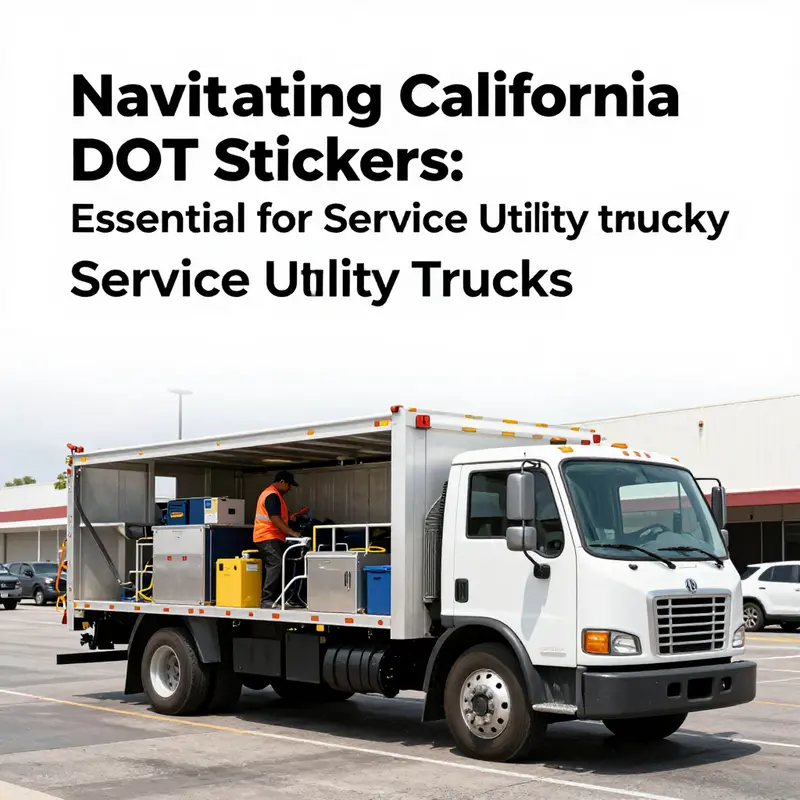
A service utility truck sits outside a shop at dawn, knuckles of rusted metal catching the first light as a supervisor runs through a checklist that blends practicality with regulatory sense. The truck is built to haul gear, crawl over uneven ground, and power through a workday that may include climbing hills, threading through traffic, and delivering a repair crew to the next outage or service call. For someone responsible for that vehicle, the question isn’t only about where to park it or how to refuel it. It’s about whether the job-site footprints the truck leaves in the state of California trigger a particular compliance regime—specifically, the California Department of Transportation sticker that signals the vehicle’s status as a commercial operator under state rules. The answer, in broad strokes, is that many service utility trucks used for commercial purposes within California do indeed require a DOT-related sticker, but the details hinge on how the truck is used and how much it weighs. The chain from usage to sticker is not simply a matter of intent; it is a set of regulatory touchpoints that connect registration, safety, and interstate as well as intrastate operation into a single, practical framework. This is not an arcane bureaucracy designed to trip up fleet managers. It is a supply-chain safeguard that helps ensure that vehicles involved in essential services—whether repairing power lines, maintaining water systems, or delivering critical equipment—are operating under a standard that the state can monitor, enforce, and improve over time. To understand where your own service utility truck fits, it helps to start with a clear picture of what a utility truck is in this context, how California classifies commercial use, and what the sticker represents in the broader ecosystem of vehicle regulation. A utility truck, in this sense, is a work-focused vehicle designed to carry tools and equipment for on-site service tasks. Its open-back, low-sided design is meant to maximize accessibility to gear, while its rugged chassis and tires are intended to handle rough terrain and uneven surfaces typical of field operations. This combination of features makes the vehicle highly functional for repairs, installations, and emergency responses, but it also makes it more likely to fall under regulations that assume the vehicle will be used for business purposes rather than personal transportation. In California, that commercial use status is the hinge on which the door to regulatory compliance swings. The state’s approach to commercial vehicles is not a one-size-fits-all regime. It blends vehicle weight, use, and operator status into a framework that can require additional registrations, higher levels of safety scrutiny, and, in many cases, a sticker that signals to authorities and customers alike that the vehicle is part of a regulated commercial fleet rather than a private, personal ride. The practical upshot for the manager or owner of a service utility truck is straightforward on the surface but nuanced in practice: if the truck is used for paid services, if it transports equipment or personnel for business purposes, or if it operates under a business license, it will commonly be treated as a commercial vehicle. That designation can bring responsibilities that extend beyond the basic registration you may already perform for a private vehicle. In California, registration is the anchor of compliance. The DMV expects that vehicles used for commercial activity follow precise registration steps, and that if the vehicle qualifies as a commercial motor vehicle, additional layers of regulation come into play. The phrase “commercial motor vehicle” may trigger extra requirements, including but not limited to weight-based classifications, vehicle inspections, and specialized stickers or markings. The question then becomes whether your utility truck crosses a critical weight boundary that makes it a candidate for the Caltrans or DMV’s commercial vehicle framework. The determinant weight is often tied to the Gross Vehicle Weight Rating, GVWR, a label that aggregates the vehicle’s maximum permissible weight when fully loaded, including fuel, passengers, cargo, and equipment. When a vehicle’s GVWR surpasses a particular threshold—California’s context commonly involves a criterion around 10,000 pounds—the likelihood of a commercial classification increases. This threshold is not an absolute barrier; rather, it is a guiding line that helps allocate attention to compliance items that may otherwise be overlooked for lighter personal-use vehicles. The practical workflow becomes a matter of verification: is the truck’s use genuinely commercial, does the GVWR push the vehicle into a higher regulatory tier, and what do the DMV and Caltrans guidelines say about required stickers or registrations for CMVs in that tier? The DMV’s own resources provide a clear starting point: they outline what qualifies as vehicle registration for commercial use and where to find the official requirements for commercial vehicle registration and related stickers. If your truck serves positions within a utility fleet—whether employed by a business or individually owned but used for business tasks—the need for registration and sticker compliance becomes a real consideration. The decision tree is not a long maze but a sequence of practical checks. First, confirm whether the truck is used for any form of commerce. If the work you do depends on a paid service, a contract, or a business operation that requires you to move equipment, deliver parts, or transport crew members to job sites, that is a strong signal of commercial use. Second, verify the GVWR on the vehicle specification plate and in the vehicle’s documentation. If the GVWR exceeds 10,000 pounds, the likelihood of needing additional compliance steps rises. Third, consult official state resources—most directly the California DMV and its commercial vehicle information pages—to confirm the current stance on stickers or registrations tied to CMVs in your category. The state’s guidance is clear that commercial-use vehicles are subject to more robust regulatory oversight, not merely for registration but for ensuring ongoing safety compliance, roadworthiness, and accountability in operation. This is the point where the practical path diverges from assumption. A truck that looks like a standard pickup might still be a CMV by operation if it routinely carries heavy equipment, serves commercial clients, and travels to job sites as part of a service contract. Conversely, a heavier truck parked in a private driveway could avoid the sticker regime if it is used only for noncommercial activities and remains outside the defined commercial-use envelope. The key is to map use against regulatory criteria rather than relying on a lay interpretation of “work truck” or “utility vehicle.” As managers or operators move through this evaluation, the decision to pursue or defer the sticker becomes a matter of risk management and planning. If the truck falls under the CMV umbrella, the stickers and related compliance measures ensure that the vehicle is not only properly registered but also aligned with safety and regulatory expectations. The DMV’s vehicle registration pages emphasize that registration and licensing are the backbone of this compliance system. They also point to the existence of a separate track for commercial vehicle registration and related stickers, a track that is designed to handle fleets and vehicles that participate in commercial operations. The nuance here is that the sticker—often referred to in practical terms as a Caltrans or DOT-related marking—acts as both a signal of compliance and a tool for oversight. It informs inspectors and authorities about a vehicle’s status, which in turn influences how inspections are conducted, what safety checks may be required, and what penalties might apply for noncompliance. In the day-to-day practical sense, patching the gap between a utility truck’s job site responsibilities and the regulatory framework can look like a simple administrative task, but it carries weight in how a fleet is managed and how a business projects risk. For a fleet manager, there is value in integrating compliance considerations into a broader procurement, maintenance, and safety program. The procurement angle matters because the decision to label a truck as a CMV for regulatory purposes can influence how you plan acquisitions, maintenance cycles, insurance requirements, and driver training. As you consider the purchase or repurposing of a service utility truck, you can draw on procurement strategies that emphasize safety, reliability, and regulatory alignment. It is one thing to select a truck based on payload capacity and terrain capability; it is another to ensure that it aligns with state requirements so it can operate without interruption across job sites. A practical approach to this alignment starts with a clear record-keeping routine: documenting how the truck is used, the typical loads it carries, and the frequency with which it travels between work sites. These records help establish a defensible case for whether the vehicle is indeed a CMV under current California law. They also simplify communication with regulators should your fleet come under audit or inspection. The conversation around DOT stickers and CMV status is not a mere legal abstraction. It shapes the maintenance demands, the driver safety standards, and the insurance coverage that a service operation must sustain. When a vehicle is classified as a CMV, compliance becomes a shared responsibility that touches the driver, the fleet manager, and the organization’s leadership. It’s about safeguarding the roadways while ensuring that essential services—like utility work that prevents outages and supports infrastructure—remain uninterrupted. In this sense, the sticker represents more than a bureaucratic requirement; it signals a commitment to predictable service delivery and accountability. The practical takeaway for someone weighing whether their service utility truck requires a California DOT sticker is to approach it as a structured, verifiable determination rather than a guess. Start with the commercial-use check, confirm the GVWR, and then reference the DMV’s official guidance on commercial vehicle registration and stickers. If there is any doubt, there is little harm in consulting the official resources, and there is real value in documenting the decision process for the fleet team and leadership. For those wrestling with procurement and budgeting, the decision to pursue compliance items early—a proactive approach—often pays dividends in smoother operations, fewer regulatory surprises, and clearer communication with customers and regulators alike. When one considers the broader ecosystem—maintenance scheduling, parts procurement, driver training, insurance coverage—the sticker is not a standalone credential but part of an integrated system of fleet governance that keeps critical services moving. It is in the intersection of daily fieldwork and statewide regulatory oversight that the question transforms from a simple yes-or-no determination into a disciplined, ongoing process. The path from a utility truck’s function on the ground to a regulated status in the eyes of the state is paved with practical steps and documented decisions. If your truck is used for commercial activity or serves as a workhorse in your service operations, plan for the likelihood of a DOT-related sticker and related compliance. If, instead, you determine that the vehicle’s use remains purely noncommercial, the sticker may not apply, but you should still maintain accurate records of vehicle status, registration, and any local regulations that could affect operation. Either way, the key is to anchor the decision in documented use, specific vehicle weight, and current regulatory guidance, rather than a loose interpretation of what “utility” implies in practice. As you move toward a formal determination, you may find it helpful to engage in broader planning for safety and procurement, drawing on resources that address how fleets balance regulatory compliance with operational efficiency. For practitioners who want to explore related topics further, consider reading about how safety and procurement practices intersect in fleet decisions and how to approach complex equipment acquisitions with an eye toward compliance and reliability. Purchasing for Safety: Community-Driven Fire Truck Procurement Strategies. The idea is not to treat compliance as a hurdle but as a baseline that informs all subsequent decisions about maintenance cycles, driver training, and risk management. In this way, the chapter on commercial-use definitions and California DOT sticker requirements connects to a larger narrative about building resilient, compliant, and efficient service fleets. For those seeking definitive, up-to-date guidance, official state resources remain the best compass. They provide the current criteria, weight thresholds, and procedural steps necessary to determine whether a Caltrans or DMV sticker is required for your utility truck. The definitive guidance can be found on the California DMV’s site, which hosts the most current information on vehicle registration and the commercial vehicle pathway. In the end, understanding whether your service utility truck needs a California DOT sticker is less about chasing a label and more about aligning the vehicle’s use, weight, and operation with a disciplined compliance framework. The sticker becomes a natural outcome of that alignment, signaling to regulators, customers, and the workforce that the vehicle is part of a responsible, well-governed operation. For those who want to verify the latest requirements directly, consult the relevant official resource: https://www.dmv.ca.gov/dmv/vehicleinfo/commercial.htm.
null
null
Final thoughts
In summary, if you’re operating a service utility truck in California, understanding the necessity of a California DOT sticker is fundamentally important to ensuring legal compliance and optimal operation within the state. Each chapter provided insight into regulations, definitions of commercial use, and the procedural steps required for securing your DOT sticker. With this knowledge, you can confidently navigate state requirements and ensure your service utility truck is fully compliant.