
Who Builds Postal Service Trucks
No single company builds America’s mail trucks. The USPS writes the specification and awards the contract. A prime contractor answers for the vehicle. Body builders, chassis suppliers, and parts distributors fill in the rest. Regional shops keep old trucks running long after production ends. The best-known product of that chain is the Grumman LLV, the aluminum-bodied truck that defined American mail delivery for more than three decades. The same structure now governs the Oshkosh NGDV that is replacing it.
That chain starts with the 1986 LLV contract and runs through production, contractor roles, refurbishment, and the point at which replacement costs less than repair. Fleet specifications recur at every stage: when a fleet spans several generations, common specs and parts inventories decide how manageable the whole thing is, a problem that standardizing fleet specifications also addresses in other public fleets.
Grumman LLV Origins: How the Postal Service Truck Was Designed and Built
By the mid-1980s, the USPS fleet was running on borrowed time. The Jeep DJ-5s that had carried mail since the early 1970s were rust-prone, short on cargo capacity, and based on a two-wheel-drive CJ-5 built for light commercial work. Mail volume was climbing, routes were lengthening, and maintenance crews were patching vehicles that had outlived their design. USPS wanted a purpose-built truck, not another adapted van.
The agency’s solicitation asked for a right-hand-drive, high-cube, low-maintenance truck that could survive a decade of stop-and-go delivery routes. Three teams built prototypes: Grumman with General Motors, Poveco (a Fruehauf and General Automotive joint venture), and American Motors. The prototypes were tested in Laredo, Texas, in 1985, including a 24,000-mile road test with frequent stops, gravel, cobblestones, potholes, and payloads up to 2,000 pounds. The requirements were unusually specific for the era, and they shaped everything that followed.
Winning the Contract
Grumman won the contract in April 1986: $1.1 billion for 99,150 trucks, with an option for 54,000 more. Grumman Allied Industries, the company’s bus and specialty-vehicle subsidiary, brought aluminum body construction from its bus and aircraft work and sourced the mechanicals from General Motors rather than designing its own powertrain.
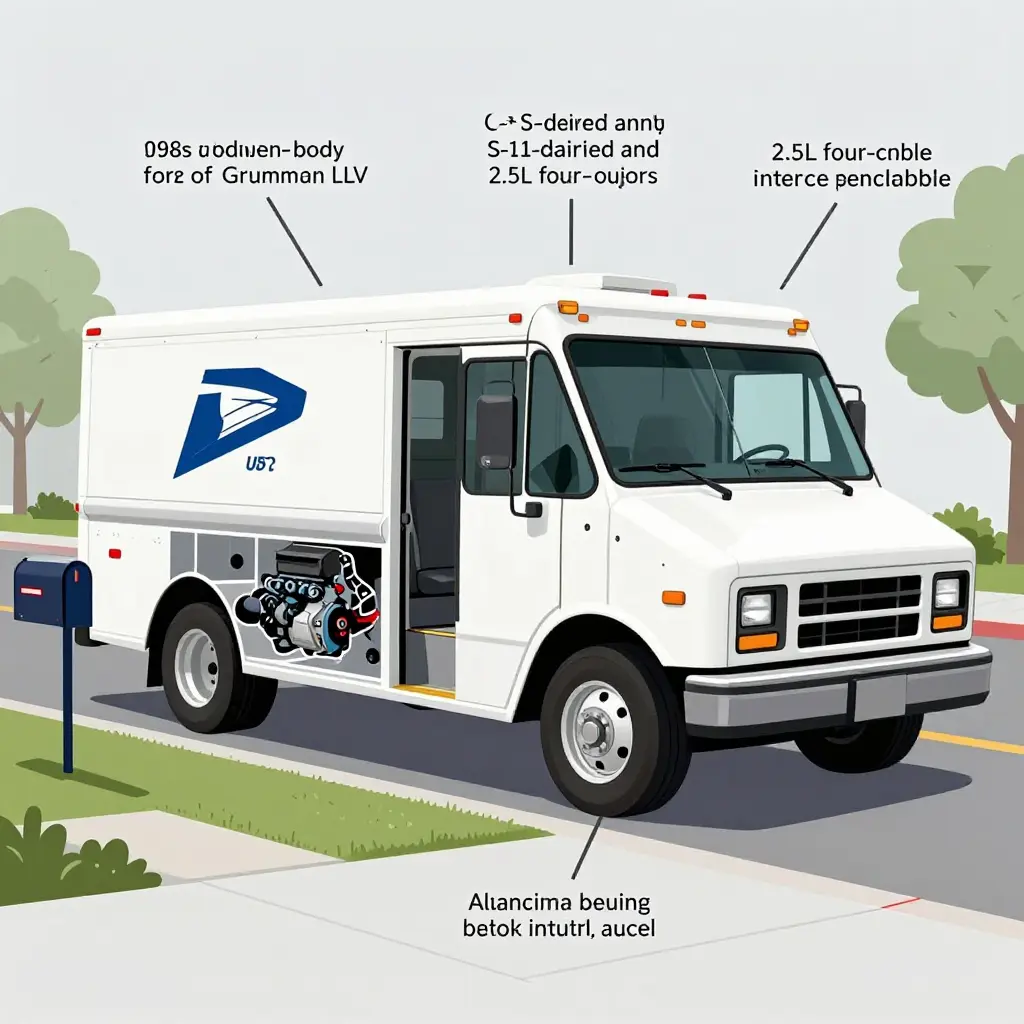
The result was the LLV, or Long Life Vehicle. Grumman built the aluminum body on a chassis and powertrain derived from the GM S-10 pickup, powered by GM’s 2.5-liter four-cylinder and a three-speed automatic. The parts that wore out were common, catalogued, and cheap.
The Design Brief, Translated Into Hardware
Each requirement served the same goal: keep the truck productive across as many delivery stops as possible.
- Right-hand drive and a sliding curbside door, so the carrier steps from seat to sidewalk without crossing traffic.
- Low step-in height, to reduce fatigue across hundreds of daily dismounts.
- A high-cube cargo bay, commonly cited at about 121 cubic feet, sized for parcels rather than passengers.
- Flat, bolt-on aluminum body panels that could be swapped after a minor collision instead of sent to a body shop.
Grumman kept the cab plain. Fewer features meant fewer failures, and a truck that spends less time in the shop is a truck that finishes its route.
Production, Ownership and Longevity
Production ran from the 1987 model year through 1994, with total volume widely cited at about 140,000 units. Northrop acquired Grumman in 1994, and the builder became part of Northrop Grumman.
Aluminum resisted the corrosion that had eaten earlier steel-bodied carriers. The GM drivetrain meant any fleet garage could source a water pump or brake component without a special order. Accessible panels shortened repair time, and modest curb weight kept brake and suspension wear predictable. The truck was never fast, quiet, or comfortable. It was serviceable, which is why many LLVs stayed in daily service decades beyond their 24-year design life and why fleet managers still use the design as a benchmark for uptime and lifecycle cost. The lesson is the same one behind quality service and reliability on the road: design for service instead of adding it later.
Mapping the Build Program: Ramp-Up and Wind-Down
The LLV program did not produce trucks at a steady rate. It began with a pilot batch, rose steeply as Grumman’s Montgomery, Pennsylvania plant and later facilities hit their stride, plateaued around 1990-1991, and wound down as the final USPS orders were filled. About 140,000 trucks were delivered between 1987 and 1994, making the LLV one of the most-produced purpose-built postal vehicles in history. The chart below shows the approximate annual split.
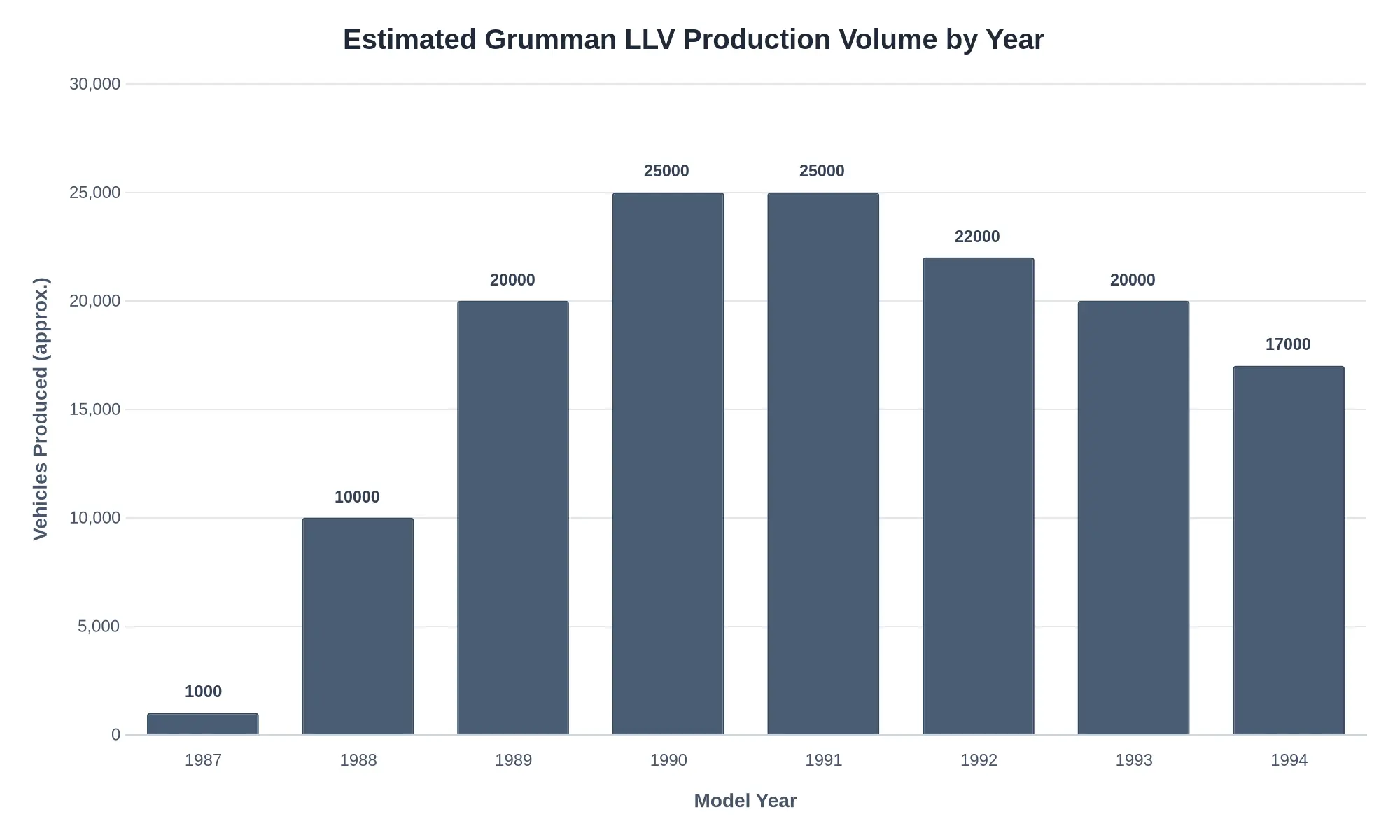
Figure: Estimated annual Grumman LLV production and delivery volume, 1987-1994. Figures are approximate and intended to show the shape of the production program; annual totals vary by source.
Output was concentrated in a few years, so the surviving LLVs sit in a narrow age band. That is why rebuild programs, parts standardization, and longevity-focused maintenance became central to the truck’s service life.
USPS Contractors: Who Actually Builds and Maintains Postal Service Trucks
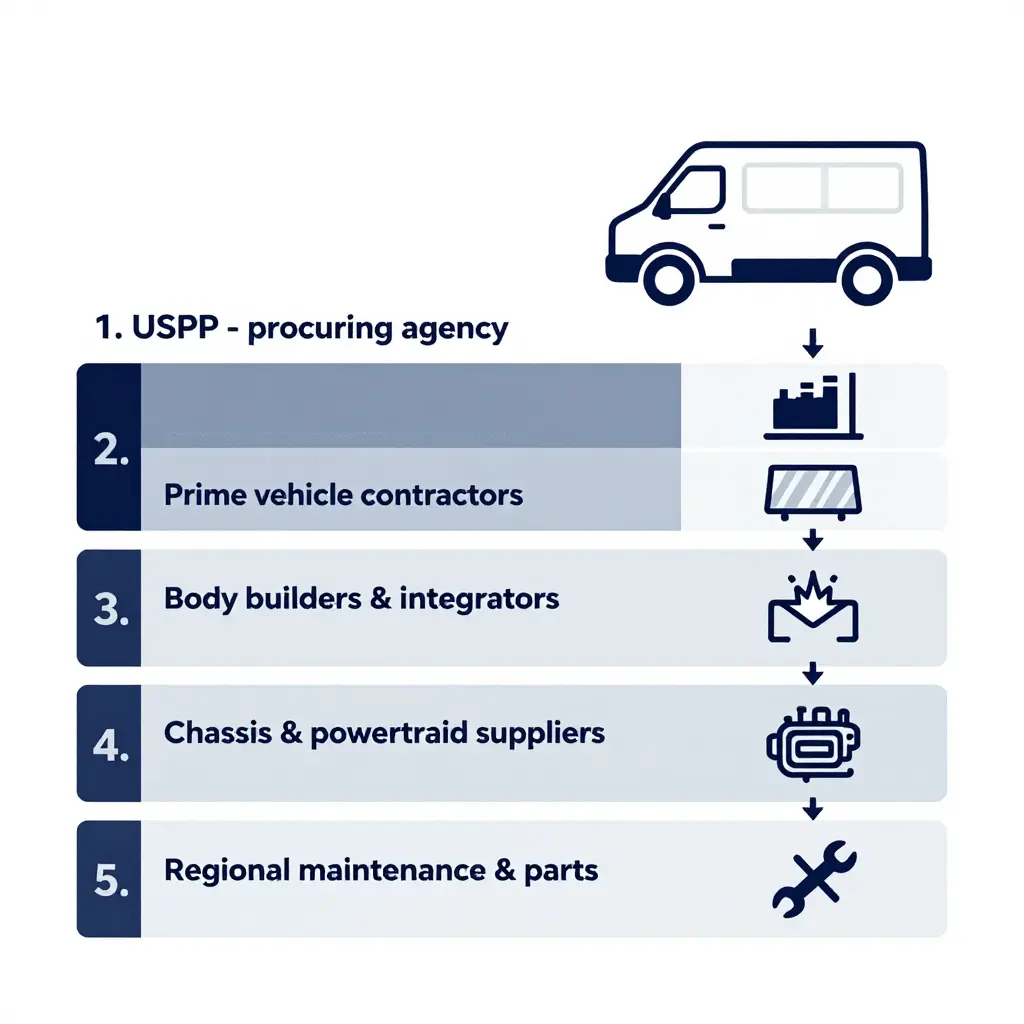
A postal truck is rarely the product of one assembly line. USPS sets the requirement, a prime contractor holds the contract, body builders fabricate the shell, suppliers deliver chassis and drivetrains, and a separate maintenance layer keeps 30-year-old trucks on daily routes. That division of labor explains why the LLV looked the way it did, why its replacement took so long, and who answers when a truck breaks down in a rainstorm.
Tier One: USPS as the Procuring Agency
USPS is buyer, specifier, and fleet owner. Its engineering and acquisition staff write the requirement package (payload, route length, step-in height, right-hand drive, service life) and then award the contract. Maintenance has stayed largely in-house through its Vehicle Maintenance Facilities (VMFs), so delivery is not the end of a supplier’s obligation. Parts support, technical documentation, and repairability are part of what USPS buys.
Tier Two: Prime Contractors Holding the Vehicle Contract
Prime contractors carry legal and integration responsibility. Grumman won the Long Life Vehicle competition in 1986 and built about 140,000 LLVs through 1994. Sustainment and engineering support moved to Northrop Grumman after the 1994 acquisition. Ford and Utilimaster held the same kind of role for the flexible-fuel FFV vans built from 1999 to 2001. In February 2021, Oshkosh Defense won the Next Generation Delivery Vehicle (NGDV) contract, a 10-year indefinite-delivery/indefinite-quantity arrangement for 50,000 to 165,000 vehicles, including battery-electric units.
Tier Three: Body Builders and Integrators
Body production and final assembly often sit with a different company than the contract holder. Grumman Olson fabricated the LLV’s aluminum body, and Utilimaster built bodies for the Ford-based FFVs. For commercial off-the-shelf purchases such as the Mercedes-Benz Metris and Ram ProMaster, the “integrator” is usually the OEM’s upfit partner network adding shelving and route equipment, not a dedicated postal body line.
Tier Four: Chassis and Powertrain Suppliers
The drivetrain layer is where names disappear from the public story. General Motors supplied the LLV’s chassis architecture, 2.5-liter four-cylinder, and three-speed automatic, all derived from Chevrolet S-10 components. That matters to fleet managers because LLV parts availability has always run through GM’s legacy parts pipeline rather than Grumman’s.
Tier Five: Regional Maintenance and Parts Support
Below the OEMs sits the least visible tier: commercial garages, parts distributors, and rebuilders working under local agreements alongside USPS’s own VMF technicians. They handle brake and steering work, body panel replacement, and mid-life refurbishment.
How Contract Structure Shapes the Fleet
Contract type decides who builds, who supports, and who stays involved for decades:
| Structure | Where it appears | Practical effect |
|---|---|---|
| Firm-fixed-price production | LLV production; NGDV initial buy | Locks unit cost; puts the burden on the prime to engineer for low build cost |
| IDIQ / multi-year ordering | NGDV quantities | Lets USPS ramp volumes up or down without re-competing |
| Sustainment and parts support | LLV, FFV programs | Keeps the original prime or successor responsible for spares and engineering changes |
| Local and regional agreements | Maintenance, upfit, refurbishment | Pushes day-to-day support to commercial vendors near each facility |
The name on the contract is rarely the name on the engine, and postal vehicle procurement is judged as much on twenty-year supportability as on the initial bid. The same trade-off appears in other public fleets, where procurement best practices hinge on support commitments rather than sticker price. For anyone operating heavy or specialty fleets, the postal model is a useful case: the truck is one contract, but the fleet is a network that has to hold together for decades.
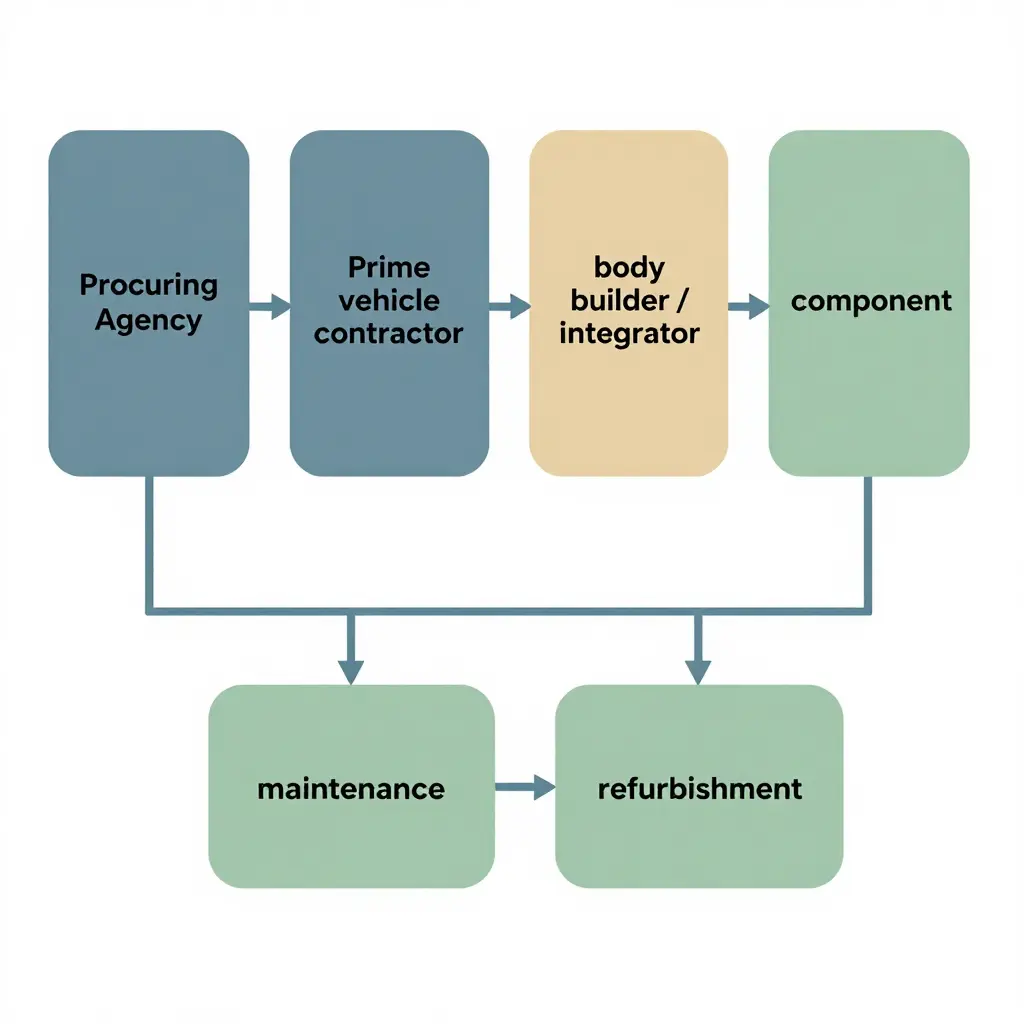
Figure: The contracting chain flows from the procuring agency to the prime vehicle contractor, then outward to body builders, integrators, and component suppliers. Maintenance and refurbishment contractors sit on a parallel branch that feeds back into the fleet’s in-service life.
Key Contractors in the Postal Truck Supply Chain
- Prime vehicle contractor – Grumman Allied Industries (later Northrop Grumman): Held the master USPS contract for the Grumman LLV and was accountable for design, durability targets, delivery schedules, and subcontractor performance.
- Chassis and powertrain supplier – General Motors: Supplied the S-10-derived chassis, 2.5-liter four-cylinder, and driveline components. Standard GM part numbers kept routine engine and transmission work within reach of local mechanics.
- Body and aluminum structure fabricator – Grumman’s body operation and aluminum suppliers: Formed, riveted, and bonded the aluminum panels and load floor. Aluminum construction is also what made later panel replacement practical.
- Final assembly integrator – Grumman’s Montgomery, Pennsylvania plant: Married the GM chassis to the aluminum body and installed electrical, HVAC, and mail-handling systems. The site was the single point of build-quality accountability.
- Parts and sustainment supplier – GM Service Parts Operations and specialty aftermarket distributors: Carried wear items, body panels, and electrical components through decades of service.
- Regional maintenance and refurbishment contractor – independent refurbishment shops and regional service providers: Performed heavy repairs, panel replacement, and drivetrain rebuilds. These shops are often the first call when a local maintenance facility lacks capacity.
- Next-generation delivery vehicle prime contractor – Oshkosh Defense: Builds the NGDV fleet that is replacing the LLV and carries forward the prime-contractor accountability model used in the Grumman era.
Warranty claims, parts sourcing, and service responsibility follow this division of labor. When a component fails, knowing who built, supplied, or integrated it determines who pays, who ships the replacement, and who performs the repair. Fleet managers who map those roles before a failure avoid misrouted claims, cut diagnostic downtime, and negotiate better sustainment terms.
Postal Truck Models, Producers and Key Characteristics
The table below compares the vehicles that have defined the USPS delivery fleet, from the Jeep-based DJ-5 to the Oshkosh NGDV now being delivered from South Carolina. The contract structure behind each one is easier to see side by side.
| Vehicle/Program | Prime Contractor or Builder | Production/Service Era | Chassis and Powertrain Source | Body Material or Configuration | Typical Fleet Role |
|---|---|---|---|---|---|
| Jeep DJ-5 series (Dispatchers) | Kaiser Jeep, then AMC/AM General | 1960s through 1980s (DJ-5 production 1965-1984) | Jeep CJ-5-derived two-wheel-drive chassis with four- or six-cylinder gasoline engine | Steel body, factory right-hand drive, open or enclosed cargo area | City and suburban letter routes |
| Grumman LLV | Grumman Allied Industries (Grumman Olson) | 1987-1994 production, service into the 2020s | General Motors S-10-derived chassis; 2.5-liter four-cylinder (2.2-liter later), three-speed automatic | Aluminum body on steel frame, rear-loading cargo box | Primary route delivery workhorse |
| Ford-Utilimaster FFV | Ford and Utilimaster | 1999-2001 production; service into the 2000s | Right-hand-drive Ford Explorer chassis; 4.0-liter V6; gasoline or E85 | Aluminum step-van body, higher gross weight than the LLV | Package, bulk and heavier-payload routes |
| Oshkosh NGDV | Oshkosh Defense, with Ford supplying engines, transmissions and drivetrain components | 2020s onward; first deliveries in 2024 | Oshkosh purpose-built chassis; Ford 2.0-liter turbo four or battery-electric | Purpose-built body, walk-in stand-up cab, air conditioning, cameras | Main replacement for the aging LLV fleet |
| Refurbished legacy vehicles | USPS maintenance facilities and private refurbishment contractors | Ongoing, parallel to new-vehicle programs | Rebuilt or re-powered original chassis | Original body with repaired panels, repainted shells | Extending service life until replacements arrive |
Note: Specifications are summarized at a general level and are meant as a comparison aid rather than a definitive technical reference. Configurations, powertrain options and body details vary by production batch, model year and individual retrofit program.
Early postal vehicles were commercial Jeeps adapted for mail delivery. The LLV paired a Grumman aluminum body with a GM chassis and engine. The NGDV reverses that arrangement: Oshkosh owns the design and integration and buys engines, transmissions, and electric-drive components from Ford and other suppliers. Procurement has moved from adapting an existing truck to commissioning a purpose-built one. That shift puts more weight on long-term parts support and refurbishment capacity, because each generation now depends on fewer suppliers.
Refurbishment Shops: Who Keeps Postal Trucks in Service
A Grumman LLV built in the early 1990s was designed for a 24-year service life. Thousands are still delivering mail past 30 years. The trucks are not the reason. USPS’s own maintenance organization, dedicated refurbishment centers, and commercial shops and upfitters do the work.
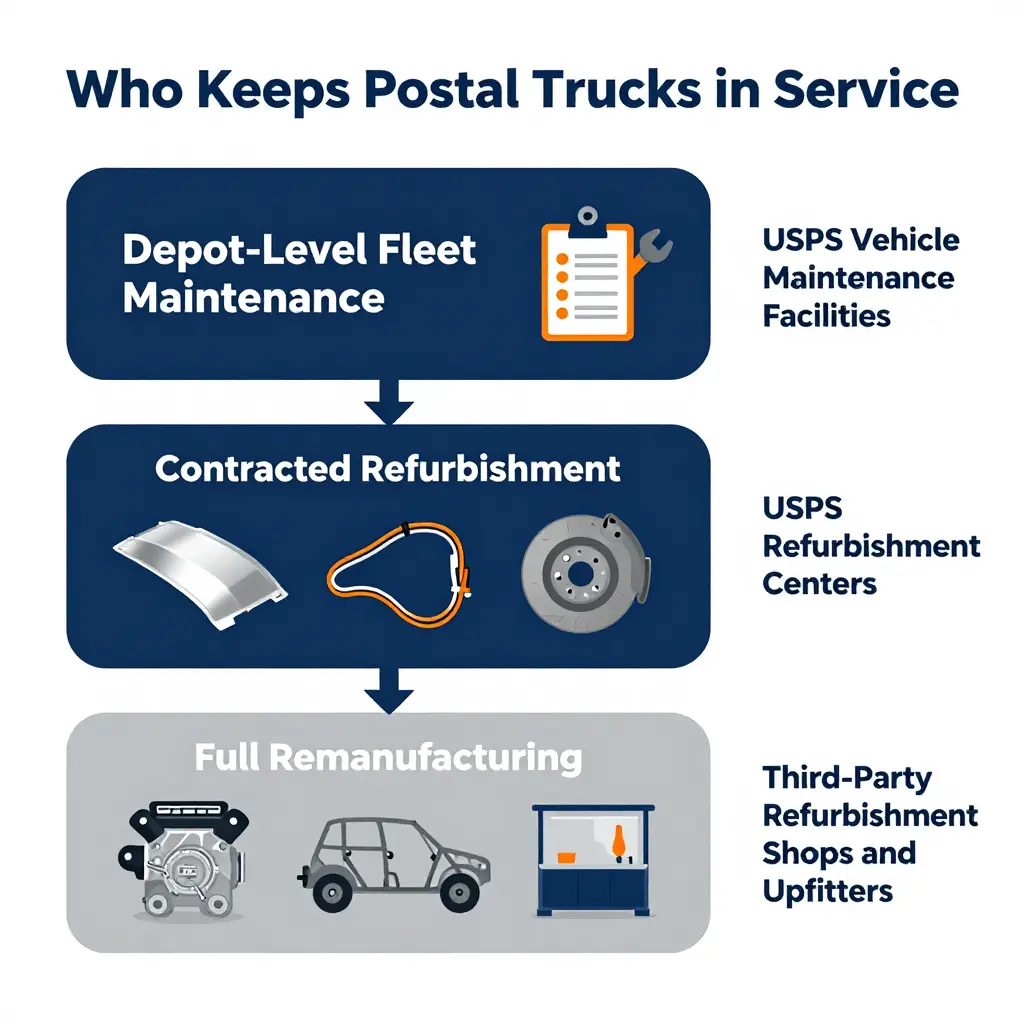
Depot-Level Work, Contracted Refurbishment, and Full Remanufacturing
These terms get used interchangeably in casual conversation, but they describe different scopes of work and different organizations.
Depot-level maintenance is the routine end. USPS vehicle maintenance facilities perform scheduled service, brake and tire work, safety inspections, and corrective repairs that keep a truck legal and mechanically sound between routes. The work is fast and local, built around daily route availability rather than long-term restoration.
Contracted refurbishment sits in the middle. A truck is pulled from service for weeks rather than hours, and a shop replaces or restores wear items and damaged structures: body panels, doors, wiring, brakes, suspension, seats, and lighting. USPS has run in-house refurbishment operations, including programs that reworked large batches of LLVs, and has also contracted outside firms to do the same work on a production-line basis.
Full remanufacturing is the deepest tier. The vehicle is stripped close to the bare frame, the chassis is measured and repaired, and major assemblies such as the engine, transmission, and axle are rebuilt or replaced. A remanufactured truck returns to service with a service life measured in additional years, not just additional miles.
Inside a Typical Refurbishment Scope
A realistic scope covers the whole vehicle. Body repair and aluminum panel replacement come first, because route trucks take constant low-speed contact damage around fenders, doors, and rear quarter panels. Frame inspection follows, checking for cracks, bent crossmembers, and corrosion at mounting points. Electrical work addresses the harnesses, relays, and lighting that take a beating from weather and stop-and-go cycling. Powertrain replacement or rebuild, along with brakes, springs, steering components, and a fresh interior, finishes the job.
Shops sequence the work so structural and mechanical items are finished before paint and trim, which keeps a truck from being opened twice. Many of these shops also serve private fleets, applying the same standards to delivery vans, box trucks, and utility vehicles.
Why Aluminum on Steel Makes Structural Refurbishment Feasible
The LLV’s aluminum panels on a steel chassis are the reason this level of rebuilding is practical. Aluminum does not rust through the way steel does, so panels stay dimensionally stable and can be replaced individually instead of requiring a new body shell. Riveted and bolted construction means a damaged panel can be drilled out and a new one set in place. The steel chassis underneath is a known quantity that any competent heavy-duty shop can inspect, straighten, and weld. The weak point is galvanic corrosion where the two metals meet, which is why refurbishment includes cleaning, isolating, and resealing those joints. A durable body on a serviceable frame is what keeps the LLV rebuildable instead of disposable.
Where Private Fleets Fit In
The same shops that rebuild postal trucks also rebuild parcel vans, service bodies, and specialty vehicles for private fleets, and they share tooling, panel fabrication techniques, and technician experience across both. For a small business running a fleet maintenance or body shop, the skills transfer directly to commercial delivery work. For a fleet manager, it means capacity exists outside the OEM channel when new trucks are expensive or unavailable, and it explains why a well-maintained postal truck can stay productive longer than its specification suggested.
Where the Money Actually Goes
Rebuild budgets are not spread evenly. Planners need to know which systems will absorb most of a rebuild budget before they scope the job, because that split determines whether a full refurbishment or a targeted mechanical overhaul makes sense.
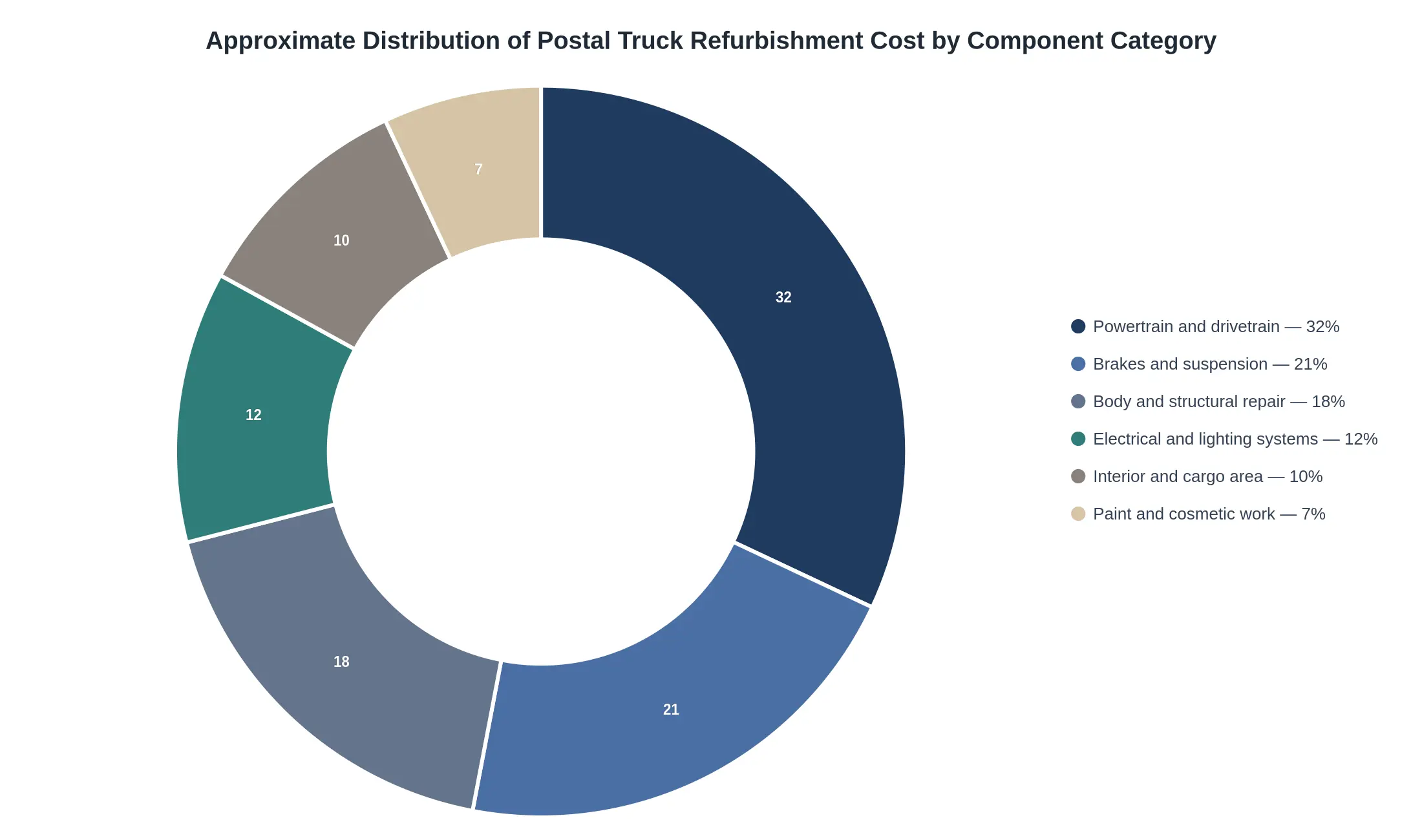
Approximate distribution of postal truck refurbishment cost by component category, shown as illustrative percentages. The split is intended to show relative cost weight, not the result of a specific program audit, contract, or individual vehicle.
The Postal Truck Refurbishment Process, Step by Step
A Grumman LLV that has carried mail for two decades rarely needs one dramatic repair; it needs a disciplined sequence of checks and corrections. Reputable shops follow roughly the same order of operations, because every stage depends on the measurements and records produced by the stage before it. The best of them treat the work as engineering rather than cosmetics, which is why a fully documented workflow matters more than a fresh coat of paint.

- Intake inspection and condition grading. The truck is photographed from all sides, its VIN and odometer are recorded, and inspectors grade corrosion, panel damage, and mechanical wear against a written standard. That grade fixes the scope of work and the budget before work begins.
- Teardown and component tagging. Technicians remove shelving, interior panels, lamps, and driveline components, tagging or bagging every fastener and bracket by location. Parts scheduled for rebuild are logged so they return to the same vehicle.
- Structural and frame inspection. The bare frame, floor stringers, and body mounts are measured for cracks, bending, and rust perforation, with suspect areas checked by dye penetrant. Frames are straightened or repaired to specification before any new panel is fitted.
- Body panel and corrosion repair. Damaged aluminum panels are patched or replaced, corroded seams are cut out and re-welded, and rivet lines are restored to factory spacing. Bare metal receives conversion coating immediately to prevent flash rust.
- Powertrain and drivetrain replacement or rebuild. The 2.5-liter four-cylinder (2.2-liter in later LLVs) and three-speed automatic are rebuilt to OEM tolerances or swapped for remanufactured units, while the rear axle, driveshaft, and mounts are inspected in the same pass. Cooling, fuel, and exhaust systems are renewed alongside them.
- Brake and suspension service. Lines, calipers, wheel cylinders, drums, rotors, and friction material are replaced as assemblies rather than piecemeal. Leaf springs, shackles, bushings, shocks, and steering linkage are then renewed so the truck tracks and stops correctly when loaded.
- Electrical and lighting rework. The harness is inspected for chafing and corrosion, damaged sections are replaced, and grounds are cleaned and re-terminated. Headlamps, turn signals, brake lights, and reverse lamps are fitted with compliant units and function-tested circuit by circuit.
- Paint and corrosion protection. The body is prepped, primed, and finished in the specified USPS white, with seam sealer applied to all floor and wheel-arch joints. Underbody coating, cavity wax, and closed-cell insulation go on the areas where LLVs historically rust.
- Final testing and return-to-service documentation. The truck is road-tested both loaded and empty, aligned, weighed, and checked for leaks, and every repair is logged against the VIN. The completed file, including inspection photos and parts traceability, is handed to the operator with the keys.
Two practices separate a durable rebuild from a cosmetic refresh: every measurement is recorded, and teardown happens in stages. Shops that log each measurement and photograph every stage leave a verifiable baseline, so the truck that comes out can survive another decade of daily delivery. Without that record, the next owner inherits hidden corrosion, mismatched components, and repeat failures that show up long after the paint cures.
The Refurbishment Cycle at a Glance
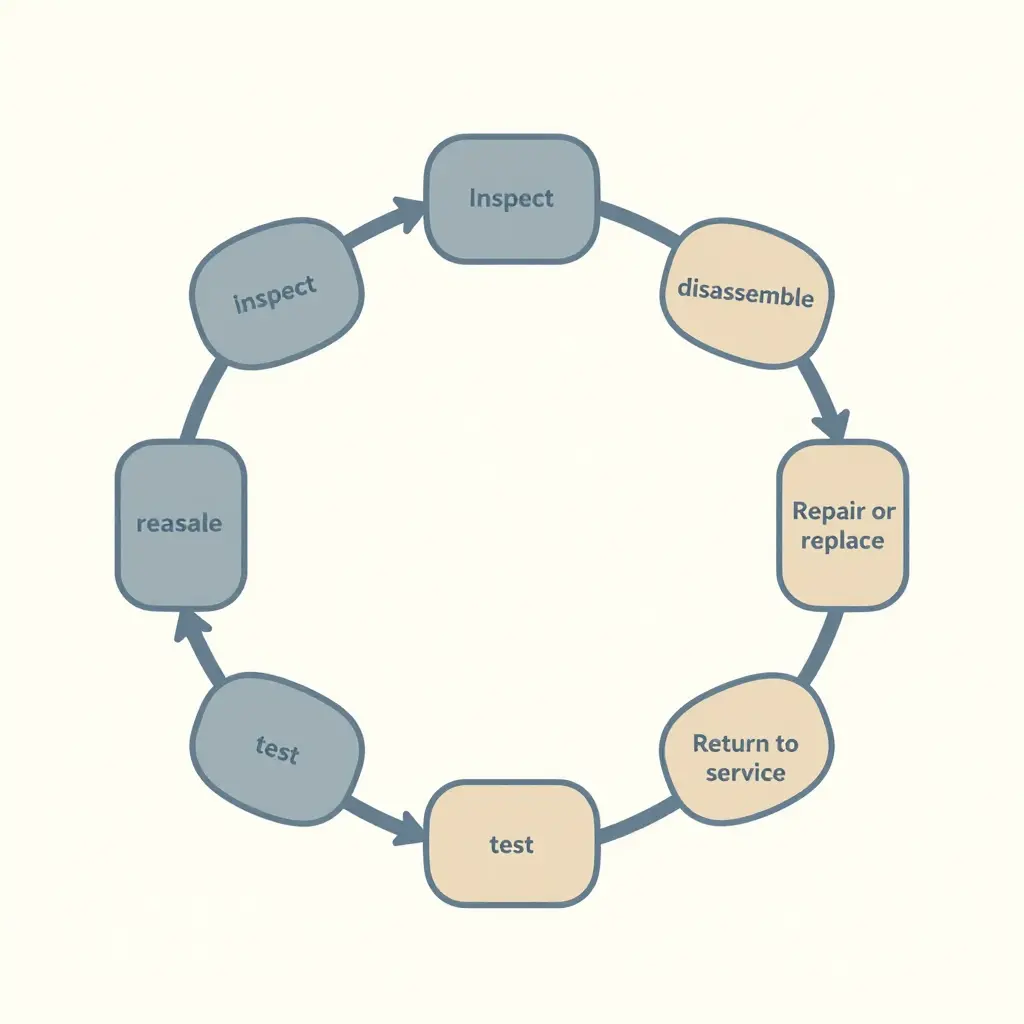
Refurbishment is a loop, not a one-time repair. Every vehicle returned to service adds inspection data to the next cycle and extends the fleet’s useful life.
Shops track inspection findings closely for that reason: each pass through inspect, disassemble, repair or replace, reassemble, and test sharpens the next one. Wear patterns become predictable maintenance intervals instead of surprise breakdowns. Operators who treat the cycle as continuous rather than reactive see fewer roadside failures and longer service windows, the same discipline behind maximizing uptime through product support in other fleet environments.
Replace or Refurbish: Lifecycle Economics for Postal and Commercial Fleets
Fleet managers do not retire a truck because it looks tired. They weigh capital outlay against capital avoidance, structural life against parts scarcity, and downtime against delivery obligations. For a delivery fleet, the question is rarely “is this truck old?” It is “what does the next 100,000 miles cost, and can we afford the transition?”
Acquisition Cost Versus Refurbishment Cost Per Unit
A depot-level rebuild usually costs less than a new truck, commonly estimated at half to two-thirds of sticker price once body repair, powertrain overhaul, paint, and electrical work are bundled. Spread across dozens of units and often scheduled in-house or at a regional shop, it also avoids the lumpy capital spike of a mass order. The saving holds only while parts and labor stay predictable. When every rebuild starts requiring custom fabrication, it disappears.
Remaining Structural Life Is the Hard Ceiling
Refurbishment restores systems; it does not restore metal. The body shell and frame rails determine how much life a rebuild can actually buy. Aluminum bodies resist corrosion far better than steel, which is why so many postal units stayed viable for decades. But frame fatigue, stress cracking at mounting points, and floor degradation set an absolute limit. A practical rule: rebuild only when the structure has roughly eight to ten years of service left. Anything less turns refurbishment into expensive deferral.
Parts Availability, Training, and the Knowledge Base
A rebuild is only as good as its supply chain. Vehicles built on shared commercial powertrains have deep aftermarket support, cheap consumables, and technicians who already know the platform. Proprietary components reverse that advantage. Training cuts the same way: a platform your shop has serviced for fifteen years is fast and cheap to rebuild, while a new architecture demands diagnostic software, high-voltage certification, and hours of unfamiliar labor.
Downtime Tolerance and Route Duty Cycle
Refurbishment is scheduled; replacement arrives in disruptive waves. Fleets that can rotate units through a rebuild pipeline without losing route coverage gain real flexibility. Thinner fleets with a tight spare ratio may find a two-week rebuild as painful as a six-month delivery backlog. Duty cycle sharpens the calculation. High-mileage, high-stop-density routes consume brakes, suspensions, and doors quickly, but they also erode a new vehicle’s advantages quickly. Low-mileage routes with heavy idling reward rebuilds because the structure outlives the systems.
Regulatory and Emissions Pressure
Compliance often decides the question. Aging engines face tightening emissions inspection, safety upgrades, and insurance scrutiny that no rebuild can fully resolve. New vehicles bring airbags, air conditioning, cameras, and telematics that affect driver retention and claims as much as fuel bills. When regulators or customers demand features a rebuilt chassis cannot carry, refurbishment stops being economical regardless of the invoice.
| Decision factor | Points toward refurbishment | Points toward replacement |
|---|---|---|
| Cost per unit | Rebuild at roughly half to two-thirds of new | New unit cost offset by warranty and reliability |
| Structural life | 8-10 years of body and frame remaining | Frame fatigue or corrosion beyond repair |
| Parts availability | Shared commercial powertrain, deep aftermarket | Discontinued or proprietary components |
| Technician training | Shop already certified on the platform | New architecture, new tooling, new software |
| Downtime tolerance | Spare ratio allows staged rebuilds | Tight route coverage, no spare capacity |
| Regulatory | Meets current inspection and safety rules | Cannot meet emissions or safety mandates |
| Duty cycle | Low annual miles, long idle, light payload | High miles, growing package volume |
What the Grumman LLV Taught the Industry
The Grumman LLV is a clear case study in postal fleet lifecycle economics. Built from 1987 through 1994 on a modified GM S-10 chassis with a corrosion-resistant aluminum body, it was designed for 24 years of service. Thousands of units went through refurbishment programs (new engines, rebuilt transmissions, refreshed bodies) because the structure, the parts network, and simple diagnostics made each rebuild a bargain compared with replacement. That logic held for nearly thirty years. It broke down when parts pipelines thinned, safety expectations rose, and operating a fleet without airbags and modern ergonomics became a liability rather than a saving.
The Next Generation Delivery Vehicle changes the arithmetic rather than ending it. Purpose-built for mail routes, the NGDV brings air conditioning, airbags, 360-degree cameras, a lower step-in height, better fuel economy, and telematics that make per-vehicle condition visible in real time. Those features raise acquisition cost and add training and charging obligations, but they also push fleets toward replacement cycles based on total cost per mile instead of purchase price. The successor to the LLV will be judged by the same measure as its predecessor: cost per delivered stop, year after year.
The Crossover Point
Rebuild when a vehicle still has eight or more years of structural life, a healthy parts channel, and a shop that knows the platform. The rebuilt unit delivers most of the reliability at a fraction of the capital. Replace when parts dry up, compliance requirements outrun the chassis, or route volume outgrows the payload. The trigger is the crossover point, not the model year. A service partner that keeps uptime predictable through scheduled service makes that crossover visible early, which is what quality service and reliability on the road ultimately buys.
Frequently Asked Questions About Postal Service Trucks and Refurbishment
The questions below come up most often from fleet managers, contractors, and readers who want to know who actually built the mail truck.
Who originally built the Grumman LLV?
The Grumman LLV, short for Long Life Vehicle, was designed and built by Grumman. Grumman won the USPS competition in 1986 with a GM-supplied chassis; its Grumman Olson body division built the aluminum body. Production ran at Grumman’s Montgomery, Pennsylvania plant. The truck was engineered to a USPS specification that stressed corrosion resistance, low maintenance, and a long service life.
How many LLVs were produced?
Total output is generally cited at approximately 140,000 units, delivered between roughly 1987 and 1994. Some sources put the figure near 142,000, depending on how contract options and delivery dates are counted. Either way, the LLV is one of the most numerous purpose-built delivery vehicles ever produced for a single civilian fleet.
Why does the LLV use a right-hand drive configuration?
The LLV was built in right-hand drive. Sitting on the right lets a carrier pull alongside a curbside mailbox and reach it without crossing traffic or climbing across the cab, which saves time and reduces accident exposure on busy roads. Most served mounted routes, where the carrier stays in the vehicle.
Which contractors have built postal vehicles since the LLV?
Since the LLV program, USPS has bought vehicles from Ford (Transit Connect vans and the flexible-fuel FFV chassis), Chrysler (minivans, some converted to right-hand drive), General Motors (minivans and small route vehicles), Utilimaster (bodies for the FFVs), and Oshkosh Defense, which won the NGDV contract in 2021. Many were commercial off-the-shelf platforms adapted for mail delivery.
What does a postal truck refurbishment typically include?
Most refurbishment programs begin with structural inspection and frame repair, rust remediation, and body panel replacement. Mechanical work covers engine and drivetrain overhaul plus brakes, suspension, and steering. Electrical, lighting, and HVAC systems are repaired or replaced, interiors get new seats, flooring, and cargo shelving, and vehicles are repainted and re-certified for safety and emissions before returning to service.
How long can a refurbished postal vehicle remain in service?
The LLV was designed around a 24-year service life, yet many stayed in service past 30 years. A thorough refurbishment typically adds five to ten years, depending on mileage, corrosion, and parts availability. USPS is retiring the fleet as replacement vehicles arrive, so extensions are increasingly assessed case by case.
Further Resources on Fleet Maintenance and Vehicle Lifecycle Management
Lifecycle decisions depend on maintenance data and disciplined procurement, whether you are tracking an LLV or planning a municipal fleet replacement. The following guides from 5 Star Truck Inc. cover service reliability, technician training, fleet standardization, uptime support, and specification planning.
- Quality service and reliability on the road – Why consistent inspection and repair standards matter for service-life and cost projections.
- Fire truck maintenance and service training – Technician training focused on preventive maintenance, useful for building in-house capability as equipment ages.
- Benefits of standardizing fire truck fleets – How common platforms and parts inventories simplify maintenance planning and lower the long-term cost of mixed fleets.
- Maximizing fire apparatus uptime through product support – Parts availability, support agreements, and documentation that reduce downtime late in a vehicle’s life.
- Fire apparatus procurement best practices – Specification writing, bid evaluation, and total cost of ownership, the stage where replacement decisions are made.
Summary: The Contractors and Shops Behind Postal Service Trucks
The Grumman LLV came from one USPS contract, won by Grumman in 1986 and backed by GM chassis and powertrain components. One prime contractor, one awarded program, and one established automotive supplier produced the truck that carried mail for decades and set the pattern for later acquisitions.
Building and supporting the fleet is still distributed. Prime contractors, body builders, component suppliers, and service partners each own a defined part of the vehicle and its long-term support, so capability is spread across tiers rather than concentrated in one company.
Refurbishment extends the life of trucks that still have sound structure and available parts, using a repeatable sequence of inspection, structural repair, and powertrain renewal. These shops do not just patch worn vehicles; they return aging units to dependable service, an approach familiar to anyone who values quality service and reliability on the road in high-mileage fleets.
New postal vehicle programs and refurbished legacy trucks will coexist for years. Oshkosh is ramping NGDV production while USPS keeps older units in service, maintaining and rebuilding them to bridge the gap.