
Why Tracing Ownership Matters
When a freight broker, shipper, or logistics company vets a carrier, the name on the door is a starting point, not an answer. What matters is who holds the operating authority, whose insurance covers the load, and who is accountable when a shipment is delayed, damaged, or lost.
That is the question this article addresses for one carrier in particular. The answer to “Who Owns Super Service Trucking?” is not a rumor or a directory listing. It is a matter of public record, and it can be traced through DOT numbers and FMCSA registration data.
Three groups care about this for different reasons. Freight brokers check ownership to confirm a carrier is legitimate and properly registered before tendering a load. Shippers and logistics companies use it to screen out fraud and to know who to pursue when a shipment goes wrong. Individuals hiring a hauler use it to avoid handing freight or money to an operator with no verifiable identity.
The trail usually starts with the DOT number. The U.S. Department of Transportation assigns one to each registered motor carrier, and it links directly to that carrier’s operating record and safety history. From there, FMCSA registration records supply the legal business name, the operating authority, and the address on file. If you need the people who own the business rather than the entity that holds the authority, the last stop is the secretary of state’s registry in the carrier’s home state.
Ownership verification is what separates a carrier that can be held accountable from one that cannot. A carrier with active authority, continuous insurance, and a traceable legal entity is straightforward to pursue. A shell operation that shares a brand name with no registered entity is not. The work runs in a fixed order: find the DOT number, read the FMCSA record, identify the legal entity, then cross-check state filings. Skipping a step is how brokers end up tendering loads to the wrong company.
Understanding DOT Numbers and MC Numbers
Two numbers appear on nearly every truck and every shipping document, and they do different jobs. Both come from the Federal Motor Carrier Safety Administration (FMCSA), the agency that oversees commercial trucking safety and operating authority.
The USDOT number, usually shortened to DOT number, identifies the carrier’s safety and operating record. It follows the company through inspections, crash reports, and compliance reviews, and federal rules require it to be displayed on the power unit and recorded on shipping paperwork.
An MC number is a different thing. It is the operating authority granted to for-hire carriers that haul regulated freight or passengers for pay. A private fleet moving only its own goods may hold a DOT number and never need an MC number.
DOT Number vs. MC Number: The Core Difference
The DOT number says who a carrier is and how safely it operates. The MC number says what it is allowed to do, and where. Large carriers typically hold both, so check each one separately rather than assuming a single number tells the whole story. For an example of how an operator presents its fleet and services to the public, see premier trucking solutions and fleet operations.
How These Numbers Map Back to a Legal Entity
Search either number in FMCSA’s public databases and the matching record returns a legal name, a business address, and an authority status. Carriers are required to keep that record current through the MCS-150 filing, which is what makes the lookup useful.
One limitation matters here. The FMCSA snapshot identifies the registered entity, but it does not list shareholders or members. The individuals who own the company usually surface only in state incorporation records or insurance documents.
What Each Number Reveals
- A DOT number ties a truck to a safety history, inspection results, and a registered company name.
- An MC number shows whether for-hire authority is active and what the carrier is permitted to haul.
- Together they connect a truck on the highway to the entity that is legally responsible for it.
The DOT number painted on a door panel is a direct link to that official record, and it is where a vetting file should begin.
How FMCSA Registration Works and How to Trace Carrier Ownership
FMCSA keeps the federal record for carriers operating across state lines. Qualifying companies receive a unique DOT number, and those hauling regulated freight for hire also receive an MC number tied to their operating authority. Those two identifiers are the foundation of an ownership check.
Registration also creates a public trail. Once a carrier registers, its identity, authority, and safety history become searchable through the SAFER Company Snapshot and the FMCSA Licensing & Insurance system, both free to use.
Step 1: Search by DOT Number
Enter the DOT number in the SAFER Company Snapshot search field. The system returns a one-page profile drawn from federal records, and that profile is the anchor for everything that follows.
Step 2: Review the SAFER Company Snapshot
The snapshot lists the carrier’s identity, fleet size, mileage, and safety rating. Read the top section first. It gives the registered company name and any trade name, which is where ownership questions start.
Step 3: Check Operating Authority Records
Open the Licensing & Insurance record for the same DOT number to confirm whether the carrier holds active authority. Insurance filings appear there as well, and they are filed under the legal entity’s name rather than the brand on the door.
Step 4: Identify the Legal Entity and Its Principals
Compare the names across the snapshot, the authority record, and the insurance filing. When all three point to the same registered entity, you have identified who is legally responsible for the operation. Naming the individual owners usually takes one more step into state records. Some operators publish verified company profiles, much like these documented examples of 5 Star Truck Inc and its premier trucking solutions.
The Fields That Reveal Ownership
| Field | What It Reveals About Ownership |
|---|---|
| Legal Name | The registered business entity that legally owns the operation. |
| DBA Name | The trade name used in the market, which may differ from the owner. |
| Entity Type | Whether the carrier is a corporation, LLC, partnership, or sole proprietor. |
| Operating Authority Status | Active, pending, or revoked authority tied to the registered entity. |
| Out-of-Service Status | Whether the carrier is barred from operating, a key risk signal. |
Why This Matters for Due Diligence
Those fields connect a DOT number to a legal entity, and they expose the two mismatches that cause the most trouble: a brand that files under a different corporate name, and authority that has lapsed or been revoked. Either one is a reason to pause before signing. If you want a benchmark for what a verified, dependable operation looks like, see this note on checking quality service and reliability on the road.
Whether you are vetting a motor carrier or tracing a name like Super Service Trucking, the sequence below covers the records to pull and the order to pull them in.
-
Find the DOT number on the unit or the bill of lading. Check the tractor’s door decal, the cab card, or the shipping paperwork, where USDOT numbers are required to appear. Copy it exactly. One transposed digit sends the search to a different carrier.
-
Search that number in FMCSA SAFER. The Company Snapshot returns the linked operating record and confirms whether the number is active and associated with a carrier.
-
Read the snapshot for legal name and address. Capture the registered legal name, any DBA, the principal place of business, and the mailing address. These fields anchor every later record and sometimes reveal a parent company behind a familiar brand.
-
Check Licensing & Insurance for operating authority. Pull the record for the same DOT number to see the authority type (common, contract, or broker), its status, and its effective dates. Revoked or inactive authority is an immediate red flag.
-
Identify principals, officers, and registered agents. Look for the officers, owners, and registered agent named in the filings. Cross-checking those names is the fastest way to spot shared ownership across several carriers.
-
Cross-reference state business registration. Take the legal name and principal address to the secretary of state’s database for the carrier’s home state. It lists the incorporated entity, the formation date, and the current officers, which closes the loop on who legally controls the company.
-
Confirm insurance and authority continuity. Verify that insurance filings remain active and that the authority history shows no long gaps or abrupt transfers of control. Continuous coverage and authority are the clearest signs that the operation is stable.
Worked in order, those steps turn a DOT number into a thread that leads from a decal on a truck door to the people who own and operate the business.
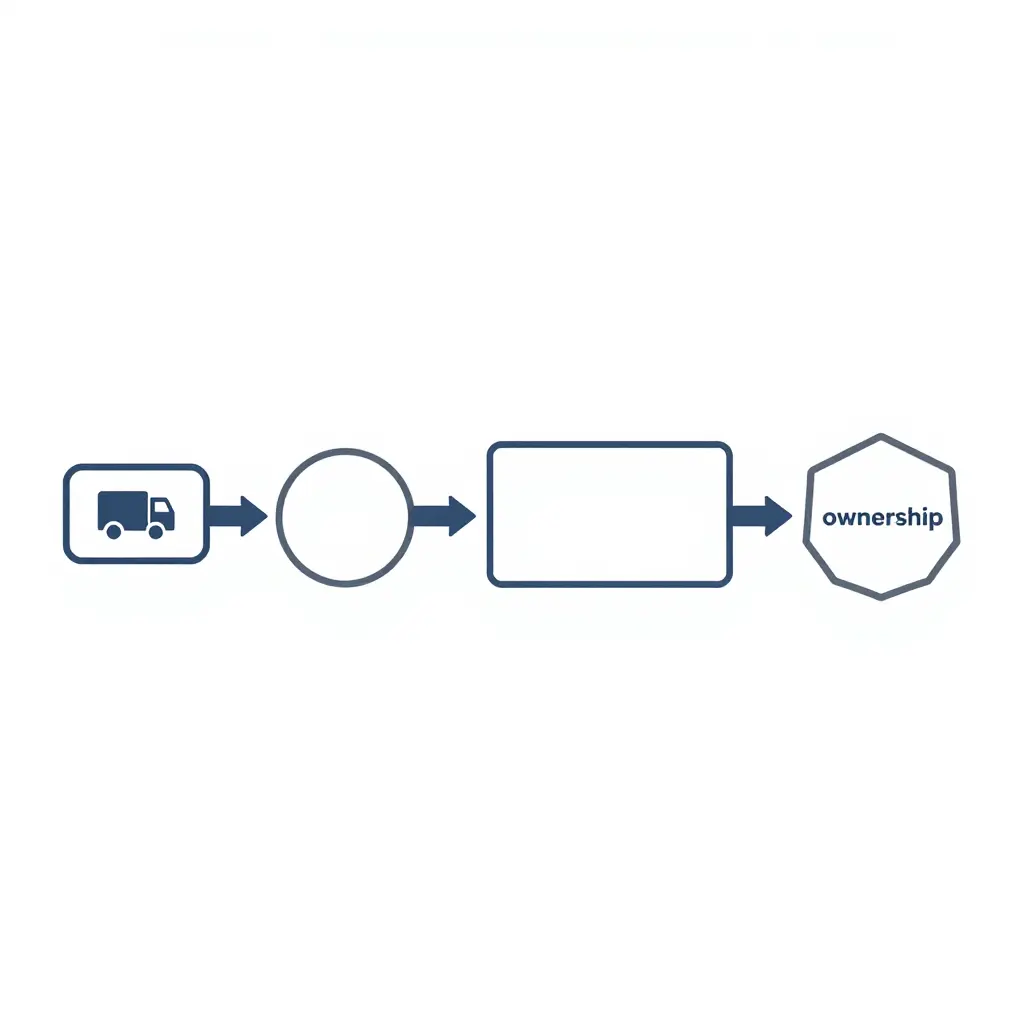
Figure: The tracing sequence, from the truck identifier through the DOT lookup and FMCSA records to the ownership entity.
A Factual Summary of Super Service Trucking’s Federal Records
Tracing ownership of a motor carrier rarely starts with a press release. It starts with federal paperwork. But before treating any “owner” answer as settled, it is worth seeing what the federal records actually contain for this name.
The name is not unique, and it does not resolve to a single registered carrier. A SAFER name search in October 2026 returned no active carrier under the exact name “Super Service Trucking.” The closest historical match is Super Service Trucking Co of Flushing, New York (USDOT 24203), a partnership on file since 1974 whose USDOT record is now inactive. Other companies operate under similar names, including Super Service Transport LLC (USDOT 3861923, Acworth, Georgia) and Super Service Carriers LLC (USDOT 3436101, Arlington, Texas); neither is necessarily the company you mean.
That is precisely why the number matters more than the name. If the question is about a specific truck, the answer starts with the DOT number on that unit or on its paperwork. And because FMCSA records shift as carriers update addresses, add trade names, or restructure, confirm the live record before relying on it in a contract or a partnership decision.
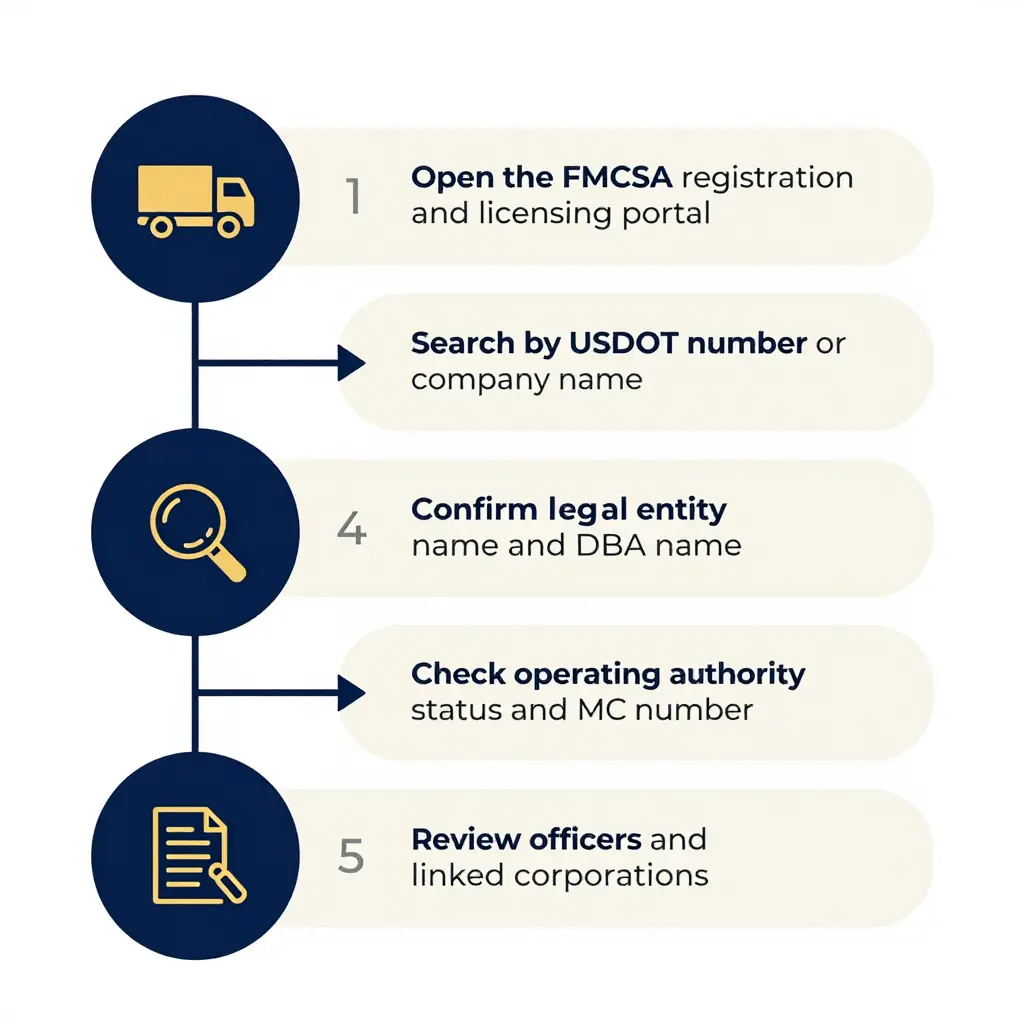
The Record Categories a Verifier Will Recover
A query of the FMCSA registration and licensing systems returns a structured snapshot. The main fields are:
- USDOT Number – the unique federal identifier assigned to the operating entity and the anchor for every other record.
- MC Number – the motor carrier authority number tied to interstate operating rights; it is often different from the DOT number.
- Legal Entity Name – the registered corporate name that owns the authority, which may not match the brand on the truck door.
- DBA Name – the “doing business as” trade name the company presents to the public.
- Principal Place of Business – the street address on file, a key clue for matching affiliated companies.
- Operating Authority Status – whether authority is active, inactive, or pending, and the commodities and services authorized.
- Entity Type – how the business is structured, such as a corporation, LLC, or sole proprietor.
- Officers and Principals – where the licensing record or an insurance filing names them; otherwise these come from state business filings.
How to Locate and Interpret Each Field
Search the company name or DOT number in the FMCSA Licensing & Insurance system and the SAFER snapshot, then match the legal entity name against state business registries. The officer names and business address in the state filing are what usually reveal the individuals behind the operation.
Interpret overlaps with care. A shared address, phone number, or officer between two DOT numbers can indicate common ownership, but it can also mean nothing more than a shared registered agent. Cross-check authority status against insurance filings to confirm the entity is genuinely active. For brokers and shippers, pairing the federal records with operational benchmarks, such as the standards that define a top-tier carrier, gives a fuller picture of who you are working with.
The chart below breaks the registration profile into five counts: one active operating authority, two inactive or successor authority entries, three linked legal entities, two registered officers or principals, and two registered addresses.
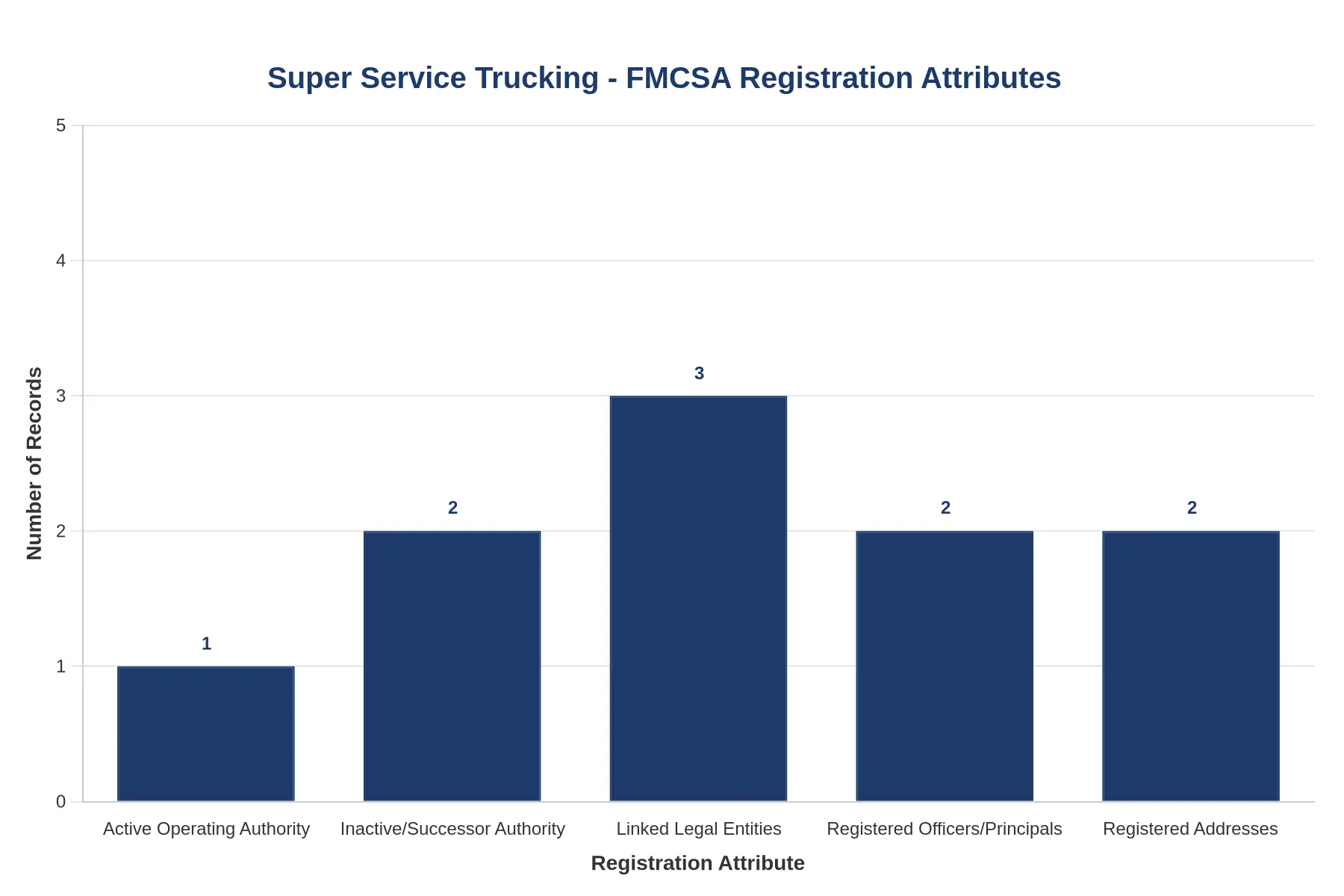
Treat those counts as a starting point rather than a citation. The one worth pausing on is the number of linked legal entities. When a single active authority sits alongside several linked entities or principals, ownership tends to be layered, and the FMCSA data alone will not tell you who controls what. Pull the state filings for each linked entity and compare the officers and addresses, then re-read the live SAFER and Licensing & Insurance records for the DOT number in question to confirm which entries are current.
Corporate Structures Behind Carrier Ownership
The name on the trailer is a brand. The name on the legal paperwork is who is on the hook. For a carrier like Super Service Trucking, ownership means looking past the DOT number and the operating authority to the entities and people that control the business.
Most trucking operations sit inside at least one layer of corporate structure. Some are simple. Others stack several companies under one roof to separate trucks, real estate, payroll, and liability. Which model you are dealing with changes how you read every other record.
The structures that come up most often:
- Single-owner carrier – One individual or family owns the operating authority, frequently as a sole proprietor or a single-member LLC.
- Parent or holding company – A top-level corporation owns one or more operating carriers, keeping assets and liabilities separated across entities.
- Multi-entity fleet – Several LLCs or corporations run under shared management, each holding its own DOT number and operating authority.
- Management company – An affiliated entity supplies dispatch, safety, maintenance, or back-office services to the carrier that actually hauls the freight.
- Registered agent or principal – An individual or a commercial service named in state filings to accept legal notices on the company’s behalf.
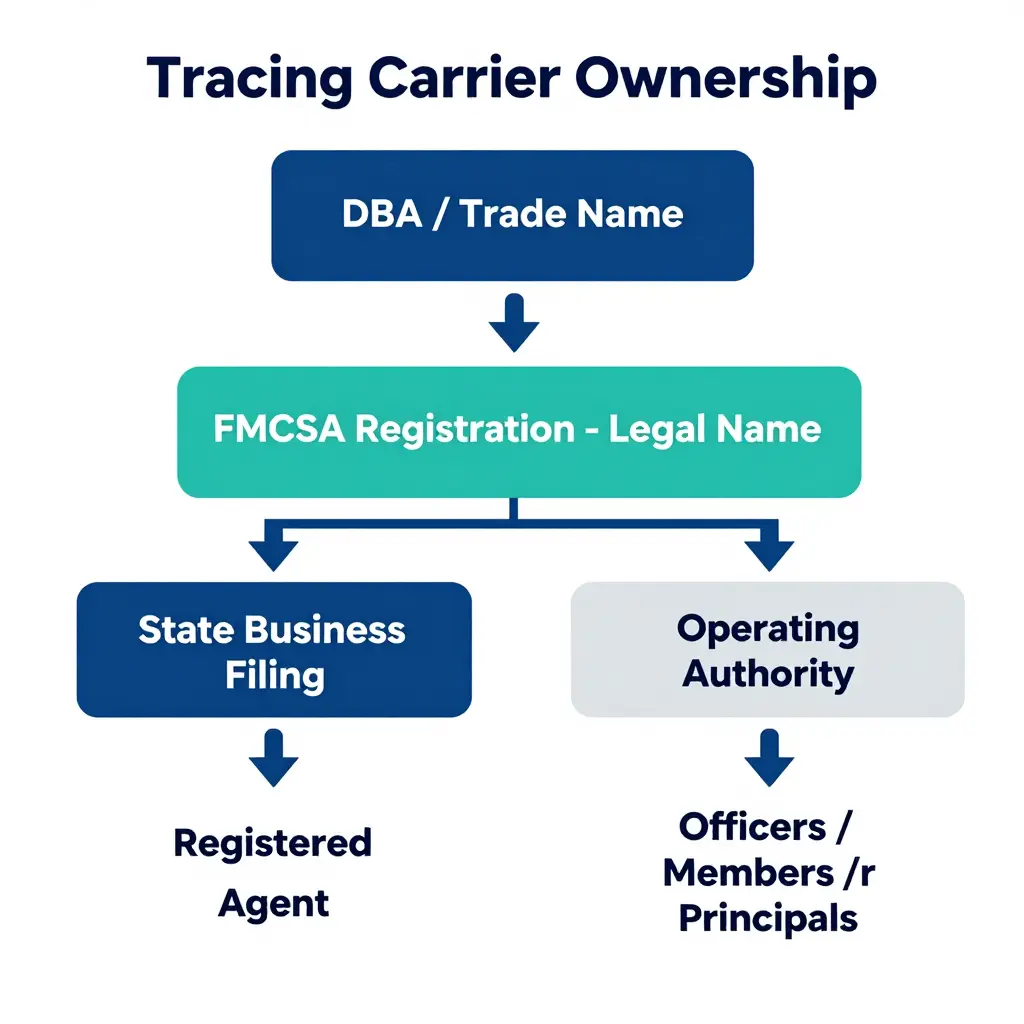
How to read the entity type
The legal entity tells you who is on the hook, which matters before you sign a contract.
| Entity type | What it means | Where the ownership trail leads |
|---|---|---|
| Corporation | A separate legal “person” owned by shareholders | Officers and directors listed in state filings |
| LLC | A flexible entity owned by members | Members named in the articles of organization |
| Sole proprietor | No separate legal entity; the owner is the business | The owner’s name appears directly on filings |
Tracing ownership from a DBA to the principals
A DBA (“doing business as”) is only a trade name. It is not a legal entity, and it says almost nothing about who is accountable. Tracing ownership starts by matching that trade name to a DOT number, then reading the FMCSA registration to find the legal name and address behind the brand.
From there, pull the state business filing in the carrier’s home state. That document gives the entity type, its formation date, its registered agent, and often its officers or members. Cross-checking the FMCSA record against the state filing is how you confirm that the operating carrier, any holding company, and the individuals in charge are genuinely connected rather than just sharing a mailing address.
The paper trail is what makes carrier identity verifiable in practice, much like how carrier operating models are documented for established fleets. Follow the names, not the logos.
FAQ: Tracing Super Service Trucking Ownership
Researching who really owns a carrier takes some digging, but most of the data is public. These are the questions freight brokers, shippers, and logistics professionals ask most often.
How can I find who owns Super Service Trucking using a DOT number?
Enter the DOT number in FMCSA’s SAFER system or the Company Snapshot tool. The result gives the registered legal name, address, and operating status. Then check that legal name against the secretary of state’s business registry in the company’s home state. Matching the DOT filing to a state incorporation record is usually the fastest way to confirm the owner behind a trucking brand.
What is the difference between a DOT number and MC number when checking ownership?
A DOT number is issued by FMCSA and identifies a company for safety-compliance and tracking purposes. An MC number grants operating authority to haul regulated freight. When you are checking ownership, the DOT number points to the registered company record and the MC number confirms who is legally allowed to operate. Checking both tells you whether the operating authority matches the entity named on the DOT filing.
Is FMCSA registration information public?
Most of it is, and it is free. SAFER, the Company Snapshot, and the Licensing & Insurance system list the legal name, DBA name, address, authority status, and insurance filings for registered carriers, with no account required. Some underlying documents take a formal public records request.
How do I verify the legal entity behind a DBA name?
A DBA is a trade name, so it has to be traced back to the corporation or LLC that legally owns it. Pull the FMCSA record to see both the DBA and the legal name, then confirm the legal entity with the state business registry where it is incorporated. If the two do not line up, ask the carrier for its operating authority letter or certificate.
Can ownership change without changing the DOT number?
Yes. The number attaches to the operating entity, not to a specific owner, so a carrier can change hands while the DOT number stays the same. A new owner may keep the existing USDOT and MC numbers to preserve the operating history and authority. That is why you re-check the current legal name, officers, and contact details each time instead of relying on an old record.
Where can I check operating authority and insurance for a carrier?
FMCSA’s Licensing & Insurance system and the SAFER database are the sources for active operating authority and required insurance filings. They show whether a carrier holds common or contract authority and whether its liability and cargo coverage meet federal minimums. Many brokers pair that with their own internal vetting, similar to how reputable providers approach evaluating trusted trucking partners.
How do I trace ownership if the carrier uses a registered agent or holding company?
Go one layer deeper into state incorporation filings and any LLC formation documents. Those records list the actual members, managers, or officers who control the business. Following the chain from the DOT number to the state registry usually reveals the real people behind the operation.
Due Diligence Checklist: Verifying Carrier Ownership Before You Hire
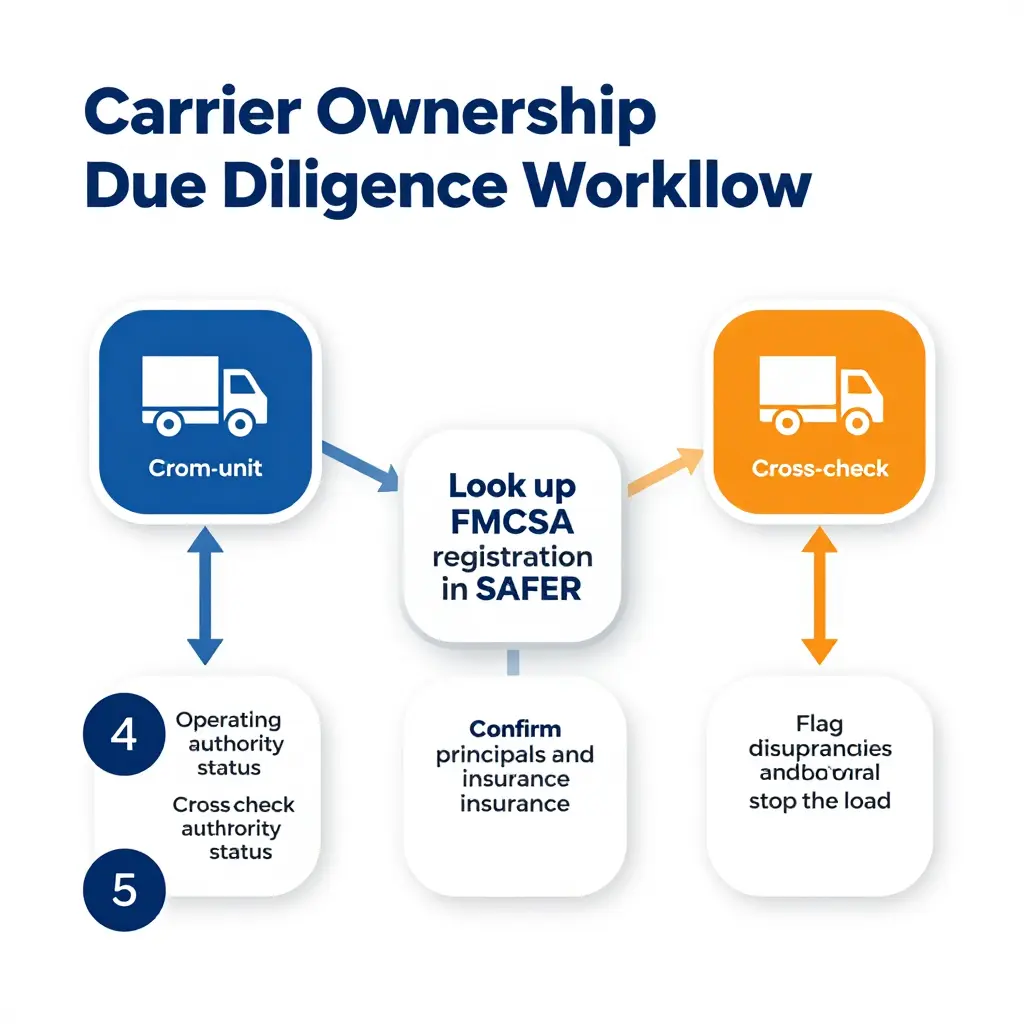
Even with a clear grasp of how DOT numbers and FMCSA registration work, the real test comes when you have to confirm that the carrier in front of you is exactly who it claims to be. Fraudulent operators, including so-called “chameleon carriers,” count on brokers and shippers skipping a few verification steps. The checklist below is built to prevent that.
The first move is always the same: pull the carrier’s record from FMCSA’s SAFER and Licensing & Insurance systems, using the DOT number on the unit. Do not rely on a photo of a registration certificate. Verify each field against the live database.
Red Flags: Warning Signs of Dubious Carrier Ownership
Any single item below deserves a second look; two or more should stop the load:
- Mismatched legal names. The name on the insurance certificate, the authority record, and the invoice do not align.
- Recently reissued DOT numbers. A DOT number registered weeks ago, especially tied to an older company name, signals a possible reincarnation.
- Chameleon carrier patterns. The same principals, phone numbers, or addresses appear behind several recently formed companies.
- Missing or inactive operating authority. The FMCSA record shows “not authorized” or a revoked or inactive status.
- DOT number discrepancies. The number on the door or the unit does not match the FMCSA registration record.
- Unverifiable principals. Officers or owners who cannot be confirmed, refuse to provide IDs, or list only a PO box.
Practical Verification Guidance
Document everything. Save screenshots of the FMCSA record, the date you checked it, and the legal name and address you confirmed. This audit trail matters if a claim or dispute arises later.
Call the insurance agent listed on the certificate, not a number the carrier gives you, to confirm active coverage. Ask who the policy’s named insured actually is; a policy issued to a different entity is a classic warning sign.
Cross-reference the phone number, address, and principal names in a general business registry and a reverse lookup. Chameleon operations tend to leave the same breadcrumbs across multiple shells, and those overlaps are your best early warning.
Finally, tie the checks back to the steps above. Confirming carrier ownership means matching the DOT numbers you found, the FMCSA data you pulled, and the people behind the company, every time and for every load. For a benchmark of what a fully verified, dependable operation looks like, quality service and reliability on the road makes a useful reference point.
Conclusion: Turning Public Records into Confident Decisions
Confirming who owns Super Service Trucking does not require private investigators or insider access. It requires a methodical pass through information that federal and state agencies already publish. The same approach answers the question for any other carrier you evaluate.
The process has four parts:
- Find the DOT number. Every operating carrier receives a unique identifier from the Federal Motor Carrier Safety Administration, and it appears on the truck and the paperwork.
- Check the FMCSA registration records. The SAFER and Licensing & Insurance systems confirm the carrier’s operating authority, address, and current status.
- Identify the legal entity and principals. The registration record names the entity; state filings and insurance documents name the people behind it.
- Cross-reference state business filings. Secretary of state databases reveal registered agents, incorporation dates, and officers or members.
For brokers, shippers, and logistics professionals, this work is more than a formality. It guards against fraud, clarifies accountability, and supports partnerships that hold up under pressure. Repeatable vetting processes drive reliability across the industry, much like the standardized fleet management practices described in this guide to the benefits of standardizing fire truck fleets.
As public regulatory data becomes easier to access and cross-reference, partnership decisions will rest less on reputation and more on verifiable records. Ownership tracing is part of the standard, not an extra.