
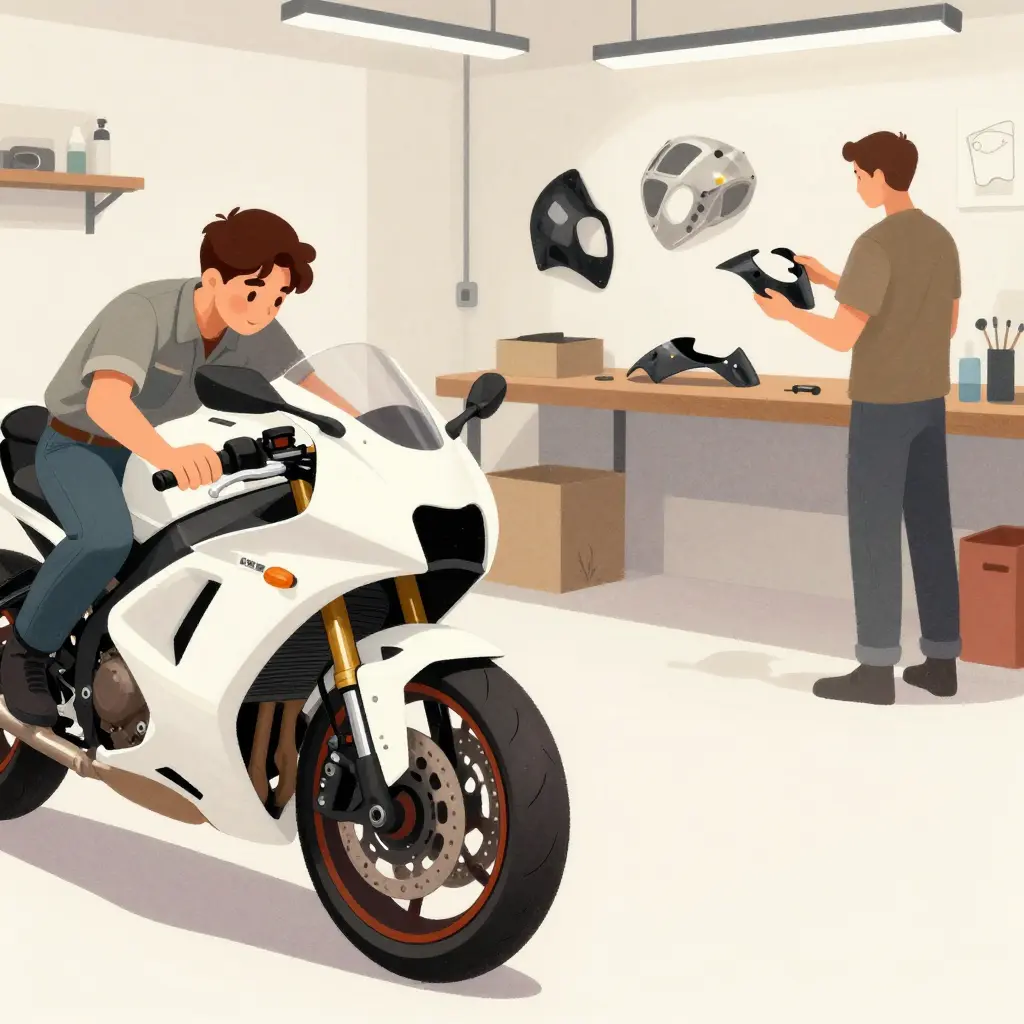
Allocating Fairing Supply: Crash Repair Shops Versus Custom Builders
Crash repair shops and custom builders buy the same parts: body panels, fairing kits, brackets, trim. Both are viable fairing channels, and the choice between them rarely comes down to which segment is larger. It comes down to demand profile, cost to serve and SKU fit. A big segment that orders unpredictably, returns a lot and expects finishes you do not stock will cost more than it earns.
What separates the two is why they buy. A repair shop buys against a job in front of it, usually under insurance or customer time pressure, so availability and fit accuracy outrank price per unit. A builder buys against a design intent, in smaller volumes, with more variability, longer evaluation cycles and a much stronger interest in finish, customization and supplier flexibility.
Those habits change what the same SKU costs you to serve. A high-velocity, low-variation repair account rewards depth in fast-moving part numbers. A builder account rewards breadth, tolerance for special orders and technical dialogue. Run both through one price list and one service promise, and you will over-serve one segment and under-serve the other. Suppliers in adjacent vehicle categories evaluate channel decisions the same way, and procurement best practices offer a useful reference point.
Channel economics widen the gap. Repair demand follows collision frequency, the model mix on the road and cycle-time targets. Builder demand follows project pipelines, show and season calendars and design trends. One channel is a replenishment business, the other behaves more like a project business, and each needs its own service promise and inventory posture.
The comparison below runs the same criteria against both channels and closes with a phased recommendation for suppliers who cannot fund both equally well at the start.
Crash Repair Shops as a Fairing Channel: What Buyers of Aftermarket Fairings and Fairing Kits Actually Need
Crash repair shops are not browsing for the latest styling trend. They are rebuilding motorcycles that insurers, riders and regulators expect back on the road quickly, and that single fact changes how a motorcycle fairing supplier should price, stock and serve this channel.
What a Motorcycle Fairing Supplier Must Get Right for Crash Repair Shops
Demand is claim-driven, not taste-driven. Replacement volume arrives because of collisions and insurance authorizations, so it clusters around the models most often involved in incidents rather than the models riders admire online. Carry depth in accident-prone platforms instead of spreading inventory thinly across the whole catalog, and treat collision frequency, not showroom popularity, as the planning signal for aftermarket fairings.
Downtime turns lead time into a line item. Every day a bike occupies a repair bay without parts is a day the shop cannot invoice, so delivery speed is part of the product. Quote dispatch windows you can hit, stage inventory closer to your busiest accounts, and flag a backorder before the shop discovers it on a job card.
Fitment and color matching decide whether an order stays sold. A panel that misses a mounting tab or arrives two shades off the factory finish turns a sale into a return, a rework bay and eventually a lost account. Publish mounting compatibility, tab positions and colorway references for fairing kits, and show how fitment is checked before dispatch. That protects margin better than any discount.
Reorder patterns concentrate on fast movers. Volume sits in a handful of popular models and a narrow set of common colorways, ordered again and again in small, urgent batches. Suppliers who hold stock depth on those fast movers and make reordering effortless get the routine business that keeps a channel profitable quarter after quarter.
Price sensitivity meets zero tolerance for late delivery. Shops quote against approved repair amounts and know exactly what each job pays, so they push hard on price. A cheap part that arrives late still costs them more than a fairly priced one that arrives on time. Tiered pricing that rewards volume, while still protecting quality service and reliability on the road, is the balance this channel responds to.
Administration is part of service. Clean invoicing, correct part numbers and predictable lead times keep a repair order moving through the office as smoothly as through the workshop. Consolidated invoicing, clear backorder communication and consistent lead-time statements cut disputes, and a shop that stops chasing answers stops shopping around.
Lead-time accuracy, fitment confidence and administrative discipline are the product here, not optional extras. Get those three right and shops route routine replacement volume to you instead of pricing every job from scratch.
Profiling Custom Builders as a Fairing Supply Channel
Custom builders sit at the opposite end of the supply spectrum. They order in small quantities, but the variety, finish specification and design input they demand make them a different commercial channel in practice. Where a repair shop buys to restore, a builder buys to differentiate, and that changes minimum order quantities, catalog depth and the technical support you have to carry. The profile below mirrors the repair shop profile point for point so the two can be compared directly.
Low volume, high variety. One build can pull a front fender, a side panel set and a belly pan from three unrelated model families, often as single units. That calls for MOQ structures built around mixed-SKU orders, per-unit picking and the operational willingness to ship partial cartons rather than push builders into bulk commitments they cannot absorb.
Unusual models and wide bodywork styles. Builders routinely request fitments that mainstream catalogs skip, plus wide-body conversions and stretched proportions. Catalog depth is the deciding factor: a supplier who stocks or can tool niche fitments wins the account, while a thin catalog loses the inquiry before pricing is discussed.
Unfinished surfaces ready for custom paint. Most orders arrive raw or gelcoat-only, so surface quality, gelcoat consistency and packaging that survives transit matter more than color matching. Quality control on unfinished shells and protective packing standards belong in the supply agreement, written down rather than assumed.
Longer lead times accepted when the geometry is right. Builders will wait on a schedule if the panel fits, because a misfit costs them days of rework. Publish honest lead times and compete on fitment accuracy instead of on speed.
Willingness to pay a premium for scarce shapes. Price resistance drops when a style is hard to find. Tiered pricing, limited-run exclusivity and controlled distribution protect margin on scarce custom motorcycle fairings.
Dependence on design consultation and mock-up confirmation. Builders want input on proportions, mounting points and sign-off before a production run. That is a real technical support load: CAD files, renders, test-fit panels, delivered through an assigned account contact much like established aftermarket support programs in other vehicle segments.
Trial order first, then scale. Nearly every relationship starts with a single fairing kit or a small set of aftermarket fairings before larger programs follow. Low-risk starter bundles plus documented repeatability, same tool and same gelcoat batch, are what turn a trial into a repeat program.
| Builder Behavior | Supplier Requirement |
|---|---|
| Small, mixed-SKU orders | Flexible MOQ and per-unit picking |
| Niche and wide-body fitments | Deep catalog and tooling access |
| Raw or gelcoat finish | Surface QC and protective packing |
| Longer lead times accepted | Accurate, transparent scheduling |
| Premium on scarce styles | Tiered pricing and exclusivity |
| Consultation and mock-ups | High-touch technical support |
| Trial before commitment | Starter bundles and consistency |
This segment rewards suppliers who treat variety as the product and accuracy as the promise, backed by catalog depth and real technical capacity rather than aggressive volume pricing. For a supplier able to absorb consultation time and small-order complexity, custom builders convert into loyal, high-margin, design-led accounts that rarely defect on price alone.
Crash Repair Shops vs Custom Builders: Fairing Supply Comparison
Where you point your fairing supply effort depends on matching production capacity to the way each channel buys. The table lines the two up so volume, flexibility and cash flow can be weighed on equal terms.
| Comparison Factor | Crash Repair Shops | Custom Builders | Supplier Implication |
|---|---|---|---|
| Order volume per cycle | Moderate, job-driven batches per repair | Low volume, single-project buys | Plan mixed pallet sizes and flexible MOQs |
| Order frequency | Steady weekly reorders after approvals | Irregular, project-timed orders | Hold predictable reorder stock; absorb irregular spikes |
| SKU breadth needed | Wide coverage of mainstream OEM models | Narrow but exotic, model-specific ranges | Stock fast movers; source long-tail parts on demand |
| Model and style variety | Standard street and commuter platforms dominate | Vintage, custom, and specialty builds dominate | Balance broad catalog with specialist sourcing network |
| Price sensitivity | High; insurers cap repair costs | Moderate; pays premium for uniqueness | Offer tiered pricing and value-engineered options |
| Lead time tolerance | Short; vehicle downtime costs money | Long; projects scheduled well ahead | Prioritize fast dispatch for repair accounts |
| Customization requirement | Minimal; OEM-matched fitment expected | High; bespoke finishes and modifications | Separate custom quoting from catalog order flow |
| Returns and fitment risk | Elevated; wrong-part returns common | Lower volume but higher rework cost | Budget returns handling; publish precise fitment data |
| Technical support demand | Moderate; quick answers on interchangeability and hardware | High; design collaboration, CAD files and finish advice | Resource technical depth and clear response SLAs |
| Payment and credit preference | Net terms tied to insurance cycles | Deposits and staged payments | Extend credit selectively; use deposits for custom work |
| Repeat business predictability | High; recurring panel replacement demand | Project-based and less predictable | Forecast repair accounts; treat builders as opportunistic |
Each row is a trade-off: the middle columns show how the two channels buy, and the last column shows what that behavior demands from inventory, pricing and operations.
Demand Signals and Ordering Behaviour: Crash Repair Shops vs Custom Builders
Two buyers can order the same fairing set and behave nothing alike. One calls every few weeks for a repeat batch of a best-selling model in a standard color. The other sends a single, oddly specific request for a niche body style in a finish nobody stocks. Reading those patterns correctly is what separates a supplier who plans capacity from one who is always short a fast mover or sitting on dead stock.
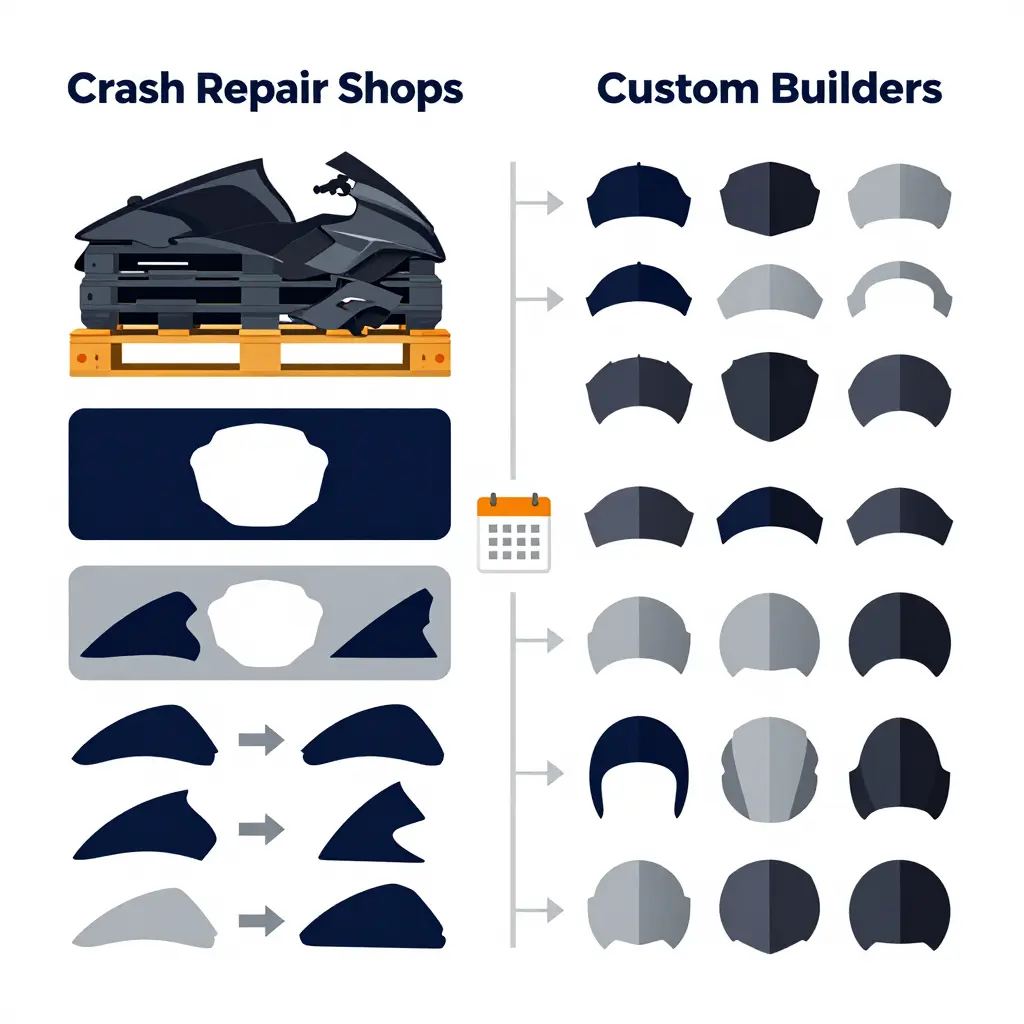
Depth versus breadth: reading the first three orders
Crash repair shops buy in depth. Most of their work restores a bike to factory condition, so bulk orders concentrate on a short list of high-volume models and standard colorways (black, white, OEM-matched gloss), repeated in batches sized to a few weeks of workshop throughput. A shop would rather hold four sets of one popular side panel than one set each of four exotics.
Custom builders buy in breadth. Demand spreads across niche models, older generations and styles no volume forecast would predict: matte finishes, wide-body conversions, track-inspired kits, primed panels headed for paint. Units per style are small, variety per order is wide, and the mix changes with every new project brief.
That split drives most planning decisions downstream, so it belongs in the forecast model rather than in a sales anecdote.
Forecasting logic that respects both channels
- Segment the forecast before you total it. Build two demand streams, depth-driven volume from crash repair shops and breadth-driven volume from custom builders, and never average them into one number.
- Forecast shop volume on rolling consumption of fast movers. Base depth on repeat draw-down of top models and standard colorways, and cap speculative depth on long-tail styles.
- Forecast builder volume on pipeline, not history. Weight project briefs, open quotes and repeat requests for the same niche style rather than last year’s average mix.
- Treat MOQ and restock terms as forecasting inputs. Where minimums are high, buyers consolidate and demand arrives in lumps; where minimums are low, demand arrives as a steady trickle of small, varied orders.
The first two rules protect inventory investment. A shallow, uniform forecast across all SKUs almost always under-serves the models that turn and over-serves the ones that look interesting on paper. Depth planning keeps the top of the range replenished without locking working capital into dozens of styles that move once a quarter.
The last two protect flexibility. Builder demand rarely announces itself in advance, so pipeline signals (quotes, build inquiries, finish requests) do more forecasting work than order history. Order terms change behavior too: a high minimum on a niche style pushes buyers into fewer, bigger, harder-to-predict purchases, while a low minimum smooths the inflow and makes the whole supply chain easier to schedule.
Seasonality and pre-season stocking
Crash repair demand follows riding season with a lag: bikes go down when they are being ridden, and shops stock ahead of that window so a queue never means a stripped bike waiting on bodywork. Their stocking is defensive and fairly predictable. Custom builders run on a different calendar of winter builds and project deadlines, and they pre-order for a build in progress rather than for a season. Plan pre-season inventory for standard colorways in volume, reserve small-lot production capacity for build-season custom requests, and the two channels do not cannibalize each other.
What each channel expects from MOQs and restock cycles
| Expectation | Crash Repair Shops | Custom Builders |
|---|---|---|
| Minimum order quantity | Accept moderate minimums on fast movers, provided fill rate is high | Need low minimums per style, accept paying a premium |
| Restock cycle | Short and reliable, frequent top-up of a tight SKU list | Longer cycles fine if the niche style can be sourced at all |
| Range breadth | Narrow, standard colorways | Wide, custom finishes and primers |
| Forecast basis | Historical consumption | Project pipeline and quotes |
Buyers remember consistency of delivery, the same principle behind this look at quality service and reliability on the road. A missed restock costs a shop a bay day; a missed niche style costs a builder a reveal.
Repeat-order rates as a channel health signal
Repeat-order rate only means something once it is split by segment. In the crash repair channel a healthy account reorders the same core SKUs on a steady rhythm. A rising repeat rate signals trust and share of wallet; a flat or falling rate on a shop that used to buy monthly usually points to a competitor, a local stockist or a change in insurance work. Builder health looks different, because repeat orders arrive with shifting SKUs: a growing style range per repeat customer signals a good relationship, while a repeat buyer who suddenly orders one narrow item signals a stalled pipeline. Read the two cohorts separately and a motorcycle fairing supplier gets an early warning system instead of a lagging sales report.
Comparing Order Volume and Frequency: Crash Repair Shops vs Custom Builders
Before splitting a fairing supply allocation, it helps to see how the two channels actually buy. Crash repair shops order in volume and repeat often; custom builders order lean and deliberately. The chart puts both side by side on the three metrics that shape stocking, pricing tiers and freight planning.
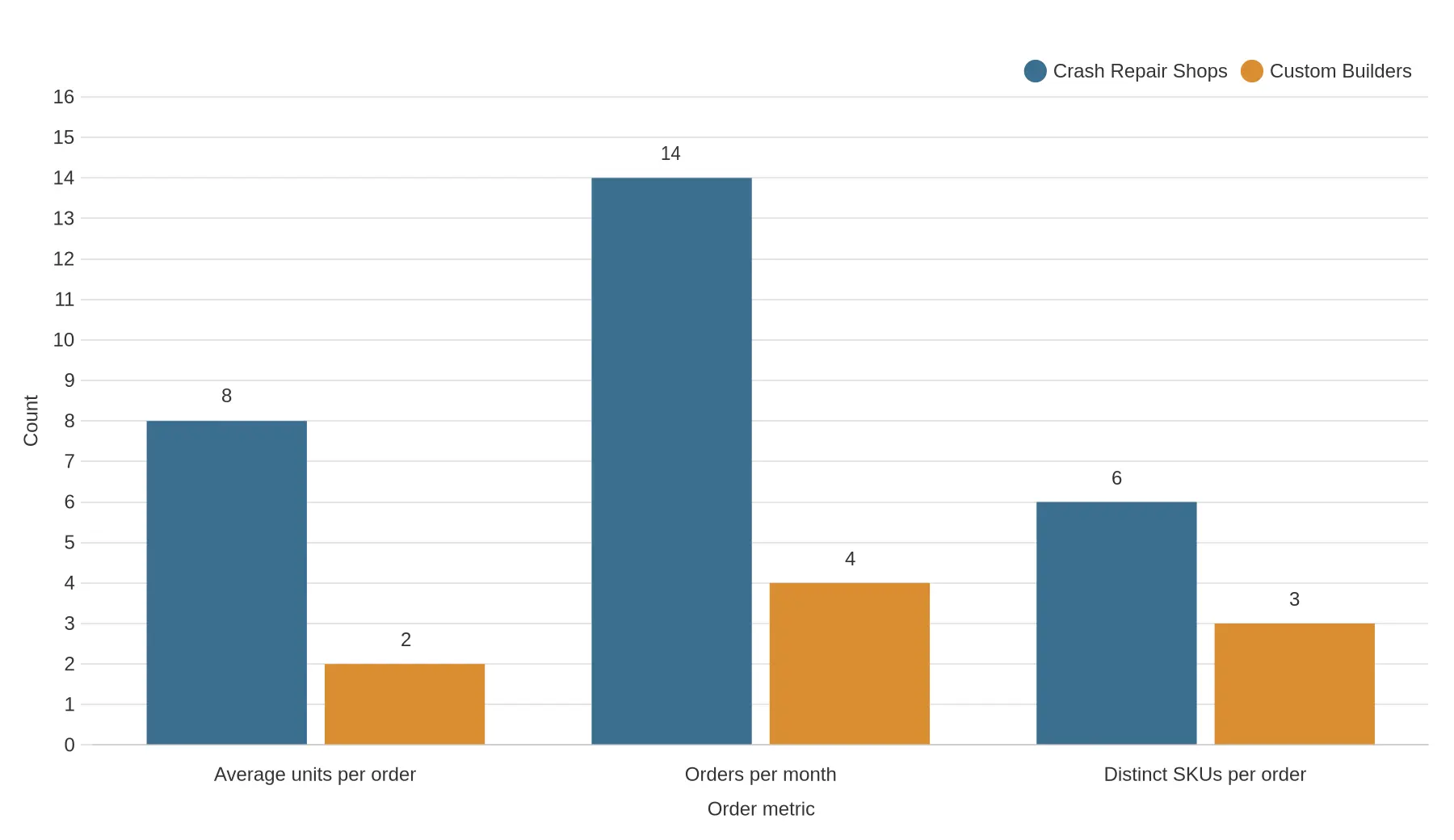
Crash repair shops order roughly four times more units per order and more than three times more often than custom builders, which makes them the fairing supply channel with the steadiest, most predictable demand.
The Same Numbers in Table Form
| Metric | Crash Repair Shops | Custom Builders |
|---|---|---|
| Average units per order | 8 | 2 |
| Orders per month | 14 | 4 |
| Distinct SKUs per order | 6 | 3 |
What the Pattern Means in Practice
- Crash repair shops carry your volume. Eight units per order at 14 orders a month comes to roughly 112 units monthly from a single account, spread across about six part numbers. That mix rewards depth on fast-moving, high-damage fairings and simple reorder paths.
- Custom builders carry variety and margin. Two units per order, four orders a month, three SKUs each is low volume and high touch. These buyers need consultation, one-off finishes and small-batch availability, not pallet quantities, and they pay for the flexibility.
- SKU spread sets warehouse cost. A six-SKU average from repair shops means more pick faces and tighter kitting discipline. If you are deciding how far to standardize the catalog to keep picks efficient, review the benefits of standardizing fleets on a common spec before committing shelf space to long-tail parts.
- Two channels, two service models. Repair shops respond to fast shipping, bulk price breaks and dependable stock. Custom builders respond to lead-time transparency, small minimums and design input. Running both from one price list usually costs you one of them.
Repair shops win on units per order, frequency and SKU breadth, which is why they should anchor base volume while custom builders fill the gaps that keep your brand’s design reputation alive.
Margin, Pricing, and Cost-to-Serve: Where Channel Profit Actually Lives
A headline price is not a margin. Between the quote you send and the cash you keep sit picking time, packing materials, freight class, fitment questions and returns, and those costs behave very differently depending on whether you are shipping one tailored set to a builder or a steady stream of repair orders to a collision shop. Here is the same fairing supply catalog read through three lenses: headline price, hidden cost and net margin.
Headline price: unit margin is not account margin. Unit margin tells you what one part earns before overhead. Account margin tells you what the customer earns across a quarter, after every pick, pack, question and credit note. A distributor running an export catalog of over 3,000 styles, covering almost all motorcycle models, can offer prices 10-40% below comparable sites because that breadth spreads tooling and inventory cost across far more SKUs. The same breadth also means thousands of low-volume lines, each carrying its own handling burden. Fewer, larger repair orders concentrate revenue into predictable batches, so labor and freight amortize cleanly. Many small orders from custom builders lift revenue per transaction modestly while multiplying touches per dollar earned. Neither model is wrong; they fail at different points, and the failure shows up in account margin rather than unit price.
Hidden cost: packaging and freight per unit punish fragmentation. Freight is priced on dimensional weight and class, not on part value, so five single-fairing shipments usually cost materially more per unit than one consolidated pallet of the same parts. Custom work compounds this: film wrap, edge protection and reinforcing for oversize or one-off pieces cannot be batched, and every bespoke packing pattern costs design time you never invoice. Then comes the quietest expense, fitment disputes and returns. A part that is correct but perceived as wrong still triggers inspection, repacking, return freight and a reshipped replacement, often wiping out several units of margin on a single order. Handling many small custom orders versus fewer, larger repair orders is mostly a question of how often that cycle repeats.
| Cost driver | Small custom orders | Fewer, larger repair orders |
|---|---|---|
| Picking and packing per unit | High, rarely batched | Low, batch-friendly |
| Freight cost per unit | High, dimensional weight dominated | Low, consolidated |
| Fitment query volume | High, model-specific detail | Moderate, repeat part numbers |
| Return and dispute exposure | Elevated per unit | Spread across volume |
| Margin visibility | Obscured by overhead | Easier to forecast |
Net margin: controlled cost-to-serve is what converts a discount into profit. A lower purchase price only becomes profit when cost to serve is controlled. Wholesale fairing pricing 10-40% under comparable sites creates real room to compete, but if that room is consumed by re-packs, repeat fitment calls and return freight, the customer feels a discount while you feel a thinner account. Practical controls matter more than discounts: standardize packaging by fairing family, publish fitment data so questions are answered once rather than per order, and commit to fast responses so a query never becomes a dispute. A six-hour answer guarantee on every question is not a service flourish; it is a cost-to-serve instrument that stops ambiguity from turning into returned goods. Buyers weighing channels often find that procurement best practices built on total cost of ownership explain the gap between a cheap quote and a profitable relationship, and the arithmetic is the same whether the asset is a fire apparatus or a set of aftermarket fairings.
The channel that turns price advantage into repeat profit more reliably is the one whose order pattern lets you batch handling and keep disputes rare, typically larger, repeatable repair-order volume rather than a long tail of one-off customs. Custom builders reward you with loyalty and premium positioning, but only once packaging standards and fitment clarity are in place to protect the margin their orders consume.
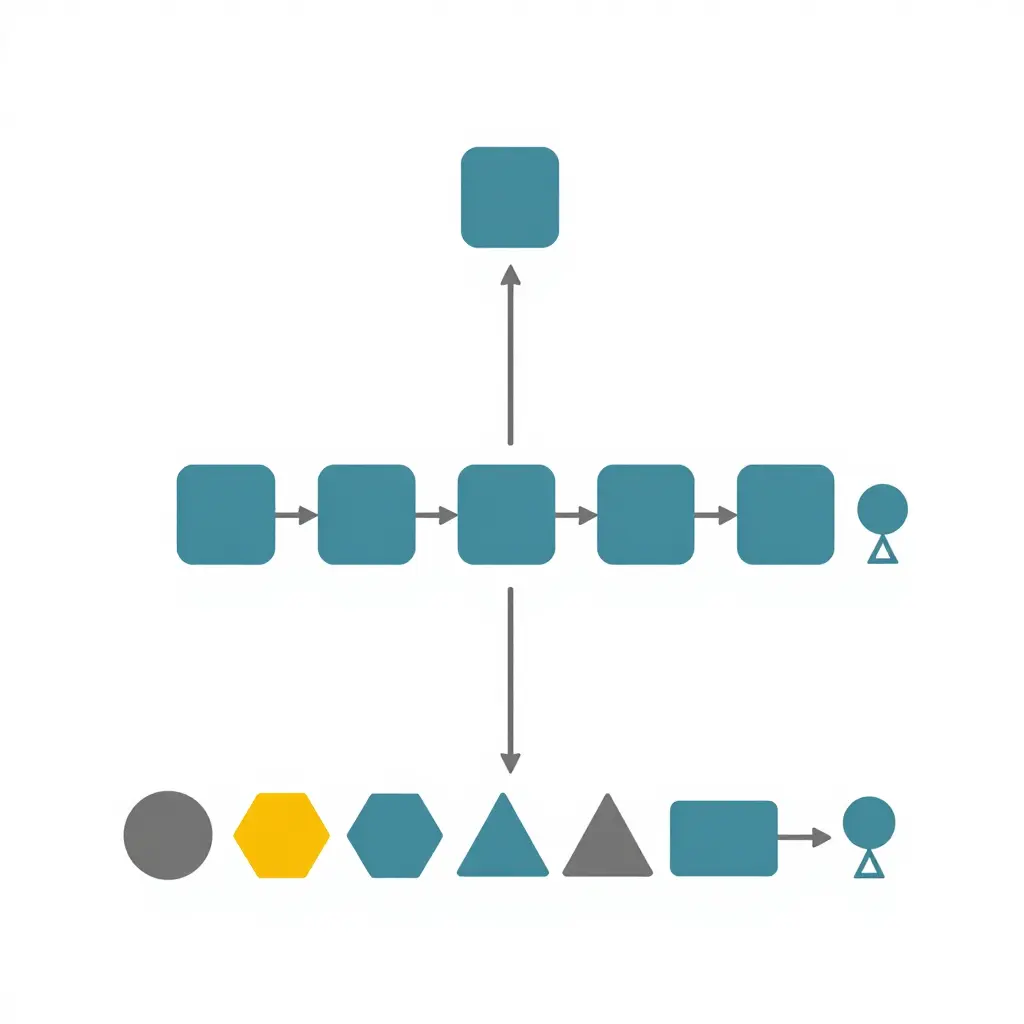
One catalog splits into two very different journeys: the repair channel runs short and wide on identical repeat units, while the custom channel runs long and narrow through one-off builds before either reaches delivery.
Catalog Breadth and Inventory Strategy: Allocating 3,000+ Styles Across Two Channels
A catalog of more than 3,000 styles covering almost all motorcycle models is a serious competitive asset, but only if it is allocated with intent. Spread that breadth evenly and you get warehouses full of parts nobody asks for and empty shelves where demand actually lives. Here is the allocation logic we recommend to any motorcycle fairing supplier running a repair-driven channel alongside a build-driven one:
- Fast movers: stock deep and keep them at the front of the pick line; these are the models with large installed populations and predictable crash frequency.
- Mid-tail: stock shallow and replenish on a tight cycle, letting each channel’s order history set the reorder point.
- Long-tail: hold as special-order, made-to-mold or on-demand supply rather than shelf inventory.
- Crash repair shops: allocate fast movers and the mid-tail, prioritized in factory color-matched variants ready to bolt on.
- Custom builders: allocate the long-tail and any structurally distinctive styles, weighted toward unpainted and custom-color options.
- Color-match variants: deep stock only on the highest-velocity paint codes; everything else is painted to order.
- Discontinued and slow-moving molds: retain the tooling, run in batches against confirmed demand, and flag last-time-buy windows.
- High-frequency repair buyers: protect a reserved share of fast movers so custom orders never consume their availability.
Tiering starts with evidence, not instinct. Pull crash and replacement frequency by model and year, cross it with the installed population in your markets, and watch how often each style turns over in your own order history. Anything that repeats reliably becomes a fast mover. Anything that sells in steady but modest volume sits in the mid-tail and earns its place through availability rather than depth. The genuine long-tail, rare years, low-volume models and one-off body styles, is where a broad fairing supply catalog creates the most perceived breadth with the least capital tied up. That is also where the two channels diverge: repair shops live on speed of replacement, so the mid-tail fits them, while custom builders treat the long-tail as raw material for a vision and will wait for the right shell.
Depth decisions follow the same split. Stocking depth belongs to fast movers in a small set of high-demand color-match variants, plus a consistent unpainted base that serves both audiences and keeps custom motorcycle fairings projects moving without paint-shop dependency. Special-order depth, meaning the commitment to mold and paint on request with a clear lead time, belongs to everything else, and the honest conversation with a builder is about timeline, not shelf stock. When a mold slows down or a model is discontinued, move it to a batch-run model rather than delisting it, so long-standing customers can still complete a fairing kits order years later. Protect repair accounts by ring-fencing inventory for them: a reserved share that custom work cannot draw down, plus published lead times so nobody is guessing. Handled this way, breadth and reliability stop competing and both channels feel served.
Eight-Point Channel Qualification Scorecard
Before you commit fairing supply to a single channel, run both crash repair shops and custom builders through the same eight criteria and rate each from 1 (poor) to 5 (excellent). Add the scores, compare the two totals side by side, and let the numbers open the conversation instead of your gut, the same discipline that sits behind sound procurement best practices.
- Order predictability – Score how reliably each channel reorders: steady monthly volumes earn a 5, one-off bursts followed by long silences earn a 1 or 2. The target is a buyer whose order rhythm you can forecast two to three months ahead.
- SKU fit with the existing catalog – Measure how much of their demand lands on parts you already stock, mold and finish, because catalog overlap turns fairing supply into repeat business rather than a tooling project. Roughly 60% or more of requests matching what you carry is a good result.
- Net margin after cost-to-serve – Subtract freight, packaging, small-order handling and returns from gross margin before comparing channels. The margin has to hold at realistic order sizes, not just on a best-case full pallet.
- Fitment and returns risk – Score historical return rates, fitment complaints and the labor needed to resolve them; crash repair shops usually demand exact OEM-style fit, while custom builders may tolerate more variation. A return rate under 5%, backed by clear, documented fitment data, is a good result.
- Support workload – Estimate the hours per order spent on quotes, photos, fitment questions and follow-ups. The best channel self-serves from your catalog and escalates only genuine technical issues.
- Payment reliability – Review agreed terms, days-to-pay history and any past delinquency, weighting late payments heavily against the account. Consistent on-time payment with no chasing is the standard.
- Reorder potential – Score the likelihood of repeat orders within twelve months based on repair volume or build pipeline. A channel that becomes recurring revenue after the first two or three orders scores well.
- Strategic growth potential – Weigh where each channel is heading: expanding custom builders can grow with your brand, while established crash repair shops deliver dependable volume. A partner whose growth pulls your fairing supply into new territory earns the higher score.
Add up the totals; the higher score usually names the channel to lead with.
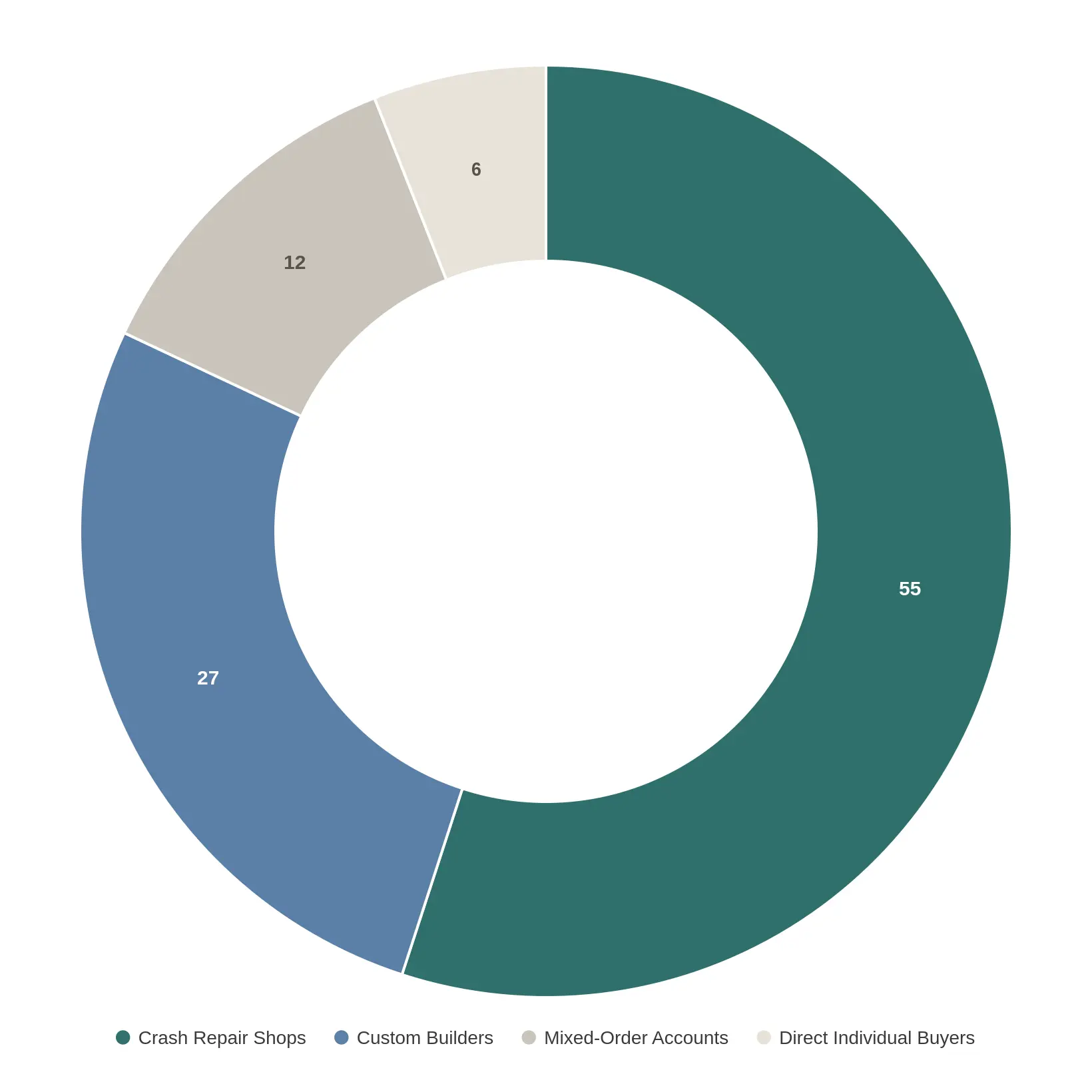
This revenue mix reflects a deliberately balanced fairing supply portfolio rather than a default split, keeping crash repair volume as the backbone while custom builders and mixed-order accounts keep the pipeline resilient.
Operational Risk Compared: Crash Repair Shops vs. Custom Builders
Every fairing supply relationship carries risk you cannot fully price per unit: panels that arrive scuffed, fitment arguments that drag on for weeks, returns that eat margin without anyone noticing, and support questions that arrive at 9 p.m. before a show deadline. What makes the comparison interesting is that the same product behaves differently depending on who receives it. Crash repair shops order against a job card and a customer’s insurance timeline; custom builders order against a design vision and a build calendar measured in months. Different volumes, different tolerances, different definitions of “good enough.” The read below covers where the exposure actually sits, channel by channel, so you can price, package and staff each relationship deliberately.
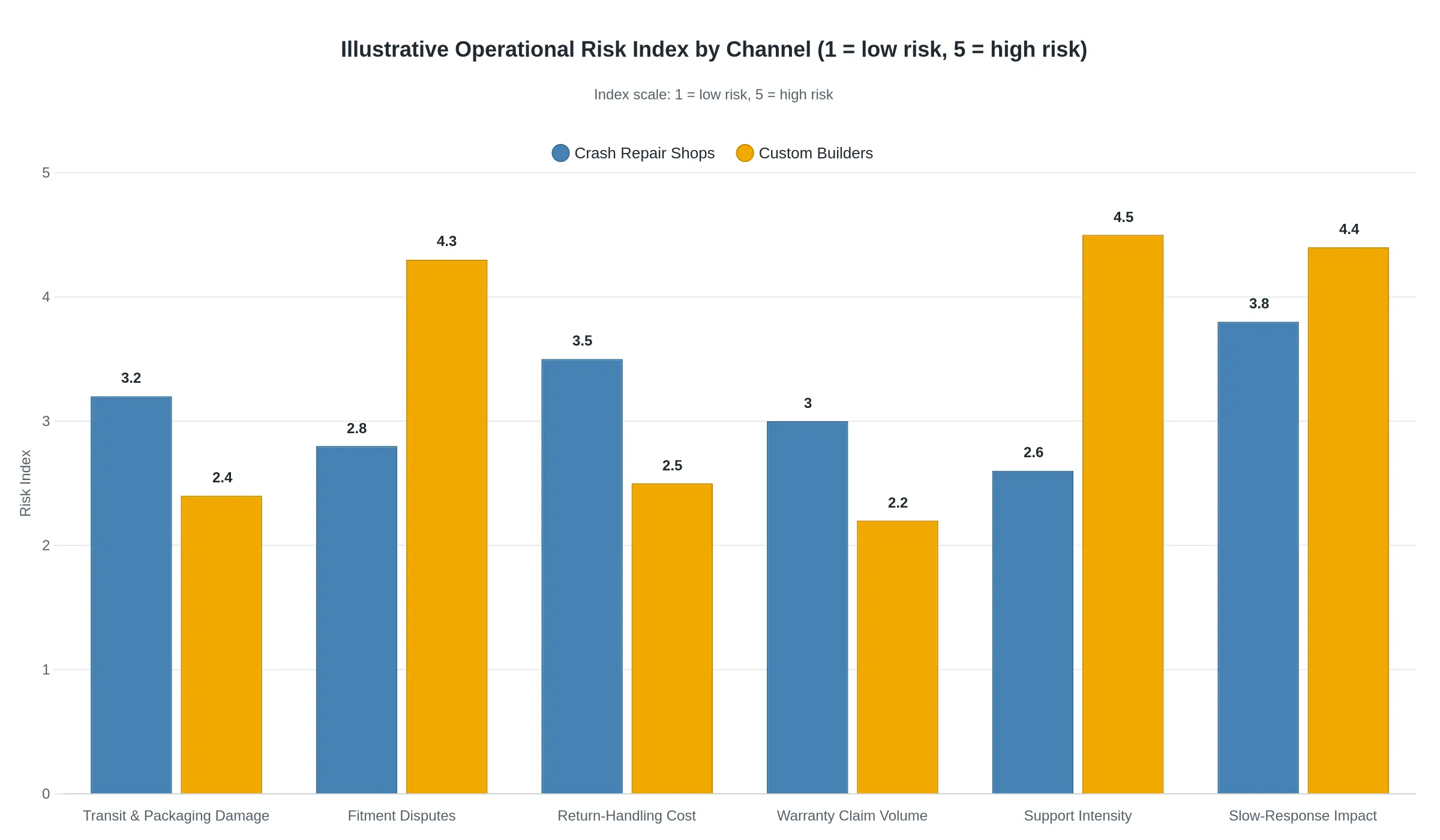
Four controls do most of the work in both channels:
- Package to the channel, not to the pallet. Double-box and foam-block single-set shipments; use rigid corner protection, stretch wrap and edge guards on bulk lots.
- Publish a fitment verification checklist. Photograph mounting points, tab locations and hardware bags so disputes are settled with evidence rather than opinion.
- Set restocking tiers in writing. Flat-fee restocking on resalable sets, a higher percentage on opened or painted parts, and photo authorization before any return ships.
- Front-load technical content. Mounting guides, torque values and paint-prep notes on the product page cut support minutes per order far more than any phone script.
Transit and packaging damage exposure
Crash repair shops tend to order what the job needs now, often one to three panels, shipped individually and unpacked in a hurry on a busy shop floor. Small-parcel handling means more touches per part, so scuffed edges and cracked tabs are a recurring cost. Custom builders usually consolidate larger orders, which reduces per-panel handling but raises the stakes: one damaged nose section can stall an entire build. The practical answer is dimensional weight discipline in one direction and rigid over-packing in the other.
Fitment disputes: one set versus many
This is where the channels diverge most sharply. A shop fitting one set to one damaged bike expects factory-level alignment and judges quickly, but the dispute is usually narrow and documented by a repair order. A builder fitting many sets across a project, often with aftermarket bodywork, custom subframes or modified mounting points, introduces far more variables. When alignment is off, the cause may be the frame, an earlier repair or the builder’s own modification, and untangling that takes hours of diagnostics. Bulk orders amplify the question: is one bad panel a packing error or a production trend?
Return handling and restocking policy fit
Returns from shops skew toward wrong-part and wrong-color scenarios driven by urgent ordering, and they are frequent but small. Returns from builders skew toward changed-direction decisions and oversprayed or drilled parts, which are rarer and almost never resalable. A restocking policy that charges by percentage of value works for shops; a policy that charges by panel count and requires pre-paint dry-fitting documentation works better for builders. State it before the first order and most of the friction disappears.
Warranty and defect claims volume
Defect claims per order run higher in the shop channel, partly because more orders mean more touch points and partly because shops escalate anything that threatens a promised delivery date. Builders file fewer claims but expect deeper investigation and root-cause answers, since a failure mid-build can cost them a deposit. Track claim reasons by channel rather than in aggregate; the two lists rarely look alike.
Technical support intensity
Support is where aftermarket fairings turn expensive without it showing on the invoice. Shops mostly need a quick confirmation on interchangeability and hardware. Builders need mounting guidance, bracket sequencing, trimming tolerances and detailed paint preparation, including adhesion promoter selection, flex additive ratios and how much surface scuff a gel coat tolerates before primer. That is a consultative conversation, not a lookup. Planning support capacity so it protects delivery dates matters as much as inventory planning, and the difference shows up in repeat order rates.
Response speed and channel loyalty
Slow answers cost more in the builder channel because a paused build pauses cash flow; slow answers in the shop channel cost a bay. That is why a six-hour response commitment is a structural advantage rather than a marketing line. It converts support from a cost center into a retention mechanism, and in a market where suppliers look interchangeable, the vendor who replies first usually keeps the account.
Conclusion: The shop channel carries lower structural risk, because order sizes stay small, fitment variables are limited and returns remain largely resalable. The builder channel offers richer relationships and larger tickets, but demands heavier support investment and a tolerance for complex, judgment-based disputes.
Drawing Supply-Chain Parallels from Adjacent Heavy-Duty Vehicle Sectors
Deciding who should receive a fairing supply offer, crash repair shops, custom builders or both, is really a decision about channel structure. Neighboring heavy-duty sectors have already run that experiment. Fire apparatus and commercial truck fleets buy in a structurally similar pattern: a fragmented buyer base, high cost of downtime, long asset life and heavy specification scrutiny. Those similarities make the sector a useful mirror rather than a competitor, and three of its principles transfer cleanly to fairing supply.
Principle One: A Shared Catalog Shrinks Complexity Across the Buyer Base
Heavy-duty buyers learned that variety is a cost, not a feature, once every unit in a fleet carried its own part logic. Consolidating around a common catalog cut training, inventory and mis-order rates across large fleets, the same effect set out in the benefits of standardizing fire truck fleets. For a motorcycle fairing supplier serving repair shops, a standardized core range with consistent fitment families, part numbering and mount conventions converts hundreds of near-unique requests into a predictable catalog. Custom builders will still need bespoke work, but they can be served from a documented base instead of from scratch each time.
Principle Two: Support and Uptime Planning Weigh as Much as Unit Price
Purchase price is the visible number; availability is the expensive one. Adjacent sectors treat support as a line item in the buying decision, which is why operators focus on how to maximize fire apparatus uptime product support rather than on invoice price alone. A repair shop that cannot quote a timeline because panels are backordered will not stay a customer, however competitive the unit cost looked. Replacement speed, damage-rate transparency, packaging integrity and return handling belong in the offer right next to price.
Principle Three: Multi-Stakeholder Buyers Reward Documentation and Predictable Lead Times
When a decision passes through committees, estimators and several approvers, the supplier who documents wins. Written specifications, revision control and stable lead times lower perceived risk for every party in the chain, a pattern visible in established fire apparatus procurement best practices. Custom builders tend to buy on trust and craft; institutional buyers buy on paper. A B2B supply partnership serving both therefore has to run on published specs and dependable schedules rather than verbal assurances.
| Transferable principle | Heavy-duty precedent | Fairing supply implication |
|---|---|---|
| Shared catalog | Fleet-wide part commonality | Core fitment families plus a documented custom tier |
| Uptime planning | Support contracts and parts availability | Lead-time commitments and replacement speed |
| Documented specifications | Committee-reviewed bid packages | Published specs, revision control, stable schedules |
The lesson is not that fairings should be sold like fire trucks. It is that the channel questions are structurally the same: how much variation the buyer base can absorb, how much downtime it can tolerate, and how much documentation its decision process demands. Read those three signals from your own prospects and the crash-shop versus custom-builder split becomes a routing decision rather than a guess.
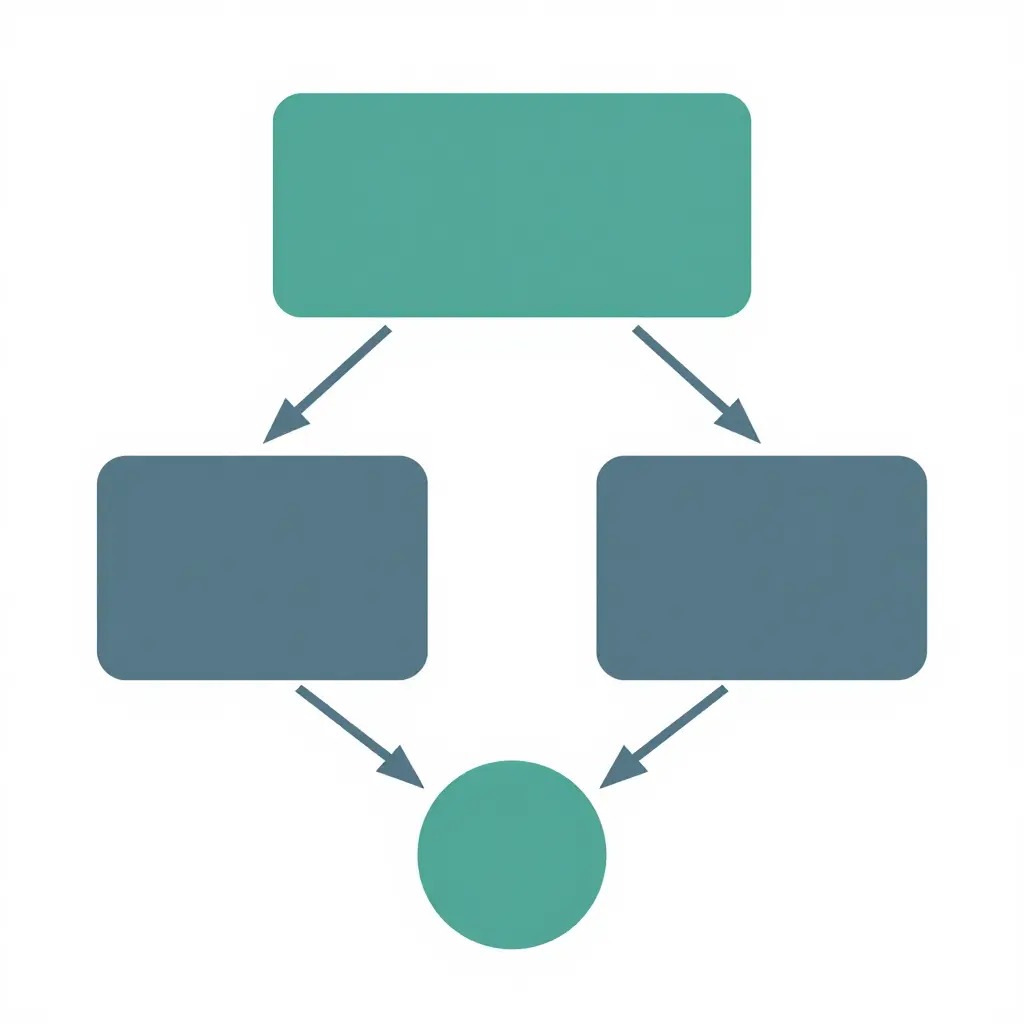
One consolidated fairing supply core feeds two parallel distribution branches that later merge into a single support and returns function, keeping service capacity unified while each channel is served independently.
The Recommended Dual-Channel Strategy: Lead With Crash Repair, Then Layer in Custom Builders
The strongest position is a sequenced dual-channel approach: lead with crash repair shops, then layer custom builders on top. Sequence matters more than picking a side. Collision-driven demand gives a supplier a predictable base to staff, stock and quote against, while the builder channel absorbs long-tail catalog breadth and lifts margin. Both run on one shared inventory core and one set of support standards, so a fairing supply business grows without splitting itself in two.
Volume Foundation: Why Crash Repair Shops Come First
Crash repair shops buy on a rhythm. Repairs arrive steadily, parts fail in recognizable patterns, and reorders follow the same models and vintages month after month, which makes demand forecastable and wholesale fairing pricing easy to structure in tiers. That predictability supports bulk stocking, simplifies production planning and gives a motorcycle fairing supplier a dependable baseline that covers fixed costs before anything experimental enters the catalog. Start here and the operation earns the right to expand rather than gambling on it.
Margin and Differentiation: The Custom Builder Layer
Custom builders want one-off finishes, modified mounting points, short-run colors and rare model coverage, which is exactly where catalog breadth and margin live. Serving them turns slow-moving SKUs into sellable inventory, opens premium and semi-custom lanes, and positions a supplier as a design partner rather than a parts counter. This layer also protects the core business: repair volume funds the flexibility builders require, and builder projects keep the brand visible in high-profile builds.
Shared Operations: One Core, One Standard
Both channels pull from the same inventory core, the same quality checks and the same support promise, which keeps a B2B supply partnership clean and consistent. Segmentation lives in how orders are priced, packed and prioritized, not in duplicated warehouses or separate teams. A customer should experience one company whether they order a single replacement panel or a seasonal run of custom bodywork.
Three-Step Rollout Sequence
- Segment the catalog. Split SKUs into a high-rotation collision core and a long-tail custom tier, tagging each by demand pattern, lead time and margin band so ordering rules follow the data instead of habit.
- Define service levels. Publish separate commitments for crash repair shops (fast dispatch, core-part availability, tiered wholesale fairing pricing) and for custom builders (quote turnaround, finish options, minimum quantities), then hold both to the same quality and response standards.
- Set a review cadence. Run a monthly internal review of fill rate, reorder frequency and margin by channel, plus a quarterly check-in with accounts in each segment, then adjust stock depth and service terms to what the numbers show.
That order protects cash while building reach: volume first, differentiation second, one operational backbone underneath both. Questions sent to our team receive an answer within six hours.
FAQ: Choosing a Fairing Supply Channel
Is crash repair or custom builder a better first fairing supply channel?
For most suppliers, crash repair shops are the safer first channel. Their demand is repeatable, driven by collision volume rather than personal taste, and they reorder aftermarket fairings in steady batches all year. Custom builders deliver higher margin per order but irregular timing and far more consultation. Start with repair shops to build predictable cash flow, then layer builders on once your catalog, packaging and invoicing processes have survived real volume.
Do custom builders order enough volume to justify the support load?
Individually, no; collectively, often yes. At two units per order and four orders a month, a single builder is a small account, but fifty of them add up to more monthly volume than a repair shop’s roughly 112 units. The real cost is support: color matching, fitment questions and design consultation consume hours that never appear on an invoice. Build that service into builder pricing, publish clear specification cutoffs, and reserve deep technical help for accounts that hit annual minimums.
Can one fairing catalog serve both channels?
Yes, with segmentation. A broad 3,000-plus style catalog of aftermarket fairings covers most collision orders and nearly every custom build, provided stock depth favors high-turnover OEM-style SKUs while custom-exclusive designs run leaner. The difference is merchandising rather than inventory breadth: repair shops need fast lookup by model year and color code, while builders need galleries, fitment notes and finish options. One catalog, two front doors, one warehouse.
How do minimum order quantities and lead times differ between the two?
Crash repair shops accept modest opening orders and expect restocking within days, because a customer bike is sitting in the bay. Custom builders tolerate four to eight week lead times but want firm commit dates, and they will often accept higher minimums to secure an exclusive finish. Publish separate minimum order quantity tiers per channel and treat lead time as a written promise. Structured procurement planning keeps both promises realistic.
What support do custom builders expect from a motorcycle fairing supplier?
Builders expect more than boxes. They want fitment verification before ordering, physical finish samples, and a named contact who answers in hours rather than days. A six-hour response commitment is a credible differentiator for any fairing supply partner, because a stalled answer can idle an entire build schedule. They also expect consistent gel coat quality, clear replacement terms for transit damage, and advance notice whenever a fairing kit is discontinued or backordered.
How can a supplier test channel demand before committing inventory?
Run a limited pilot instead of a full launch. Offer ten to fifteen fast-moving SKUs to a small panel of crash repair shops and custom builders, then track fill rate, reorder speed and support tickets per order. Pre-orders and quote requests reveal genuine intent without inventory risk. Six to eight weeks of clean data usually shows which channel deserves the first deep stock position, and whether your pricing holds when real customers push back.
Decision Summary: Match the Channel, Price the Service, Sequence the Rollout
Nothing in this comparison points to a single right buyer for a fairing supply program, only to a right sequence. Crash repair shops deliver steady, insurance-driven volume with predictable part numbers. Custom builders deliver higher-margin, specification-heavy work that rewards responsiveness and technical depth. Match the channel to the demand profile in front of you, price against cost to serve rather than the number printed on the invoice, and allocate the 3,000-plus style catalog by tail length so fast movers sit close to the customer and slow movers do not tie up working capital. Then sequence the channels instead of choosing one, opening with the segment your operation can serve profitably today and adding the second as capacity allows.
Each point below reflects procurement best practices that hold whether you serve a single-bay shop or a full production studio.
- Channel fit follows demand profile: repair-driven volume and specification-driven projects need different stock depth, lead times and support levels.
- Cost to serve, not headline price, sets real margin once freight, packaging, returns and fill rate are counted.
- Catalog allocation by tail length keeps top-moving styles available while long-tail items stay orderable without inflating inventory.
- Sequencing beats a single-channel bet, because a phased rollout protects both cash flow and service quality.
Read the full fairing catalog and current pricing to compare options against your own demand profile, and treat the published terms as the starting point for a tailored quote. As a motorcycle fairing supplier working with both crash repair shops and custom builders, we answer every question within six hours.